Using AI to write project specifications produces better specs faster than writing alone, when humans add the four components AI handles poorly. AI excels at structure, completeness, edge case enumeration, and consistent formatting; humans must add user context, business priority, technical constraints from existing systems, and quality of judgment about what matters. The combination produces specs that ship features successfully rather than specs that produce wrong features.
This tutorial walks through what AI handles well in specifications, what humans must add, the prompts that get good output, and the four mistakes when using AI for specs.
Why AI Assisted Spec Writing Matters
AI assisted spec writing matters because spec quality determines build quality. Vague specs produce wrong builds; comprehensive specs produce right builds. AI helps reach comprehensiveness faster.
The 2026 reality is that specs without AI assistance increasingly underperform AI assisted specs in completeness and clarity. The productivity gap is substantial.
A 2025 product specification study of 200 product teams found that teams using AI assisted spec writing shipped features in 35 percent fewer iterations than teams writing specs without AI. Spec quality measurably affects build outcome.
The pattern to copy is the way architects use computer aided design alongside hand sketches. CAD handles precision and completeness; hands handle creative judgment. Specs work the same way; AI plus human beats either alone.
What AI Handles Well In Specifications
Four spec components AI handles well.
Component 1, structure and outline. AI generates complete spec outlines from feature description; outlines cover sections humans forget.
Component 2, edge case enumeration. AI lists edge cases systematically; humans miss cases AI catches.
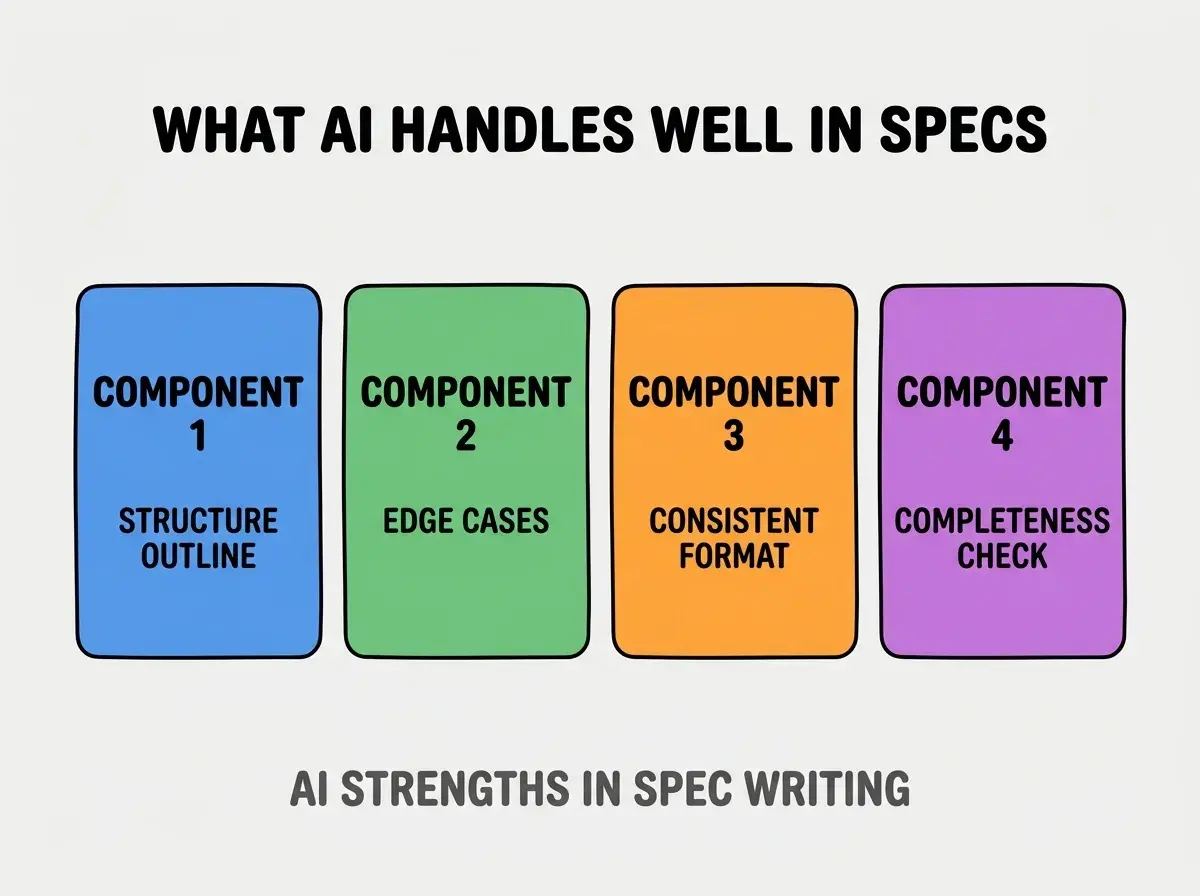
Component 3, consistent formatting. AI applies consistent format across all specs; humans drift in formatting under time pressure.
Component 4, completeness checks. AI catches missing sections, undefined acceptance criteria, ambiguous language.
What Humans Must Add To AI Specs
Four human additions transform AI drafts into shippable specs.
Addition 1, user context. Why this feature matters to specific users. AI cannot know unstated user research.
Browse more tools articles
Read more toolsAddition 2, business priority. Why this feature ranks above alternatives. Priority is judgment AI does not have.
Addition 3, technical constraints from existing systems. Integration points, performance limits, legacy compatibility. AI does not know your specific systems.
Addition 4, judgment about what matters. Trade off decisions, scope reduction, MVP definition. Judgment is irreducibly human.
The Prompts That Get Good AI Output
Three prompt patterns produce useful spec drafts.
Prompt 1, request structured outline first. "Generate a product spec outline for this feature with sections for: user value, acceptance criteria, technical approach, edge cases, success metrics. Do not fill content yet."
Prompt 2, fill sections with explicit context. "Fill the user value section assuming users are [persona]. Reference these existing features: [list]. Note constraints: [list]. Do not invent context not provided."
Prompt 3, request completeness review. "Review this spec. List ambiguous statements, missing acceptance criteria, edge cases not addressed, and questions that need answers before building."
What Makes AI Spec Writing Sustainable
Three patterns separate sustainable AI spec writing from one off experiments.
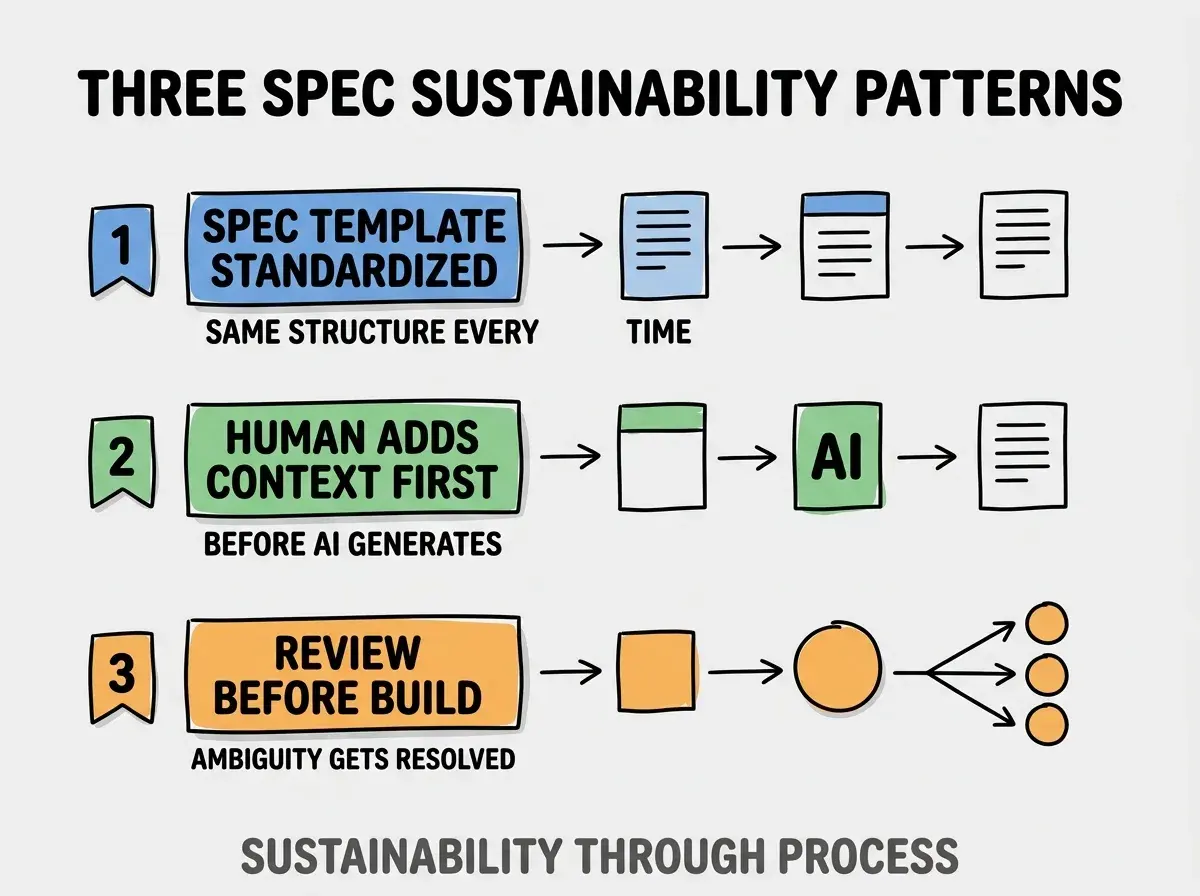
Pattern 1, spec template standardized across team. Template ensures consistency; AI fills template better than free form.
Pattern 2, human adds context first, then AI generates. Context first prevents AI invention of details that do not match reality.
Pattern 3, review before build. Spec review catches ambiguity; ambiguity unresolved produces wrong builds.
The combination produces sustainable AI spec writing. Without these patterns, AI spec writing produces fast vague specs.
How To Adopt AI Spec Writing Progressively
Three adoption patterns help teams shift to AI assisted specs.
Pattern A, start with edge case enumeration. AI handles edge cases well; start where AI shines.
Pattern B, expand to full draft generation. Once team trusts AI for edge cases, expand to full drafts with human additions.
Pattern C, integrate with existing tools. AI works in existing spec tools (Notion, Linear, Jira); no new tools required.
Common Questions About AI Spec Writing
AI spec writing raises questions worth addressing directly.
The first question is whether AI can replace product managers. No; AI replaces typing, not judgment. PMs become more valuable, not less.
The second question is whether to share specs with engineering before refinement. Share refined specs; engineers handle ambiguity poorly. Refinement saves rework.
The third question is whether AI specs should mention AI involvement. Internal disclosure encourages transparency; external usually unnecessary.
The fourth question is whether to use AI for technical specs vs product specs. Both work; technical specs benefit from AI structure; product specs benefit from AI edge case enumeration.
How AI Spec Writing Affects Team Dynamics
AI spec writing affects team dynamics in compounding ways. Dynamic effects compound across team interactions.
The first compounding effect is engineering trust. Better specs build engineering trust in product; trust enables faster execution.
The second compounding effect is PM scope. Faster spec writing enables PMs to cover more features; coverage compounds output.
The third compounding effect is decision quality. Better specs reveal trade offs earlier; decisions improve with better visibility.
The combination produces team dynamics shaped by spec quality. Without AI assistance, spec quality varies with PM bandwidth.
How To Validate AI Generated Specs
Three validation patterns ensure AI specs ship correctly.
Pattern A, engineer review for technical feasibility. Engineering catches technical impossibilities AI invents.
Pattern B, designer review for UX implications. Designers catch UX issues spec describes without resolving.
Pattern C, stakeholder review for business alignment. Stakeholders catch business misalignment AI cannot detect.
The combination produces specs that ship successfully. Without validation, AI specs may produce technically incorrect or business misaligned features.
The most damaging AI spec writing mistake is asking AI to generate specs without providing context. AI without context invents plausible details that do not match reality; invented details produce wrong builds. The fix is to provide explicit context before requesting generation; AI fills templates well when context is clear. PMs who provide context produce useful specs; PMs who request blank generation produce specs that mislead engineers.
The other mistake is treating AI specs as final after generation. Specs need human review and refinement; generation is draft, not delivery.
A third mistake is using AI for trivial specs. Small features may not need full spec; AI assistance overhead exceeds benefit.
A fourth mistake is missing the iteration opportunity. AI specs benefit from iteration; multiple AI passes improve output dramatically.
What This Means For You
Using AI to write project specifications produces better specs faster when humans add judgment AI cannot provide. The four AI strengths, four human additions, and prompt patterns produce specs that ship features successfully.
- If you're a product manager: Add AI spec writing to your weekly workflow; productivity gain compounds across all features.
- If you're a founder: Use AI specs to communicate with engineering more clearly; clarity speeds execution.
Browse more tools articles
Read more tools