Vibe coding vs traditional coding is not a question of which is better. It is a question of which is right for your specific project, timeline, and skill level. Vibe coding uses natural language to generate code through AI, while traditional coding means writing every line by hand. Each approach has genuine strengths the other lacks.
That nuance gets lost in most comparisons. Advocates for vibe coding oversell it as a replacement for learning to code. Defenders of traditional coding dismiss it as a gimmick. The truth, as usual, is more interesting than either extreme.
Why This Comparison Matters Right Now
The landscape shifted fast. Ninety-two percent of US developers now use AI coding tools daily. Forty-six percent of all new code is AI-generated. But only 33% of developers trust AI code accuracy. Those numbers tell you something important: even the people who use vibe coding every day have reservations about it.
Meanwhile, 63% of active vibe coding users are not developers at all. They are founders, marketers, and career changers who never learned traditional coding and went straight to AI tools. For them, the comparison is not academic. It shapes what they can build, what they cannot build, and where they will get stuck.
The most revealing statistic is this one: senior developers ship 2.5 times more AI-generated code than juniors and report 81% productivity gains. People with deep traditional coding knowledge are getting the most value from vibe coding. That should tell you something about the relationship between these two approaches.
Senior developers report 81% productivity gains with vibe coding tools, while juniors using the same tools produce 2.5x less output. Traditional coding knowledge is not obsolete; it is a force multiplier for AI-assisted building.
This is not a "pick one and ignore the other" situation. Understanding both approaches, even at a conceptual level, makes you better at whichever one you choose.
GPS Navigation vs Knowing the Streets
Here is the analogy that clarifies this comparison. Think about navigating a city.
GPS navigation gets you where you need to go without memorizing a single street name. You type in your destination, follow the blue line, and arrive. It works brilliantly for most trips. You can navigate a city you have never visited, avoid traffic in real time, and find the fastest route without any local knowledge.
But GPS has failure modes that local knowledge does not. When the GPS loses signal, you are lost. When it routes you into a dead-end street that Google Maps has not updated, you are stuck. When you need to make a creative detour (cutting through that parking lot because you know it connects to the back road), GPS cannot help you. And when you need to explain directions to someone else, you realize you do not actually know where anything is.
Knowing the streets by heart has the opposite profile. It takes years to develop. You cannot fake it. But once you have it, you navigate with a flexibility and confidence that GPS cannot replicate. You understand why the city is laid out the way it is. You know shortcuts that do not appear on any map. You can adapt instantly when something unexpected happens.
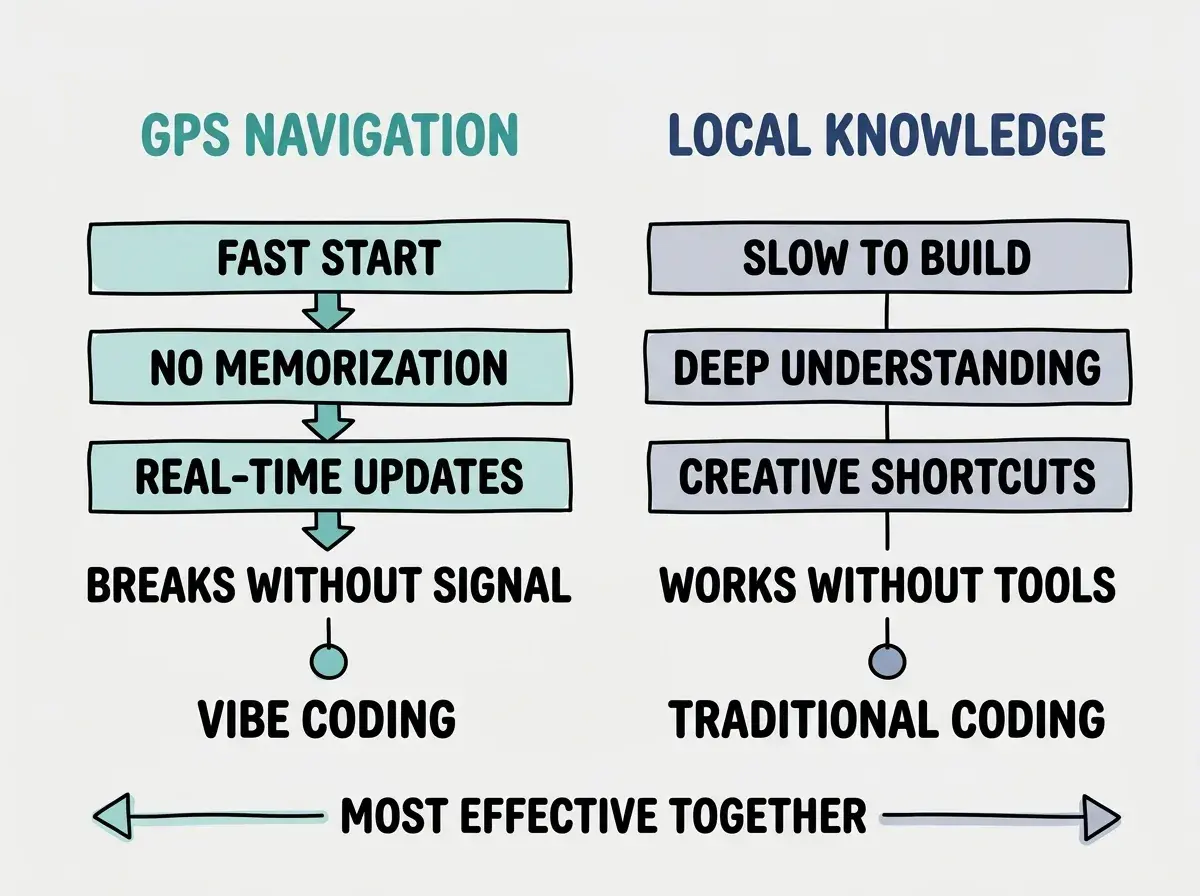
Vibe coding is GPS. Traditional coding is knowing the streets. The best builders, the ones shipping the most and hitting the fewest walls, combine both.
This analogy also explains the 70% wall that vibe coders hit. GPS works perfectly until you encounter a situation it was not designed for. Then you need at least some local knowledge to get unstuck. In vibe coding, AI handles the straightforward 70-80% of a project beautifully. The remaining 20-30%, where you encounter edge cases, performance issues, and architectural decisions, is where traditional coding knowledge (or at least conceptual understanding) becomes essential.
Where Each Approach Wins
Let me be specific about strengths, because vague claims help no one.
Vibe coding wins at speed to first version. If you need an MVP, a prototype, or a proof of concept, vibe coding gets you there in hours or days. Traditional coding takes weeks or months for the same output. For founders testing ideas, this speed advantage is transformative. Y Combinator's Winter 2025 batch proved this: 25% of their startups had 95% or more AI-generated codebases.
Vibe coding wins at accessibility. You do not need months of prerequisite learning. If you can describe what you want clearly, you can build it. Sixty percent of Lovable's users are non-developers who could not have built software at all five years ago.
Traditional coding wins at depth and control. When you need to optimize a database query that runs millions of times per day, or build a real-time system where milliseconds matter, or architect a codebase that twenty developers will maintain for five years, traditional coding gives you control that vibe coding cannot match.
Traditional coding wins at debugging complex problems. When your vibe-coded app enters a bug loop (where fixing one thing breaks another), understanding what the code actually does is the fastest path out. This is why senior developers extract so much more value from AI tools. They can read the code AI generates, spot problems, and guide corrections.
Our guides help you find the right approach for your goals.
Explore guidesNeither approach wins at everything, and anyone telling you otherwise is selling something.
The Hybrid Reality Most People Miss
You might think vibe coding and traditional coding are separate paths. But actually, almost everyone who ships real products is combining them.
The typical workflow looks like this. Use vibe coding to generate the initial structure, the boilerplate, the repetitive patterns. Then review the output with enough technical understanding to catch problems. Then use vibe coding again for the next feature. Then manually adjust the parts that AI gets wrong.
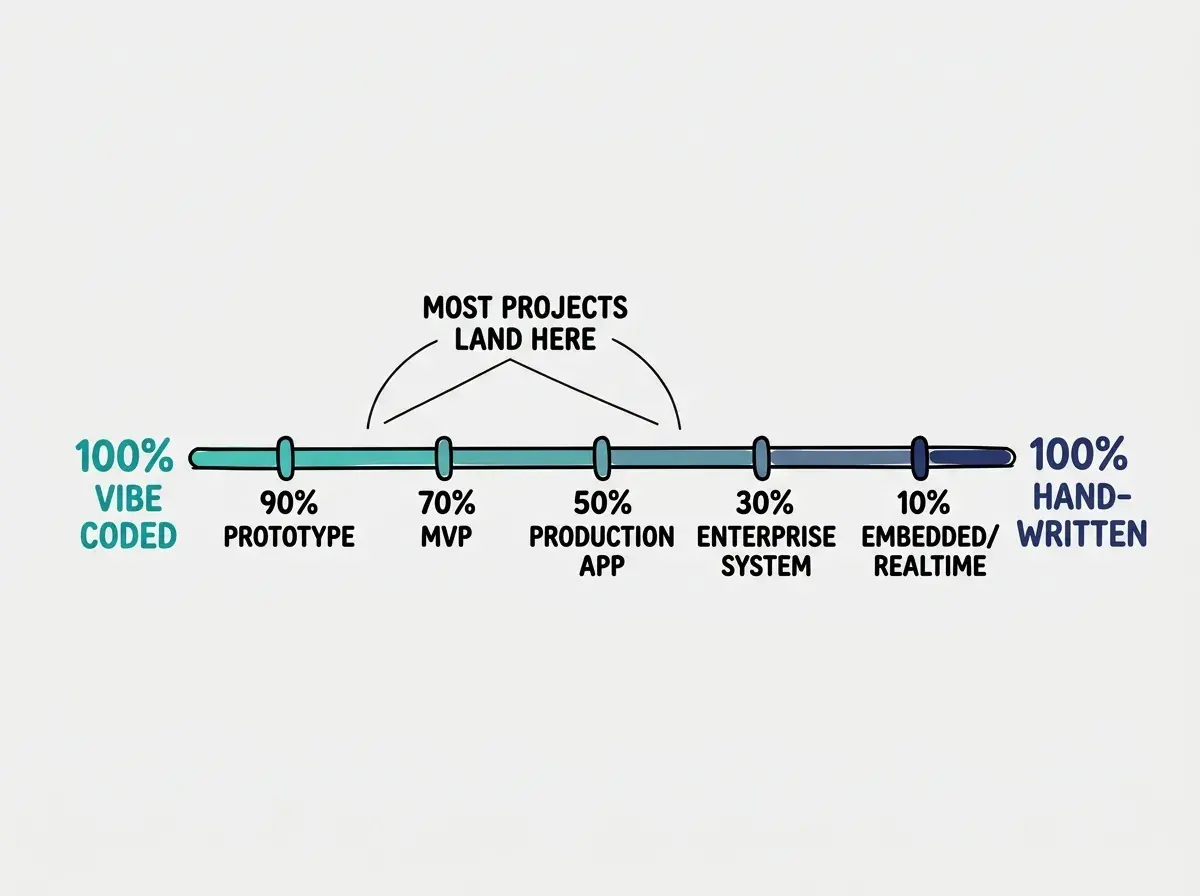
This hybrid approach is why the "vibe coding vs traditional coding" framing is slightly misleading. It implies a binary choice. In practice, the choice is more like a spectrum. Some projects are 95% vibe coded. Some are 95% hand-written. Most fall somewhere in between.
The 46% of code that is now AI-generated did not replace 46% of developers. It freed those developers to spend their time on the 54% that requires human judgment, creativity, and architectural thinking. The relationship is collaborative, not competitive.
This confuses everyone at first, especially people who are just getting started. You hear "vibe coding" and think it means never learning anything technical. Or you hear "learn to code" and think it means ignoring AI tools entirely. The reality is messier and more interesting than either extreme.
The most common mistake is treating vibe coding and traditional coding as mutually exclusive. Beginners who refuse to learn any coding concepts hit the 70% wall hard. Experienced developers who refuse to use AI tools ship slower than their peers. The winning strategy is combining both based on the task at hand.
The practical question is not "which should I learn?" It is "how much of each do I need for what I am trying to build?"
How to Choose Your Starting Point
If you are reading this article, you are probably trying to decide where to invest your time. Here is a decision framework that works.
Start with vibe coding if you have a specific project you want to build, you are not planning to become a professional developer, and you need results in weeks rather than months. The learning curve is gentler and you will see tangible output almost immediately.
Start with traditional coding if you want to become a professional developer, you are building something that requires deep technical control from day one, or you are the kind of person who needs to understand the engine before driving the car. The payoff takes longer but runs deeper.
Start with both (recommended) if you want the highest ceiling. Learn vibe coding for speed and shipping. Learn coding concepts (not necessarily syntax) for understanding and debugging. The combination gives you the GPS plus the local knowledge, and that is when things get powerful.
Eighty-five percent of students are already using AI coding assistants. The next generation is not choosing between these approaches. They are growing up with both, and that combination is going to produce builders who outperform anyone locked into a single approach.
Dig deeper
A few hand-picked sources if you want to go further.
What This Means For You
The vibe coding vs traditional coding debate generates heat because it touches on identity. People who spent years learning to code feel threatened. People who build with AI feel dismissed. But the data is clear: the most productive builders use both, in whatever ratio their project demands.
- If you're a founder: Start with vibe coding for your MVP. It is the fastest path to a testable product. But invest at least a few hours learning what the code AI generates actually does. That conceptual knowledge will save you weeks of debugging and thousands of dollars when you eventually hire developers.
- If you're changing careers: Do not let anyone tell you that you must spend six months learning syntax before you can build anything. Use vibe coding to start building immediately, then learn coding concepts as you encounter them in real projects. Context makes learning stick.
- If you're a student: Learn both. Seriously. Traditional coding concepts will deepen your understanding and extend your ceiling. Vibe coding will let you build and ship things while you are still learning. The students who combine both approaches will have an enormous advantage in the job market.
Whether you start with vibe coding or traditional coding, we have guides for both.
Browse all guides