To do test driven development effectively with AI, follow the four phase approach (write specification as test before implementation, run test to confirm it fails as expected, ask AI to implement until test passes, and refactor with test as safety net), recognize what makes TDD work with AI assistance better than pure manual TDD, and apply the patterns that produce sustained TDD practice. The AI assisted TDD capability matters because TDD with AI produces both faster iteration and better verification than either alone.
This piece walks through the four TDD phases, what makes AI assisted TDD different, the specific patterns, and the four mistakes when doing TDD with AI.
Why TDD With AI Matters
TDD with AI matters because combining specification driven development with AI implementation produces benefits neither alone can match. The combination matters; TDD provides specification, AI provides fast implementation, combination produces faster verified development.
The 2026 reality is that TDD has historically faced adoption resistance due to upfront test writing cost. AI implementation reduces that cost dramatically; AI handles implementation while developer focuses on specification. The shift makes TDD more practical than it has been.
A 2025 software engineering study comparing TDD with AI assistance against pure AI generation found that TDD plus AI produced 64 percent fewer post merge bugs while achieving equivalent feature velocity. The combination outperforms either approach alone significantly.
The pattern to copy is the way contractors work from blueprints. Blueprints specify what to build; contractors execute. TDD with AI follows similar pattern; tests specify behavior, AI executes implementation. The separation of concerns produces both quality and speed.
The Four TDD Phase Approach
Four phases produce effective AI assisted TDD.
Phase 1, write specification as test before implementation. Test describes intended behavior; specification precedes implementation. Test serves as executable specification.
Phase 2, run test to confirm it fails as expected. Test should fail because feature does not exist; failure confirms test tests right thing. Without confirmation, test may pass for wrong reasons.
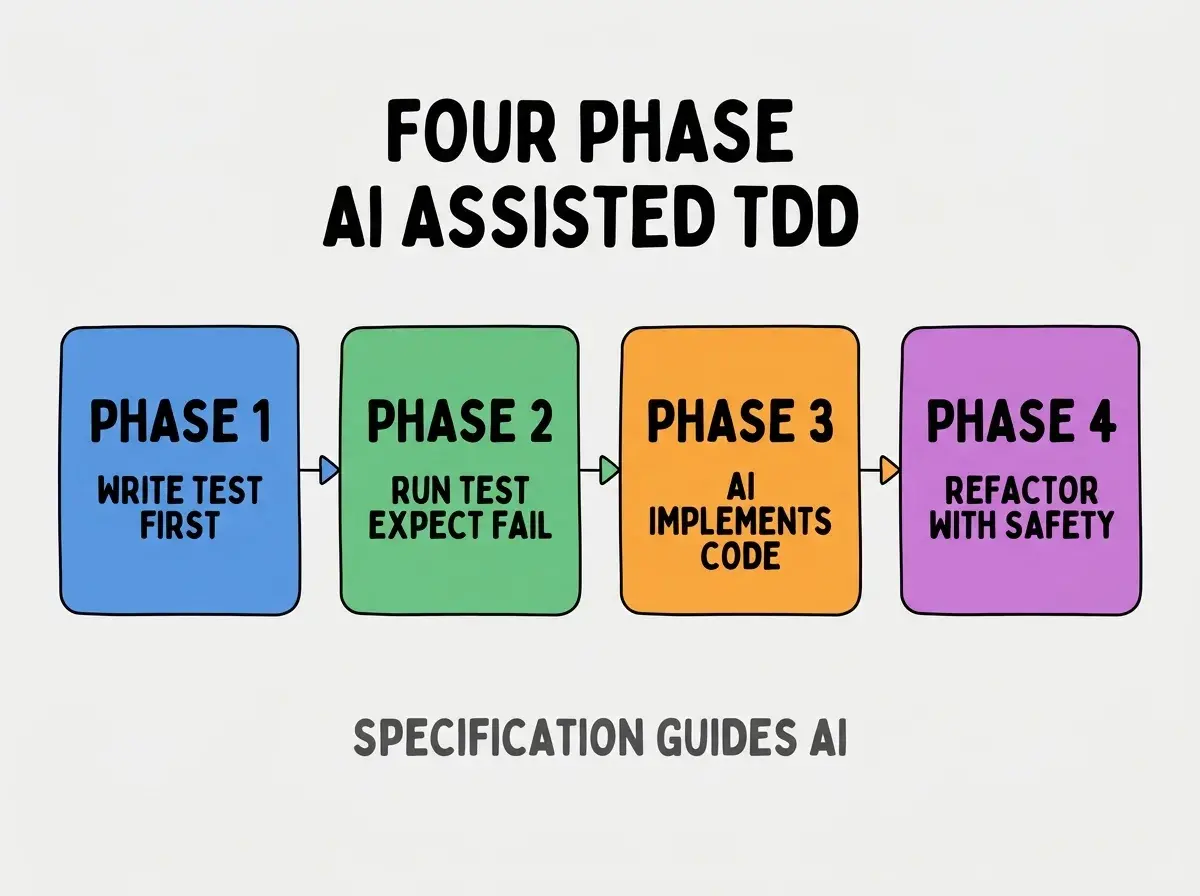
Phase 3, ask AI to implement until test passes. AI generates implementation matching test specification. Iteration continues until test passes.
Phase 4, refactor with test as safety net. Refactor for clarity, performance, structure with test catching regressions. Refactoring becomes safer with test net.
What Makes AI Assisted TDD Different
Three differences distinguish AI assisted TDD from manual TDD.
Difference 1, implementation speed dramatically faster. AI implements faster than human; faster cycles enable more iteration. Speed enables practice that manual TDD discouraged.
Browse more ship articles
Read more shipDifference 2, specification quality matters more. AI implements what test specifies; bad specification produces bad implementation. Specification quality drives outcomes.
Difference 3, refactoring becomes more attractive. Cheap implementation enables aggressive refactoring with test safety net. Refactoring frequency increases.
The Specific Patterns That Work
Three patterns produce successful AI assisted TDD.
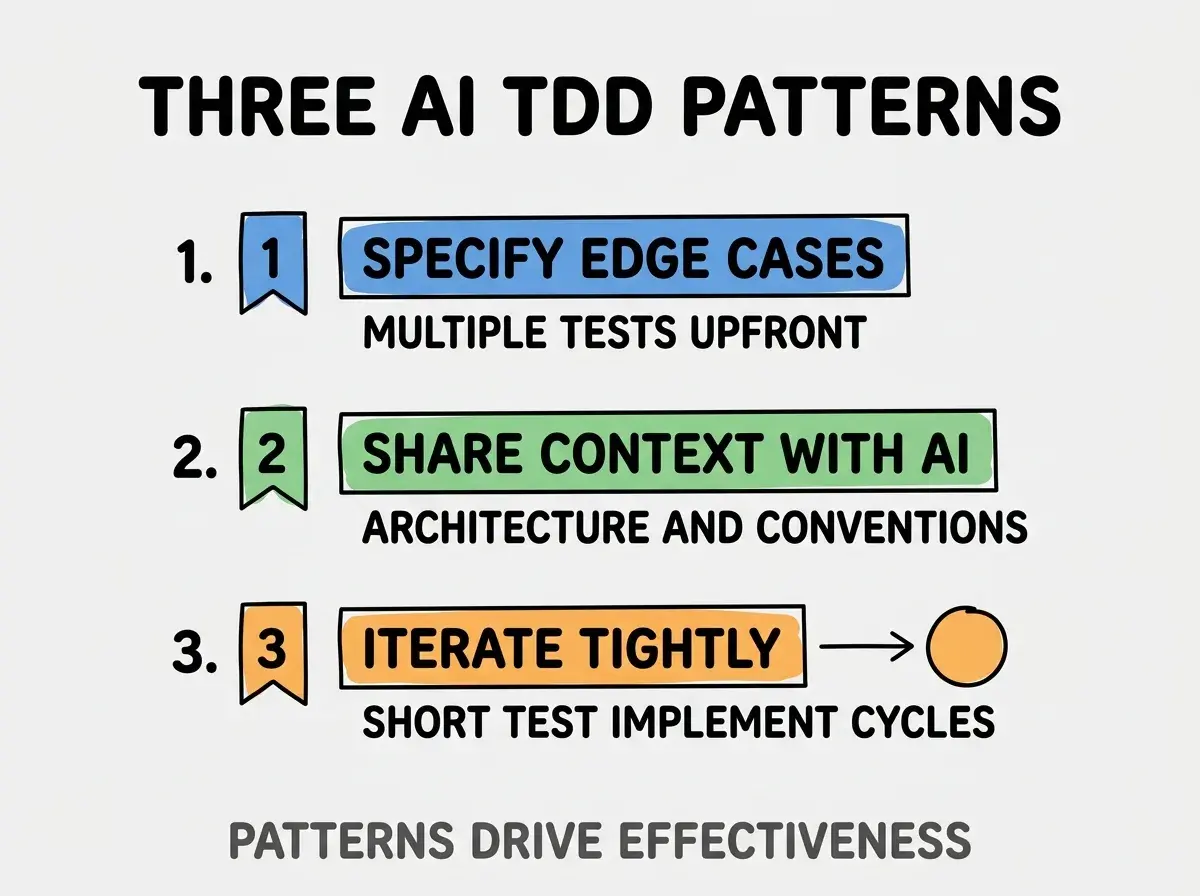
Pattern 1, specify edge cases upfront in multiple tests. Edge cases drive implementation completeness. Without upfront specification, edge cases get missed.
Pattern 2, share architecture and convention context with AI. Context produces implementations matching project. Without context, AI implements correctly but incompatibly.
Pattern 3, iterate tightly with short test implement cycles. One test, one implementation pass. Tight iteration prevents AI generating in wrong direction.
What Makes AI TDD Sustainable
Three patterns separate sustainable AI TDD from problematic patterns.
Pattern 1, specification quality maintained over time. Tests as specifications evolve with feature understanding. Without maintenance, tests drift from specifications.
Pattern 2, refactoring habits develop from cheap implementation. AI makes refactoring cheaper; teams should refactor more. Without habit shift, refactoring opportunity gets missed.
Pattern 3, AI prompting skills develop alongside TDD skills. Better prompting produces better implementation. Without skill development, AI assistance plateaus.
The combination produces AI TDD that compounds over time. Without these patterns, AI TDD produces initial benefits then plateaus.
How To Start AI Assisted TDD
Three starting patterns help teams adopt AI assisted TDD.
Pattern A, start with single feature pilot. One feature validates approach. Without pilot, broad adoption may face resistance.
Pattern B, train team on test writing as specification. Specification mindset matters more than test syntax. Mindset training produces better tests than syntax training alone.
Pattern C, measure impact through bug rates and velocity. Both metrics needed; either alone misleads. Measurement validates approach value.
The combination produces successful AI TDD adoption. Without starting patterns, adoption often stalls.
The most damaging AI TDD mistake is treating tests as afterthought rather than specification. Tests written after implementation lock in current behavior; tests written before implementation specify intended behavior. The fix is to write tests as executable specifications before any implementation; specification first changes what AI implements toward correctness rather than just toward passing. Teams that specify before implementing produce better outcomes than teams that test after implementing.
The other mistake is missing edge case specification. Edge cases drive most production bugs; specification without edge cases produces incomplete implementation.
A third mistake is skipping the refactor phase. Refactor phase produces code quality that test plus implement alone cannot match.
A fourth mistake is letting AI choose what tests to write. AI test choice often misses business intent; specification mindset matters.
How To Handle Specific TDD Challenges With AI
Three challenges deserve specific approaches.
Challenge A, complex business logic specification. Break into smaller specifications; one test per behavior aspect. Decomposition makes specification tractable.
Challenge B, integration test setup complexity. Use AI to generate setup boilerplate. Boilerplate generation reduces setup friction.
Challenge C, test maintenance as features evolve. AI assists test updates alongside feature changes. Without AI assistance, maintenance becomes burden.
The combination produces approaches handling real TDD challenges. Without specific approaches, common challenges produce TDD abandonment.
How AI Assisted TDD Will Likely Evolve
AI assisted TDD will likely continue evolving as AI capabilities mature.
The first likely evolution is specification understanding deepening. AI better understands intent from specifications. Improvement reduces specification refinement cycles.
The second likely evolution is automated specification generation from requirements. AI generates initial tests from requirements descriptions. Generation accelerates specification writing.
The third likely evolution is integrated TDD workflows in AI tools. Tools designed specifically for AI assisted TDD. Integration reduces friction.
The combination suggests AI TDD will become more accessible. Engineers learning patterns now build skills that remain valuable as tools mature.
Common Questions About AI Assisted TDD
AI assisted TDD raises questions worth addressing directly.
The first question is whether AI assisted TDD works for legacy code. Yes for new features in legacy code; harder for refactoring existing without tests. Apply AI TDD to new work first.
The second question is whether to use TDD for all features. No; high stakes features benefit most. Apply TDD where stakes justify investment.
The third question is whether to switch tools when AI TDD struggles. Sometimes; tools differ in TDD support. Switch if tool consistently struggles despite good practices.
What This Means For You
AI assisted TDD produces both speed and quality benefits. The four phases, AI specific patterns, and adoption approaches produce framework for sustained TDD with AI.
- If you're a senior dev: AI assisted TDD makes TDD more practical than ever. Invest in TDD skills; AI removes historical TDD adoption barrier.
- If you're an indie hacker: Solo builders benefit from TDD discipline AI removes from being burden. Apply TDD where stakes justify.
- If you're a founder: Help engineering team adopt TDD with AI. Combination produces quality benefits without traditional TDD speed cost.
Browse more ship articles
Read more ship