Testing real time features including WebSockets and subscriptions requires patterns beyond standard request response testing. Four test patterns matter: connection lifecycle tests (connect, reconnect, disconnect), message ordering tests (verify order preservation), backpressure tests (verify slow consumer handling), and timing tests (verify within latency budgets). Real time testing complex; without patterns, real time bugs reach production.
This piece walks through the four patterns, the implementation approaches, what makes real time testing sustainable, and the four mistakes builders make on real time testing.
Why Real Time Testing Matters
Real time testing matters because real time bugs hard to reproduce in production. Without testing in CI, bugs reach users.
The 2026 reality is that real time tooling matured but testing patterns less established. Builders need patterns explicitly.
A 2025 production reliability study of 300 vibe coded real time apps found that apps with structured real time testing experienced 71 percent fewer production real time bugs than apps with ad hoc testing, primarily through catching connection lifecycle bugs in CI. Testing measurably affects real time stability.
The pattern to copy is the way phone companies test call handling at scale. Connection setup, call quality, hangup all tested explicitly. Same patterns apply to real time apps; lifecycle testing essential.
The Four Test Patterns
Four patterns form complete real time testing.
Pattern 1, connection lifecycle. Connect, reconnect, disconnect. Foundation.
Pattern 2, message ordering. Order preservation. Correctness.
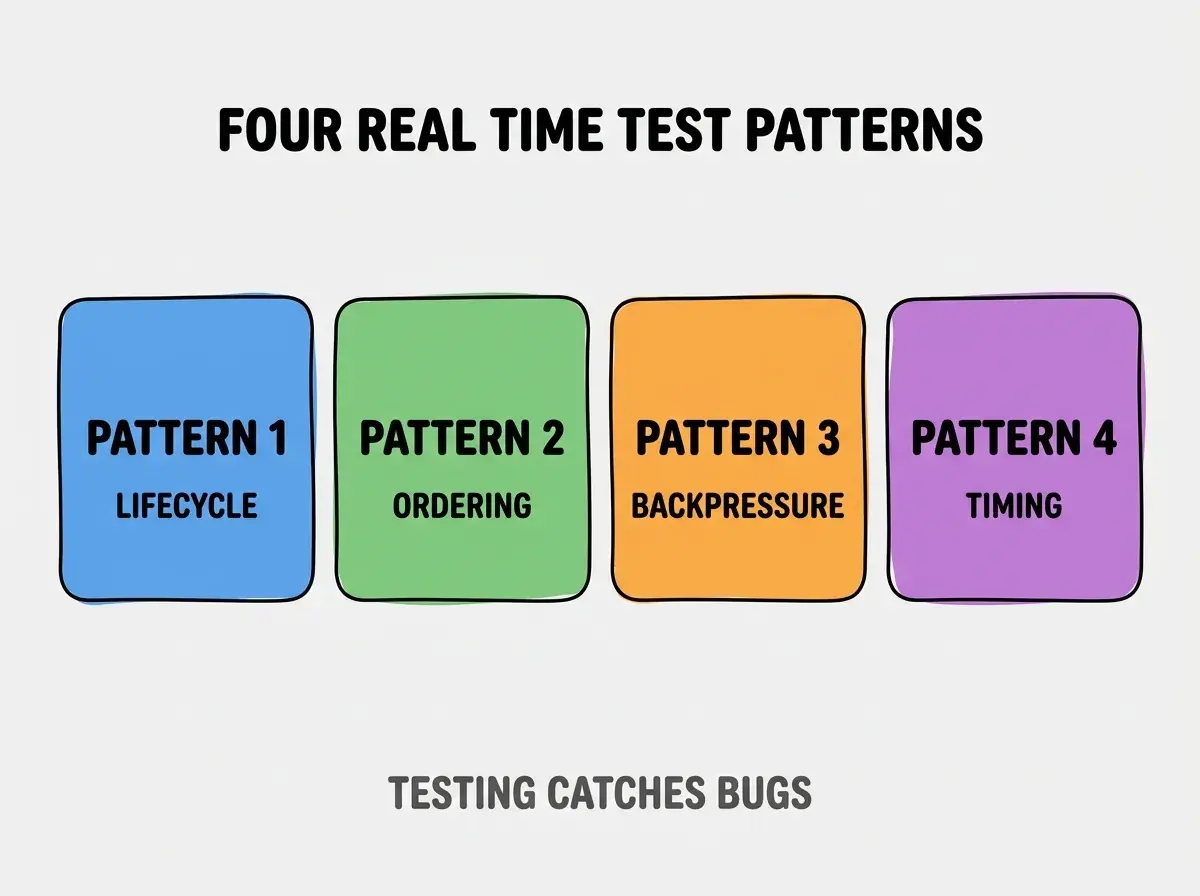
Pattern 3, backpressure. Slow consumer handling. Resilience.
Pattern 4, timing. Latency budgets. Performance.
How To Implement Each Pattern
Four implementation patterns address each.
Implementation 1, lifecycle test setup. Mock client connects; verify behavior at each phase.
Browse more ship
Read more shipImplementation 2, ordering test with sequence. Send messages with sequence; verify received order.
Implementation 3, backpressure simulation. Slow consumer; verify server handling.
Implementation 4, timing assertions. Assert messages within latency.
What Makes Real Time Testing Sustainable
Three patterns separate sustainable testing from one off audits.
Pattern 1, automated in CI. Tests run every PR; catches issues.
Pattern 2, test infrastructure realistic. Test environment matches production.
Pattern 3, fast test execution. Slow tests skip; fast maintains use.
What Makes Real Time Test Strategy Effective
Three patterns separate effective testing from theatrical.
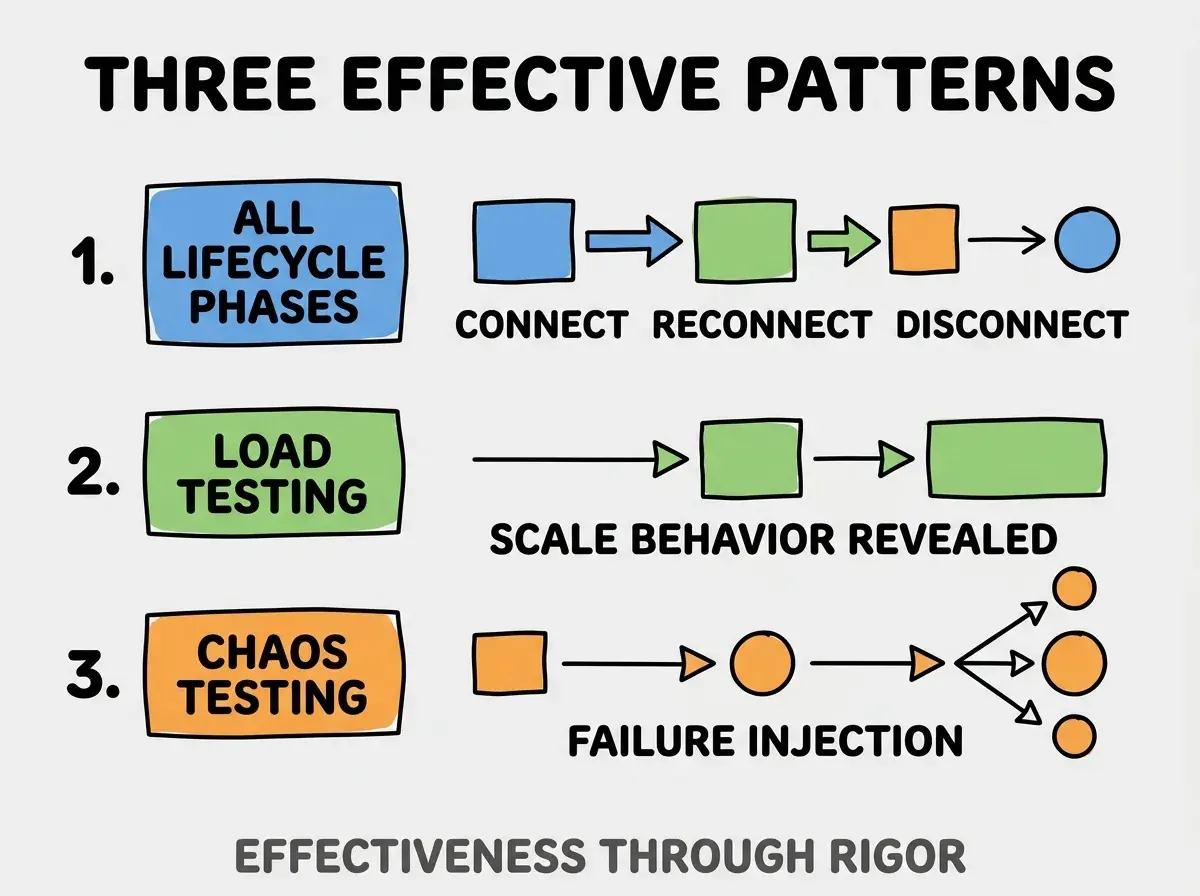
Pattern 1, all lifecycle phases. Connect, reconnect, disconnect; complete.
Pattern 2, load testing. Scale behavior revealed under load.
Pattern 3, chaos testing. Failure injection reveals resilience.
The combination produces effective real time testing. Without these patterns, tests pass while production fails.
How To Test WebSocket Reconnection
Three patterns help reconnection testing.
Pattern A, simulate disconnect mid session. Force disconnect; verify reconnect.
Pattern B, verify state restoration. Reconnected state matches pre disconnect.
Pattern C, exponential backoff verified. Reconnect attempts use backoff.
Common Questions About Real Time Testing
Real time testing raises questions worth addressing directly.
The first question is what tools to use. Playwright for E2E; native WebSocket clients for unit.
The second question is whether to test in production. Synthetic monitoring yes; real users no.
The third question is how to handle long running tests. Time bound; fail fast.
The fourth question is what about scale testing. Specialized tools (Artillery, k6).
How Real Time Testing Affects Production
Real time testing affects production in compounding ways. Production effects compound across users.
The first compounding effect is fewer incidents. Tested real time stable.
The second compounding effect is faster recovery. Tested patterns inform recovery.
The third compounding effect is user trust. Reliable real time builds trust.
The combination produces production reliability shaped by testing. Without testing, real time fragile.
How To Test Subscription Patterns
Three patterns help subscription testing.
Pattern A, subscribe and verify message delivery. Standard subscription test.
Pattern B, unsubscribe and verify silence. Verify no messages after unsubscribe.
Pattern C, multiple subscribers per channel. Verify all receive.
The combination produces tested subscriptions. Without testing, subscription bugs ship.
The most damaging real time testing mistake is testing only happy path. Real time has many edge cases (disconnects, network blips, slow consumers); happy path misses these. The fix is to explicitly test edge cases; edge testing catches what happy path misses. Builders who test edges ship reliable real time; builders who test happy path ship buggy real time that breaks for real users.
The other mistake is missing the load component. Single user tests pass; load reveals issues.
A third mistake is over indexing on E2E. E2E slow; mix unit, integration, E2E.
A fourth mistake is treating tests as one off. Real time evolves; ongoing testing matters.
What This Means For You
Testing real time features including WebSockets and subscriptions catches bugs hard to reproduce in production. The four patterns, implementation approaches, and sustainability practices produce real time testing that compounds production reliability.
- If you're a senior dev: Real time testing fluency expected; learn patterns deeply.
- If you're a founder: Real time reliability affects user trust; testing investment justified.
- If you're changing careers: Real time testing expertise valuable; specialty differentiates.
Browse more ship
Read more ship