To understand when AI generated tests help versus mislead, recognize the four reliability patterns AI tests exhibit (test the happy path well but miss edge cases, test what code does rather than what it should do, test implementation details that break with refactoring, and produce passing tests that do not actually verify behavior), see what makes AI tests genuinely useful, and apply the patterns that produce reliable AI test usage. The reliability understanding matters because misleading tests provide false confidence that costs more than no tests.
This piece walks through the four reliability patterns, what makes AI tests useful, the verification patterns, and the four mistakes when using AI generated tests.
Why AI Test Reliability Matters
AI test reliability matters because tests carry implicit confidence claim. The claim matters; passing tests imply functionality works while misleading tests imply functionality works when it does not.
The 2026 reality is that AI tools generate tests faster than humans but reliability varies significantly. Without explicit reliability assessment, AI generated tests often accumulate as confidence theater rather than actual verification.
A 2025 software quality study comparing AI generated tests against human written tests found that AI tests had equivalent passing rates but caught 47 percent fewer real bugs in production. The bug catching gap reveals reliability difference that pass rates alone cannot detect.
The pattern to copy is the way pharmaceutical companies validate clinical trials. Trials with positive results require independent verification before claims become accepted. AI generated tests follow similar pattern; tests need independent verification before claims become reliable. Verification matters as much as test creation.
The Four Reliability Patterns
Four patterns characterize AI test reliability characteristics.
Pattern 1, happy path well, edge cases poorly. AI tests typical inputs effectively but misses edge cases. Coverage looks complete while edge cases remain untested.
Pattern 2, tests what code does not what code should do. AI generates tests matching current behavior; correctness assumed rather than verified. Tests pass but may not catch incorrect behavior.
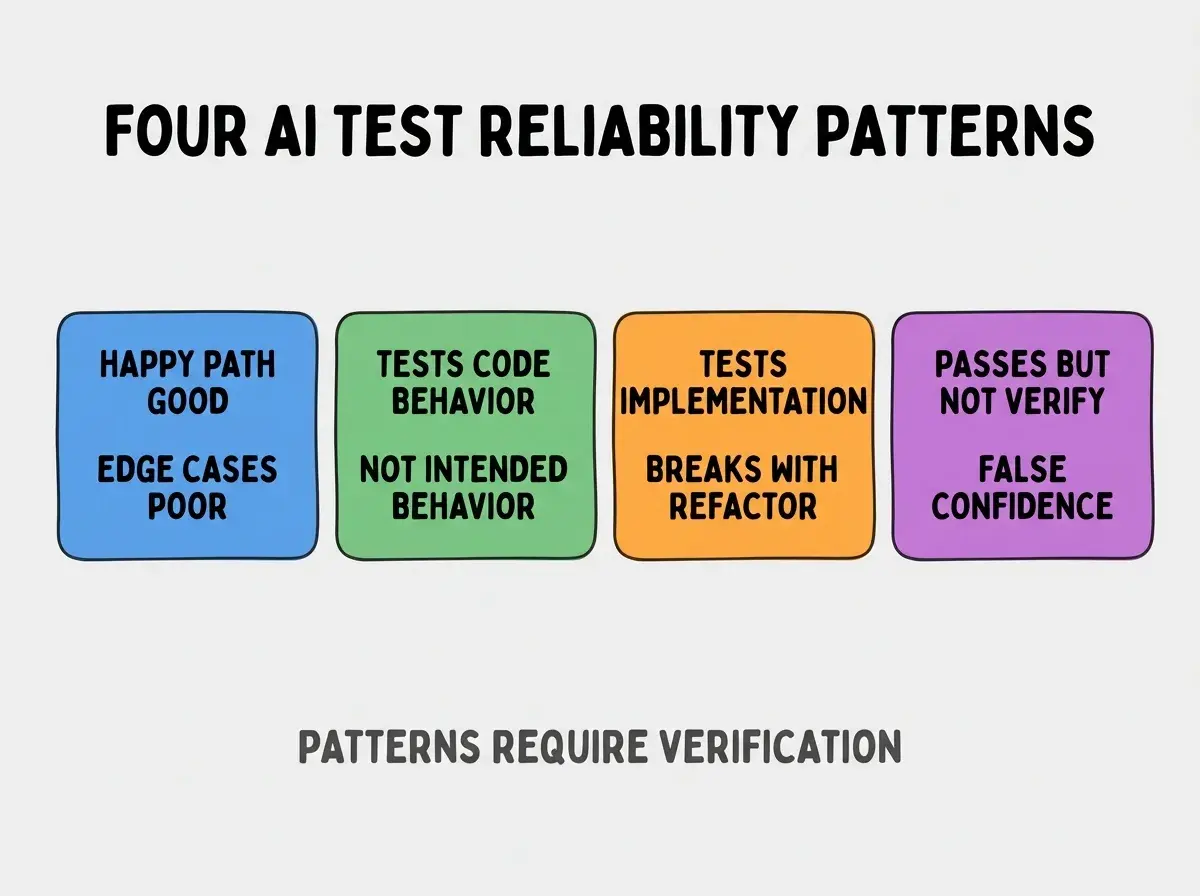
Pattern 3, tests implementation details rather than behavior. AI tests internal structure not external behavior. Tests break with refactoring while behavior unchanged.
Pattern 4, passes but does not actually verify behavior. Tests pass without testing meaningful conditions. Tests provide confidence theater rather than real verification.
What Makes AI Tests Useful
Three patterns characterize AI tests that actually help.
Pattern 1, AI tests reviewed for correctness alongside generation. Review verifies tests test what they claim. Without review, tests may test wrong things.
Browse more ship articles
Read more shipPattern 2, AI tests focused on patterns AI tests well. Boilerplate, simple flows, obvious cases. Focus produces value where AI excels.
Pattern 3, AI tests supplemented by human edge case tests. AI handles common cases; humans add edge cases AI misses. Combination beats either alone.
The Verification Patterns That Work
Three verification patterns make AI tests reliable.
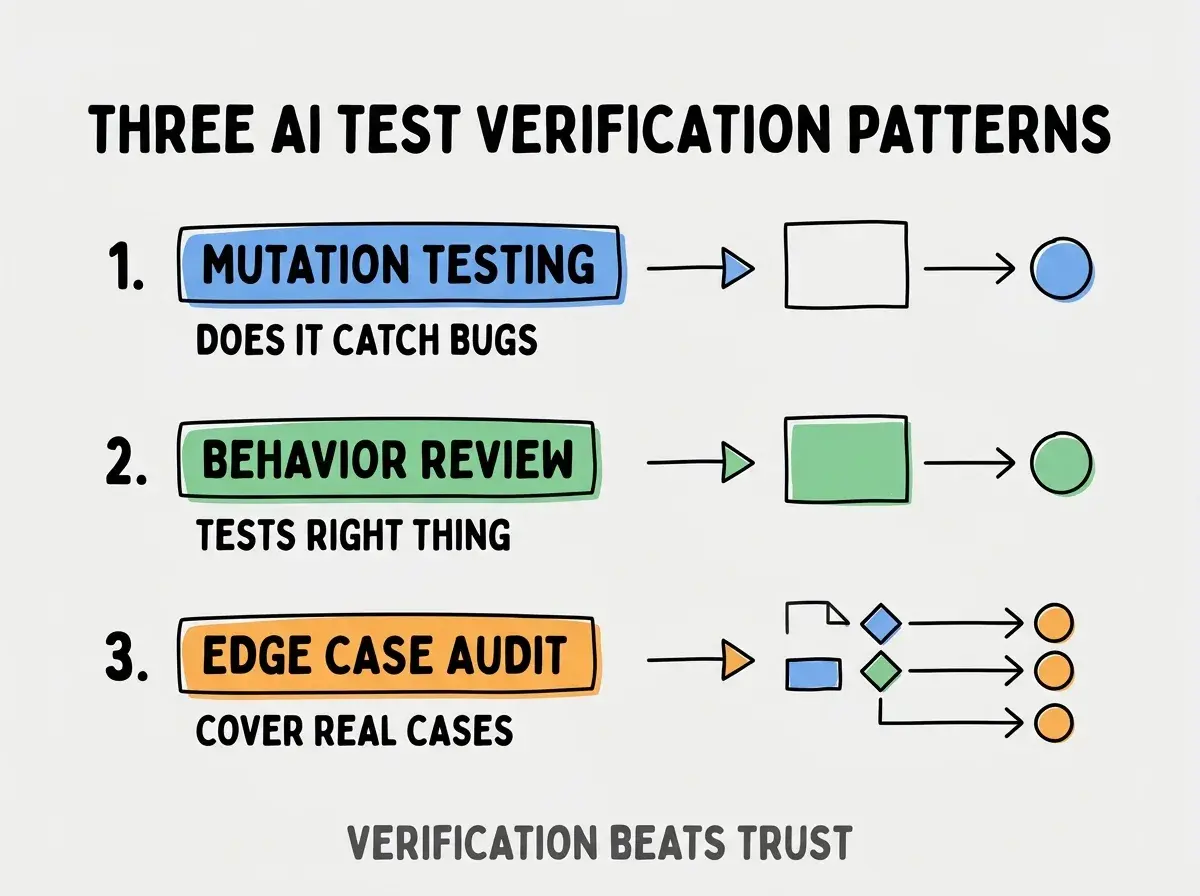
Pattern 1, mutation testing to verify tests catch bugs. Introduce intentional bugs; tests should catch them. Mutation testing reveals which tests actually work.
Pattern 2, behavior review confirming tests test correctness. Read tests; verify they test intended behavior not just current behavior. Review catches behavior assumption issues.
Pattern 3, edge case audit catching gaps. Explicit edge case checklist; verify AI tests cover or supplement with human written. Audit catches edge case gaps.
What Makes AI Test Usage Sustainable
Three patterns separate sustainable AI test usage from problematic patterns.
Pattern 1, AI tests treated as starting points not endpoints. Tests need refinement after generation. Without refinement, tests stay at AI baseline quality.
Pattern 2, test review process catches reliability issues. Code review includes test review with reliability focus. Without process, reliability issues accumulate.
Pattern 3, periodic test suite audit removing low value tests. Stale, redundant, low value tests get removed. Without audit, suite accumulates noise.
The combination produces AI test usage that maintains reliability over time. Without these patterns, AI test usage often produces false confidence that compounds.
How To Recognize AI Test Failures
Three failure recognition patterns help catch unreliable AI tests.
Pattern A, tests passing while bugs reach production. Bugs that should have been caught reveal test gaps. Production bugs are signals about test reliability.
Pattern B, tests breaking with cosmetic refactoring. Tests that break without behavior change signal implementation testing. Implementation tests reveal reliability issues.
Pattern C, test count high relative to bug catching rate. Many tests with few bug catches signal test value gaps. Quantity without quality reveals issues.
The combination produces failure recognition. Without recognition, failures continue silently.
The most damaging AI test mistake is treating passing tests as evidence of correct functionality without verifying tests actually verify correctness. AI tests can pass without testing anything meaningful; passing tests provide confidence proportional to test quality, not test count. The fix is to verify AI tests through mutation testing, behavior review, and edge case audit; tests that survive verification provide real confidence while unverified tests provide false confidence that costs more than no tests.
The other mistake is generating tests for code without first understanding what code should do. Tests generated from code lock in current behavior; if behavior wrong, tests perpetuate wrong behavior.
A third mistake is missing edge case identification. Edge cases drive most production bugs; AI tests rarely identify edge cases without explicit prompting.
A fourth mistake is treating AI test generation as one shot. Iterative refinement produces better tests than single shot generation.
How To Improve AI Test Quality
Three improvement patterns help teams improve AI test quality.
Pattern 1, prompt AI with specification not just code. Telling AI what code should do produces better tests than asking AI to test code. Specification driven matters dramatically.
Pattern 2, request edge cases explicitly. Ask AI for edge cases alongside happy path. Explicit request produces edge case coverage.
Pattern 3, validate AI tests through deliberate bug introduction. Mutation testing surfaces which tests actually work. Validation reveals reliability.
The combination produces AI tests that approach human quality. Without improvement patterns, AI tests stay at baseline quality.
How AI Test Generation Will Likely Evolve
AI test generation will likely improve as AI capabilities mature.
The first likely evolution is specification understanding improving. AI better understands what code should do. Improvement reduces behavior assumption issues.
The second likely evolution is edge case identification improving. AI better identifies edge cases. Improvement reduces gap between AI and human test coverage.
The third likely evolution is integrated verification becoming standard. Tools that automatically verify AI test reliability. Standardization reduces verification burden.
The combination suggests AI tests will become more reliable but verification remains important. Engineers learning verification now build skills that remain valuable as tests improve.
Common Questions About AI Generated Tests
AI generated tests raise questions worth addressing directly.
The first question is whether AI tests count as proper testing. Verified AI tests count; unverified AI tests provide false confidence. Verification status determines value.
The second question is whether to disable AI test generation when reliability concerns arise. No; improve AI test usage through verification rather than disabling. Verification produces value where disabling loses value.
The third question is whether team should write tests when AI can generate them. AI generation supplements human testing; team should still write tests for high stakes features.
What This Means For You
AI generated test reliability determines whether tests provide real confidence. The four patterns, verification approaches, and improvement strategies produce framework for reliable AI test usage.
- If you're a senior dev: AI test verification is critical skill. Without verification, AI tests provide false confidence that costs more than no tests.
- If you're a founder: Help engineering team verify AI tests systematically. Without verification, test counts grow while bug catching does not.
- If you're an indie hacker: Solo builders benefit from AI test generation but need verification discipline. Without verification, tests become liability not asset.
Browse more ship articles
Read more ship