To understand open source maintainer perspective on AI generated contributions, recognize the four maintainer concerns the AI era produces (PR volume increasing while quality varies dramatically, low effort PRs from AI generation crowding out thoughtful contributions, AI generated PRs missing project conventions and context, and burnout from triaging AI volume), see what these concerns mean for OSS maintenance, and consider what the perspective means for contributors. The maintainer perspective matters because OSS sustainability depends on maintainer capacity that AI volume threatens.
This piece walks through the four maintainer concerns, what AI changes for OSS, the contributor implications, and the four mistakes when interpreting AI impact on open source.
Why Maintainer Perspective On AI Matters
Maintainer perspective matters because OSS sustainability depends on maintainer capacity. The matter; without sustainable maintenance, OSS projects fail regardless of AI productivity.
The 2026 reality is that AI generated PRs have transformed maintainer experience. Some changes positive, some negative; understanding both matters for OSS health.
A 2025 OSS maintainer survey of 800 active maintainers found that 67 percent reported AI generated PR volume as significant burden, while 47 percent reported some AI PRs as legitimately helpful. Mixed effects characterize AI impact on OSS rather than uniform impact.
The pattern to copy is the way historians analyze technology impacts on creative communities. Some technologies expand creative communities; some burden them. AI impact on OSS shows both patterns; understanding informs better contribution practices.
The Four Maintainer Concern Patterns
Four patterns characterize maintainer concerns about AI generated contributions.
Pattern 1, PR volume increasing dramatically. AI enables more PRs; volume creates triage burden. Volume matters even when quality acceptable.
Pattern 2, low effort AI PRs crowding thoughtful contributions. Easy AI PRs for trivial issues; thoughtful contributions get less attention. Crowding shifts maintainer attention.
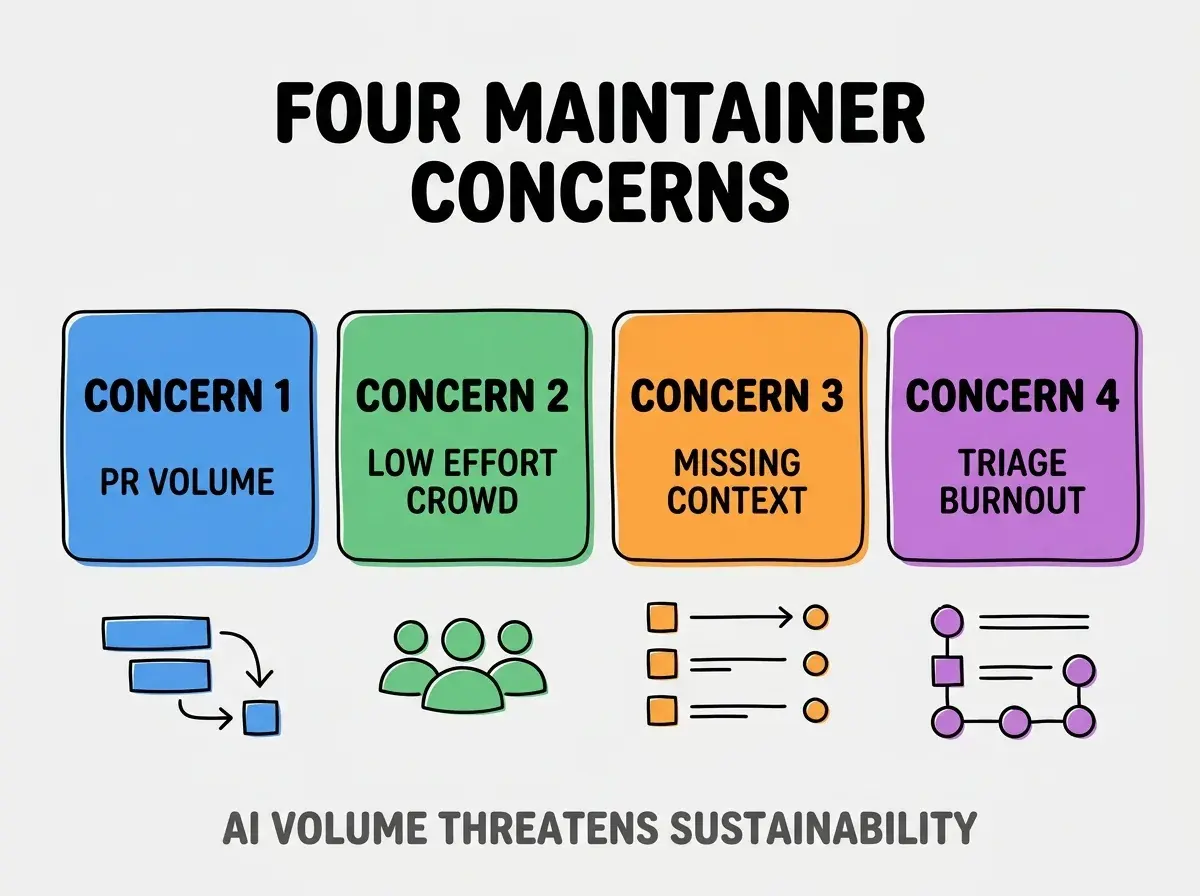
Pattern 3, AI PRs missing project conventions. AI without project context produces inconsistent contributions. Inconsistency creates review burden.
Pattern 4, triage burnout from AI volume. Maintainer burnout accelerates from volume. Burnout threatens project sustainability.
What AI Changes For OSS Maintenance
Three patterns characterize AI impact on OSS maintenance.
Pattern 1, contribution velocity increases. More contributions arrive; capacity unchanged. Mismatch creates pressure.
Browse more foundations
Read more foundationsPattern 2, contribution quality variance widens. Excellent AI contributions and poor AI contributions both increase. Variance complicates triage.
Pattern 3, maintainer attention becomes scarce resource. With more PRs, maintainer attention rationed. Scarcity affects review quality.
What The Perspective Means For Contributors
Three implications matter for AI assisted contributors.
Implication 1, contribution quality matters more than ever. Volume produces noise; quality produces signal. Signal stands out in noise.
Implication 2, project context investment beats fast AI generation. Reading project conventions, history, current discussions matters. Context separates good contributions.
Implication 3, maintainer relationship building still matters. Personal relationships preserve attention. Without relationships, contributions compete for limited attention.
How Contributors Should Adapt
Three adaptation patterns help AI assisted contributors.
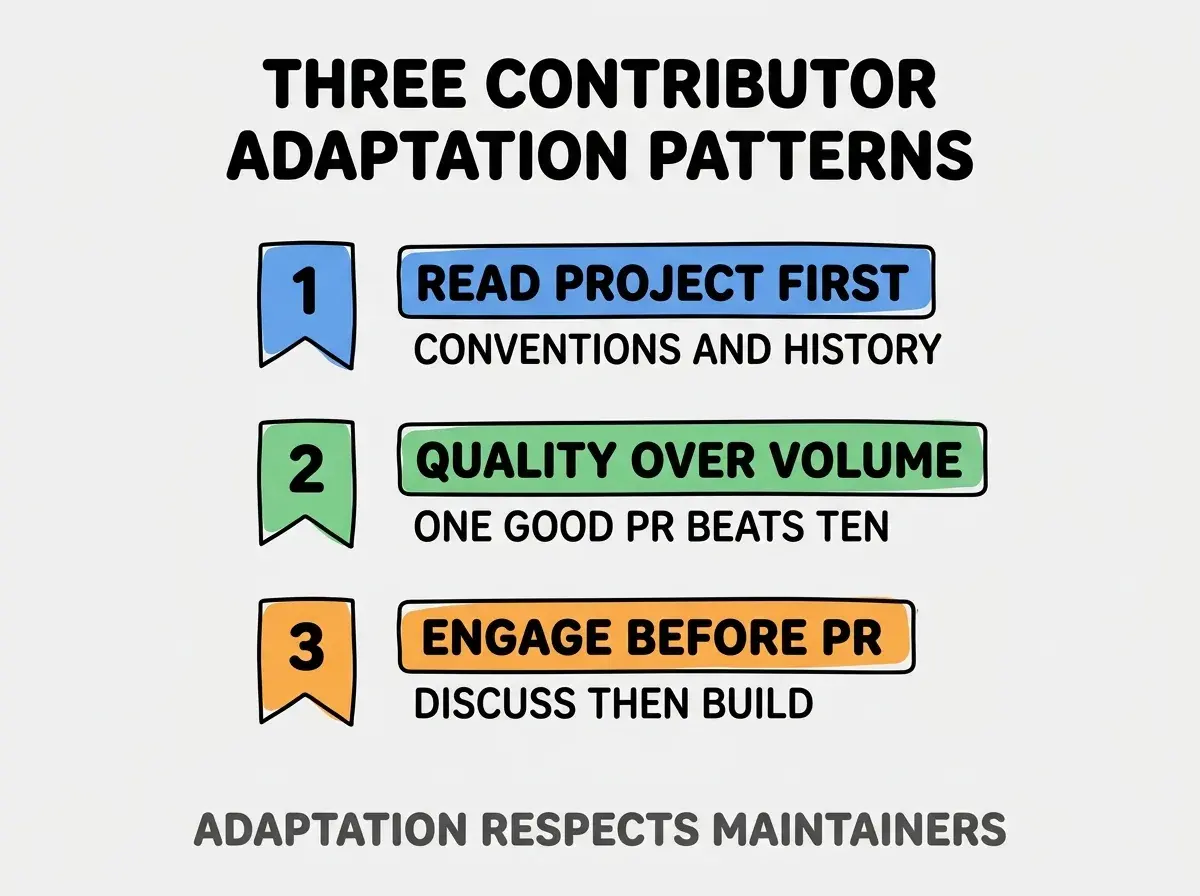
Pattern 1, read project context before AI generation. Project conventions, architecture, current direction. Context matters dramatically.
Pattern 2, quality over volume in contribution strategy. One thoughtful PR beats ten AI PRs. Quality builds reputation.
Pattern 3, engage before PR through issues and discussions. Discussion before code reduces wasted PRs. Engagement builds relationships.
What Makes AI Era OSS Sustainable
Three patterns separate sustainable AI era OSS from problematic patterns.
Pattern 1, maintainer capacity protected through contribution practices. Practices reducing maintainer burden. Without protection, sustainability erodes.
Pattern 2, automated triage handling AI volume. Bots, templates, automation. Without automation, manual triage overwhelms.
Pattern 3, contribution quality standards explicit. Standards filter quality. Without standards, quality variance unaddressed.
The combination produces sustainable AI era OSS. Without these patterns, AI volume threatens projects.
How To Recognize Quality AI Contributions
Three pattern recognition approaches help maintainers identify quality AI contributions.
Pattern A, evidence of project context understanding. PR description shows context awareness. Without context awareness, AI lacks project understanding.
Pattern B, appropriate scope matching issue size. Right sized PRs match issue. Without sizing, scope creep common.
Pattern C, tests and documentation included. Complete contributions include tests and docs. Without completeness, partial contribution.
The combination produces quality recognition. Without recognition, all AI PRs appear similar.
The most damaging maintainer perspective mistake is treating all AI PRs as either good or bad uniformly. AI PRs vary dramatically; treating uniformly misses both quality contributions and burden creating contributions. The fix is to develop pattern recognition for quality AI PRs versus burden AI PRs; recognition enables appropriate response. Maintainers who recognize patterns produce better outcomes than maintainers who treat AI uniformly.
The other mistake is closing OSS to AI contributions entirely. Some AI contributions valuable; closing loses value.
A third mistake is missing the contribution practice opportunity. Contribution practices reduce maintainer burden if adopted.
A fourth mistake is treating maintainer burnout as personal failure. Burnout structural; structural problems require structural responses.
How To Improve OSS Contribution Practices
Three practice patterns help improve AI era OSS.
Pattern A, contribution guidelines specifying AI expectations. Explicit expectations help contributors. Without expectations, ambiguity persists.
Pattern B, automated checks reducing manual triage. Linting, tests, format checks automated. Without automation, manual triage dominates.
Pattern C, contributor onboarding emphasizing context. Context investment prevents poor PRs. Without onboarding, context investment skipped.
The combination produces practices that improve AI era OSS. Without practices, ad hoc patterns produce ad hoc results.
How OSS And AI Will Likely Evolve
OSS and AI relationship will likely continue evolving as both mature.
The first likely evolution is automated triage tools maturing. AI assisted triage reducing maintainer burden. Tools enable scale.
The second likely evolution is contribution quality standards spreading. Best practices emerging across projects. Standards reduce variance.
The third likely evolution is contributor patterns differentiating. Quality contributors and volume contributors recognized. Differentiation affects attention.
The combination suggests OSS and AI will reach equilibrium over time. Maintainers and contributors learning patterns now build practices that remain valuable.
Common Questions About Maintainer Perspective
Maintainer perspective on AI raises questions worth addressing directly.
The first question is whether OSS will sustain through AI era. Yes with practice adaptation; no without. Sustainability requires deliberate practices.
The second question is whether contributor reputation matters more in AI era. Yes; quality reputation distinguishes contributors. Reputation building takes time.
The third question is whether maintainers should accept AI assisted PRs. Quality AI PRs welcome; burden AI PRs declined. Pattern recognition enables decisions.
The fourth question is how to handle hostile AI contributors. Same as hostile human contributors; clear policy, consistent enforcement. AI does not change response patterns.
How Maintainer Concerns Affect OSS Future
Maintainer concerns affect OSS future beyond individual project sustainability. Future effects compound for software ecosystem.
The first compounding effect is project failure rate. Burned out maintainers abandon projects. Abandonment affects ecosystem broadly.
The second compounding effect is contributor experience quality. Burned out maintainers produce worse experience; experience affects contributor retention.
The third compounding effect is innovation pace. Sustainable maintainers produce innovation; unsustainable maintenance produces stagnation.
The combination produces ecosystem effects that single project view misses. Maintainer perspective matters for ecosystem health beyond individual projects.
What This Means For You
Open source maintainer perspective on AI reveals contribution practices that sustain OSS. The four concerns, contributor adaptation, and practice patterns produce framework for AI era OSS contribution.
- If you're a senior dev: Apply quality over volume in OSS contributions. Quality builds reputation while volume creates burden.
- If you're a maintainer: Develop pattern recognition for quality AI PRs. Recognition enables appropriate response that uniform treatment cannot match.
- If you're a contributor: Read project context before AI generation. Context investment separates good contributions from burden contributions.
Browse more foundations
Read more foundations