To understand why your AI built app slows down over time, recognize the four technical debt patterns AI accumulates (duplicated logic across files because AI does not see existing implementations, inconsistent patterns because AI applies different solutions to similar problems, dead code that AI added but never removed, and missing abstractions because AI optimizes for working code not maintainable code), see how AI debt differs from human written debt, and apply the patterns that prevent debt accumulation. The technical debt accumulation matters because it determines whether your app gets faster or slower to modify over time.
This piece walks through the four debt patterns, why AI accumulates them faster than human developers, the prevention patterns, and the four mistakes that accelerate debt accumulation.
Why Technical Debt In AI Built Apps Matters
Technical debt in AI built apps determines long term project viability. The accumulation matters; debt compounds over time, producing apps that become impossible to modify regardless of how productive AI tools were initially.
The 2026 reality is that AI tools accelerate both feature development and debt accumulation. Without intentional debt management, AI built apps reach unmaintainable states faster than human written apps reach the same state.
A 2025 study tracking 200 AI built projects over 12 months found that projects without intentional debt management became 3x slower to modify by month 6 and 8x slower by month 12 compared to projects with structured debt paydown. The compounding produces dramatic differences in long term project viability.
The pattern to copy is the way financial debt compounds. Small unpaid debts accumulate into crushing burdens over time; technical debt follows the same pattern but operates on different timescales. Understanding the compounding helps prioritize debt paydown before debt becomes unmanageable.
The Four Technical Debt Patterns
Four patterns characterize technical debt in AI built apps.
Pattern 1, duplicated logic across files. AI does not see existing implementations when generating new code. Same functionality gets implemented multiple times across the codebase.
Pattern 2, inconsistent patterns across similar problems. AI applies different solutions to similar problems based on how prompts are phrased. Codebase ends up with multiple patterns for the same operation.
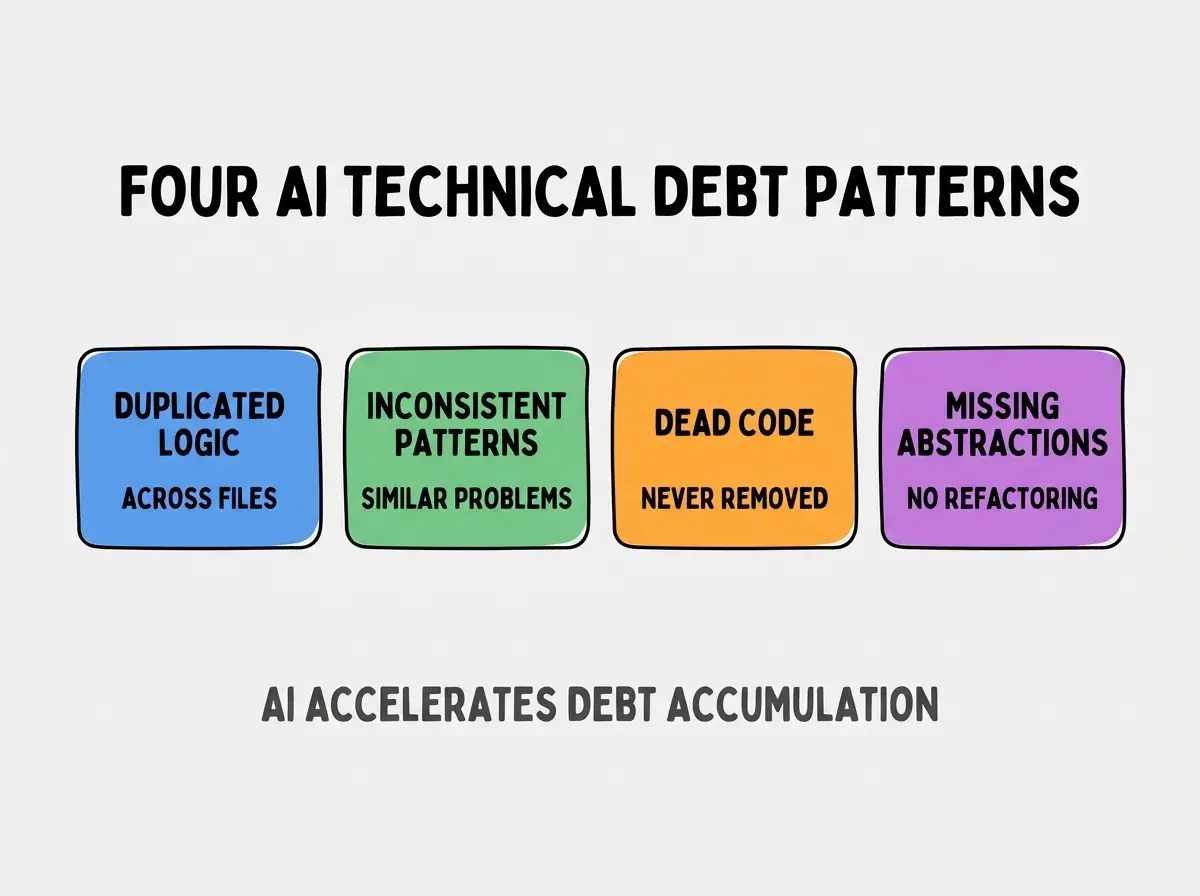
Pattern 3, dead code that AI added but never removed. AI generates code for changing requirements but does not remove obsolete code. Codebase accumulates dead code that confuses future modifications.
Pattern 4, missing abstractions because AI optimizes for working code. AI generates working code without identifying when extracted abstractions would simplify future changes. Missing abstractions force changes to ripple through many files.
How AI Debt Differs From Human Written Debt
Three differences distinguish AI accumulated debt from human written debt.
Difference 1, accumulation speed dramatically faster. Human developers accumulate debt over years; AI built projects accumulate equivalent debt in months. Speed compresses debt timelines.
Browse more foundations articles
Read more foundationsDifference 2, debt patterns more uniform across projects. Human written debt varies by developer; AI accumulated debt follows similar patterns across all AI built projects. Uniformity enables pattern based prevention.
Difference 3, debt visibility lower than human written debt. Human written debt often visible in commit messages and review comments; AI accumulated debt happens silently as AI generates code. Lower visibility delays debt recognition.
How To Prevent AI Technical Debt Accumulation
Three prevention patterns reduce AI debt accumulation.
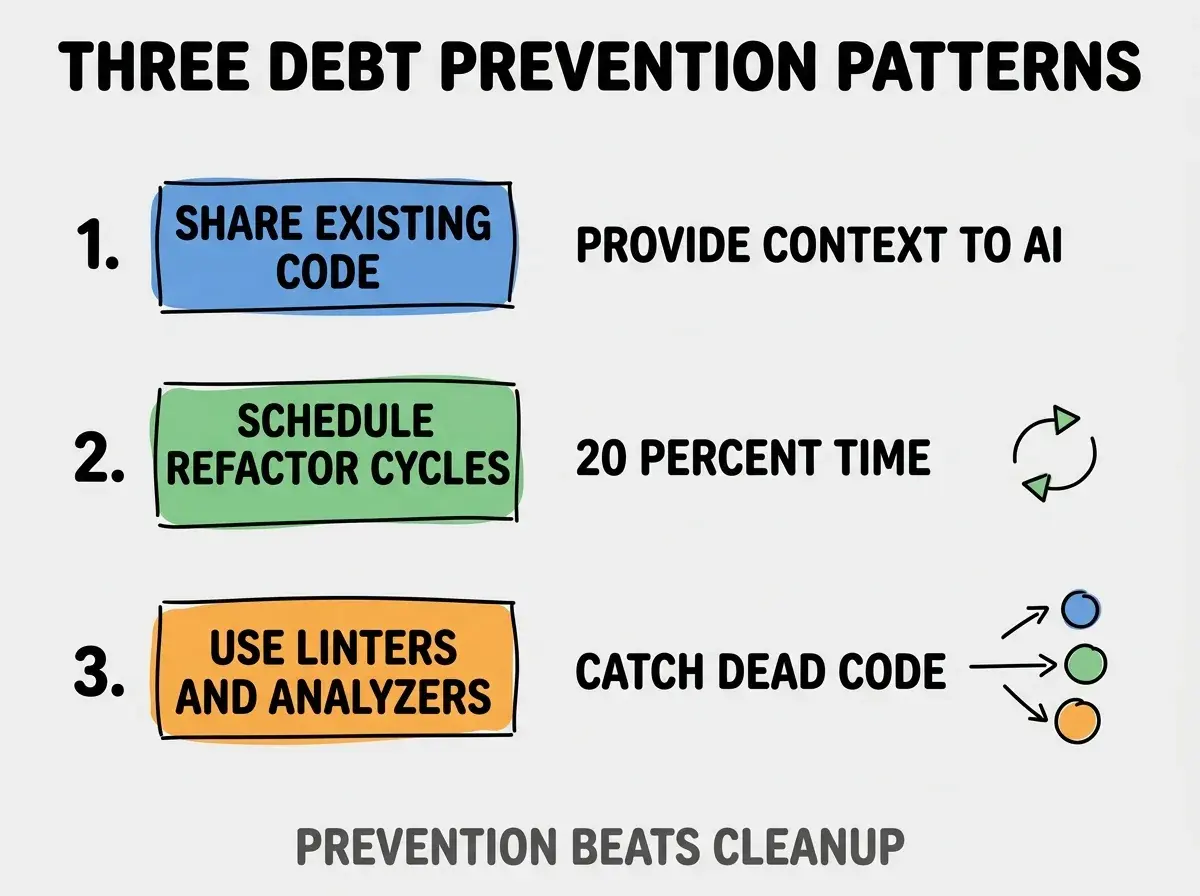
Pattern 1, share existing code as context with AI. Including existing implementations in prompts prevents AI from creating duplicate logic. Context sharing dramatically reduces duplicated code accumulation.
Pattern 2, schedule refactor cycles using the 20 percent rule. 20 percent of development time spent on refactoring prevents debt compounding. Without refactor cycles, debt compounds until paydown becomes impossible.
Pattern 3, use linters and static analyzers to catch debt patterns. Dead code detection, duplication detection, and complexity warnings catch debt patterns automatically. Tools enforce what manual review misses.
The combination produces AI built apps that maintain modification velocity over time. Without these patterns, AI built apps slow down predictably; with these patterns, velocity holds steady or improves.
The most damaging technical debt mistake in AI built apps is treating debt as a future problem rather than a current cost. Debt compounds with interest; what feels manageable in month one becomes overwhelming by month six. The fix is to treat debt paydown as essential rather than optional; schedule refactor cycles from week one rather than waiting until debt becomes unbearable. Apps that schedule debt paydown maintain velocity; apps that defer paydown grind to halts.
The other mistake is conflating AI velocity with sustainable velocity. AI feature velocity feels sustainable but produces unsustainable debt accumulation. The fix is to measure sustainable velocity (features delivered minus debt accumulated) rather than raw feature velocity.
A third mistake is assuming refactoring will happen naturally. Refactoring requires explicit time allocation; without scheduled time, refactoring never happens.
A fourth mistake is treating each AI generated change as standalone. Changes accumulate; treating them individually misses the cumulative debt accumulation pattern.
How To Detect Existing Technical Debt
Three detection patterns help identify accumulated debt in existing AI built apps.
Detection 1, modification velocity over time. Compare time to add similar features over months. Increasing time signals debt accumulation; constant or decreasing time signals healthy debt management.
Detection 2, code duplication metrics. Static analysis tools measure code duplication. Increasing duplication signals AI debt accumulation; stable or decreasing duplication signals healthy patterns.
Detection 3, bug regression rates. Bugs that reappear after fixes signal underlying patterns that accumulate without resolution. Regression rates correlate with debt levels.
The combination produces visibility into debt levels that intuition alone misses. Without measurement, debt accumulates invisibly until it becomes overwhelming.
How AI Built Apps Will Likely Evolve
The patterns visible in 2026 will likely evolve as AI tools improve, but technical debt management will remain central to project longevity.
The first likely evolution is AI tools developing better debt awareness. Future AI tools may detect duplication during generation rather than after. The improvement will reduce but not eliminate debt accumulation.
The second likely evolution is integrated refactoring becoming standard. AI tools will likely offer integrated refactoring suggestions alongside feature development. The integration reduces friction of debt paydown.
The third likely evolution is debt visibility tooling improving. Specialized tools for AI generated debt detection will emerge. The tooling enables systematic debt management that current tools require manually.
The combination suggests technical debt management will remain critical but become more tooled over time. Builders who invest in debt management practices now build skills that remain valuable as tooling matures.
Common Questions About Technical Debt
Technical debt in AI built apps raises questions worth addressing directly.
The first question is when to start worrying about debt. The answer is from day one; debt accumulates from the first AI generated code regardless of project stage. Starting debt management early prevents accumulation that becomes painful later.
The second question is how much refactoring is enough. The 20 percent rule provides starting point; some projects need more, some less. Adjust based on observed velocity changes over time.
The third question is whether debt rewrites ever make sense. Sometimes; when debt accumulation makes modification impossible, rewrites become necessary. The rewrite cost is dramatically higher than incremental debt paydown would have been; rewrites are last resort not first choice.
What This Means For You
Technical debt accumulation determines long term AI built app viability. The four patterns, prevention strategies, and detection methods produce framework for debt management.
- If you're a founder: Schedule debt paydown from week one. Apps without debt management become unmaintainable; apps with debt management remain modifiable for years.
- If you're an indie hacker: Debt paydown is investment in future velocity. Time spent on debt prevents larger time spent later when debt becomes overwhelming.
- If you're a senior dev: Help non technical founders understand debt patterns. Without understanding, founders deprioritize debt paydown until apps become unmaintainable.
Browse more foundations articles
Read more foundations