A dead end architecture is the structural shape of a project that worked great for the first ten features but cannot accommodate the eleventh. AI tools reliably steer projects into dead ends because they optimize each prompt locally without considering the global shape of the codebase. By the time the dead end is visible, the cost of changing direction is a partial rewrite, and most solo builders simply stop adding features instead.
This piece walks through the four most common dead end architectures AI tools generate, why each one feels good initially, and the early warning signals that let you change course before the rewrite tax kicks in.
Why AI Generates Dead Ends
The deeper reason AI paints projects into corners is that AI tools cannot see the future of your project. When you ask for "a way to send emails," the AI writes a working email function. When you later ask for "scheduled emails," the AI writes another function that looks similar but was not designed to coexist with the first. By the time you have requested email logging, retry behavior, and template management, the four functions are tangled in ways that resist reorganization.
A senior engineer would have seen the trajectory after the second feature and built an abstraction that accommodates the next ten. The AI cannot, because it does not know what the next ten will be. Each prompt is local. The architectural debt is invisible to the AI and to you, until the moment a new feature does not fit at all.
A 2025 study of 800 vibe coded projects that exceeded six months in production found that 64% had hit at least one architectural dead end requiring a partial rewrite. The median cost of the rewrite was 23% of the original development time, and the most common cause was "the abstraction was missing for two features past where it should have been added."
The pattern to copy is the early stages of city planning. Cities that grew organically without zoning decisions in their first hundred years have streets too narrow for fire trucks, blocks too short for modern infrastructure, and intersections that nobody can fix without demolishing buildings. Cities that planned grids or boulevards before they grew did not need to predict the future, they only needed to leave room for it.
The Four Most Common Dead Ends
Four architectural shapes show up repeatedly in AI-built projects that hit dead ends. Each one starts as a reasonable shortcut and ends as a structural limit.
Dead end 1, the god component. Every page in the app accumulates state and logic in a single React component because that was easiest in week one. By month three, the component is 800 lines and any change breaks two unrelated features. The escape requires breaking the component into many pieces, which is exactly the kind of work AI is bad at.
Dead end 2, the implicit data shape. Every function that touches a user object knows the shape of a user implicitly, no shared type, no central definition. Adding a field to users requires changing 30 functions, each of which the AI rewrites in slightly different ways. The fix is to centralize the type, but doing it later means updating 30 callers.
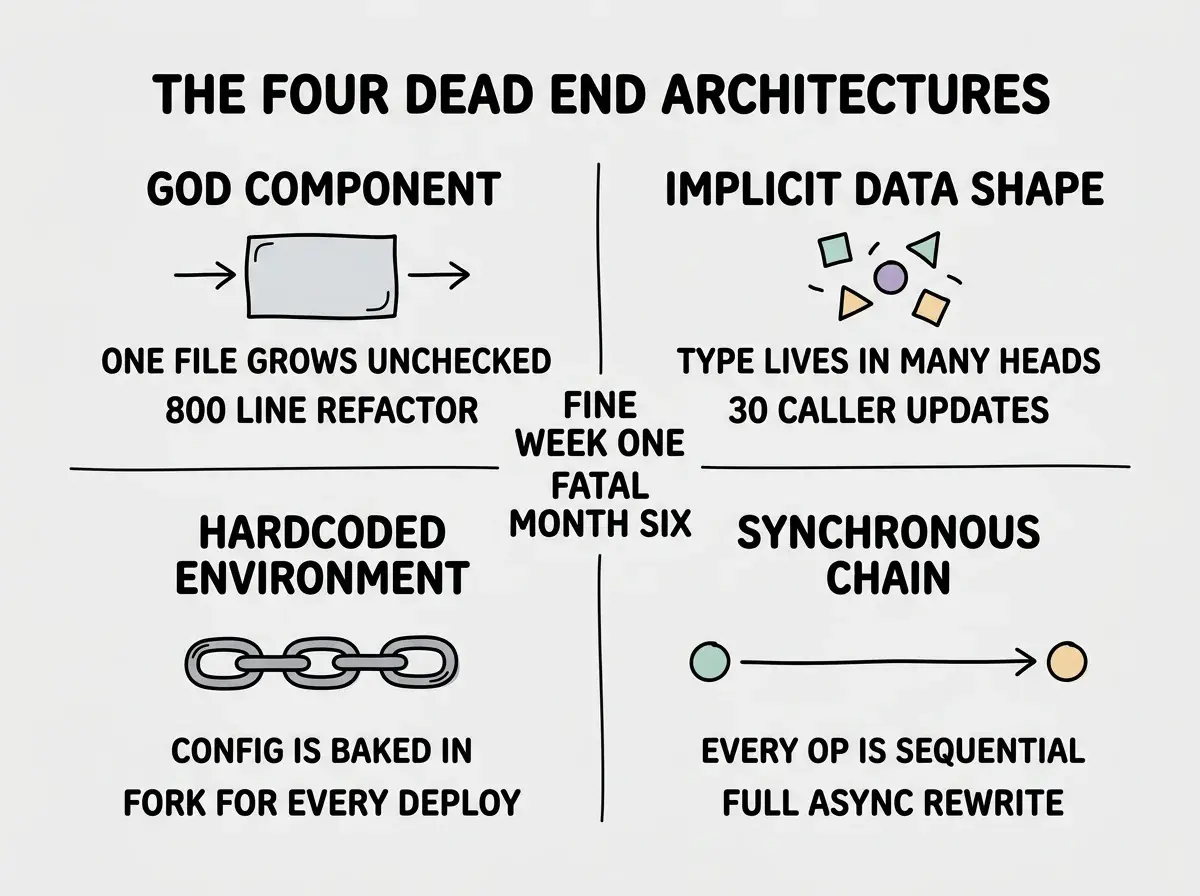
Dead end 3, the hardcoded environment. Configuration values, URLs, and feature flags are sprinkled directly through the codebase as literals. Every deploy environment requires a fork or a brittle find-replace. The fix is centralized configuration, but adding it later means tracking down every hardcoded value across many files.
Dead end 4, the synchronous chain. Every operation is written as one big sequential function, no queues, no background jobs, no async boundaries. The first time the app needs to handle a slow third-party call without blocking the user, the entire request flow has to be rewritten as async, often touching dozens of call sites.
Reading the Trajectory Early
The skill that prevents dead ends is reading the trajectory of the project two features ahead, not just one. The AI cannot do this, but you can, with practice.
The exercise is simple. Every time you ship a feature, write down the next three features you might want. Look at your most recent code and ask, "would those three features fit naturally, or would they require restructuring." If they would require restructuring, do the restructuring now, while the codebase is small, instead of later when it is large.
Read more mental models for vibe coding
Browse foundations articlesThe other technique is the abstraction smell test. After three similar features, ask "is the third one harder to write than the first two were." If yes, the abstraction is missing. The right time to add it is now, when only three features depend on it. The wrong time is later, when twenty do.
The Cost Curve of Fixing Each Dead End
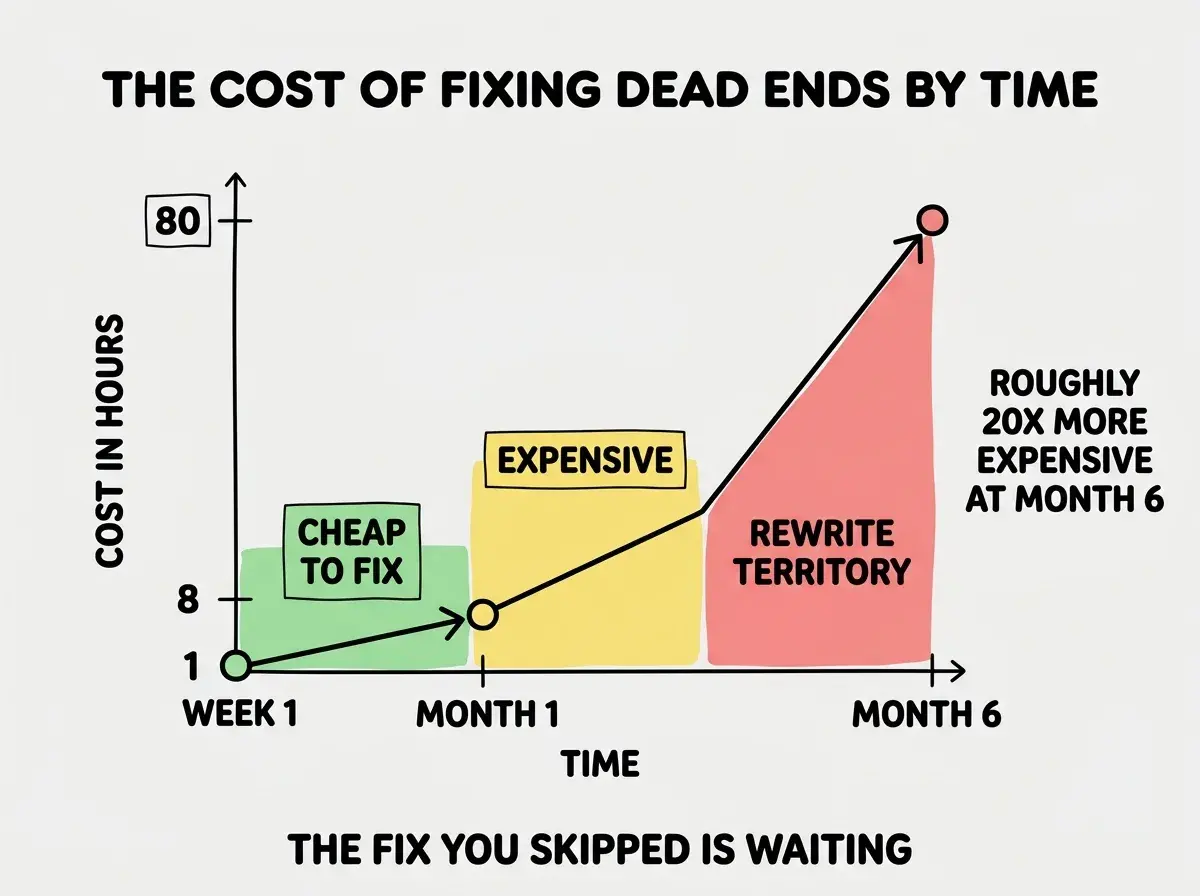
Fixing a dead end always costs something, but the cost grows non-linearly with how late you fix it. Understanding the curve is what makes the case for early intervention.
In week one, fixing a missing abstraction costs an hour. The codebase is small, the AI can hold most of it in context, and you can describe the change in one prompt. In month one, the same fix costs four to eight hours, because there are more callers and more surrounding code that needs updating. In month six, it can cost two to four weeks, because the abstraction is wrapped around so much code that changing it requires re-deriving every dependent decision.
The math is brutal but simple. Architectural fixes are roughly 20x more expensive at month six than at week one. The fix in week one feels unnecessary because everything works. The fix in month six feels impossible because nothing else can move until it is done.
The most damaging dead end mistake is the optimistic refactor, "we will clean this up later when we have more revenue." The codebase is hardest to change exactly when revenue starts demanding new features. The right answer is to clean up small messes early, when the work is invisible to customers and cheap to do.
The corollary is that the absence of pressure to ship is the best time to do architectural work. If you are between features and feeling slow, that is the right week to refactor. If you are mid-launch and feeling pressure, save the refactor for after.
What This Means For You
Dead end architectures are the architectural form of compound interest, small early decisions become large later constraints. The work of avoiding them is mostly noticing patterns and intervening early, not heroic redesigns at the end.
- If you're a founder: Block one hour every Friday for "code shape review." Look at what was written this week and ask if it sets up the next month well. The hour is cheap insurance.
- If you're changing careers: Reading code with a "what does this make impossible" eye is one of the highest-leverage skills to develop. Most junior engineers focus on what code does, senior ones focus on what code precludes.
- If you're a student: Pick any small project and intentionally hit a dead end, then fix it. The lesson sticks better than reading about it.
Read more architectural mental models
Browse foundations articles