The maintenance cliff is the surprisingly consistent point in a vibe coded project's lifecycle when small changes start taking ten times as long as they used to. For most projects the cliff arrives around month three. Day one to week six is exhilarating, features ship in hours, the AI is a magic helper. Then the curve bends, and around the 90 day mark, a one-line change requires reading three files, untangling a circular dependency, and praying that nothing else breaks.
This piece explains why the maintenance cliff is so reliably timed, what causes it specifically in AI-built projects, and how to flatten the curve before you fall off it.
Why Month Three Is the Inflection Point
The first six weeks of a vibe coded project benefit from a quiet advantage, the entire codebase fits in your active memory. You wrote it last Tuesday, you remember why every file exists, and the AI's recent context window remembers the same. Both human and AI can answer "why is this here" without looking. Changes are local, side effects are predictable, and shipping feels easy.
The advantage is fragile. Every week you work on the project, the codebase grows. The amount you have to forget to make room for new context grows in proportion. Around week eight to ten, the project crosses a threshold where you no longer remember why every file exists. The AI's context window crosses the same threshold around the same time, where it can no longer fit the whole project on every prompt.
A 2025 analysis of 1,200 vibe coded projects on GitHub found that the median time-to-make-a-bug-fix increased by 6.4x between week 4 and week 14. The curve was sharpest between week 10 and week 12, the same period engineers commonly call "the third month wall."
The pattern to copy from is mountaineering. The first day of a climb is glorious. Day three on a long expedition is when altitude sickness peaks, when the gear feels heavier, and when the most experienced climbers slow down. The cause is not weakness, the cause is accumulating biological cost from operating above your normal range. Vibe coded projects have an analogous biological cost, accumulated cognitive debt that catches up around the third month.
The Specific Forces That Compound
Three specific forces drive the cliff in AI-built projects, and each accelerates the other two. Understanding the trio is what makes the cliff predictable rather than mysterious.
Force 1, naming drift. AI tools generate names without referring to the existing codebase. By month three, you will have three slightly different names for the same concept (getUserData, fetchUserProfile, loadAccount), and the AI will produce a fourth on the next prompt unless you intervene. Refactoring later is expensive because every name is referenced from many places.
Force 2, schema sprawl. AI-generated database operations tend to add columns rather than reuse existing ones. By month three, you have multiple columns that mean almost the same thing, and queries that join across them in subtly inconsistent ways. The data model has grown a back stairwell that nobody documented.
Force 3, context window failure. The same AI that confidently generated week one code can no longer hold the whole project in its head by week twelve. It starts producing changes that conflict with code two files away, because it cannot see those files. Without explicit context curation (CLAUDE.md, .cursorrules, structured prompts), the AI's quality silently degrades.
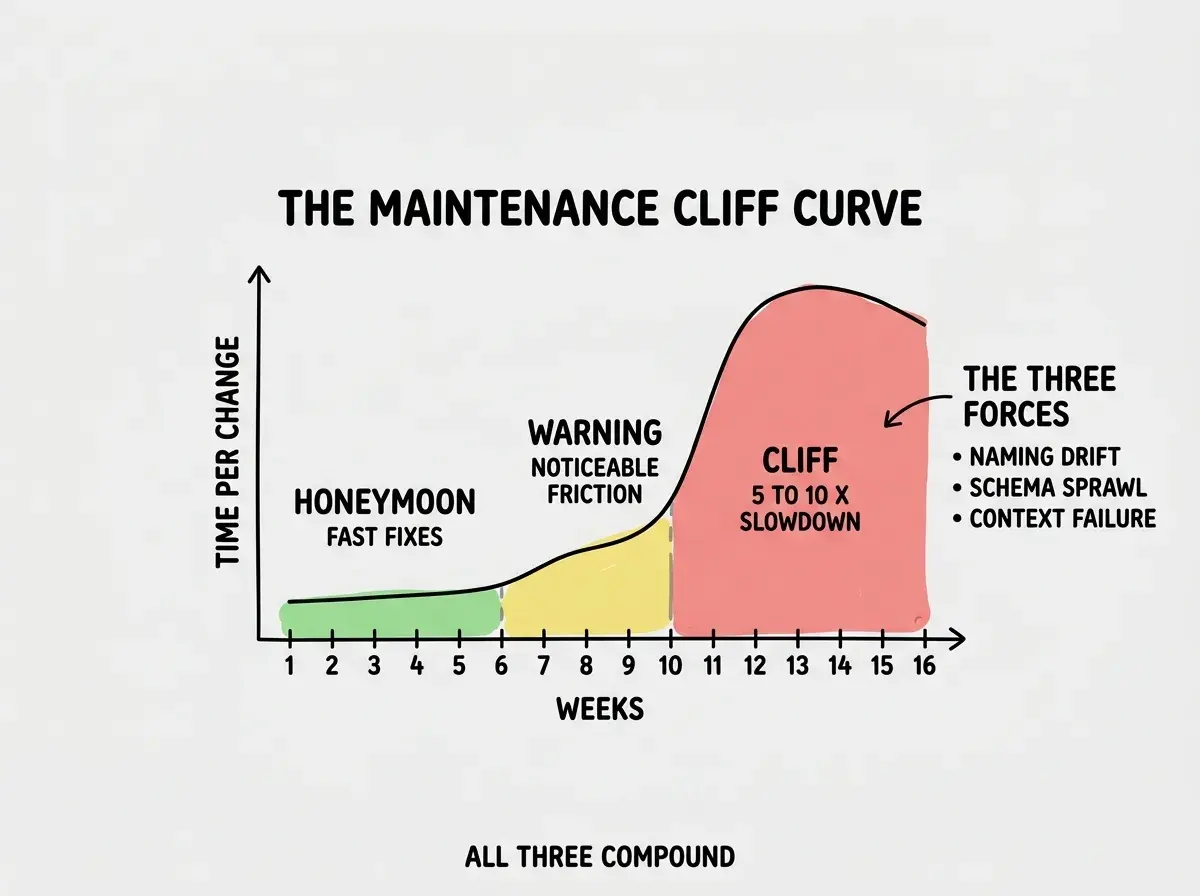
The compounding is what makes the cliff feel sudden. Each force individually is manageable, the failure mode is when all three reach critical mass within the same two-week window. Once they do, the cost of any change includes the cost of untangling each of the three.
How to Flatten the Curve
The pattern that flattens the curve is small investments at predictable intervals, not heroics during the cliff. Each of the three forces has a corresponding mitigation that pays back disproportionately if you do it early.
The naming drift fix is to maintain a glossary file at the root of your repo (often called GLOSSARY.md or part of CLAUDE.md). Every time you find yourself asking "what is this called," add the canonical name to the glossary. The AI will read the file on subsequent prompts and stop inventing new names. The total time investment is minutes per week and the savings are hours per month.
Read more long-term thinking guides for vibe coded projects
Browse foundations articlesThe schema sprawl fix is the migration habit, treat the database schema as code with version-controlled migrations. The AI will generate ad-hoc table changes if you let it. Forcing every change through a migration file makes the data model legible and the changes diffable, which compounds value over time.
Reading the Early Warning Signs
The cliff is not a surprise if you know what to watch for. Three early signals appear weeks before the steep part of the curve, and noticing them lets you intervene before the cost peaks.
Signal 1, your AI prompts are getting longer. If you are writing two-paragraph prompts to explain context that a one-line prompt covered last month, the project has outgrown the AI's context window. The fix is to invest in CLAUDE.md or .cursorrules so the AI gets context automatically.
Signal 2, you are afraid to refactor. When small refactors feel risky because you are not sure what depends on what, the codebase has accumulated invisible coupling. Spend an afternoon mapping the dependency graph before the next big change.
Signal 3, AI suggestions are starting to feel wrong. If you find yourself saying "no, that does not match how the project works" multiple times per session, the AI's mental model and your project's actual model have diverged. Recalibrate by writing or updating documentation that explains your conventions.
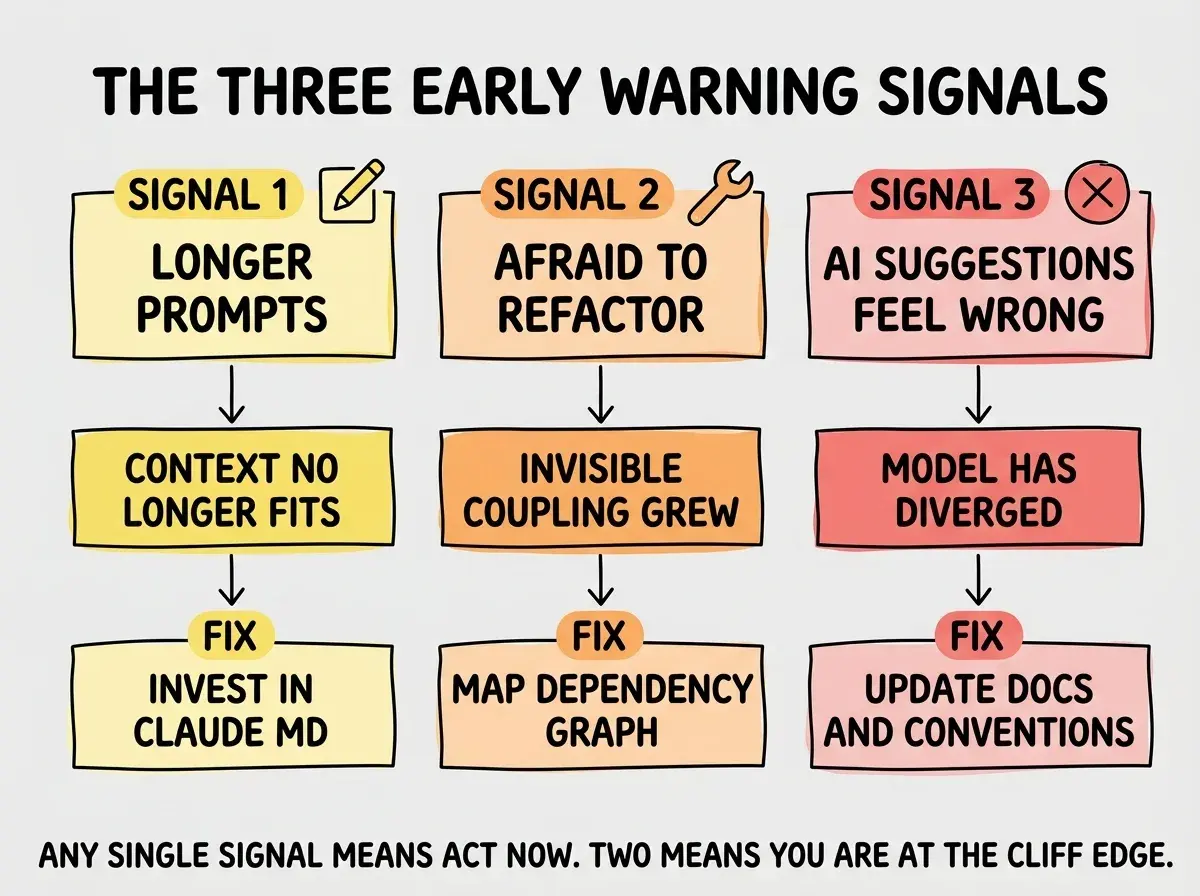
The most damaging maintenance cliff mistake is dismissing the early signals as personal failure, "I just need to focus more." The signals are structural properties of the project, not character flaws. Ignoring them does not make them go away, it concentrates the cost into a single painful week of crisis maintenance.
The compounding return on flattening the curve is enormous. A project that maintains a steady weekly velocity at month six is fundamentally different from a project that hit a 5x slowdown at month three. The first becomes a sustainable business. The second becomes a cautionary tale.
What This Means For You
The maintenance cliff is one of the most reliable patterns in vibe coded projects, and one of the most preventable. Knowing it exists is half the battle, the other half is doing the small weekly maintenance work that prevents the buildup.
- If you're a founder: Bake one hour per week into your schedule for project maintenance, glossary updates, dependency map review, AI documentation refresh. The hour is expensive in week one and life-saving in week twelve.
- If you're changing careers: Watching your own project go through the cliff is one of the highest-value learning experiences in software. Treat it as a feature of vibe coding, not a bug.
- If you're a student: Pick any vibe coded class project and continue it for three months. The lesson taught by the cliff is one no textbook can replicate.
Read more mental models for vibe coding
Browse foundations articles