The most-upvoted Reddit thread about AI coding right now is not about prompting tricks or which model is best. It has 562 upvotes and 252 comments, and the topic is maintenance. Specifically, the exhaustion of keeping AI-built apps alive after launch. People are burning out, reverting code, and quietly watching projects die. Not because AI code is bad on launch day, but because nobody told them what comes next.
Here is the number that explains why: 41% of AI-generated code gets reverted within two weeks. Not because developers are incompetent, but because AI-generated code optimizes for making something work right now rather than making it easy to change later. Technical debt accumulates faster than with hand-written code. And at the 400-hour mark, a well-documented exhaustion wall hits. Projects that looked healthy at month one start dying from accumulated fatigue at month three.
This handbook gives you the routines that prevent that. Weekly, monthly, and quarterly. What to check, what to fix, and what to delegate before the cliff arrives.
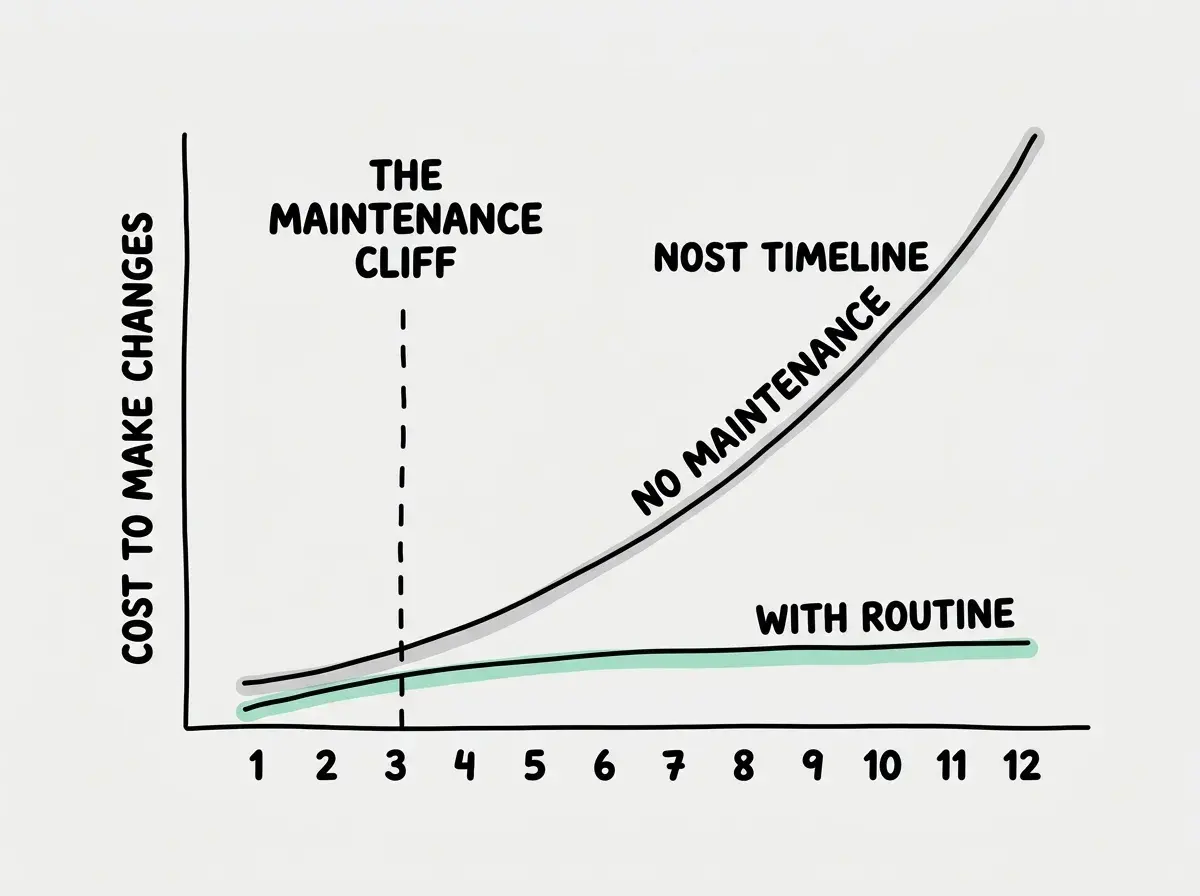
The Maintenance Cliff at Month Three
Most vibe-coded apps have a predictable decay curve. The first four weeks feel great. The AI ships fast, the app works, you are iterating on real user feedback. Month two introduces friction. Dependencies drift, small bugs accumulate, and the AI starts needing more context to make changes because the codebase is bigger than when it started. Month three is where projects either establish a maintenance rhythm or start dying.
The cleanup economy has priced this pattern precisely. Refactoring shops charge $200 to $400 per hour to untangle AI-generated code at the six-month mark. The engagements are not cheap because the work is hard. They are expensive because the accumulated decisions made for speed (duplicated logic, missing abstractions, inconsistent naming) compound into something genuinely difficult to unravel.
The antidote is not writing better prompts at the start. It is building maintenance into the calendar from day one, the same way you would schedule an oil change before the engine warning light comes on.
Your Weekly Routine (30 Minutes)
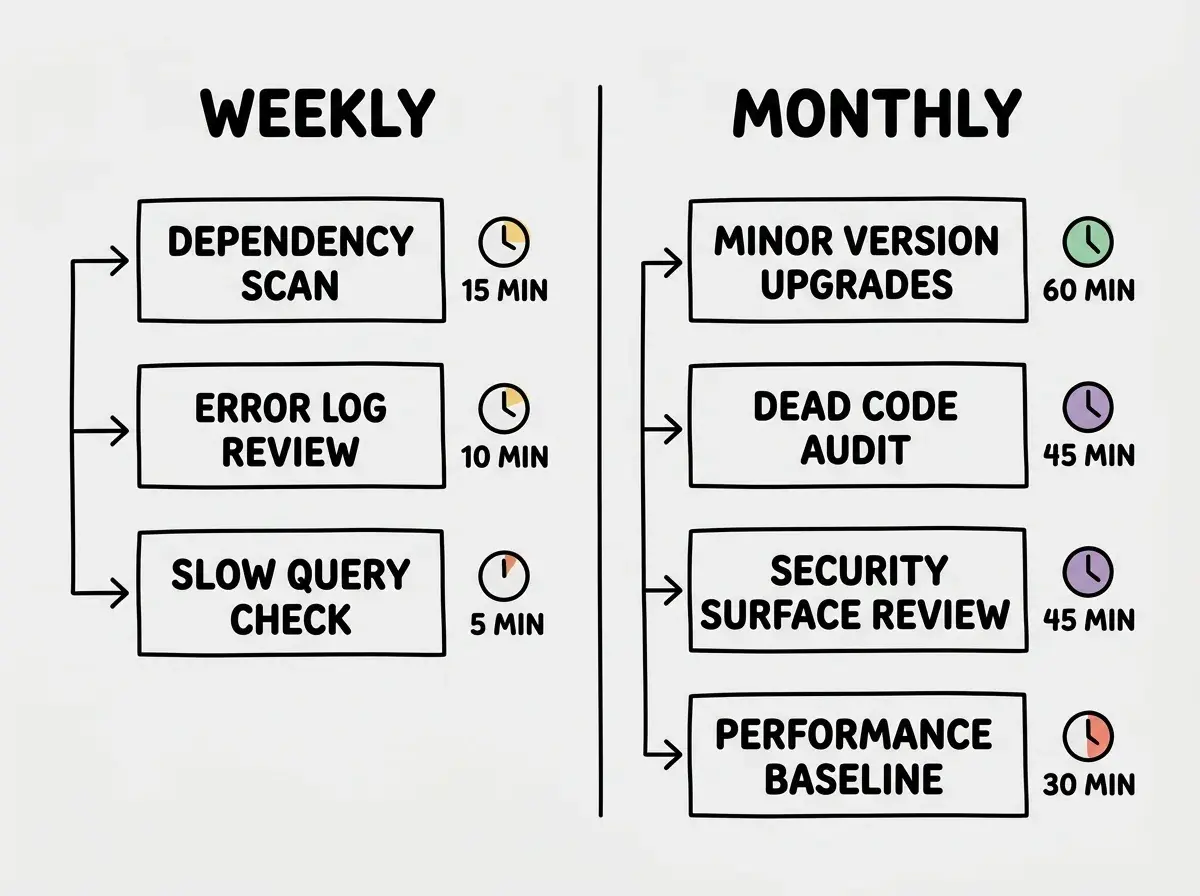
Weekly maintenance is about preventing the small fires that become large ones. Three areas need attention every week.
Dependency scan. Run your package manager's audit command and review the output. You are looking for two things. Patch-level updates you can apply immediately with low risk, and any security advisories flagged as high or critical. Do not let security advisories age past one week. The Lovable CVE case study showed what happens when a known vulnerability sits unpatched inside an AI-built app. The breach was not sophisticated. It just required someone to act before the maintainers did.
Error log review. Pull the last seven days of application errors and sort by frequency. You are not trying to fix everything. You are looking for new error types that appeared since your last deploy, error rates that are trending upward, and any errors that correlate with specific users or usage patterns. Fifteen minutes with your error tracking tool every Monday morning prevents the kind of silent failure that only gets noticed when a user emails you.
Database query check. Look at your slowest queries from the past week. AI-generated database code is notoriously query-heavy. The model often fetches more data than needed because it prioritizes correctness over efficiency. One slow query caught at week three is a five-minute fix. The same query still running at month six means a full audit.
The 400-hour exhaustion wall is real, but it is not inevitable. Projects that die at month three almost always skipped weekly maintenance in months one and two. Thirty minutes per week prevents the compounding rot that makes larger interventions feel impossible later.
Your Monthly Routine (2 to 4 Hours)
Monthly maintenance is where you step back from the fires and look at the building. Four areas, once a month.
Dependency upgrades (not just patches). Minor version bumps need a dedicated session. Run the upgrades in a staging environment, run your full test suite, and check the changelog for any behavioral changes. AI-generated code sometimes depends on implementation details of specific library versions rather than stable public APIs, which means minor bumps can break things in unexpected ways. Test thoroughly before merging.
Dead code audit. AI models generate code that works but leaves orphaned functions, unused imports, and commented-out blocks everywhere. A monthly pass to remove dead code is not cosmetic cleanup. Every line of dead code is a context load that your AI assistant has to process the next time you ask it to make a change. At 3,000 lines, your AI still has a clear picture. At 15,000 lines where 4,000 are dead, the model starts making wrong assumptions about what the codebase does.
Security surface review. Go through your authentication flows, API endpoints that accept user input, and any places where your app reads from or writes to external storage. AI-generated code frequently misses input validation on edge cases because the happy path tests pass fine. The OWASP top ten is a useful checklist here. You do not need to be a security expert to catch the obvious stuff.
Performance baseline check. Run your core user flows through a performance profiler and compare against last month. Gradual performance regressions are invisible in daily use but show up clearly in a side-by-side comparison. A monthly ten-minute session in your browser's performance panel catches the regressions before users notice.
Your Quarterly Routine (One Full Day)
Quarterly work is strategic. It requires uninterrupted focus and a willingness to make decisions that feel expensive in the short term.
Codebase archaeology. Read through your codebase as if you have never seen it before. Take notes on anything that confuses you, any logic you cannot explain quickly, and any components that feel fragile. This is not about fixing everything. It is about building an honest picture of your technical debt before it becomes invisible through familiarity. The most dangerous technical debt is debt you have learned to ignore.
Major version upgrades. Major versions of your core framework, database client, or authentication library need quarterly attention. Waiting longer creates migration projects that take weeks instead of days. Do them while the delta is still manageable.
AI context refresh. Your AI assistant's understanding of your codebase lives in whatever context you provide it, your CLAUDE.md, your project documentation, your prompt conventions. After three months of active development, these context files are often stale. Update them to reflect the current state of the codebase. This single investment reduces the time you spend re-explaining your architecture to the AI every time you start a new session.
Cost and scaling audit. Review your infrastructure costs against your usage growth curve. AI-generated apps often over-provision by default because the model uses sensible defaults rather than right-sized configurations. A quarterly review of your Cloudflare, Vercel, or AWS bill against actual traffic numbers frequently reveals 20 to 40 percent waste.
Get the full picture on deploying and operating AI-built applications in production.
Browse all articlesCumulative Code Rot Is the Silent Killer
Cumulative code rot deserves its own section because it is the failure mode nobody warns you about when you start vibe coding.
The rot is not any single bad decision. It is the accumulation of hundreds of small ones. A duplicated utility function here. A hardcoded string there. An overfetching query that adds fifty milliseconds. An unused dependency that pads your bundle. Individually, none of these matter. Together, after six months of AI-assisted development without a maintenance routine, they create a codebase that is expensive to change, slow to run, and confusing to reason about.
The $200 to $400 per hour cleanup economy exists because of this dynamic. The refactoring shops are not fixing bugs. They are untangling years of small shortcuts taken in pursuit of speed. The irony is that each individual shortcut saved maybe thirty minutes. The untangling takes weeks.
The defense is simple but requires discipline. Every time the AI generates code you do not fully understand, flag it. Every time you paste in a solution and move on, add it to a weekly review list. Every time you ship a feature with a known rough edge, write it down. The list becomes your maintenance backlog. The backlog becomes your weekly and monthly routine. The routine is what keeps the rot from compounding into something that kills the project.
Treating maintenance as something you do when the app breaks instead of on a fixed schedule. By the time problems are visible to users, the underlying rot is usually months old. Waiting for symptoms means you are always in reactive mode, and reactive maintenance costs three to five times more in time and stress than proactive routines.
The graph below shows what the cost-to-change curve actually looks like over twelve months, with and without a maintenance routine. The gap opens slowly at first, then becomes a cliff.
Building the Habit Before You Need It
The developers who successfully maintain AI-built apps long term share one behavior. They started their maintenance routines before they felt necessary. Not at the first sign of trouble, but on week one, when the codebase was still small and the routines took fifteen minutes rather than four hours.
The math is straightforward. Thirty minutes per week for fifty weeks is twenty-five hours. A single cleanup engagement at the six-month mark typically runs forty to eighty hours of paid time, at rates that make the weekly investment look trivial in comparison.
What the routines buy you is not a perfect codebase. They buy you a codebase that is always comprehensible, always patchable, and always recoverable. One where the AI you bring in for new features can actually understand what exists, rather than guessing at what the accumulated shortcuts were trying to do.
Start with the weekly routine. Set a recurring thirty-minute calendar block on Monday morning. Dependency scan, error review, slow query check. Do that for four weeks before adding the monthly routine. Build the habit when the stakes are low, so that it is already automatic when it actually matters.
The 562-upvote Reddit thread exists because people discovered the maintenance cliff by falling off it. This handbook is the railing.
Dig deeper
A few hand-picked sources if you want to go further.
The build is just the beginning. Learn how to run and grow what you ship.
Read more on the blog