To understand git conflicts with AI generated code and how to resolve them, recognize the four conflict patterns AI work produces (concurrent AI generation on same files producing different patterns, AI regenerating code that human modified differently, AI choosing different conventions than team standards, and AI consolidating files differently than human refactoring), see what makes these conflicts different from human only conflicts, and apply the resolution patterns that work for AI generated conflicts. The conflict resolution capability matters because AI accelerates conflict frequency.
This piece walks through the four conflict patterns, what makes AI conflicts different, the resolution patterns, and the four mistakes when resolving AI generated conflicts.
Why Git Conflicts With AI Matter
Git conflicts with AI matter as multiple developers use AI on shared codebases. The matter; AI usage produces conflicts at higher rates than human only development.
The 2026 reality is that AI conflicts have become regular occurrences in team development. Without specific resolution approaches, AI conflicts consume more time than human conflicts of similar complexity.
A 2025 team development study of 200 teams using AI found that AI conflicts occurred 3.4x more frequently than human only conflicts and took 2.1x longer to resolve. Among teams with AI conflict resolution practices, resolution time dropped to 1.2x human conflict time.
The pattern to copy is the way translators handle competing translations. Translators encounter situations where multiple correct translations exist; resolution requires understanding intent rather than just choosing one. AI conflicts follow similar pattern; resolution requires understanding intent that pure code comparison misses.
The Four AI Conflict Patterns
Four patterns characterize AI generated git conflicts.
Pattern 1, concurrent AI generation on same files. Multiple developers asking AI for changes to same files. Different patterns emerge for similar requests.
Pattern 2, AI regenerating code human modified. Human made specific changes; AI regenerates without those changes. Regeneration loses human intent.
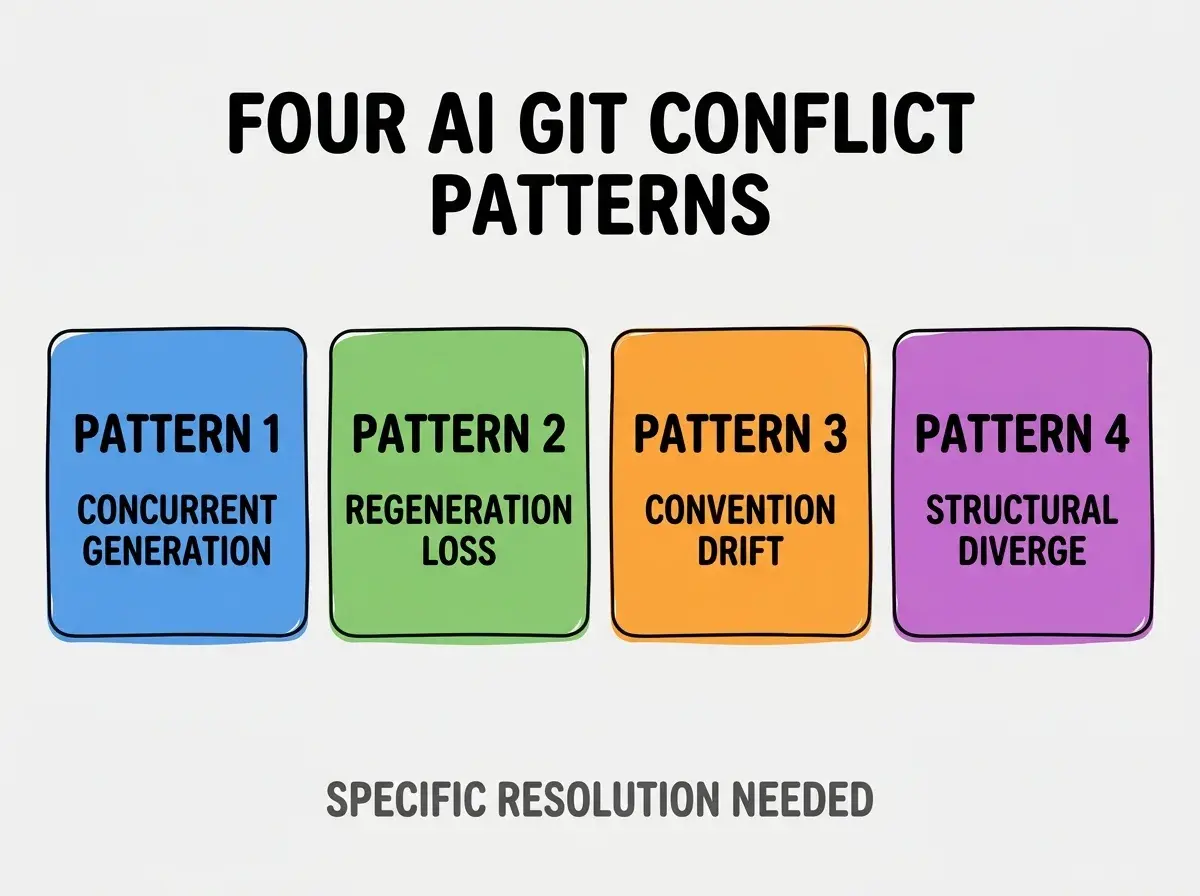
Pattern 3, AI choosing different conventions than team standards. AI without convention context chooses different conventions. Convention conflicts produce surface conflicts and underlying inconsistency.
Pattern 4, AI consolidating files differently than human refactoring. AI restructures code differently than human refactoring. Structural conflicts require architectural decisions to resolve.
What Makes AI Conflicts Different
Three differences distinguish AI conflicts from human only conflicts.
Difference 1, both sides may be incorrect. Human conflicts usually have one correct side; AI conflicts may have neither side correct. Resolution requires understanding intent beyond conflict comparison.
Browse more ship articles
Read more shipDifference 2, conflict scope often broader. AI changes touch more code than focused human changes. Broader scope produces broader conflicts.
Difference 3, intent harder to recover. AI conversation context may not be available during resolution. Intent recovery requires more inference.
The Resolution Patterns That Work
Three patterns produce effective AI conflict resolution.
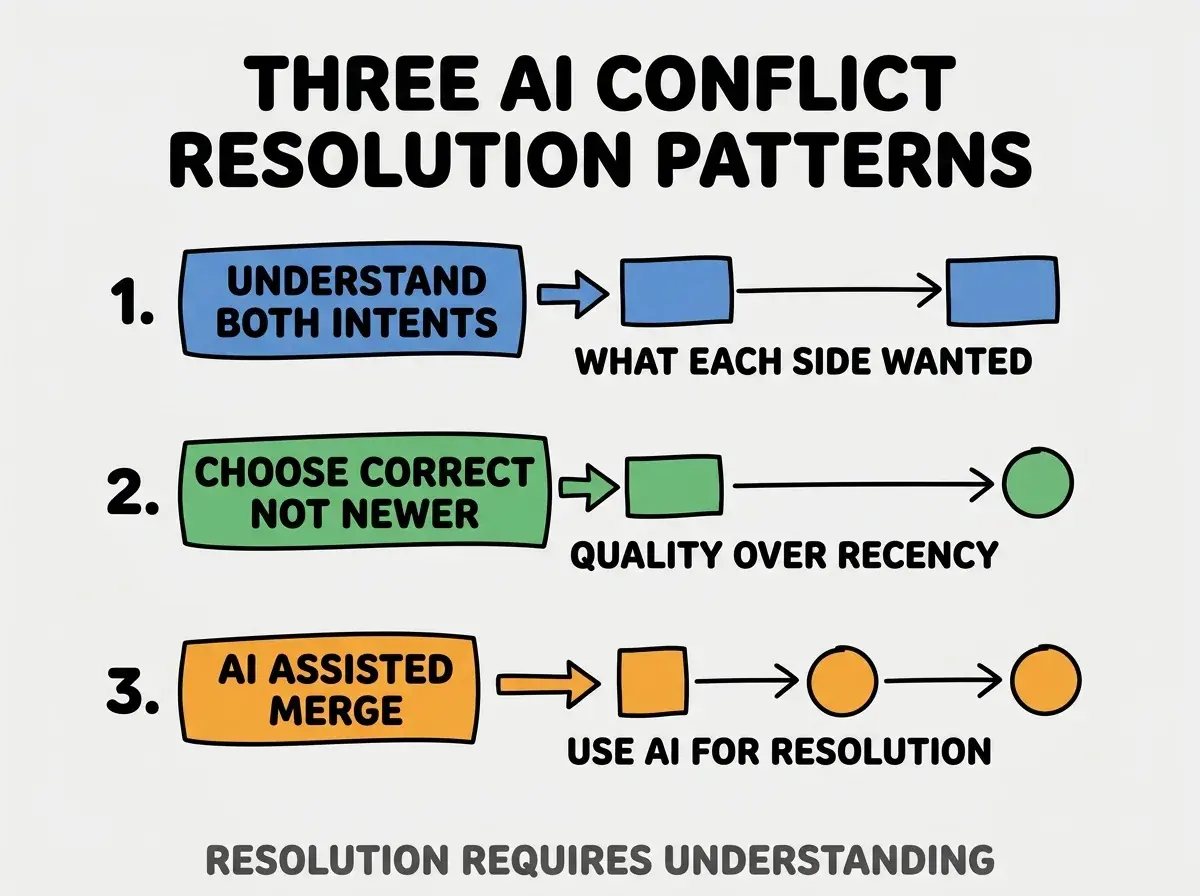
Pattern 1, understand intent of both sides before resolving. Read commit messages, conversation context, related changes. Understanding produces better resolution than picking sides.
Pattern 2, choose correct rather than newer. Both sides may be partially correct; combine rather than choose. Correctness matters more than recency.
Pattern 3, use AI assisted merge for complex conflicts. AI can synthesize both sides considering intent. AI merge often beats manual merge for complex AI conflicts.
What Makes AI Conflict Resolution Sustainable
Three patterns separate sustainable AI conflict resolution from problematic patterns.
Pattern 1, prevent conflicts through coordination. Communicate AI work on shared files. Without coordination, conflicts compound.
Pattern 2, branch hygiene preventing long lived divergence. Frequent integration prevents conflict accumulation. Without hygiene, branches diverge into hard merges.
Pattern 3, post resolution learning preventing recurrence. Patterns that produced conflicts get prevented next time. Without learning, patterns repeat.
The combination produces sustainable AI conflict resolution. Without these patterns, conflicts grow proportional to AI usage.
How To Prevent AI Conflicts
Three prevention patterns reduce AI conflict frequency.
Pattern A, frequent merging from main. Pull main daily; resolve small conflicts continuously. Without frequent merging, large conflicts accumulate.
Pattern B, communicate AI work on shared files. Slack message before AI work on shared files. Without communication, parallel AI work produces conflicts.
Pattern C, smaller scoped AI changes. Narrow AI requests produce narrow changes. Without scope discipline, broad changes produce broad conflicts.
The combination produces conflict prevention that reduces resolution time. Without prevention, resolution time grows with AI usage.
The most damaging AI conflict resolution mistake is choosing newer changes by default during conflicts. Newer changes are not necessarily correct; they may be AI generation that lacks important context the older changes preserved. The fix is to evaluate both sides for correctness rather than recency; sometimes older code is more correct than newer AI generated code. Developers who evaluate produce better outcomes than developers who default to newer.
The other mistake is missing the broader context conflicts often hide. AI conflicts often signal architectural divergence beyond surface conflict. The fix is to evaluate broader implications before merging.
A third mistake is over reliance on automatic merge tools. Automatic tools handle simple conflicts but miss intent in complex ones. The fix is to read conflicts carefully.
A fourth mistake is treating AI conflict resolution as routine. Some AI conflicts deserve discussion not just resolution. Deserve discussion when architectural implications emerge.
How To Handle Specific Conflict Types
Three conflict types deserve specific approaches.
Type A, naming conflicts where AI chose different names. Standardize on team conventions; rename AI choice. Convention enforcement prevents future conflicts.
Type B, structural conflicts where AI restructured differently. Discuss architecture before resolving. Architecture decision should happen once.
Type C, behavioral conflicts where AI changed behavior unexpectedly. Verify both behaviors against intent. Sometimes AI change is correct; sometimes human change is correct.
The combination produces type specific resolution. Without specific approaches, generic resolution misses type specific value.
How AI Conflicts Will Likely Evolve
AI conflict patterns will likely evolve as AI tools mature.
The first likely evolution is AI tools coordinating across team. Tools that communicate AI work to other team members. Coordination prevents some conflicts.
The second likely evolution is conflict prediction. Tools that predict conflicts before they happen. Prediction enables proactive resolution.
The third likely evolution is integrated AI merge assistants. Tools designed for AI conflict resolution. Integration reduces resolution friction.
The combination suggests AI conflicts will remain but become more manageable. Engineers learning patterns now build skills that remain valuable.
Common Questions About AI Git Conflicts
AI git conflicts raise questions worth addressing directly.
The first question is whether AI conflicts indicate AI tools are problematic. No; conflicts indicate parallel work which is normal. Better tools reduce frequency without eliminating.
The second question is whether to limit AI to single developer per file. Sometimes; for shared critical files, coordination matters. For independent files, parallel AI work works fine.
The third question is whether to favor manual or AI assisted resolution. Both work; choose based on conflict complexity. Complex conflicts benefit from AI assistance.
What This Means For You
AI git conflict resolution determines team development velocity with AI. The four patterns, resolution approaches, and prevention strategies produce framework for handling AI conflicts effectively.
- If you're a senior dev: Help team develop AI conflict resolution practices. Without practices, AI usage produces compounding team friction.
- If you're a tech lead: Coordinate AI work on shared files. Coordination prevents conflicts that resolution cannot fully fix.
- If you're an indie hacker: Solo developers face AI conflicts when working across multiple branches. Apply patterns even solo.
Browse more ship articles
Read more ship