Branching strategies for AI assisted development differ from traditional branching because AI changes code volume dramatically. The four branch patterns that work for vibe coded teams are short lived feature branches, AI experiment branches, daily integration branches, and protected main with required checks. Combined they let teams move fast with AI while maintaining the safety that protects shared code from AI generated breakage.
This piece walks through the four branch patterns, when to use each, how to set up branch protection for AI workflows, and the four mistakes teams make adopting AI era branching.
Why Branching Strategy Matters For AI Era
Branching strategy matters for AI era because AI generates more code per branch than traditional development. Old strategies optimized for slower change rates; AI era requires strategies optimized for higher volumes.
The 2026 reality is that teams using outdated branching strategies hit merge conflicts, lose work, and slow down despite AI accelerating individual development. Branching strategy is now a productivity bottleneck.
A 2025 development team productivity study of 300 engineering teams found that teams using AI optimized branching strategies merged code 3.2x faster than teams using traditional branching with AI. Strategy adaptation produces measurable team velocity differences.
The pattern to copy is the way air traffic controllers handle increased flight volume. Traditional separation rules become bottlenecks at high volume; new rules optimized for volume let more flights operate safely. Branching follows the same dynamic with code.
The Four Branch Patterns
Four patterns work for AI era branching.
Pattern 1, short lived feature branches. Hours to days, not weeks. AI lets features ship faster; long branches accumulate conflicts.
Pattern 2, AI experiment branches. Throwaway branches for AI exploration; commit good results to feature branches; delete experiments.
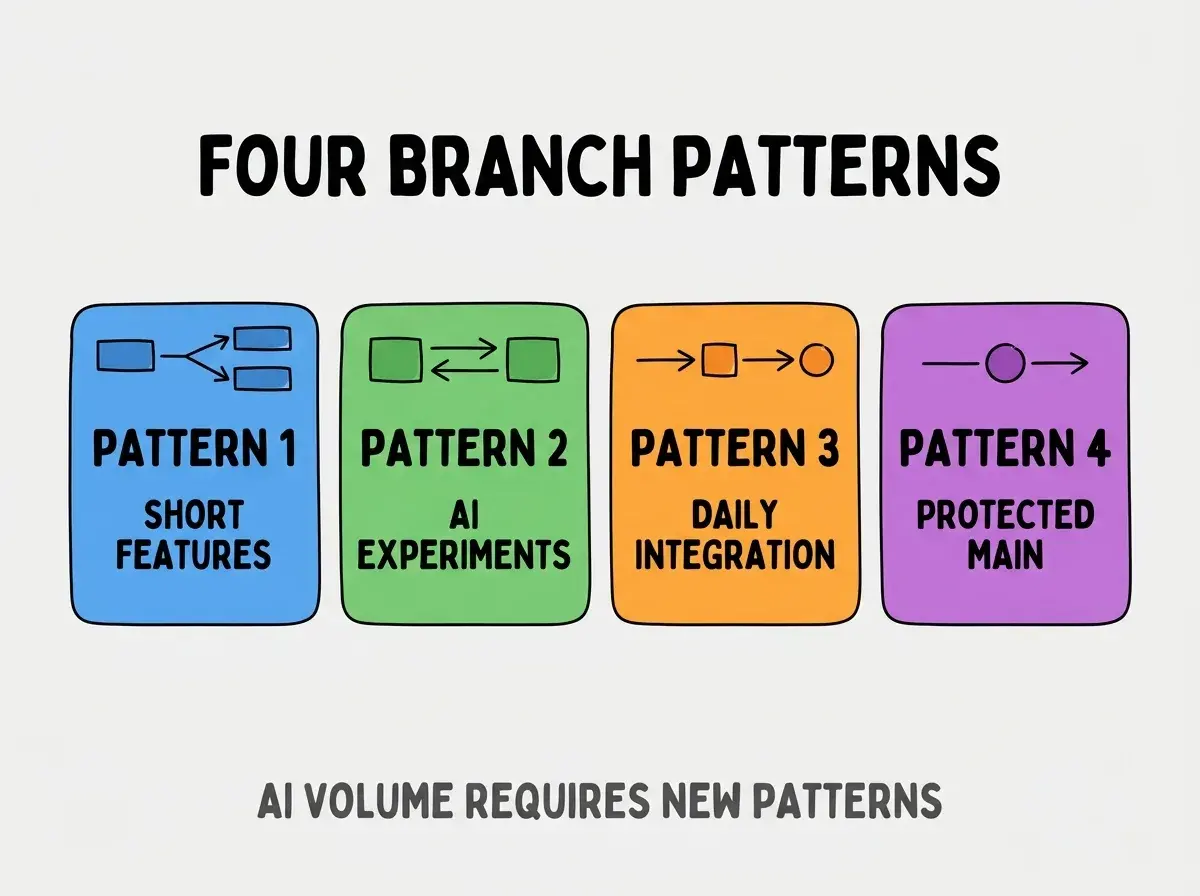
Pattern 3, daily integration branches. Merge to main daily even if features are incomplete; feature flags hide unfinished features. Daily integration prevents drift.
Pattern 4, protected main with required checks. Main branch requires CI passing, code review approval, and AI generated test coverage before merge.
When To Use Each Branch Pattern
Four scenarios match the four patterns.
Scenario 1, building a defined feature. Short lived feature branch; merge to main within 1-3 days. Define scope before starting.
Scenario 2, exploring with AI. Experiment branch; commits do not need to be clean; delete branch when done.
Browse more ship articles
Read more shipScenario 3, multi day work in progress. Feature flag the WIP code; merge daily to main behind flag; complete feature before enabling flag.
Scenario 4, deploying to production. Always from main; main is always deployable; protected status enforced.
How To Set Up Branch Protection For AI Workflows
Three setup patterns protect main from AI generated issues.
Pattern 1, required CI checks include AI specific tests. Type checking, linting, and AI focused security scans all required.
Pattern 2, required code review with AI awareness. At least one human review for AI generated code; AI tools can pre review but not approve.
Pattern 3, deploy preview required for UI changes. Visual regression and manual review on Vercel/Netlify preview before main merge.
What Makes AI Branching Sustainable
Three patterns separate sustainable AI branching from temporary discipline.
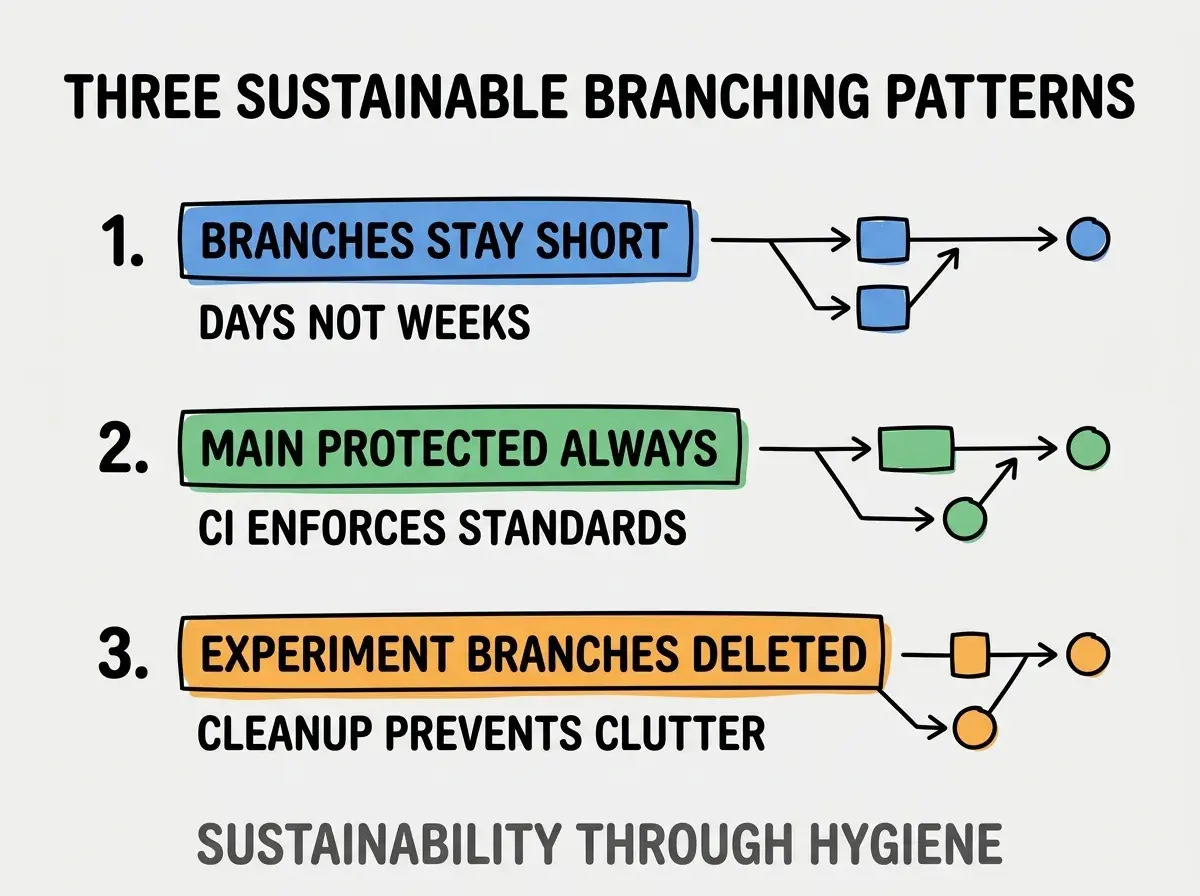
Pattern 1, branches stay short. Long branches accumulate conflicts; short branches resolve cleanly.
Pattern 2, main protected always. Protection enforced by CI; protection prevents single bad merge from breaking team.
Pattern 3, experiment branches deleted regularly. Cleanup prevents branch clutter that hides important work.
The combination produces sustainable branching. Without these patterns, branching becomes friction.
How To Adopt AI Branching Progressively
Three adoption patterns help teams shift to AI era branching.
Pattern A, shorten branch lifetime first. Reduce from weeks to days as first change; team adjusts to faster cadence.
Pattern B, add CI checks incrementally. One check per week; team adapts without overwhelming constraint.
Pattern C, introduce feature flags for gradual integration. Feature flags enable daily merge of incomplete work; flags decouple merge from release.
Common Questions About AI Branching
AI branching raises questions worth addressing directly.
The first question is whether trunk based development works with AI. Yes; trunk based works exceptionally well because short branches match AI cadence.
The second question is whether to use git flow or simpler models. Simpler usually wins; git flow ceremony overhead exceeds AI benefit.
The third question is whether AI tools should commit directly to branches. Yes for experiments; no for shared branches without review.
The fourth question is how to handle long running refactors. Feature branch with frequent rebases on main; merge in chunks behind flags.
How AI Branching Affects Team Velocity
AI branching affects team velocity in compounding ways. Velocity effects compound across releases.
The first compounding effect is merge conflict reduction. Short branches conflict less; conflict reduction saves resolution time.
The second compounding effect is integration confidence. Daily integration reveals integration issues fast; fast revelation enables fast fixes.
The third compounding effect is parallel work enablement. Multiple developers with AI work in parallel without blocking each other.
The combination produces team velocity that scales with AI usage. Without strategy adaptation, AI productivity hits team coordination ceiling.
How To Handle Branching For Solo Builders
Three patterns adapt branching for solo builders.
Pattern A, main plus single feature branch. Solo builders rarely need more; complexity adds overhead without benefit.
Pattern B, experiment branches for risky AI work. Try ideas in branches; merge winners; delete losers.
Pattern C, tag releases for rollback ability. Git tags mark deployable versions; tags enable rollback without complex branching.
The combination produces lightweight branching for solo work. Without simplification, solo branching becomes ceremony.
The most damaging AI branching mistake is treating AI generated code as needing less rigor than human code. AI generates more code with similar bug rates; rigor must increase, not decrease, with AI volume. The fix is to apply same standards regardless of generation source; protection mechanisms catch AI issues that humans would catch in human code. Teams that maintain rigor produce stable AI accelerated systems; teams that relax rigor produce instability.
The other mistake is keeping experiment branches around. Experiment branches accumulate; accumulation hides important branches.
A third mistake is missing the feature flag opportunity. Daily integration without flags requires complete features; flags enable incomplete work integration.
A fourth mistake is treating branch protection as obstacle. Protection prevents incidents; incidents cost more than protection ceremony.
What This Means For You
Branching strategies for AI assisted development require adaptation for AI volume. The four patterns, setup approaches, and adoption strategies produce branching that scales with AI productivity.
- If you're a senior dev: Lead branching strategy adaptation in your team; team velocity depends on it.
- If you're an indie hacker: Adopt simplified solo branching; over engineered branching costs solo builders disproportionately.
Browse more ship articles
Read more ship