Commit message conventions for AI assisted projects help vibe coders maintain readable Git history when AI generates many commits. Four convention components matter: type prefix (feat, fix, refactor) describing change category, scope describing affected area, subject line under 50 characters, and body explaining why not what. Conventions like Conventional Commits make Git history scannable and enable automated changelog generation. Vibe coders without conventions face Git history that becomes incomprehensible as AI commits accumulate.
This piece walks through the four convention components, the implementation patterns, what makes conventions sustainable, and the four mistakes builders make on commit conventions.
Why Commit Conventions Matter For AI Work
Commit conventions matter for AI work because AI generates many commits, fast. Without conventions, Git history becomes wall of text. Conventions enable scanning; scanning enables understanding.
The 2026 reality is that vibe coders generate 5-10x more commits than traditional developers. Volume makes conventions essential rather than nice to have.
A 2025 vibe coder Git practices survey of 1200 builders found that builders following commit conventions reduced time to find specific changes by 73 percent compared to builders without conventions. Conventions measurably affect productivity at scale.
The pattern to copy is the way scientific papers use abstract structure (background, methods, results, discussion). Abstract structure enables fast scanning; commit conventions enable similar scanning of Git history. Both work because structure aids comprehension.
The Four Convention Components
Four components form complete commit conventions.
Component 1, type prefix. feat, fix, refactor, docs, test, chore. Type categorizes change for fast scanning.
Component 2, scope description. auth, ui, api, db. Scope locates change in codebase.
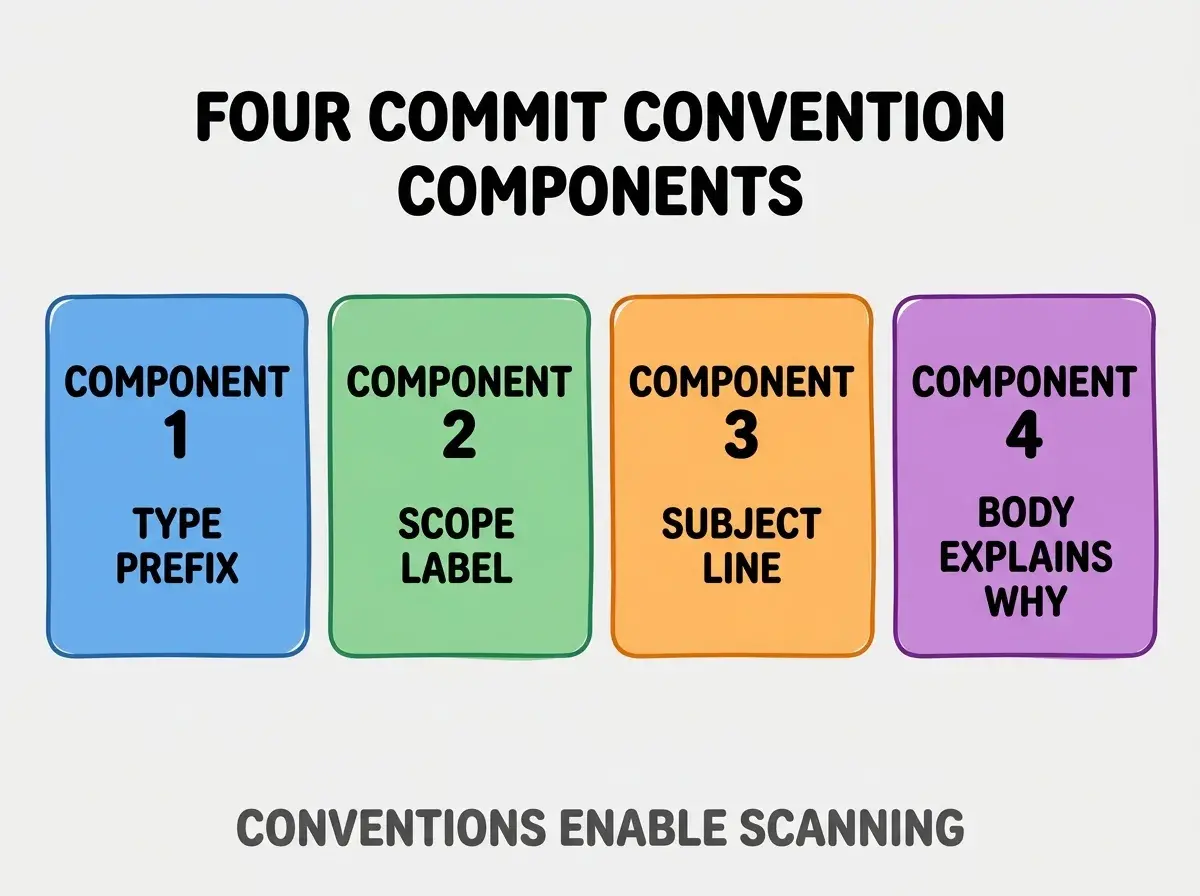
Component 3, subject line under 50 characters. Concise subject enables Git log readability; long subjects truncate.
Component 4, body explains why not what. Code shows what; commit body explains why. Why is harder to recover later.
How To Implement Each Component
Four implementation patterns address each component.
Implementation 1, Conventional Commits standard. "type(scope): subject" format. Tooling supports this format widely.
Browse more ship
Read more shipImplementation 2, scope from codebase areas. Auth, UI, API, DB, infra; pick scopes matching your structure.
Implementation 3, subject in imperative mood. "Add user auth" not "Added user auth"; imperative matches Git convention.
Implementation 4, body bullet points for clarity. Bullet body easier to scan than paragraph body; bullets aid future reading.
What Makes Conventions Sustainable
Three patterns separate sustainable conventions from one off rules.
Pattern 1, automated enforcement. Husky hooks reject non conforming commits; automation prevents drift.
Pattern 2, AI prompts include convention. Tell AI to use convention; AI follows convention naturally.
Pattern 3, periodic review of convention itself. Conventions evolve as project evolves; quarterly review keeps relevant.
What Makes Convention Adoption Sustainable
Three patterns separate sustainable adoption from initial enthusiasm.
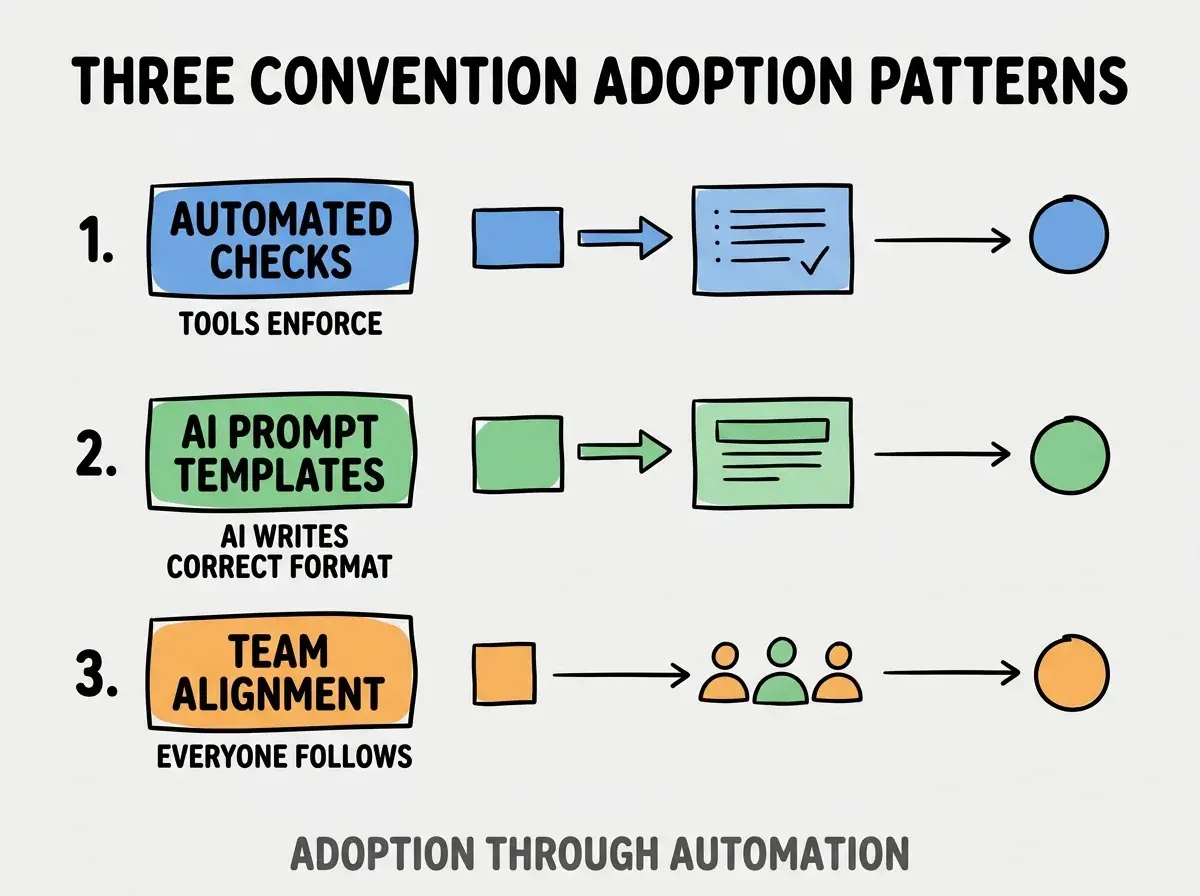
Pattern 1, automated checks. Hooks enforce; manual enforcement fails.
Pattern 2, AI prompt templates. Prompts include convention requirements; AI complies.
Pattern 3, team alignment. Solo conventions easy; team conventions require alignment. Alignment compounds value.
The combination produces sustainable conventions. Without these patterns, conventions decay.
How To Configure Tooling
Three patterns help tooling enforce conventions.
Pattern A, commitlint plus husky. Install commitlint and husky; commit hook checks format. Standard tooling.
Pattern B, IDE plugins for convention awareness. VSCode extensions show convention; visual feedback aids adoption.
Pattern C, GitHub Actions for PR checks. Action validates PR commits; PR cannot merge without convention compliance.
Common Questions About Commit Conventions
Commit conventions raise questions worth addressing directly.
The first question is whether to use Conventional Commits or custom. Conventional standard; custom rare. Standard enables tooling.
The second question is what to do with WIP commits. Squash before merge; WIP fine on feature branch.
The third question is whether AI commits need different conventions. No; AI commits follow same conventions. AI prompts include convention.
The fourth question is whether to enforce on personal projects. Yes; habit forms on personal then transfers. Inconsistency confuses.
How Conventions Affect Project Maintenance
Conventions affect project maintenance in compounding ways. Maintenance effects compound across project life.
The first compounding effect is bug investigation speed. Conventions enable finding when bug introduced; finding fast.
The second compounding effect is changelog automation. Conventional Commits enables automated changelogs; automation saves hours.
The third compounding effect is team onboarding. New developers understand history through conventions; conventions reduce ramp.
The combination produces projects easier to maintain. Without conventions, maintenance burden compounds.
How To Migrate Existing Project To Conventions
Three patterns help migrate to conventions.
Pattern A, start with new commits. Existing history fine as is; new commits follow conventions. Migration begins.
Pattern B, document convention in repo. README or CONTRIBUTING.md documents; documentation enables team adoption.
Pattern C, add tooling immediately. Tooling prevents drift; without tooling, conventions decay.
The combination enables convention migration. Without patterns, migration stalls.
The most damaging commit convention mistake is over engineering convention complexity. Conventions with 20 types and 50 scopes produce confusion not clarity; complexity defeats convention purpose. The fix is to start simple: 5-7 types, 5-10 scopes, simple format. Simple conventions adopt; complex conventions ignored. Builders who keep simple maintain conventions; builders who over engineer abandon.
The other mistake is treating conventions as syntax checking. Conventions communicate; syntax checking misses point. Body content matters more than format compliance.
A third mistake is missing the AI prompt integration. AI follows prompts; not prompting for conventions wastes opportunity.
A fourth mistake is enforcing on team without buy in. Conventions imposed produce resentment; conventions adopted produce alignment.
What This Means For You
Commit message conventions for AI assisted projects produce Git history that remains readable at AI commit volume. The four components, sustainability patterns, and adoption approaches produce conventions that compound across project life.
- If you're a senior dev: Adopt Conventional Commits this week; investment compounds across all projects.
- If you're an indie hacker: Solo conventions still valuable; future you appreciates past you's discipline.
- If you're changing careers: Convention familiarity expected by employers; learn early in career.
Browse more ship
Read more ship