To write technical specs from your AI-built MVP that engineers will actually respect, focus on four sections that engineering cares about (user flows with edge cases, data model with relationships, third-party integrations with auth requirements, performance and scale assumptions), use the prototype itself as the visual reference rather than reinventing wireframes, and write the spec as a working document that engineering can mark up and refine rather than a finished artifact. The translation work takes 4 to 8 hours for a typical MVP, and the resulting spec produces dramatically smoother handoffs than ad-hoc documentation.
This piece walks through the four spec sections, the handoff pattern that works, the common gaps PMs miss when writing specs, and the four mistakes that produce specs engineering ignores.
Why PM-Written Specs Often Fail Engineering
PMs write specs that focus on what the product does for users, which is correct but incomplete. Engineering needs additional information that PMs frequently miss: how data flows through the system, what happens when external services fail, what scale assumptions the design makes, what edge cases exist in the user flows.
PM-written specs that focus only on the user-facing behavior leave engineering to discover the missing pieces during implementation, which produces estimation errors, scope creep, and quality issues. Specs that include the engineering-relevant information produce smoother builds.
A 2025 LeadDev survey of 1,200 engineering teams found that specs from PMs who included data model, integration, and scale information had implementation estimates that were within 20 percent of actual time 67 percent of the time. Specs missing those sections were within 20 percent only 23 percent of the time. The data is clear: spec completeness predicts engineering velocity, and the missing sections are usually the ones that take real effort to think through.
The pattern to copy is the way architects produce construction documents. The drawing of what the building looks like is one part; the structural calculations, materials specifications, and code compliance documentation are equally important. Skipping the technical sections produces buildings that look right and fail inspections. Skipping spec technical sections produces products that work in demo and fail in production.
The Four Spec Sections That Matter
Each section answers questions engineering will ask anyway. Including them upfront prevents the back-and-forth that delays builds.
Section 1, user flows with edge cases. Not just the happy path but what happens when input is invalid, network fails, user cancels mid-flow, etc. Engineering needs to handle these; specs that omit them get re-litigated during build.
Section 2, data model with relationships. What entities exist, what fields they have, how they relate. Diagrams are useful; specific field-level detail is essential. Engineering can build to the model directly.
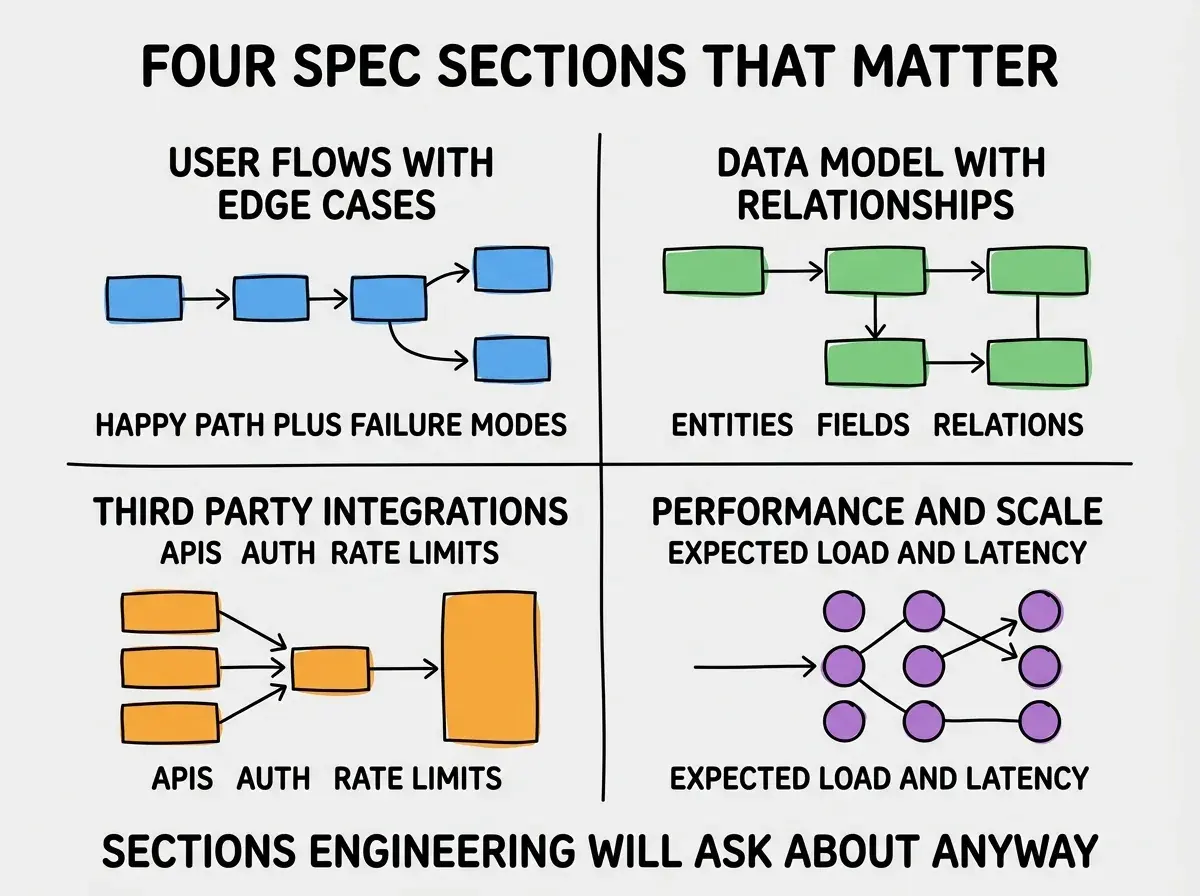
Section 3, third-party integrations. Which external services does the product use, what auth is required, what rate limits apply, what happens if they fail. Engineering needs to plan around these.
Section 4, performance and scale assumptions. Expected load, acceptable latency, growth projections. Drives architecture decisions that are hard to change later.
The Handoff Pattern That Works
The handoff is when PM-written specs meet engineering reality. Three patterns make the transition smoother.
Pattern 1, prototype as reference. Use the AI-built MVP as the visual reference instead of reinventing wireframes. Engineering can interact with the prototype to clarify questions.
Browse more PM-engineering handoff guides
Read more build articlesPattern 2, spec as living document. Write the spec in a tool engineering can edit (Notion, Linear, Markdown in git). Engineering marks up gaps and ambiguities; PM resolves them. The spec evolves during build.
Pattern 3, joint design review. Schedule a 1-hour walkthrough with engineering before implementation starts. Engineering asks questions, PM clarifies, both update the spec. This single meeting prevents most spec-related delays.
What to Watch For During the Translation
Three common gaps appear when PMs translate prototypes into specs. Catching them upfront prevents the most common spec failures.
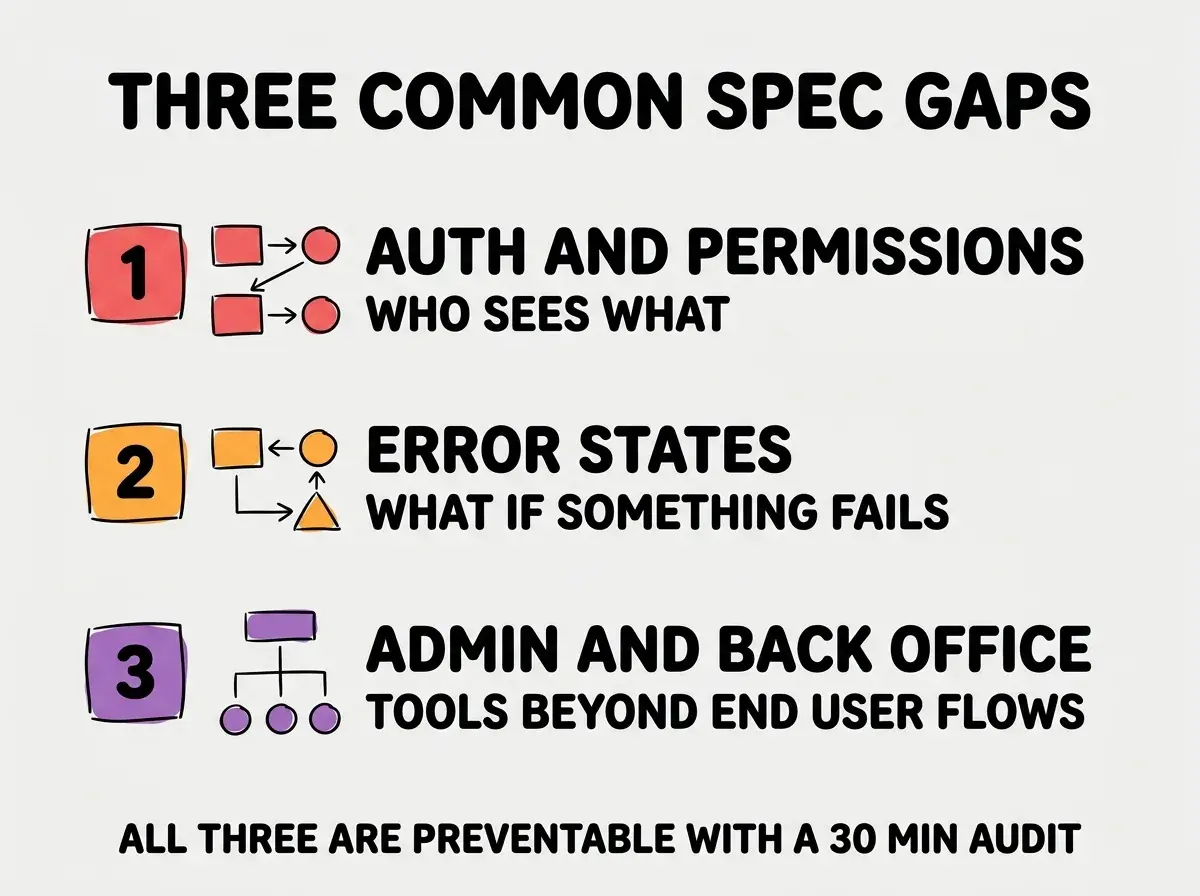
Gap 1, auth and permissions. Who can see what, what roles exist, how role assignments work. Prototypes often skip auth; specs need to address it explicitly.
Gap 2, error states. What the user sees when something fails. Prototypes assume happy path; production needs to handle failures.
Gap 3, admin and back office. Customer support tools, internal dashboards, data correction flows. Often missing from prototypes that focus on end-user experience.
The auth and permissions gap is the most consequential of the three because retrofitting authentication and authorization is expensive. Decisions about who can see what, what role hierarchies exist, and how role assignments work shape the data model and the API surface. Catching these in the spec lets engineering design the system correctly the first time; catching them during build forces refactoring.
The error states gap is the most common. Prototypes built quickly with AI assistance focus on demonstrating the happy path because that is what shows the product idea. Production needs error handling for every path: what the user sees when their request fails, what the user sees when they lose connection mid-action, what happens when the server returns an unexpected response. The spec should enumerate the error states for each major flow even when the prototype skips them.
The Translation Workflow
A repeatable workflow for translating prototypes into specs reduces the friction of doing this work consistently.
Step 1, walk through the prototype with engineering present. Spend 30 minutes interacting with the prototype while engineering watches. Engineering will ask questions that surface gaps the PM did not see. Capture every question.
Step 2, write the spec sections in priority order. Start with the data model because it is the most concrete. Then user flows because they shape the data model usage. Then integrations because they shape the architecture. Then performance and scale because they validate the architecture choices.
Step 3, mark every spec gap with a TODO. When you discover something the prototype does not specify, write a TODO instead of guessing. The TODO surfaces the gap to engineering for collaborative resolution rather than embedding a wrong answer.
Step 4, schedule the joint design review. A 1-hour review with engineering after the spec is drafted is when the spec gets pressure-tested. Engineering raises concerns, PM clarifies intent, both update the spec. This single meeting prevents most spec-related delays during build.
Step 5, treat the spec as living during build. The spec should be edited as engineering discovers ambiguities. PMs who get defensive about spec changes slow the build; PMs who treat changes as collaboration speed it up.
The whole workflow takes 4 to 8 hours for a typical MVP and produces dramatically smoother handoffs than ad-hoc documentation. The investment compounds across every project.
The most damaging spec mistake is treating the spec as a finished artifact rather than a working document. Specs change during implementation as engineering discovers ambiguities and edge cases. PMs who get defensive about spec changes slow the build; PMs who treat spec changes as collaboration speed it up. The right framing is that the spec is a starting point for the conversation, not the end of it.
The other mistake is writing the spec without engineering input. A spec written in isolation by PM and then handed to engineering as a fait accompli generates pushback, rework, and resentment. Engineering should be part of the spec writing, even if PM holds the pen.
What This Means For You
Writing technical specs from AI-built MVPs is one of the most underrated PM skills in 2026. The translation work is small if done well, and the impact on engineering velocity is substantial.
- If you're a founder: If you write specs, include the four sections above. The investment pays back in engineering velocity within the first sprint.
- If you're changing careers into PM: Spec-writing skill is hugely valued by hiring teams. Practice on personal projects.
- If you're a student: Read public spec examples (some companies publish their specs). The format and content patterns transfer to almost any product role.
Browse more PM handoff guides
Read more build articles