Will AI replace developers? The honest 2026 answer is "yes for some kinds of developer work, no for others, and the difference is more important than either headline." AI has already replaced parts of the role that involved writing boilerplate, generating CRUD endpoints, and translating specs into syntax. It has not replaced the parts that involve judgment, debugging in production, system design, or owning outcomes. The total number of professional developers in the US grew 4 percent year over year in 2025 according to BLS data, even as productivity per developer rose substantially. Both numbers are true. Both shape what your career looks like in 2026.
This piece walks through what AI has actually replaced, what it has not, what the data shows, and how to position yourself for a career that has more upside, not less, in the next decade.
What "Replaced" Actually Means
The word "replaced" gets thrown around as if it means "no humans needed." That is rarely what happens with new technologies. The historical pattern is closer to "the work changes, the people who can adapt to the new shape stay employed, the people who cannot adapt have to retrain or move." Spreadsheets did not replace accountants, but they did eliminate the role of "person who manually adds columns of numbers." Word processors did not replace writers, but they did eliminate the role of "person who types up the boss's handwritten draft."
AI coding tools are following the same pattern at a faster pace. The role of "person who writes a CRUD endpoint to spec" has been substantially eliminated. The role of "person who decides which CRUD endpoints to build, debugs them when they fail in production, and owns the system that emerges" has expanded. The same human can do both, the second pays more, and the first has compressed to a few minutes of an AI session.
A 2025 Stanford study tracking 50,000 developers across 200 companies found that AI coding tools increased individual output by 26 percent on average, but reduced the number of "junior tasks" available by 40 percent. The same headcount produced more software, but the entry-level work shifted toward review and judgment instead of typing. The careers that grew were the ones that adapted to that shift fast.
The pattern to copy is the introduction of digital cameras to professional photography. Anyone could take a sharp picture, the price of "a photo" collapsed, and the people who made money were the ones who built skills the technology did not provide: composition, client relationships, post-processing taste, and the judgment of which moment to capture. The volume of photography per professional photographer went up, the people who only knew how to operate film cameras left the industry, and a new tier of "AI-fluent photographer" emerged. Software is going through the exact same shift.
What AI Has Replaced
Being specific matters here. The work that is genuinely gone is not abstract. It is concrete tasks that used to take hours and now take minutes.
Boilerplate generation. Writing a new React form, a basic auth flow, a standard API endpoint, all of this is now a 30-second AI prompt. Developers who built careers on these tasks have had to move up the stack.
Translating specs into syntax. The role of "PM hands you a spec, you turn it into code" has compressed dramatically. AI can do the translation. The high-value work is the spec writing and the review of the output, not the typing.
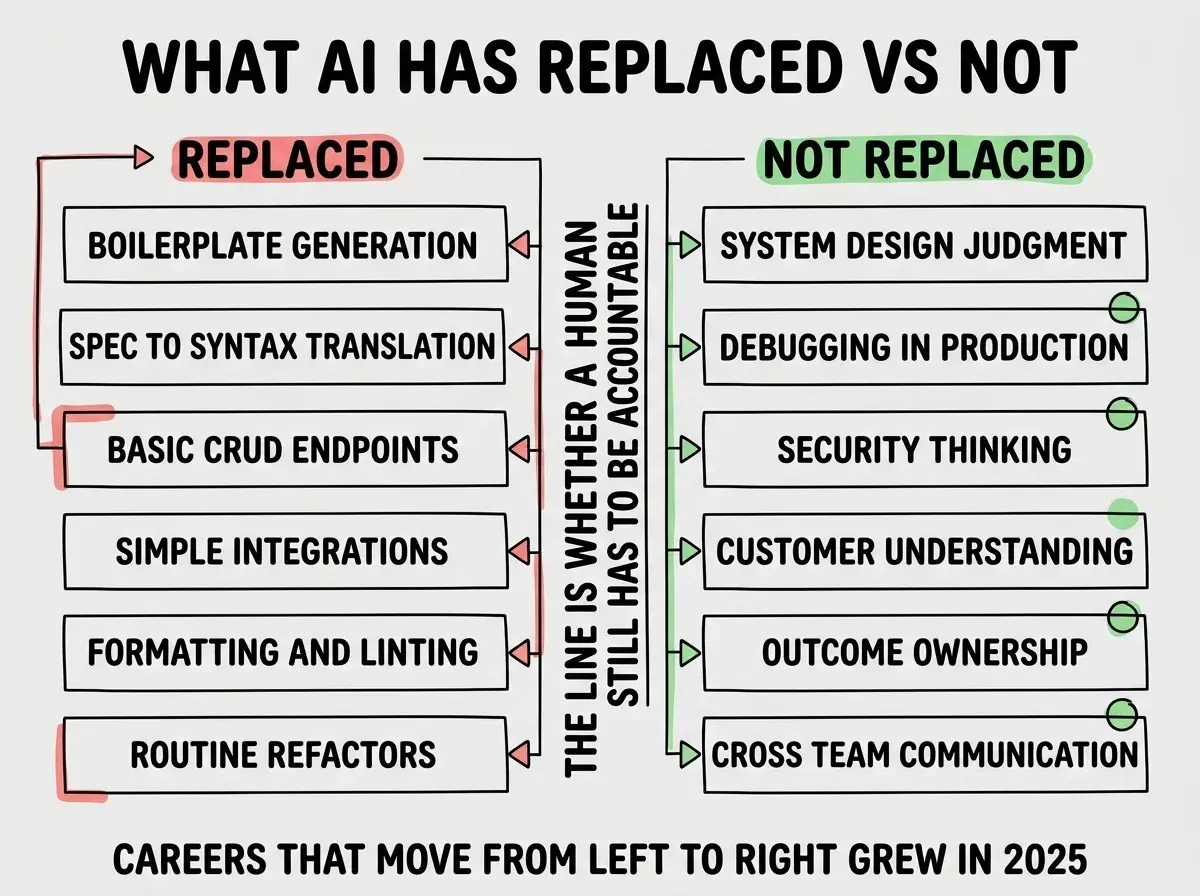
Routine refactoring. Renaming variables across a codebase, reformatting code to a new style guide, splitting large files, all of these have been commoditized.
Writing tests for known behavior. AI can write unit tests against existing code with high accuracy. The skill of "write tests that match what the code already does" has flatlined in value.
What AI Has Not Replaced
The list of things AI cannot reliably do is shorter, but it is the list that pays. Each of these is a genuine bottleneck, not a temporary capability gap.
System design judgment. AI can generate components, but it cannot reliably decide whether your system should be a monolith or services, which database to use, or how to handle eventual consistency. These decisions still go to humans because the tradeoffs are domain-specific.
Debugging in production. AI is bad at debugging the kind of failures that production code actually produces. Race conditions, memory leaks, cascading failures, integration bugs across systems, all of these still require a human who understands the system end to end.
Read more analysis on the future of AI development
Browse pulse articlesSecurity thinking. AI introduces vulnerabilities by default. The work of finding and fixing them, designing systems that are secure from the start, and knowing what to log without leaking PII is human work, and the demand for it has grown faster than supply.
What the Data Says
The data on developer employment in 2025 and 2026 is more interesting than either the doomsday or the hype version of the story. BLS data shows total US software developer headcount up 4 percent year over year, with median compensation up 6 percent. Junior hiring at large tech companies dropped 22 percent, but junior hiring at startups grew 11 percent. The shape of the pipeline changed, the size grew slightly.
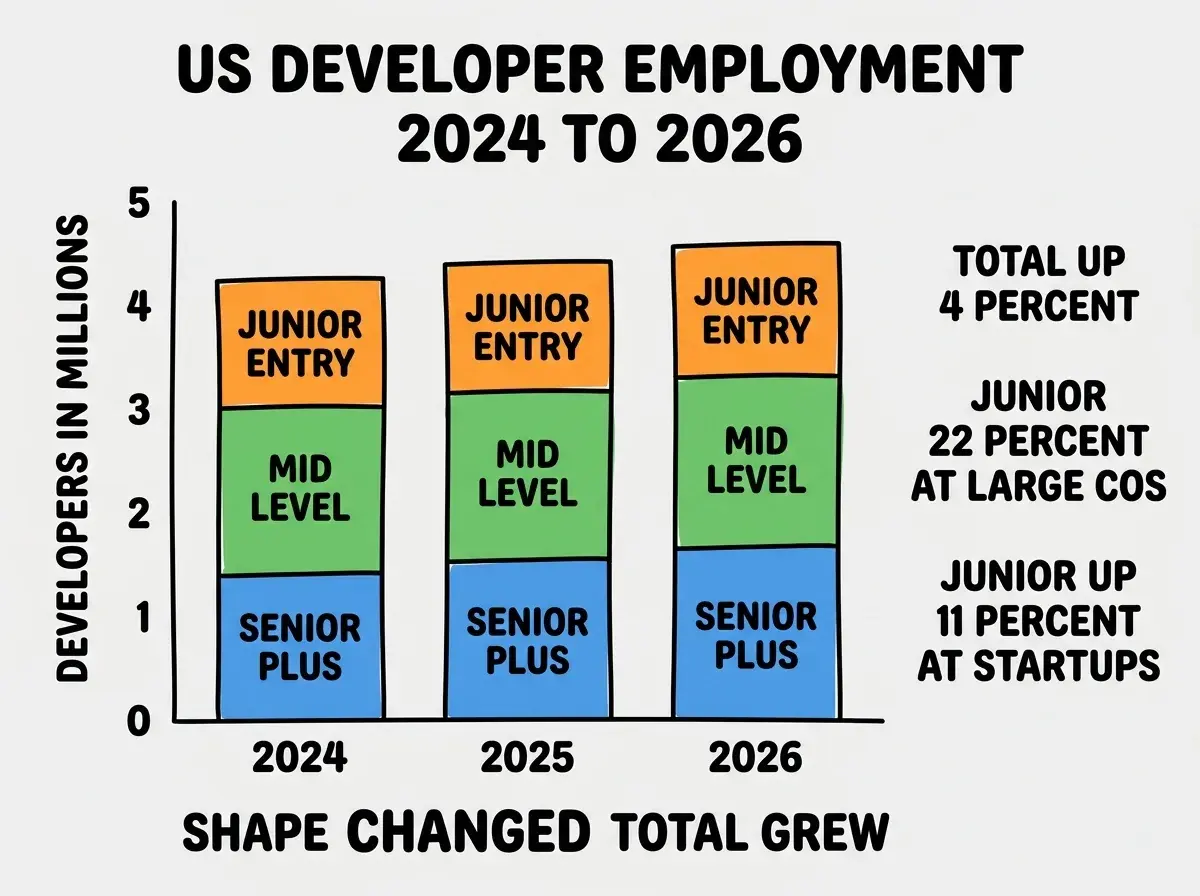
The deeper pattern is that the developers who lost roles were disproportionately the ones whose work had been "type code to spec." The developers who grew their roles were the ones who moved into review, system design, debugging, and customer-facing work. The transition was not painless. People who tried to ride out the change without adapting their skills lost ground.
The most expensive way to read the AI replacement question is in absolute terms. Asking "will AI replace developers" produces yes or no answers that are equally wrong. The right framing is "which parts of my job is AI replacing and which parts are growing." Running that check on yourself once a quarter is the single highest-leverage career move a developer can make in 2026.
The other mistake is to assume the trajectory is linear. AI capabilities are improving, but the speed of improvement on the high-value work (debugging, design, security) is much slower than the speed of improvement on the low-value work (boilerplate, syntax, refactoring). The gap between what AI can do and what humans still have to do is widening on the parts that pay, not narrowing.
FAQ
What This Means For You
The honest answer to "will AI replace developers" is that it is replacing a specific set of tasks fast and creating demand for a different specific set of tasks even faster. Your job is to know which side of that line your daily work falls on.
- If you're a founder: Hire for the skills that are not getting replaced (review, debugging, design, security). The other skills are now AI-assisted by default.
- If you're changing careers: This is the easiest moment in two decades to enter the field, because the bar to ship working software has dropped while demand for judgment has grown.
- If you're a student: Build the skills that compound (debugging, system design, security thinking) more than the skills that are getting commoditized (syntax, boilerplate, framework trivia).
Read more on careers in the AI era
Browse pulse articles