The end of boilerplate in 2026 means that AI tools handle the routine code that used to occupy 30 to 50 percent of a developer's time, and the work that grew to fill the gap is concentrated in five categories: judgment about what to build, system design and architecture, debugging and root cause analysis, security and compliance work, and customer-facing collaboration. The work that shrank is the predictable inverse: typing CRUD endpoints, writing standard configuration, generating tests against existing code, and translating specifications into syntax. The total amount of engineering work has not decreased; it has shifted upward toward the parts that require human judgment, context, and accountability.
This piece walks through the five categories that grew, the four that shrank, the data on how engineers actually spend their time in 2026, and what this means for how you should invest your skill development.
Why the Shift Happened So Predictably
The shift was visible from the moment AI coding tools became capable enough to write production code reliably (around 2024). Boilerplate is, by definition, predictable code that follows established patterns. AI is excellent at predictable patterns and weak at novel judgment. The work that AI absorbed first was the work that fit its strengths.
The work that grew was the inverse: tasks where novel judgment matters more than pattern matching. Designing a system for a specific business context. Debugging a production issue with incomplete information. Deciding whether a feature should ship or be reworked. These are tasks where AI is helpful as a thinking partner but cannot do the work alone.
A 2025 Stanford developer time-use study tracked 500 engineers across 18 months. In 2024, the median engineer spent 41 percent of their time on boilerplate-equivalent tasks (typing CRUD, writing standard tests, formatting). In 2026, that share dropped to 14 percent. The freed time went to: code review and architectural work (up 16 points), debugging and incident response (up 8 points), customer-facing collaboration (up 6 points), and security review (up 5 points). The work shifted; it did not disappear.
The pattern to copy is the way assembly-line manufacturing changed when robots took over repetitive tasks in the 1980s. Total manufacturing employment shifted, but did not collapse. The work that grew was the higher-judgment work: quality control, robot maintenance, process improvement, customer specification work. The same shift is playing out in software development, just compressed into a few years instead of a few decades.
The Five Categories That Grew
Each category represents work where humans have a structural advantage over AI in 2026, and where demand has grown to fill the time freed up by AI handling boilerplate.
Category 1, judgment about what to build. Deciding which features to ship, which to defer, which to cut. This is product engineering work that AI is terrible at because it lacks customer context. The growth has been concentrated in mid and senior engineers who blend technical and product judgment.
Category 2, system design and architecture. Choosing how to structure systems, which databases to use, how to handle scale. AI can suggest options but cannot make the trade-off decisions for you because it does not know your constraints. The work has grown in importance because AI ships components fast and the architecture decisions that hold them together have higher leverage.
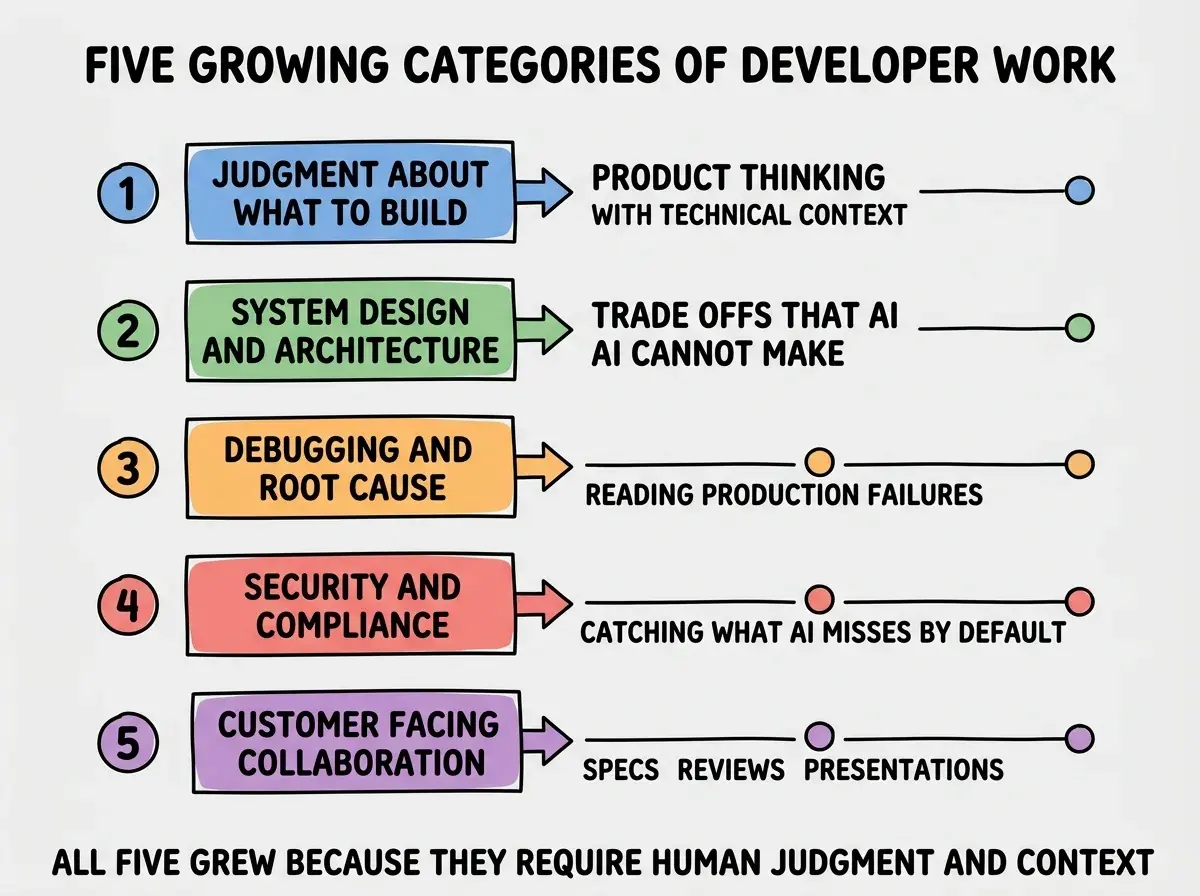
Category 3, debugging and root cause analysis. Production failures, incidents, race conditions. AI can suggest fixes but is bad at diagnosing the underlying issue from incomplete information. Senior engineers who can read a stack trace, narrow a hypothesis, and fix without breaking other systems are paid premiums.
Category 4, security and compliance work. Catching the vulnerabilities AI introduces by default. Reviewing for SQL injection, hardcoded secrets, missing rate limits, broken auth checks. The volume of code AI generates means more security review work, not less.
Category 5, customer-facing collaboration. Writing specs, presenting to stakeholders, reviewing with users, training support staff. Engineering work increasingly includes the soft skills that AI does not replace.
The Four Categories That Shrank
The work that shrank is concrete and predictable. Each category dropped because AI does it as well or better than the median human.
Category 1, typing CRUD endpoints. Creating, reading, updating, deleting database records via API endpoints. AI does this in seconds; humans took hours.
Category 2, writing standard configuration. Webpack configs, ESLint rules, TypeScript settings, deployment manifests. AI generates these reliably; humans copy from previous projects.
Browse more analysis on the future of AI development
Browse pulse articlesCategory 3, generating tests against existing code. Unit tests for functions that already exist. AI is good at this because the test follows the function's signature and behavior.
Category 4, translating specifications into syntax. PM hands you a spec, you turn it into code. AI does this when given a clear spec; the human work shifted to writing better specs.
How Engineers Actually Spend Their Time
The Stanford time-use data on 500 engineers in 2026 paints a clear picture of the shift. The total hours worked are similar to 2024; the allocation is dramatically different.
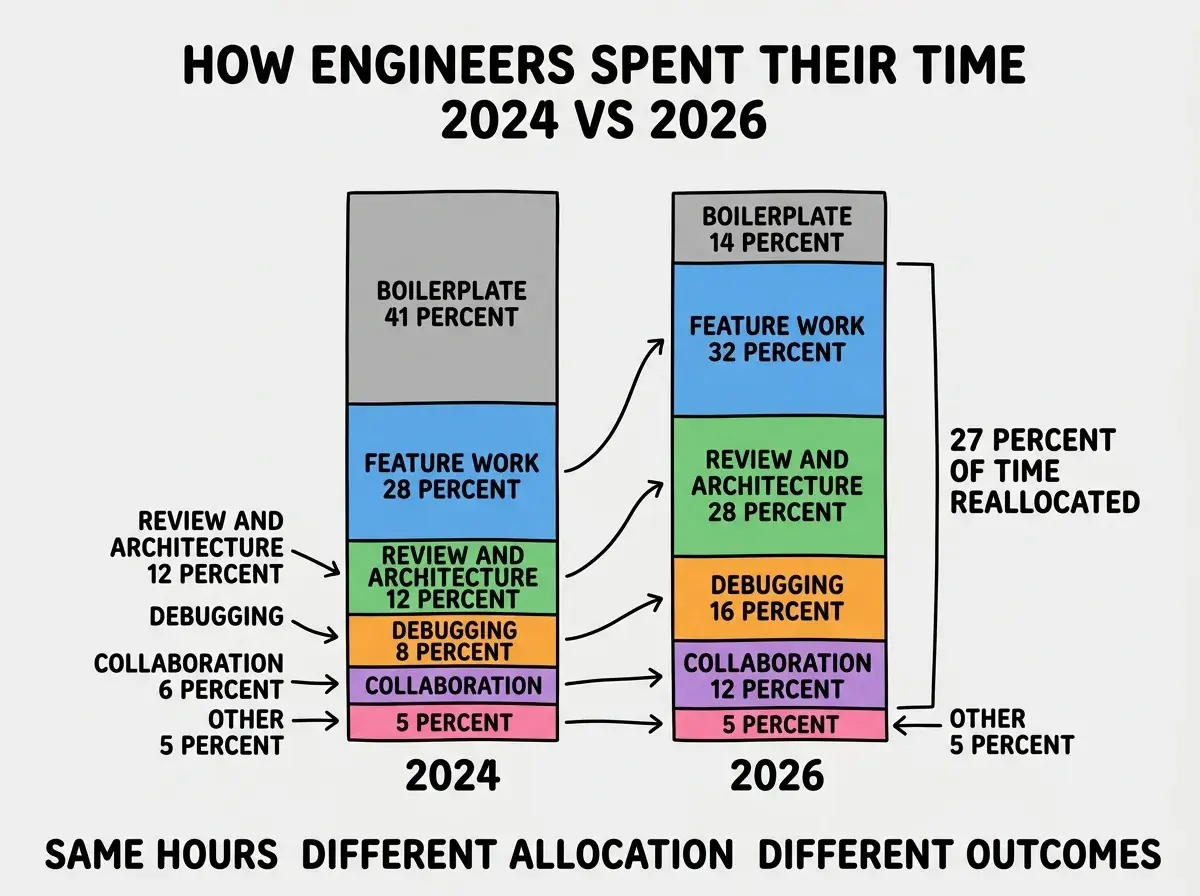
The biggest shifts are in review and architecture (up from 12 to 28 percent), debugging (up from 8 to 16 percent), and customer collaboration (up from 6 to 12 percent). These three together absorbed most of the boilerplate time. Feature work (the actual building of new things) grew slightly because each feature ships faster, allowing more features per week.
This data is the most useful input for thinking about your own skill investment. If you are spending 30+ percent of your time in 2026 on tasks that fit the boilerplate description (CRUD, configs, generating tests), your skill mix is misaligned with the market. The fix is to deliberately shift toward review, architecture, debugging, security, or customer-facing work.
The most expensive misreading of the boilerplate shift is concluding that "engineering jobs are going away." They are not. Total engineering employment grew through 2026. What changed is the composition of the work, and the engineers who adapted their skills to the new mix grew their careers while the engineers who stayed in the boilerplate-heavy roles saw their compensation flatten or compress. Read the data on what grew and what shrank, then deliberately invest your skill time in the growth categories.
The other mistake is assuming AI will eventually absorb the growth categories too. The data through 2026 does not support this. AI got better at boilerplate dramatically; it got incrementally better at judgment, debugging, and security. The gap between AI capability on routine versus novel tasks is widening, not narrowing.
What This Means For You
The end of boilerplate is real and the work that replaced it is concentrated in specific, predictable categories. Investing your skill development in those categories is the highest-leverage career move available in 2026.
- If you're a founder: Hire for the growth categories (review, architecture, debugging, security, collaboration). The skills are scarce and the impact is high.
- If you're changing careers: Lean into the categories that AI does not replace. Most career changers can build review, debugging, or customer-facing collaboration skills faster than they can build coding speed.
- If you're a student: Spend more of your study time on the growth categories than on the syntax and frameworks that AI handles. The leverage compounds across your whole career.
Browse more analysis on the future of AI development
Browse pulse articles