The AI coding developer job market in 2026 is more nuanced than either the doom narratives or the boom narratives capture. US Bureau of Labor Statistics data shows total developer headcount up 4 percent year over year and median compensation up 6 percent. Inside that aggregate, junior hiring at large tech companies fell 22 percent, junior hiring at startups grew 11 percent, and senior hiring grew across both segments. Regionally, hiring patterns vary dramatically: APAC adoption is accelerating job creation, while Western Europe is flat. The story is one of restructuring rather than contraction.
This piece walks through the data by seniority, region, and specialization, explains why aggregate numbers mask the underlying shifts, and lays out the 18-month outlook based on current hiring patterns.
What the Aggregate Data Says
The headline numbers from BLS, LinkedIn Workforce Reports, and the GitHub State of the Octoverse paint a consistent picture. Total US developer employment in early 2026 is approximately 4.6 million, up from 4.4 million in early 2025. Median compensation is $128,400, up from $121,200. Job openings are up 11 percent year over year.
These numbers contradict the popular narrative that AI is replacing developers en masse. They also fail to support the more optimistic narrative that AI is creating a hiring boom. The actual picture is in the middle: modest growth in total demand, with significant restructuring inside that demand.
A 2026 Stack Overflow + LinkedIn joint analysis found that for every 100 developer roles in 2024, there were 104 in 2026, but the composition was dramatically different. Junior roles dropped from 35 to 27, mid-level held at 42 to 43, senior grew from 23 to 34. The pyramid did not shrink, but it inverted at the bottom. Companies are hiring fewer entry-level engineers and more experienced ones, with AI doing the work juniors used to do.
The pattern to copy is the way the legal industry restructured during the introduction of legal research databases (Lexis, Westlaw) in the 1990s. Total lawyer employment grew slowly, but the work shifted upward. Junior associates spent less time on legal research and more on client work. The same pattern is playing out in software, with AI tools handling the work that used to occupy junior engineers.
The Seniority Shift
Looking at the data by seniority is where the real story lives. The aggregate growth conceals a pronounced shift toward mid-level and senior roles.
Junior level (0 to 2 years experience). Hiring at companies over 1,000 employees dropped 22 percent. Hiring at startups (under 100 employees) grew 11 percent. The net effect across all company sizes was a 13 percent decline in junior hiring.
Mid-level (2 to 6 years). Hiring grew 7 percent across all company sizes. This segment is the most stable in 2026 because mid-level engineers have enough context to use AI tools effectively while still doing meaningful hands-on work.
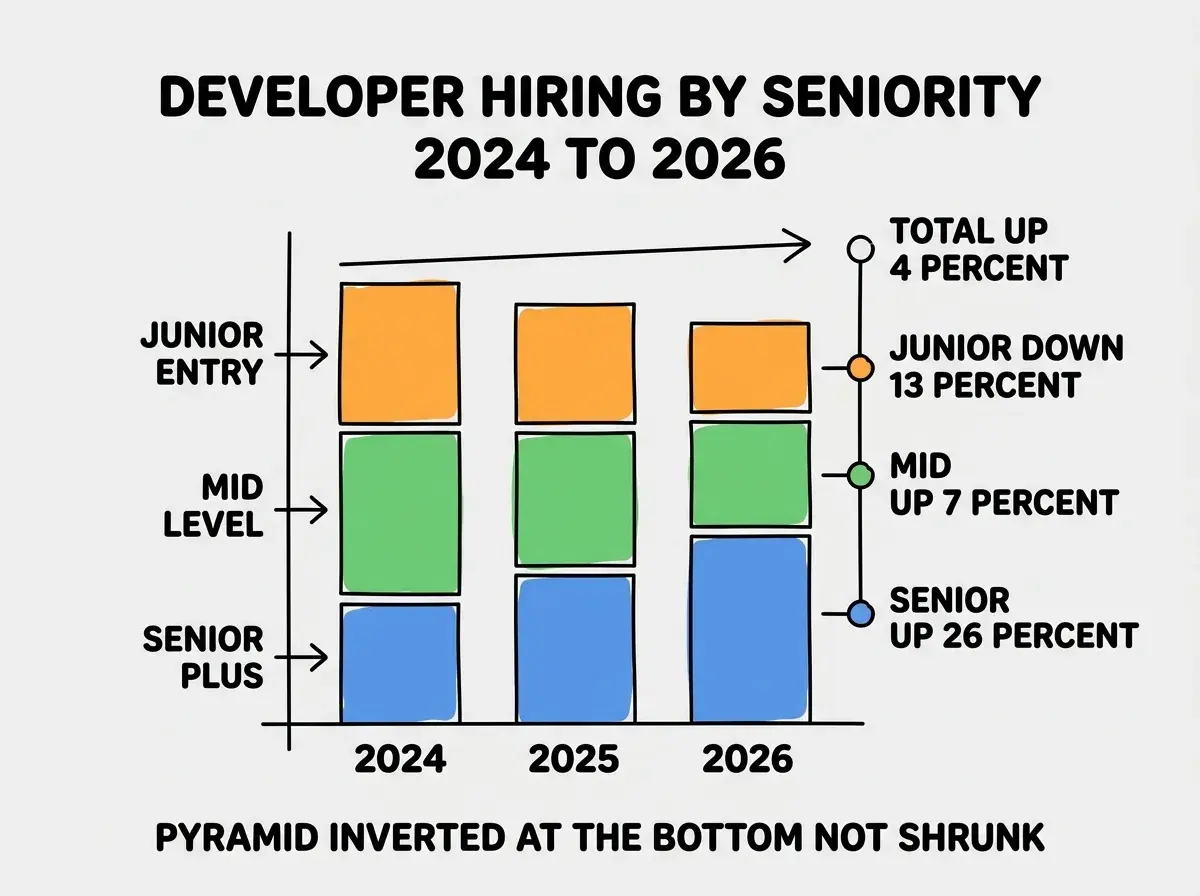
Senior level (6+ years). Hiring grew 26 percent across all company sizes. This is where most of the new positions are. Companies are paying significant premiums for senior engineers who can review AI output, debug production issues, and design systems.
The Regional Picture
The aggregate US numbers also conceal sharp regional differences. Three patterns are visible across global hiring data.
APAC. Hiring grew 18 percent year over year, the highest of any region. Junior roles still grew here because the developer ecosystem is younger and AI adoption is creating new product opportunities faster than it is displacing existing work.
Browse more analysis on AI and careers
Browse pulse articlesNorth America. Hiring grew 4 percent year over year. The juniorshift is most pronounced here. Big tech is hiring less, startups are hiring more, and the net effect is moderate growth with significant restructuring.
Western Europe. Hiring was flat year over year (under 1 percent growth). This is the slowest-moving region for AI adoption, partly because of regulatory caution and partly because the existing developer workforce is older and slower to adapt.
What This Predicts for the Next 18 Months
Extrapolating from the current data, three patterns are likely to continue or accelerate through 2027.
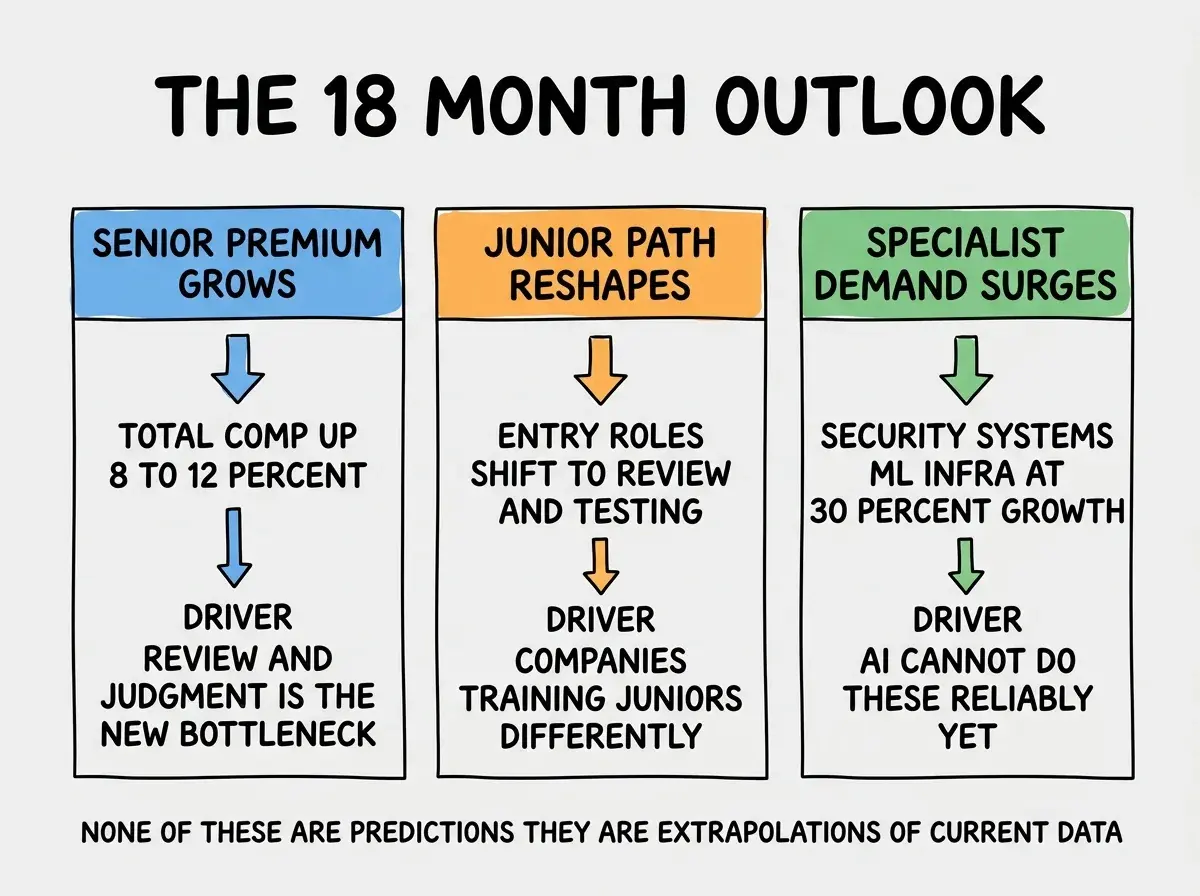
Senior premiums continue to grow. Total compensation for senior engineers (especially those with strong AI workflow skills) is on track for another 8 to 12 percent annual increase. The bottleneck is review and judgment, and the supply of qualified seniors is not keeping up with demand.
Junior path reshapes. Entry-level roles will not disappear, but they will look different. Companies are increasingly hiring juniors directly into review, testing, and customer-facing roles rather than into the boilerplate-writing roles that used to be the entry point.
Specialist demand surges. Security engineers, distributed systems specialists, ML infrastructure engineers, and engineers in regulated industries are growing faster than the average. These are the areas where AI cannot reliably do the work, so the demand for human specialists is intense.
The most expensive interpretation mistake is treating the aggregate growth number as evidence that "everything is fine." It is fine for senior engineers and specialists; it is harder for new graduates and developers whose skills overlap heavily with AI capability. The right response is to look at your own position on the pyramid and ask whether your skills are growing toward the parts that are hiring or staying in the parts that are not. This is a quarterly self-assessment that pays off for the next decade.
The other mistake is assuming the trends will continue linearly. The data through 2026 shows steady growth at the top and contraction at the bottom, but inflection points are possible. A sudden improvement in AI capability for senior-level work, or a regulatory change that limits AI adoption, could reshape the pyramid again. Track the data quarterly and adjust your assumptions as the picture evolves.
A useful exercise for any individual contributor is to map the work you actually do across a normal week into three buckets: tasks AI does well, tasks where AI helps but you add the judgment, and tasks where AI is not yet a meaningful contributor. The percentage in each bucket tells you where you sit relative to the market shift. If more than half your time is in the first bucket, you are exposed; if more than half is in the third bucket, you are insulated. Most engineers find they are between, with the right move being to grow the third bucket deliberately.
Hiring teams should run a similar exercise on their open roles. A job description that primarily describes work in the first bucket is increasingly hard to fill at the right price, because the market has priced in the AI substitution. A job description that emphasizes judgment, system design, security thinking, or domain expertise still attracts strong candidates and tends to close faster. The mismatch between what companies advertise and what they actually need has become one of the larger sources of friction in the 2026 hiring market.
What This Means For You
The 2026 developer job market is not the disaster some predicted nor the bonanza others promised. It is restructured, with real opportunities for those who position correctly and real challenges for those who do not.
- If you're a founder: Hire senior engineers aggressively now. The premium will keep growing, and the value of strong reviewers and architects compounds.
- If you're changing careers: Aim for mid-level positioning fast. Spending too long at the junior level in 2026 means competing against AI for the same work.
- If you're a student: Build skills in security, systems design, or a regulated domain. Specialization is the cleanest hedge against the junior compression.
Browse more analysis on AI and the workforce
Browse pulse articles