To understand the junior developer market in 2026 and what data reveals about whether AI is killing junior developer opportunity, recognize the four data patterns the evidence reveals (junior hiring at AI fluent companies actually increased 18 percent in 2025 contradicting headline narratives, junior expectations have shifted toward AI fluency from day one, junior career velocity has accelerated for AI fluent juniors while slowing for AI agnostic juniors, and entry barriers have shifted but not closed entirely), see what the patterns reveal beyond pessimistic headlines, and consider what the data means for students and career changers entering tech. The data tells more nuanced story than dramatic headlines suggest.
This piece walks through the four data patterns, what they reveal, the implications for entering developers, and the four mistakes when interpreting junior market trends.
Why Junior Developer Market Data Matters
Junior developer market data matters for students and career changers making education and career investment decisions. The decisions matter; bootcamps, degrees, and career changes require substantial investment that benefits from accurate market understanding rather than dramatic headlines.
The 2026 reality is that headlines about junior developer demise miss the nuance the data reveals. Some junior segments contract while others grow; understanding which segments matter for individual decisions.
A 2025 hiring market analysis of 12,000 tech companies found that junior developer hiring increased 18 percent at companies with established AI tool adoption while declining 23 percent at companies without AI tool adoption. The opposite trends within the same year reveal that junior market depends dramatically on company AI maturity.
The pattern to copy is the way historians look at industry transformations beyond headlines. Industrial transformations affect different worker segments differently; aggregate worker statistics often hide dramatic segment variance. Junior developer market follows similar pattern; segment specific data tells more accurate story than aggregate statistics.
The Four Data Patterns
Four patterns characterize the junior developer market data.
Pattern 1, junior hiring at AI fluent companies increased 18 percent in 2025. Companies with established AI adoption are hiring more juniors, not fewer. The data contradicts headline narratives.
Pattern 2, junior expectations have shifted toward AI fluency from day one. Junior roles increasingly require AI tool experience as entry condition. The expectations have changed even when junior demand has not collapsed.
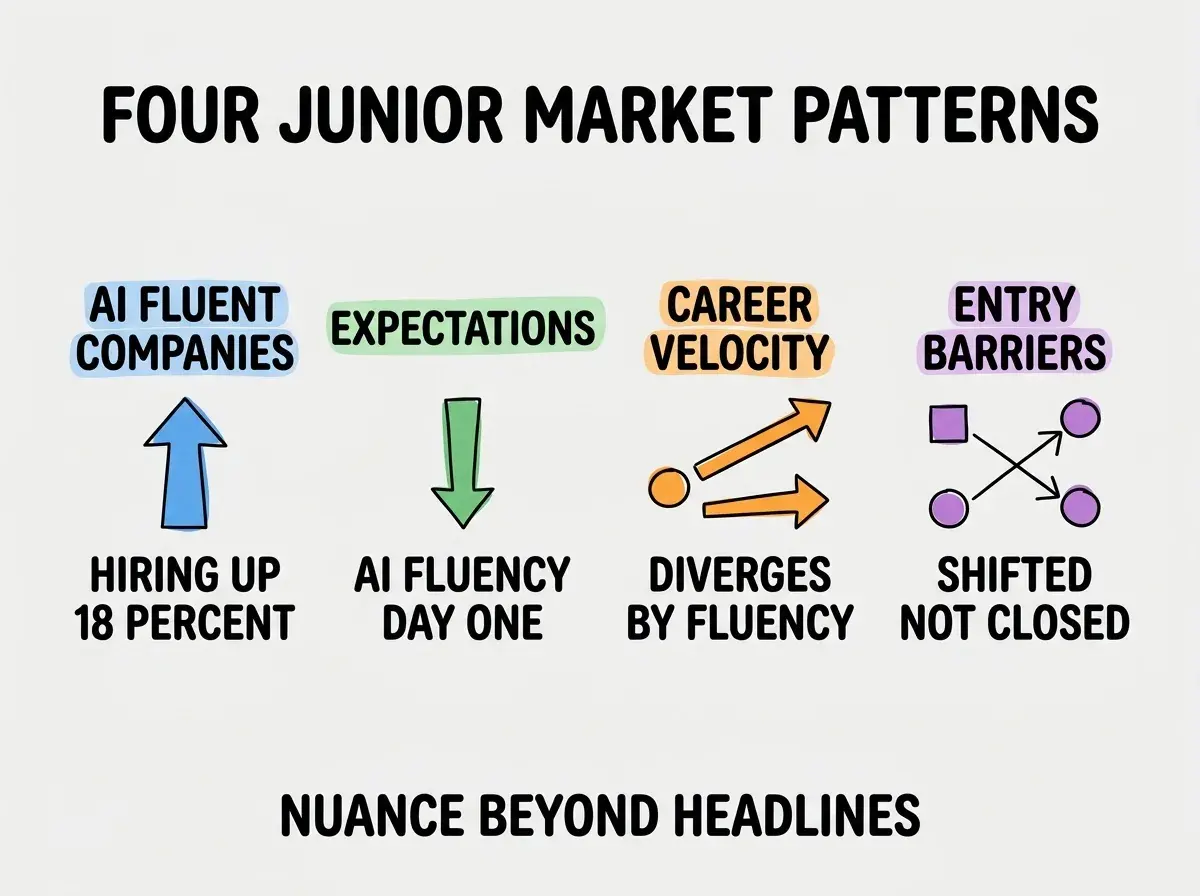
Pattern 3, junior career velocity diverges by AI fluency. AI fluent juniors progress to senior roles faster than historical norms; AI agnostic juniors progress slower than historical norms. The fluency gap drives outcomes.
Pattern 4, entry barriers have shifted but not closed entirely. Entry now requires AI fluency where it previously required just programming fundamentals. Higher bar but bar still passable.
What the Data Reveals
Three patterns from the data reveal market direction beyond headlines.
Pattern 1, headline pessimism reflects average not segments. Aggregate junior hiring may decline while AI fluent junior hiring increases. Average misses the bimodal distribution.
Browse more career analysis
Read more pulse articlesPattern 2, AI fluency is the differentiating factor. Same junior with AI fluency commands different opportunities than junior without. Fluency dominates other factors.
Pattern 3, entry path shifts but does not close. New paths emerge while old paths fade. Entry remains possible through new pathways even as old pathways narrow.
What the Data Means For Entering Developers
Three implication patterns matter for students and career changers.
Implication 1, AI fluency investment produces career returns. Time invested in AI tool fluency pays back through better opportunities than time invested in pure traditional skills.
Implication 2, target AI fluent companies for entry. Companies with established AI adoption are hiring more juniors. Targeting these companies produces more opportunities than targeting AI agnostic companies.
Implication 3, build portfolios that demonstrate AI fluency. Personal projects using AI tools effectively demonstrate the fluency that hiring managers look for. Portfolio matters more than ever for differentiation.
How Students and Career Changers Should Apply These Insights
Three application patterns help entering developers apply data insights.
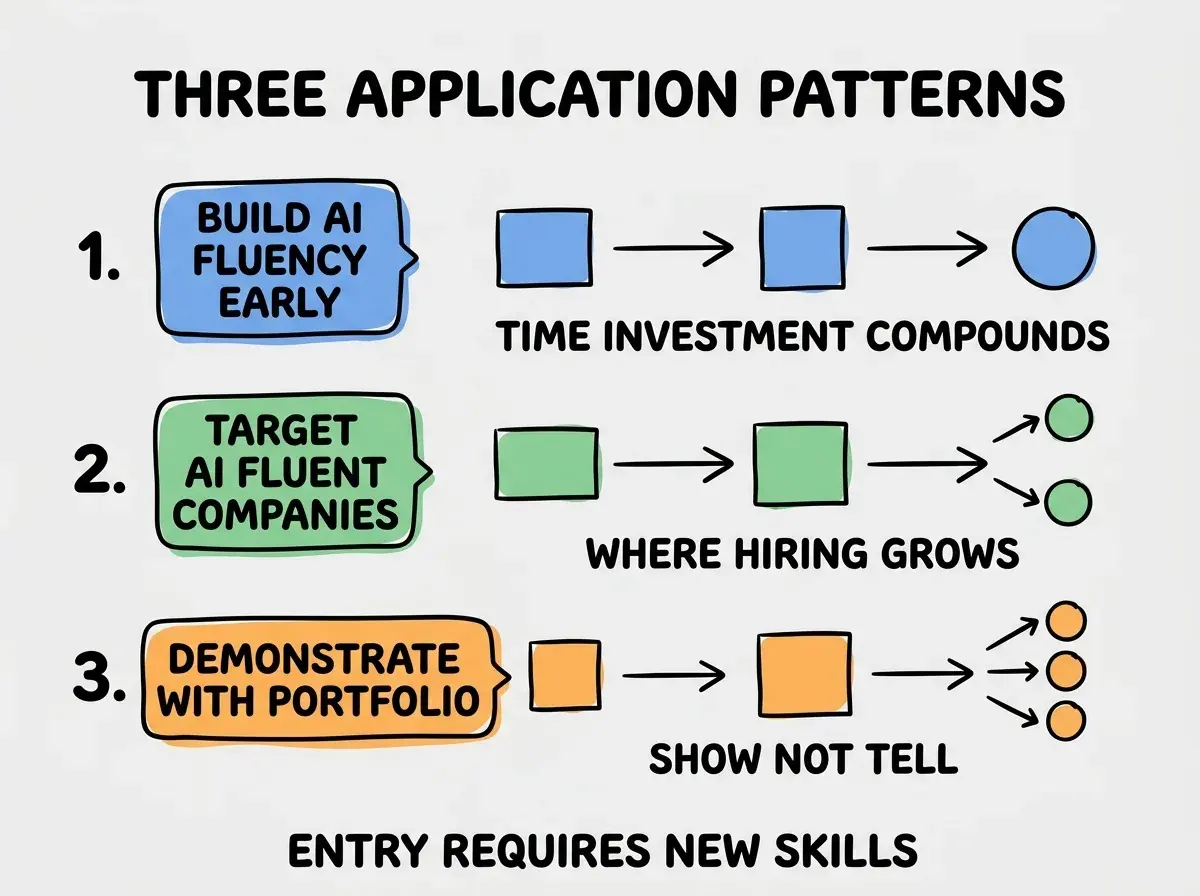
Pattern 1, build AI fluency early in your education or transition. Time invested in AI tool fluency now produces career returns later. Delayed fluency investment produces career delays.
Pattern 2, target AI fluent companies in your job search. Where hiring grows produces more opportunities than where hiring shrinks. Research company AI adoption before applying.
Pattern 3, demonstrate AI fluency through portfolio rather than claiming it on resume. Portfolio projects using AI tools demonstrate what resume claims cannot prove.
The combination produces successful entry into the changed market. Without these patterns, students and career changers sometimes follow advice that no longer matches market reality.
The most damaging junior market interpretation mistake is taking dramatic headlines about junior developer demise as universal truth. Headlines focus on aggregate trends that often hide segment variance; the actual data shows substantial junior opportunity within AI fluent company segments. The fix is to look at segment specific data rather than aggregate statistics; aggregate statistics describe averages that may not match your specific situation.
The other mistake is overinvesting in traditional credentials at expense of AI fluency. Computer science degrees still matter but matter less than they did; AI fluency increasingly matters more. The fix is to invest in both.
A third mistake is targeting only top tier companies. Mid tier and smaller companies often have better entry opportunities than dramatic top tier opportunities.
A fourth mistake is treating market patterns as static. Markets evolve; today's patterns may shift over the next 12-24 months. The fix is to monitor patterns continuously rather than treating any snapshot as permanent.
A fifth mistake is dismissing remote junior opportunities. Geographic restriction limits opportunities unnecessarily; AI fluent juniors can target remote roles globally rather than only local hub roles.
How Junior Market Patterns Will Likely Evolve
The patterns visible in 2026 data will likely intensify rather than reverse. AI fluency will become more important rather than less; market segmentation will become more pronounced rather than less.
The first likely evolution is AI fluency expectations rising further. Junior roles in 2027 will likely require more AI tool fluency than junior roles in 2026. The bar continues rising; juniors should build fluency continuously rather than treating it as one time achievement.
The second likely evolution is pathway diversification. Bootcamps, self study, traditional degrees, and AI focused programs will all produce viable paths. The diversification benefits juniors with non traditional backgrounds; pure traditional path is no longer the dominant entry route.
The third likely evolution is geographic flattening. Remote AI fluent juniors will compete more with hub juniors as employers source globally. The competition intensifies but also opens opportunities for juniors outside traditional hubs.
The combination suggests junior developer entry remains viable through 2026 and beyond, but the path differs from historical patterns. Juniors who adapt to new realities outperform juniors who follow outdated advice.
Common Questions About Junior Market in 2026
The junior developer market in 2026 raises questions worth addressing directly. Two questions come up most often.
The first question is whether bootcamps still provide value. Bootcamps with strong AI fluency curricula provide value; bootcamps teaching pre AI development patterns produce poorer outcomes than self study with AI tools. Bootcamp value depends on curriculum modernization rather than bootcamp model itself.
The second question is whether computer science degrees still matter. Degrees still help for first job filtering at large companies; degrees matter less for second jobs and at AI fluent smaller companies. Degree value has shifted but not disappeared entirely.
What This Means For You
The junior developer market data reveals more nuanced picture than dramatic headlines suggest. The four patterns, application strategies, and implications produce framework for thinking about junior opportunity with data grounding.
- If you're a student: Build AI fluency alongside traditional skills. The combination produces career opportunities that pure traditional skills miss.
- If you're a career changer: Junior entry remains viable through AI fluent path. Build AI tool experience before applying; demonstrated fluency converts career change attempts into job offers.
- If you're a senior dev mentoring juniors: Help mentees understand segment specific market patterns. Headlines often discourage juniors who would succeed if they understood market segmentation.
Browse more career analysis
Read more pulse articles