To understand why AI makes changes you did not ask for and how to stop it, recognize the four scope creep patterns AI exhibits (helpful improvements AI thinks you would want, modernization to current best practices AI assumes you prefer, refactoring during feature work AI mixes together, and side effects from changes AI does not flag), see why AI does this, and apply the constraint patterns that limit AI to requested changes only. The constraint capability matters because unconstrained AI work produces unpredictable changes.
This piece walks through the four scope creep patterns, why AI does this, the constraint patterns, and the four mistakes that produce AI scope creep frustration.
Why AI Scope Creep Matters
AI scope creep matters because unrequested changes produce unpredictability. The matter; predictable AI behavior enables productive collaboration while unpredictable behavior produces frustration.
The 2026 reality is that AI tools sometimes interpret requests broadly. Without constraint, AI generates more changes than requested; broader changes produce review burden and unintended consequences.
A 2025 AI usage study comparing constrained and unconstrained AI prompts found that constrained prompts produced changes matching requests 87 percent of time compared to 41 percent for unconstrained prompts. Constraint dramatically improves AI predictability.
The pattern to copy is the way contractors handle change orders. Original scope is bid; changes require explicit change orders. Without change order discipline, projects expand beyond budget. AI follows similar pattern; explicit scope discipline prevents expansion that loose scope produces.
The Four Scope Creep Patterns
Four patterns characterize AI scope creep.
Pattern 1, helpful improvements AI thinks you would want. AI may improve code style, naming, structure beyond requested change. Helpful but unrequested.
Pattern 2, modernization to current best practices. AI may modernize old patterns to current best practices. Modernization may not be welcome.
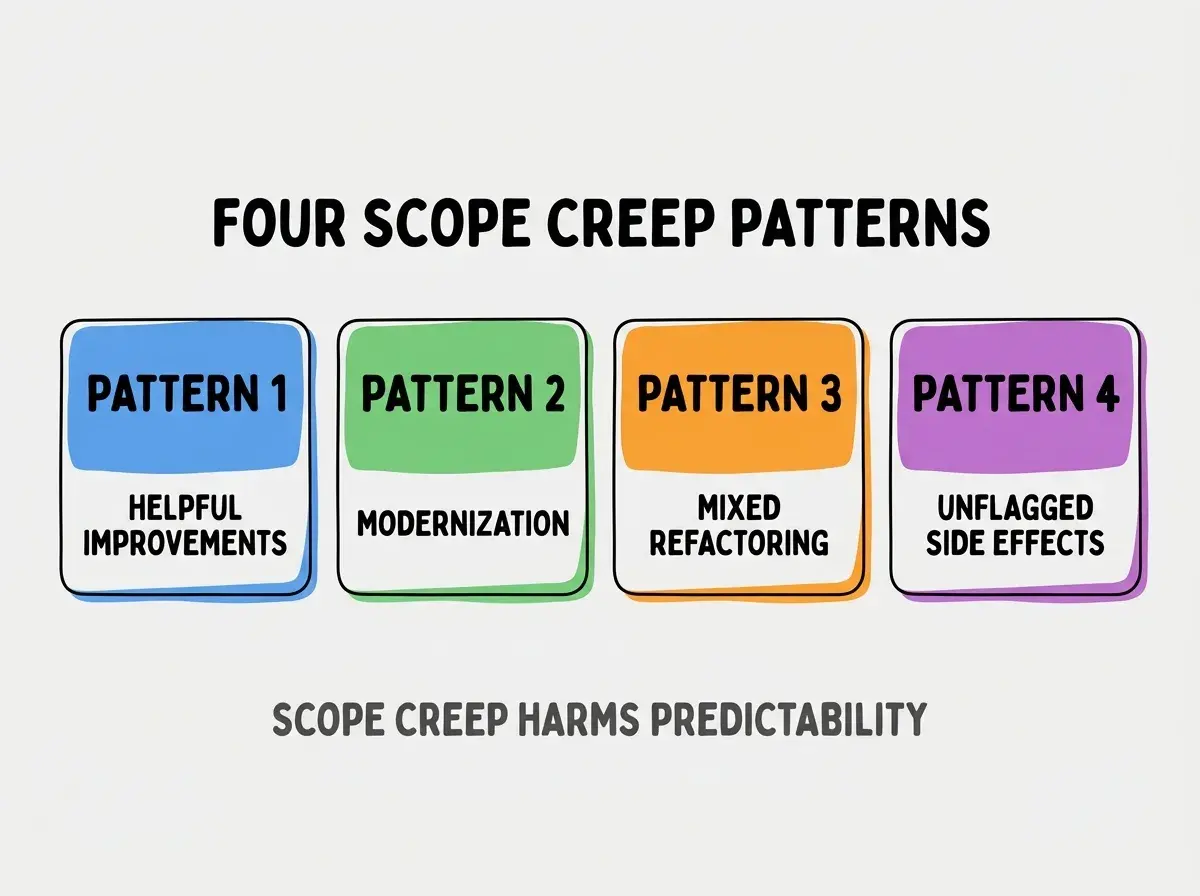
Pattern 3, refactoring mixed with feature work. AI may refactor code while implementing feature. Mixed work harder to review.
Pattern 4, side effects from changes AI does not flag. Changes affecting other code without explicit notification. Side effects discovered later.
Why AI Does This
Three reasons explain AI scope creep behavior.
Reason 1, AI training emphasizes helpful behavior. Training rewards helpful changes; helpfulness sometimes exceeds requested scope. Bias toward help.
Browse more foundations
Read more foundationsReason 2, AI lacks explicit scope boundaries. Without explicit boundaries, AI uses judgment about scope. Judgment varies from user expectations.
Reason 3, AI optimizes for code quality not change minimality. Quality optimization sometimes produces broader changes than minimal change approach. Optimization bias matters.
The Constraint Patterns That Work
Three patterns constrain AI to requested changes.
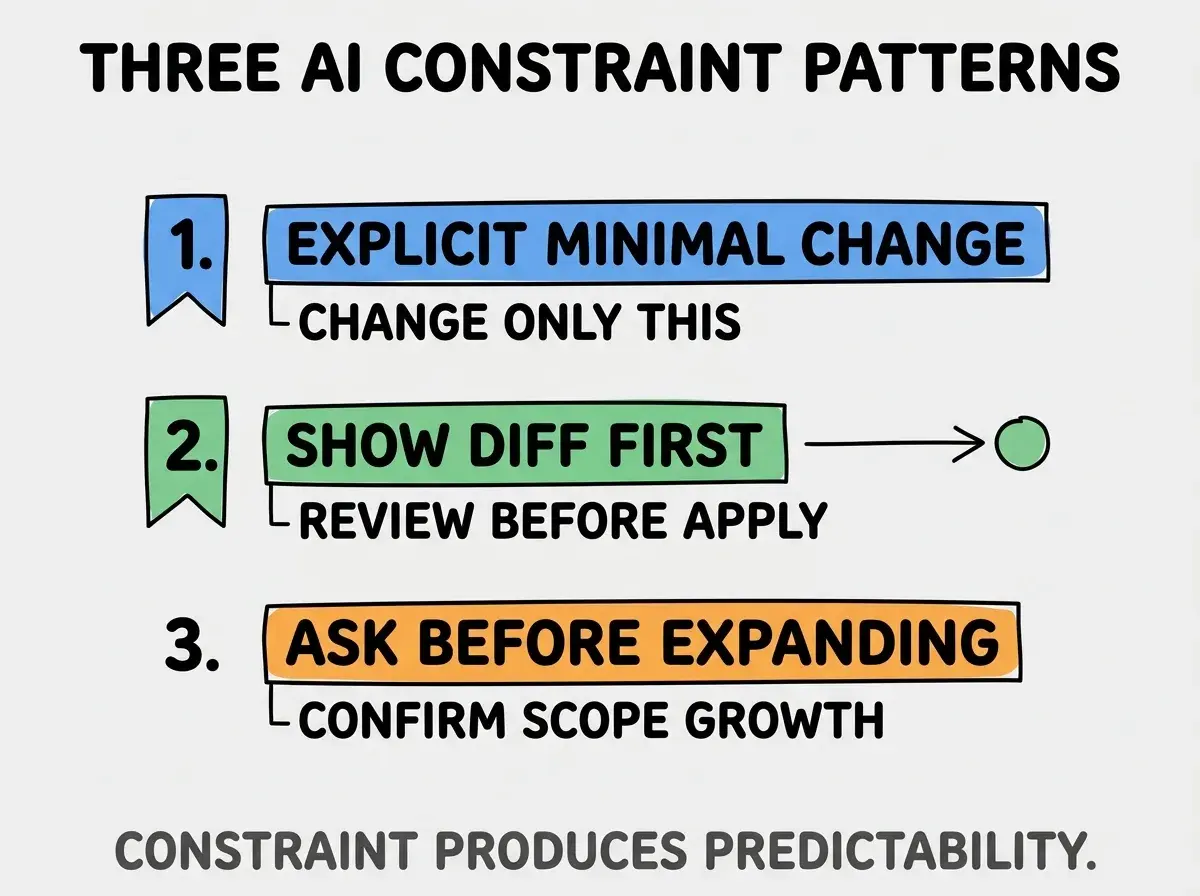
Pattern 1, explicit minimal change requests. Tell AI to change only what was asked. Explicit instruction overrides default helpfulness.
Pattern 2, show diff before apply. Review proposed changes before applying. Diff review catches scope creep before it lands.
Pattern 3, ask before expanding scope. AI should ask before adding unrequested changes. Asking preserves user control.
What Makes Constraint Sustainable
Three patterns separate sustainable constraint from problematic patterns.
Pattern 1, constraint as habitual prompt addition. Adding scope constraints habitually rather than remembering each time. Habit prevents forgetting.
Pattern 2, diff review becoming workflow part. Review built into workflow not added optionally. Without workflow integration, review gets skipped.
Pattern 3, clear feedback when AI exceeds scope. Telling AI when scope exceeded teaches better behavior. Without feedback, AI continues exceeding.
The combination produces constraint that becomes automatic. Without these patterns, constraint requires constant deliberate effort.
How To Write Constrained Prompts
Three prompt patterns produce constrained AI behavior.
Pattern A, explicit scope statement at prompt start. "Change only X, leave Y unchanged." Statement establishes scope.
Pattern B, examples of what to change versus leave. Showing scope through examples. Examples often clearer than description.
Pattern C, verification request at prompt end. "Show diff before applying changes." Verification preserves control.
The combination produces prompts that constrain AI effectively. Without constrained prompts, AI defaults to broader scope.
The most damaging AI scope creep mistake is accepting AI changes without reading diff carefully. Changes may include unrequested modifications that careful diff review would catch. The fix is to always review diff before accepting AI changes; especially when changes appear larger than expected. Developers who diff review catch scope creep before it lands; developers who skip review accumulate unrequested changes that compound over time.
The other mistake is treating AI helpfulness as universally desirable. Helpfulness sometimes exceeds desired scope; recognition of this matters.
A third mistake is missing explicit scope statements in prompts. Implicit scope produces creep; explicit scope prevents it.
A fourth mistake is accepting AI explanations of scope expansion. AI may justify scope expansion; user controls scope regardless of AI justification.
How To Recover From Scope Creep
Three recovery patterns help when scope creep happens.
Pattern 1, selective accept of changes. Accept requested changes; revert unrequested. Selective acceptance preserves request without accepting creep.
Pattern 2, undo and re prompt with constraint. Discard changes; re prompt with explicit scope. Re prompt produces cleaner change.
Pattern 3, accept and refactor separately. Sometimes accepting and addressing creep later works. Recovery depends on creep type.
The combination produces recovery options. Without recovery patterns, scope creep produces frustration without resolution.
How AI Scope Behavior Will Likely Evolve
AI scope behavior will likely continue evolving as AI tools mature.
The first likely evolution is better scope adherence in newer models. AI training improvements may produce better scope adherence. Improvement reduces but does not eliminate scope creep.
The second likely evolution is integrated scope controls. Tools providing explicit scope boundaries. Integration reduces prompt engineering burden.
The third likely evolution is diff review becoming standard. Built in diff review in AI tools. Standardization reduces user effort.
The combination suggests scope creep will become more manageable. Developers learning constraint patterns now build skills that remain valuable.
Common Questions About AI Scope Behavior
AI scope behavior raises questions worth addressing directly.
The first question is whether to disable AI helpfulness entirely. No; helpfulness sometimes desired. Constraint matters more than disabling.
The second question is whether scope creep indicates AI is broken. No; scope creep reflects training trade off. Better tools may reduce but pattern persists.
The third question is whether team conventions can prevent scope creep. Conventions help but cannot prevent; AI applies own judgment without explicit constraint.
The fourth question is how to handle scope creep that improves code. Sometimes accept and refactor separately. Sometimes reject and request narrower change. Judgment matters.
How Scope Constraint Affects Workflow
Constraint affects daily AI workflow in important ways beyond preventing creep itself.
The first effect is review cadence shift. Constrained AI produces smaller diffs that review faster. Faster review enables tighter iteration.
The second effect is debugging clarity. Constrained changes have clearer cause when bugs emerge. Clarity reduces debugging time.
The third effect is teammate review experience. Smaller focused PRs review faster than broad PRs. Constraint produces team velocity benefit beyond individual productivity.
What This Means For You
AI scope behavior determines AI usage predictability. The four patterns, constraint approaches, and recovery patterns produce framework for predictable AI work.
- If you're a founder: Help engineering team develop constraint practices. Without practices, AI usage produces unpredictable work that erodes velocity.
- If you're a career changer: Constraint practices are learnable foundational AI skills. Practice building constraint habits early.
- If you're a senior dev: Constraint discipline matters for AI productivity. Without constraint, AI work requires constant cleanup that constraint prevents.
Browse more foundations
Read more foundations