To understand the 400 hour exhaustion wall in AI coding, recognize the four exhaustion patterns that emerge over project lifetime (initial enthusiasm phase where AI feels magical, productive phase where AI velocity matches expectations, transition phase where review burden grows faster than feature velocity, and exhaustion phase where AI coding becomes QA testing rather than creative work), see what shifts when builders hit the wall, and apply the patterns that prevent or recover from exhaustion. The 400 hour wall matters because it determines whether solo AI built projects sustain over time or collapse from builder exhaustion.
This piece walks through the four exhaustion patterns, what shifts at the wall, recovery strategies, and the four mistakes that accelerate exhaustion arrival.
Why The 400 Hour Exhaustion Wall Matters
The 400 hour exhaustion wall matters for solo builders sustaining AI built projects long term. The wall determines project survival; without recognition and response, builders abandon projects that hit the wall regardless of project potential.
The 2026 reality is that AI coding produces predictable exhaustion patterns that human written coding does not produce equivalently. Understanding the patterns enables prevention and recovery; without understanding, exhaustion appears as personal failure rather than predictable system pattern.
A 2025 solo builder survey of 800 indie hackers found that 67 percent of solo AI built projects abandoned in months 4-8 cited exhaustion patterns matching the 400 hour wall description. Among survivors, 89 percent had implemented specific exhaustion prevention practices. The patterns are not destiny; deliberate practice changes outcomes.
The pattern to copy is the way endurance athletes manage exertion. Endurance athletes recognize fatigue patterns and pace themselves; sprinters who run marathon distance hit walls that pacing prevents. Solo AI builders face similar dynamics; pacing for sustained effort matters more than burst velocity.
The Four Exhaustion Patterns
Four patterns characterize the exhaustion progression in AI built projects.
Pattern 1, initial enthusiasm phase weeks 1-4. AI feels magical, velocity exceeds expectations, motivation runs high. The phase produces strong initial progress.
Pattern 2, productive phase weeks 5-12. AI velocity matches expectations, project shape emerges, momentum sustains. The phase produces most of project core functionality.
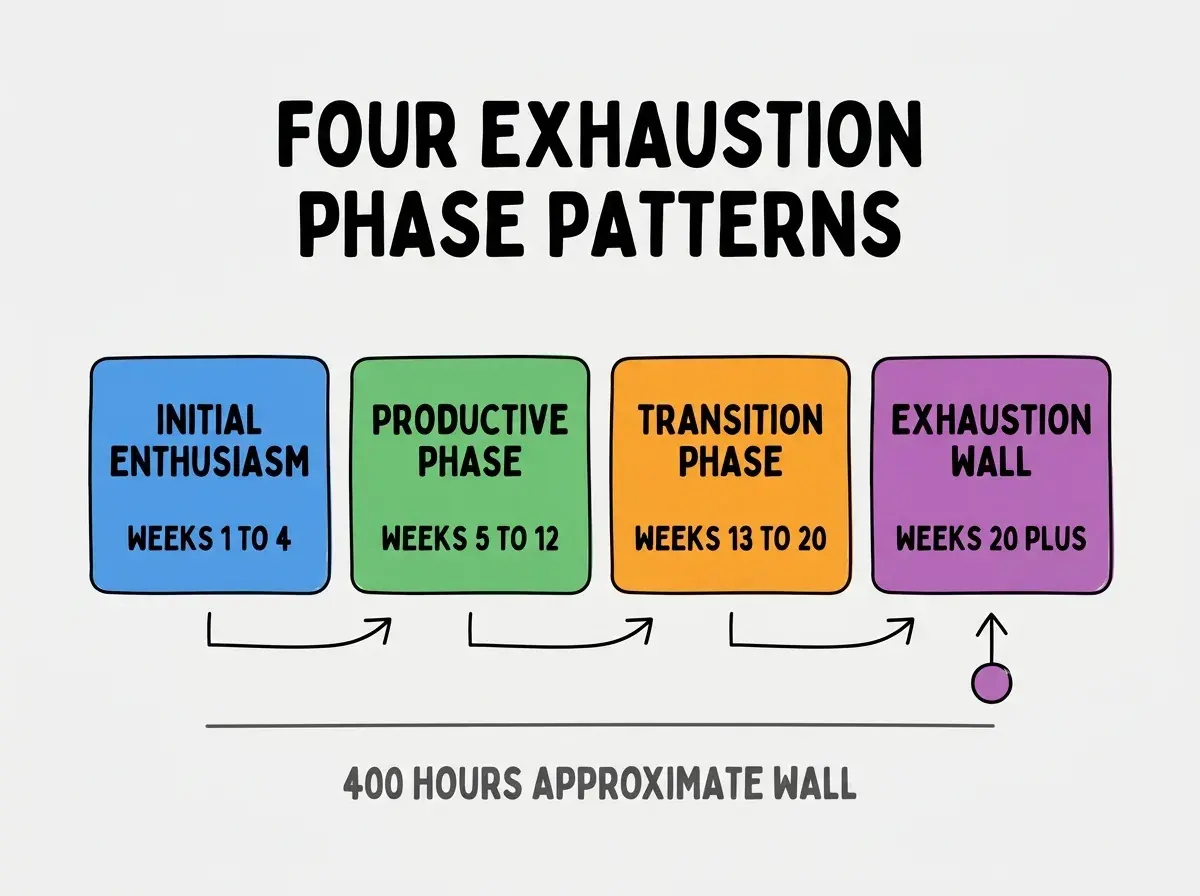
Pattern 3, transition phase weeks 13-20. Review burden grows faster than feature velocity, quality concerns emerge, motivation begins eroding. The phase signals approaching wall.
Pattern 4, exhaustion wall weeks 20 plus or 400 hours. AI coding becomes QA testing rather than creative work, motivation collapses, project abandonment risk peaks. The wall is where projects die without intervention.
What Shifts At The 400 Hour Wall
Three shifts characterize what changes when builders hit the wall.
Shift 1, creative work becomes verification work. Instead of building new things, time goes to checking AI output for correctness. Verification fatigue differs qualitatively from creative fatigue.
Browse more mental models
Read more foundationsShift 2, AI suggestions feel less helpful. Same AI tools that felt magical now feel inadequate. The shift reflects accumulated context and judgment that AI cannot match.
Shift 3, project complexity exceeds AI context window. Project size pushes against AI context limits, requiring more manual context provision. The friction compounds exhaustion.
How To Prevent Wall Collision
Three prevention patterns delay or prevent wall collision.
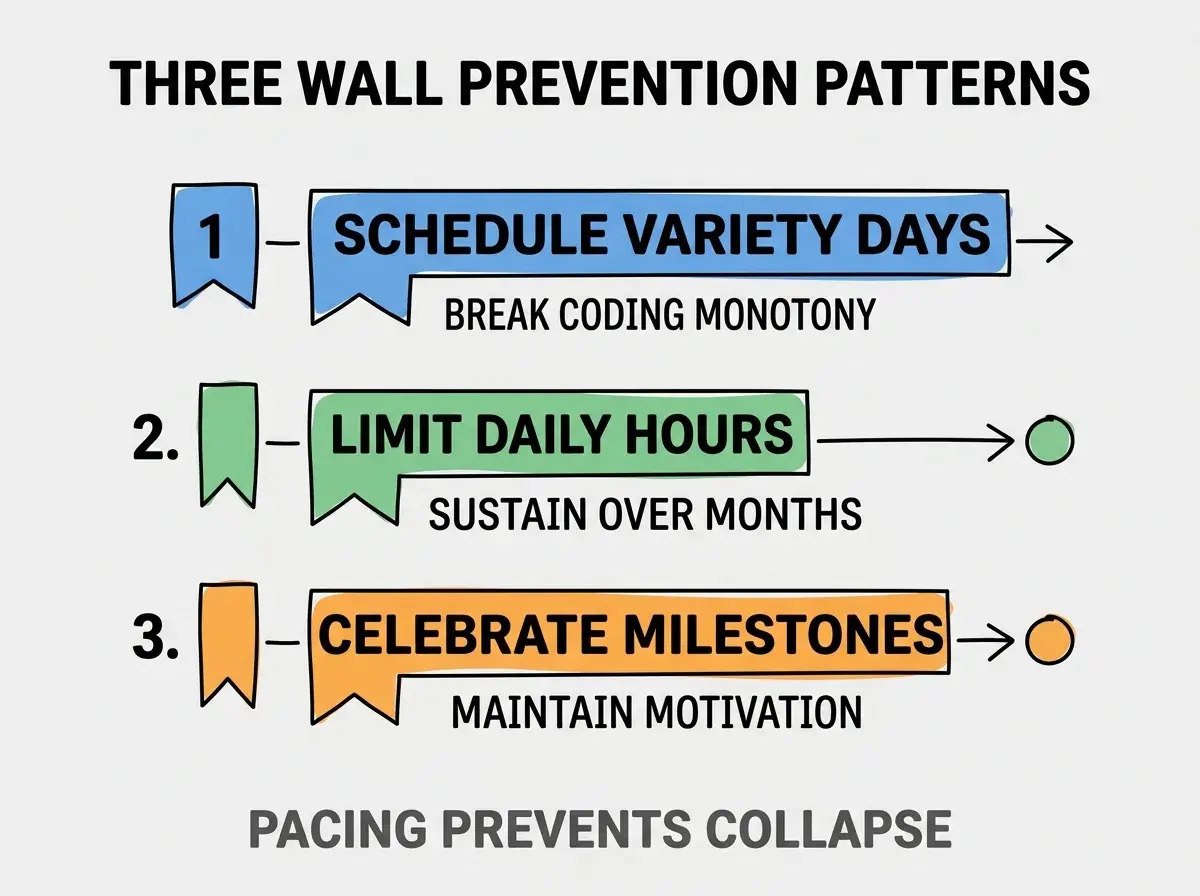
Pattern 1, schedule variety days breaking coding monotony. Days dedicated to non coding work (planning, marketing, research) prevent verification fatigue accumulation. Variety breaks exhaustion patterns.
Pattern 2, limit daily AI coding hours sustainably. 4-6 hours of AI coding daily sustains over months; 8-10 hour days accelerate exhaustion. Sustainable pace matters more than burst pace.
Pattern 3, celebrate milestones to maintain motivation. Explicit milestone recognition produces emotional fuel that sustains motivation through difficult phases. Without celebration, accomplishments feel invisible.
The combination produces sustained motivation through what would otherwise be exhausting work. Without these patterns, wall collision becomes inevitable rather than preventable.
The most damaging exhaustion wall mistake is treating exhaustion as personal weakness rather than predictable pattern. Exhaustion at 400 hours is not failure; it is system response to specific dynamics of AI coding. The fix is to plan for exhaustion explicitly; build in prevention practices from project start rather than waiting until exhaustion arrives. Builders who treat exhaustion as personal failure abandon projects that builders who treat it as predictable manage successfully.
The other mistake is pushing through exhaustion rather than recovering. Exhaustion compounds with continued pushing; recovery requires actual rest rather than reduced pushing. The fix is to schedule recovery time when exhaustion signals appear.
A third mistake is not recognizing transition phase warning signs. Quality concerns and motivation erosion signal approaching wall; ignoring signals leads to wall collision.
A fourth mistake is solo project isolation amplifying exhaustion. Talking with other builders normalizes exhaustion patterns and shares recovery strategies; isolation amplifies the wall.
How To Recover From Wall Collision
Three recovery patterns help builders past wall collision.
Recovery 1, take a real break. Two weeks completely away from project, not reduced project work. Real breaks reset patterns; reduced work prolongs exhaustion.
Recovery 2, scope reduction to make remaining work manageable. Cut features that contribute to exhaustion without contributing to project value. Smaller scope produces sustainable continuation.
Recovery 3, change AI tool patterns. Different AI tools, different prompt patterns, different workflows produce novelty that recovers motivation. Tool change can restart productive phase dynamics.
The combination produces recovery from wall collision when prevention failed. Without recovery patterns, wall collision becomes project death.
How AI Coding Exhaustion Will Likely Evolve
The exhaustion patterns visible in 2026 may shift as AI tools evolve, but human cognitive limits remain stable.
The first likely evolution is AI tools reducing verification burden. Better AI accuracy may reduce QA fatigue; the reduction shifts wall location later but does not eliminate it.
The second likely evolution is community practices spreading. As patterns become widely known, prevention practices spread through community. Spread reduces individual builder isolation that amplifies exhaustion.
The third likely evolution is tooling for exhaustion detection emerging. Tools that detect early exhaustion signs will likely emerge. Detection enables earlier intervention.
The combination suggests exhaustion patterns will remain but become more manageable through tools, practices, and community. Builders who learn pacing now build skills that remain valuable as tools improve.
Common Questions About The Exhaustion Wall
The 400 hour wall raises questions worth addressing directly.
The first question is whether the 400 hour figure is precise. The answer is no; individuals vary significantly. The figure represents central tendency; some hit wall at 200 hours, some at 800 hours. Pattern matters more than precise hour count.
The second question is whether team projects face equivalent walls. Team projects distribute verification burden, delaying wall collision but not eliminating it. Teams hit walls at different paces than solo builders.
The third question is whether exhaustion ever resolves permanently. Recovery is real but vulnerability remains; experienced builders manage exhaustion as ongoing practice rather than one time achievement.
What This Means For You
The 400 hour exhaustion wall determines solo AI built project survival. The four patterns, prevention strategies, and recovery methods produce framework for sustaining solo projects through exhaustion patterns.
- If you're an indie hacker: Plan for exhaustion explicitly. Builders who plan sustain projects; builders who do not plan abandon projects at predictable points.
- If you're a senior dev: Help mentees recognize exhaustion patterns. Recognition prevents abandonment that surprises builders unfamiliar with the patterns.
- If you're a founder: Solo founder projects face exhaustion walls. Plan project pace for sustainability rather than maximum burst velocity.
Browse more mental models
Read more foundations