To understand the 150 hour reality and why 20 minute prototypes represent only 5 percent of work, recognize the four prototype to product gaps the data reveals (production readiness gap covering errors and edge cases, integration gap covering external services and platforms, distribution gap covering marketing and onboarding, and maintenance gap covering ongoing support and updates), see why each gap takes substantial time, and apply the patterns that calibrate expectations realistically. The 150 hour reality matters because misaligned expectations produce abandoned projects.
This piece walks through the four gaps, what each takes, the calibration patterns, and the four mistakes when estimating AI built project timelines.
Why The 150 Hour Reality Matters
The 150 hour reality matters for project planning expectations. The matter; planning based on prototype speed produces missed estimates and abandonment.
The 2026 reality is that AI tools dramatically accelerated prototyping while changing very little about the prototype to product gap. The gap remains; understanding it informs better planning.
A 2025 indie hacker project tracking study of 500 projects found that average time from prototype to launched product was 147 hours despite average prototype time of 4-8 hours. The 95-5 ratio reveals fundamental dynamics of AI built project work.
The pattern to copy is the way historians track project completion. Initial work happens fast; completion takes substantial additional time. Software projects follow universal pattern; AI tools accelerate prototype but not completion.
The Four Prototype To Product Gaps
Four gaps characterize the prototype to product distance.
Pattern 1, production readiness gap. Error handling, edge cases, monitoring, security. Production readiness substantial work.
Pattern 2, integration gap. Payments, email, analytics, deployment, infrastructure. Integration adds substantial complexity.
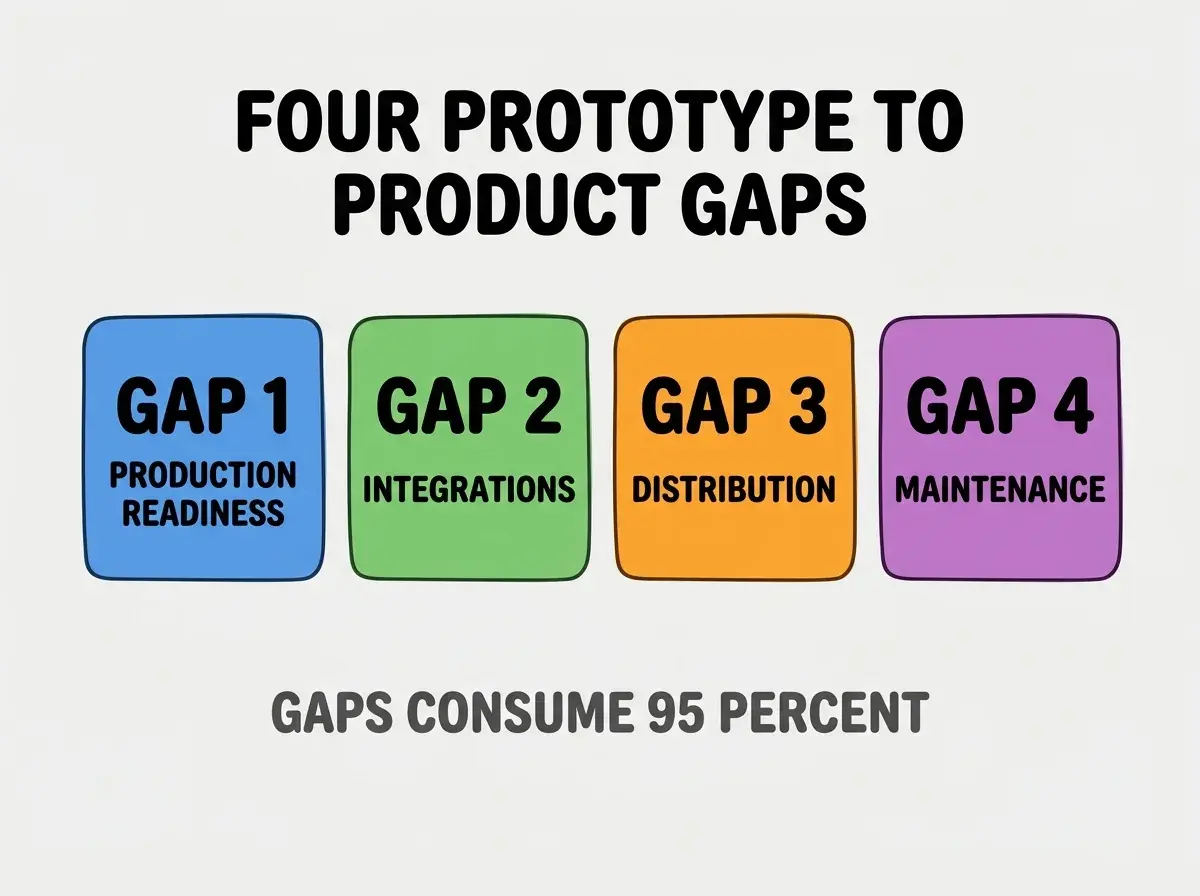
Pattern 3, distribution gap. Marketing, onboarding, customer acquisition. Distribution often equals development time.
Pattern 4, maintenance gap. Ongoing support, updates, customer questions. Maintenance continues indefinitely.
What Each Gap Takes
Three patterns characterize gap work.
Pattern 1, production readiness 30-50 hours typical. Error handling alone substantial; comprehensive readiness more. Without readiness, launches fail.
Browse more foundations
Read more foundationsPattern 2, integrations 20-40 hours per major integration. Each integration consumes substantial time. Without integrations, product incomplete.
Pattern 3, distribution 40-80 hours initial. Marketing setup, content, channel exploration. Without distribution, launch into vacuum.
The Calibration Patterns
Three patterns produce realistic estimation.
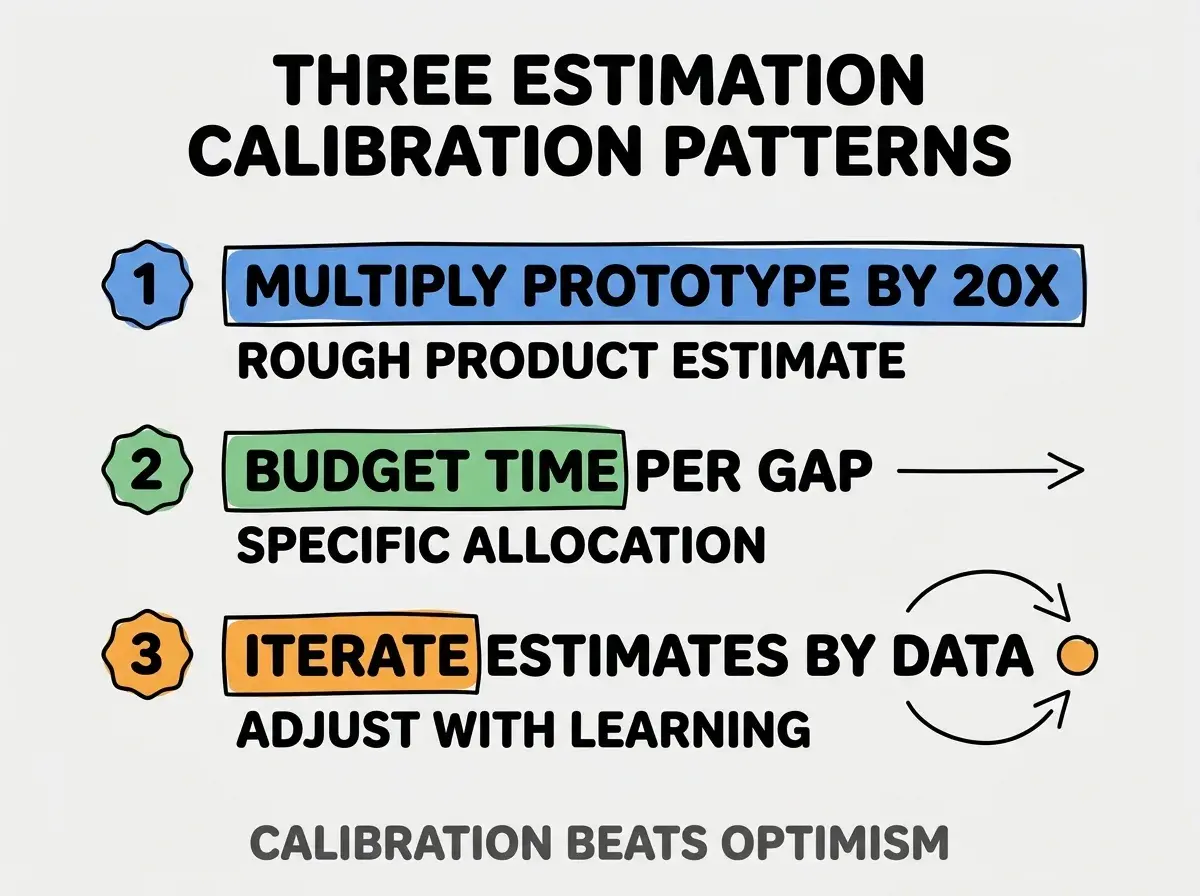
Pattern 1, multiply prototype time by 20x for product. Rough estimate that matches typical reality. Without multiplication, estimates remain optimistic.
Pattern 2, budget time per gap explicitly. Each gap gets specific allocation. Without per gap budgeting, gaps surprise.
Pattern 3, iterate estimates based on actual data. Initial estimates rough; adjust based on observed pace. Without iteration, estimates stay wrong.
What Makes Realistic Estimation Sustainable
Three patterns separate sustainable estimation from problematic patterns.
Pattern 1, expectations matched to reality not aspiration. Reality based expectations sustain motivation. Aspiration based expectations produce burnout.
Pattern 2, milestone celebration through long timeline. Long timelines need motivation patterns. Without celebration, motivation erodes.
Pattern 3, support during difficult phases. Long projects difficult; support sustains. Without support, projects abandon during difficulty.
The combination produces estimation that completes projects. Without these patterns, projects abandon when reality exceeds expectations.
How To Communicate Realistic Estimates
Three communication patterns help share realistic estimates.
Pattern A, share why estimates differ from prototype time. Education prevents misunderstanding. Without education, estimates seem unreasonable.
Pattern B, break estimates into gap categories. Categorization makes estimates concrete. Without categorization, estimates feel arbitrary.
Pattern C, update estimates as work proceeds. Initial estimates rough; updates reflect reality. Without updates, original estimates feel binding.
The combination produces communication that maintains estimate credibility. Without communication, estimates produce defensiveness.
The most damaging 150 hour reality mistake is using prototype speed to estimate product timeline. Prototype represents 5 percent of work; estimating from prototype produces 20x underestimates. The fix is to estimate based on full project not prototype; honest estimates produce sustainable plans while prototype based estimates produce abandonment when reality reveals gap. Founders who estimate honestly complete projects that founders who estimate from prototypes abandon.
The other mistake is treating each gap as optional. All gaps required for actual product. The fix is to plan all gaps explicitly.
A third mistake is missing the maintenance gap entirely. Maintenance continues indefinitely; budgeting for it matters.
A fourth mistake is solo project isolation during long timeline. Long timelines need community; isolation amplifies difficulty.
How To Plan For Long Timelines
Three planning patterns help long timeline planning.
Pattern A, milestone identification at gap completion. Each gap completion produces milestone. Milestones provide motivation.
Pattern B, sustainable pace preventing burnout. Long timelines need sustainable pace. Burst pace exhausts before completion.
Pattern C, support system through long timeline. Other builders, mentors, community sustain through long timelines. Without support, abandonment risk grows.
The combination produces long timeline plans that complete. Without planning patterns, long timelines often produce abandonment.
How The 150 Hour Reality Will Likely Evolve
The 150 hour reality will likely shift gradually as AI capabilities mature.
The first likely evolution is some gaps becoming smaller. Production readiness, integration may shrink as AI improves. Other gaps may stay constant.
The second likely evolution is distribution gap expanding. As more AI built products launch, distribution becomes harder. Distribution gap may grow.
The third likely evolution is maintenance becoming more accessible. AI assisted maintenance reduces ongoing burden. Maintenance gap may shrink.
The combination suggests 150 hour reality persists but composition shifts. Builders learning patterns now build skills that remain valuable.
Common Questions About The 150 Hour Reality
The 150 hour reality raises questions worth addressing directly.
The first question is whether 150 hours is universal. Average; specific projects vary. Use as starting point not exact prediction.
The second question is whether to skip gaps to ship faster. No; skipped gaps produce launch failures. All gaps matter.
The third question is whether outside help reduces hours. Sometimes; specialists handle gaps faster than generalists. Help worth investment for some gaps.
The fourth question is how to plan when 150 hours impossible to commit. Smaller scope reduces hours; smaller product easier to complete than ambitious scope.
How The 150 Hour Reality Affects Project Selection
Project selection should account for 150 hour reality. Selection effects compound and shape entrepreneurial outcomes.
The first compounding effect is project quality over quantity. Completing fewer projects beats abandoning many; portfolio benefits from completion.
The second compounding effect is opportunity cost awareness. 150 hours represents real cost; other opportunities pay back during same hours. Cost awareness improves selection.
The third compounding effect is sustainable project pace. Multiple 150 hour projects per year requires sustainable pace; without sustainability, burnout limits annual completion.
The combination produces project selection that completes more than indiscriminate selection. Selection discipline matters as much as execution discipline.
Project completion track record matters for entrepreneurial credibility; completed projects accumulate reputation that abandoned projects do not. The 150 hour reality affects credibility building over time.
What This Means For You
The 150 hour reality shapes realistic project planning. The four gaps, calibration patterns, and communication approaches produce framework for sustainable project completion.
- If you're a founder: Plan for full 150 hours not prototype speed. Honest planning produces completed projects; optimistic planning produces abandonment.
- If you're an indie hacker: Solo builders especially need realistic estimates. Without realism, motivation erodes during long timeline.
- If you're changing careers: Project completion matters more than speed for portfolio building. Complete fewer projects rather than abandoning many.
Browse more foundations
Read more foundations