To understand why AI hallucinates APIs and libraries and how to fix it, recognize the four hallucination patterns AI exhibits (inventing function signatures from plausible patterns, generating non existent library names, mixing patterns from different versions, and confidently stating incorrect API behavior), see why these patterns emerge from how AI generates code, and apply the prevention patterns that work in practice. The hallucination understanding matters because hallucinations cause real bugs that proper handling prevents.
This piece walks through the four hallucination patterns, why they emerge, the prevention patterns, and the four mistakes when handling AI hallucinations.
Why AI Hallucinations Matter
AI hallucinations matter because they produce code that looks correct but does not work. The deception matters; hallucinated code passes initial review but fails at runtime, producing bugs that take time to diagnose.
The 2026 reality is that AI coding tools have improved dramatically but hallucinations persist. Even the best AI tools hallucinate at non trivial rates; understanding hallucinations enables effective collaboration with AI rather than blind trust.
A 2025 AI code reliability study of 1,000 AI generated code samples found that 23 percent contained at least one hallucinated API call or library reference. Among professional developers using AI tools, hallucination catch rates correlated strongly with positive AI tool experience; developers who caught hallucinations early reported AI tools as productive while developers who shipped hallucinations reported AI tools as unreliable.
The pattern to copy is the way librarians help patrons find books. Librarians do not memorize every book; they verify catalog entries when patrons ask. AI follows similar pattern; AI generates plausible references that require verification rather than blind trust. Verification is normal not exceptional.
The Four Hallucination Patterns
Four patterns characterize AI hallucinations of APIs and libraries.
Pattern 1, inventing function signatures from plausible patterns. AI generates function calls with parameters that match common patterns but do not match actual API. Functions look right but fail at runtime.
Pattern 2, generating non existent library names. AI confidently references libraries that do not exist or were renamed. Imports fail at compile or install time.
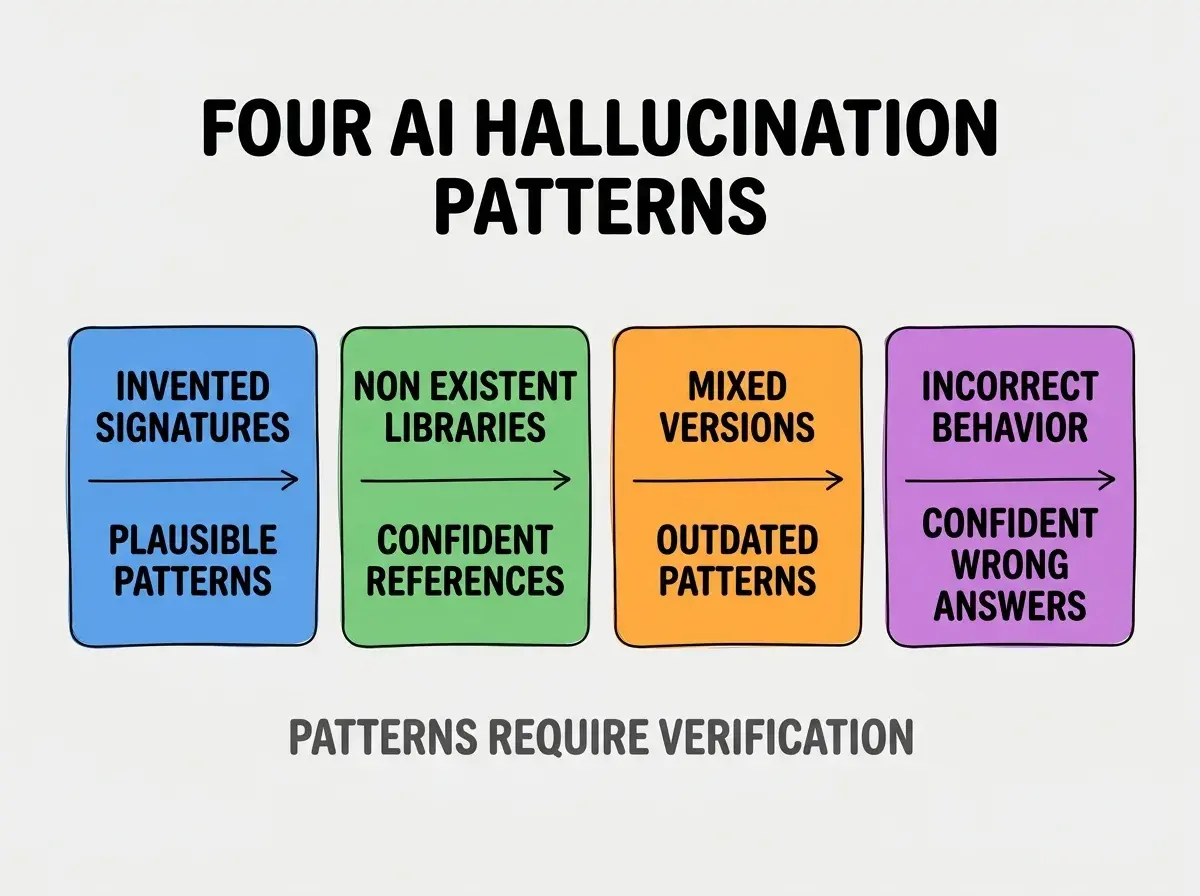
Pattern 3, mixing patterns from different library versions. AI combines patterns from different versions producing code that does not match any single version. Mix produces version specific bugs.
Pattern 4, confidently stating incorrect API behavior. AI explains how API works confidently while explanation does not match actual behavior. Confidence makes hallucinations harder to catch.
Why Hallucinations Emerge
Three reasons explain why AI hallucinates APIs and libraries.
Reason 1, AI generates from pattern not knowledge. AI predicts plausible next tokens; patterns include both real and invented APIs. Pattern generation produces hallucinations as natural consequence.
Browse more foundations
Read more foundationsReason 2, training data includes outdated and incorrect references. AI learns from web content that includes wrong API usage. Bad training data produces bad outputs.
Reason 3, AI lacks runtime verification capability. AI cannot run code to verify; verification happens after generation. Lack of verification produces unverified outputs.
The Prevention Patterns That Work
Three patterns prevent AI hallucinations from causing problems.
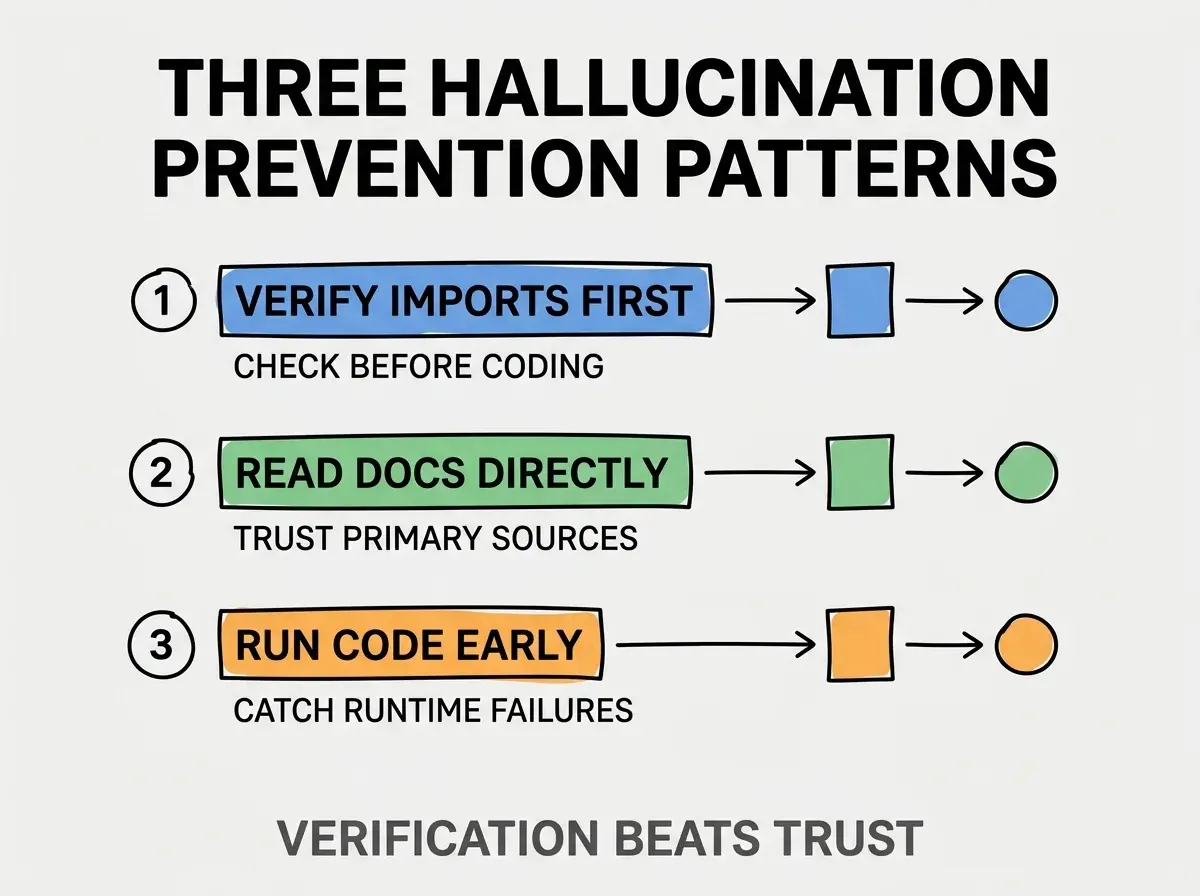
Pattern 1, verify imports and library names before using. Quick npm search or docs check verifies existence. Verification takes seconds; hallucination chase takes hours.
Pattern 2, read documentation directly for unfamiliar APIs. Primary sources beat AI explanations for accuracy. Documentation reading prevents hallucination based bugs.
Pattern 3, run code early to catch runtime failures. Quick test catches hallucinations that visual review misses. Early running surfaces hallucinations quickly.
What Makes Hallucination Handling Sustainable
Three patterns separate sustainable hallucination handling from problematic patterns.
Pattern 1, treating verification as normal not exceptional. Verification feels like overhead initially but becomes habitual. Without habit, verification gets skipped under pressure.
Pattern 2, building knowledge of common hallucination patterns. Recognizing hallucination patterns enables faster detection. Without pattern knowledge, hallucinations look like real bugs.
Pattern 3, using tools that catch hallucinations automatically. Linters, type checkers, IDE warnings. Tools catch hallucinations without manual verification.
The combination produces hallucination handling that scales sustainably. Without these patterns, hallucinations consume time disproportionate to AI productivity gains.
How To Detect Hallucinations Quickly
Three detection patterns help catch hallucinations early.
Pattern A, IDE error highlights. Type checkers flag invented function signatures. IDE feedback catches many hallucinations during writing.
Pattern B, package manager errors. npm install or pip install fails for non existent packages. Manager errors catch invented libraries immediately.
Pattern C, runtime errors during testing. Code that imports successfully but uses APIs incorrectly fails at runtime. Testing catches behavior hallucinations.
The combination produces multi layer detection. Without multiple layers, some hallucinations pass through to production.
The most damaging AI hallucination mistake is trusting AI explanations of code it generated. AI sometimes generates incorrect code and then explains why incorrect code is correct. The fix is to verify AI claims against primary sources rather than trusting AI explanations; verification through documentation, runtime testing, or third party sources catches what AI explanations miss. Developers who verify produce more reliable code than developers who accept AI explanations.
The other mistake is treating hallucinations as AI tool failure rather than AI tool characteristic. Hallucinations are inherent to current AI generation; treating them as failure misses opportunity to handle them effectively.
A third mistake is missing verification for unfamiliar libraries. Familiar libraries get verification by recognition; unfamiliar libraries need explicit verification.
A fourth mistake is over verification of familiar APIs. Excessive verification wastes time without benefit. Calibration matters.
How To Handle Specific Hallucination Types
Three types deserve specific approaches.
Type 1, library name hallucinations. Quick package manager check. Manager check catches immediately.
Type 2, function signature hallucinations. IDE type checking or quick docs reference. Type information catches signature issues.
Type 3, API behavior hallucinations. Runtime testing or documentation cross reference. Behavior verification requires testing or docs.
The combination produces type specific handling. Without specific handling, generic verification catches some types poorly.
How AI Hallucinations Will Likely Evolve
AI hallucinations will likely decrease but not disappear as AI improves.
The first likely evolution is reduction in basic hallucinations. Common APIs will be less hallucinated. Reduction does not eliminate but reduces frequency.
The second likely evolution is shift to subtle hallucinations. As basic hallucinations decrease, subtle hallucinations become primary concern. Shift requires evolved detection patterns.
The third likely evolution is verification tooling improving. Better tools for catching hallucinations automatically. Improvement reduces manual verification burden.
The combination suggests hallucination handling will remain important but evolve. Engineers learning patterns now build skills that remain valuable as hallucinations evolve.
Common Questions About AI Hallucinations
AI hallucinations raise questions worth addressing directly.
The first question is whether better AI models eliminate hallucinations. No; hallucinations are characteristic of generation approach. Better models reduce frequency without eliminating.
The second question is whether to disable AI for tasks involving unfamiliar libraries. No; AI still helps with familiar patterns. Adapt verification for unfamiliar territory rather than disabling AI.
The third question is whether team standards can prevent hallucinations. Standards help but cannot prevent; verification still matters. Standards complement rather than replace verification.
What This Means For You
AI hallucinations are predictable AI characteristic that proper handling makes manageable. The four patterns, prevention approaches, and detection methods produce framework for hallucination handling.
- If you're a senior dev: Hallucination handling becomes critical skill for productive AI use. Invest in verification habits; they pay back through avoided bugs.
- If you're a career changer: Hallucination recognition is learnable skill. Practice verifying AI output to build recognition that reduces hallucination based bugs.
- If you're a student: Understanding hallucinations early builds correct mental model of AI. Without understanding, hallucinations appear as random failures rather than predictable patterns.
Browse more foundations
Read more foundations