To understand why 41 percent of AI code gets reverted within two weeks, recognize the four reversion patterns the data reveals (incomplete edge case handling becoming visible in production, integration mismatches that local testing missed, performance issues at production scale that development testing missed, and design choices that conflict with team conventions noticed during review), see what the patterns reveal about AI code stability, and apply the patterns that reduce reversion rates. The reversion data matters because high reversion indicates wasted work that proper practices prevent.
This piece walks through the four reversion patterns, what they reveal, the prevention patterns, and the four mistakes when interpreting AI code reversion data.
Why AI Code Reversion Rates Matter
AI code reversion rates matter because reversion represents wasted work. The matter; reverted code consumed time twice (writing then reverting) without producing value.
The 2026 reality is that AI code reversion rates have stabilized at concerning levels. The 41 percent figure persists despite AI tool improvements; reversion appears systemic rather than tool specific.
A 2025 enterprise software study tracking 50,000 AI generated code commits found that 41 percent were reverted within 14 days of merge. Among teams with structured AI code review practices, the rate dropped to 18 percent; reversion patterns largely preventable through practices.
The pattern to copy is the way construction inspectors catch defects before walls close. Defects caught early cost dramatically less than defects caught after construction. AI code reversion follows similar pattern; issues caught in review cost less than issues caught after merge through reversion.
The Four Reversion Patterns
Four patterns characterize AI code reversion causes.
Pattern 1, incomplete edge case handling. Edge cases become visible in production load. AI generation often misses edge cases that production exposes.
Pattern 2, integration mismatches. Code works in isolation but fails in integration. Local testing misses integration issues that production reveals.
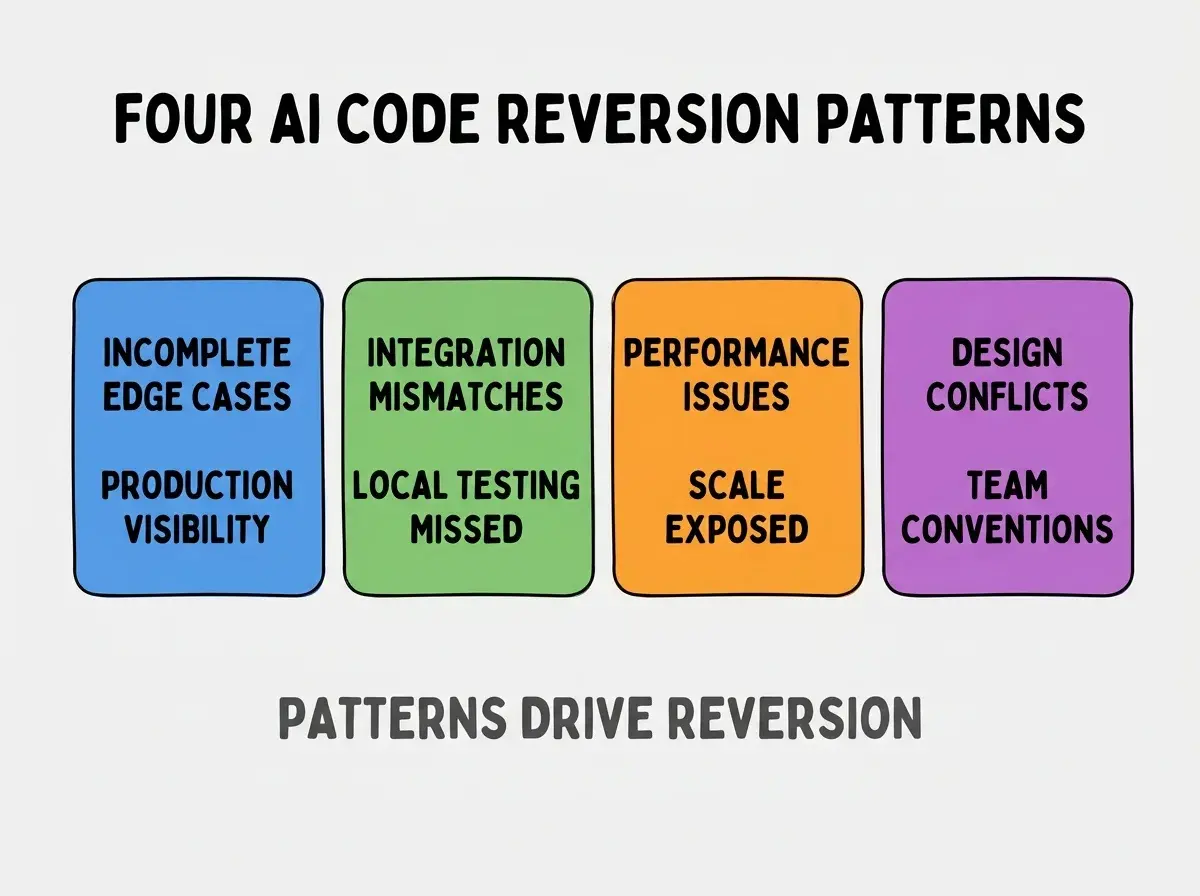
Pattern 3, performance issues at production scale. Code performs adequately in development but fails at production scale. Scale matters.
Pattern 4, design conflicts with team conventions. Code works but conflicts with how team builds. Convention conflicts produce reversion despite functional correctness.
What The Patterns Reveal
Three patterns reveal underlying AI code dynamics.
Pattern 1, AI generation outpaces verification. AI generates faster than humans verify; verification deficit produces reversion. Speed without verification produces waste.
Browse more foundations
Read more foundationsPattern 2, integration and scale issues require production exposure. Some issues only visible in production; faster cycles enable faster discovery. Production exposure remains necessary.
Pattern 3, convention alignment requires explicit context. AI without convention context produces convention conflicts. Context provision matters for reduction.
How To Reduce Reversion Rates
Three reduction patterns reduce AI code reversion.
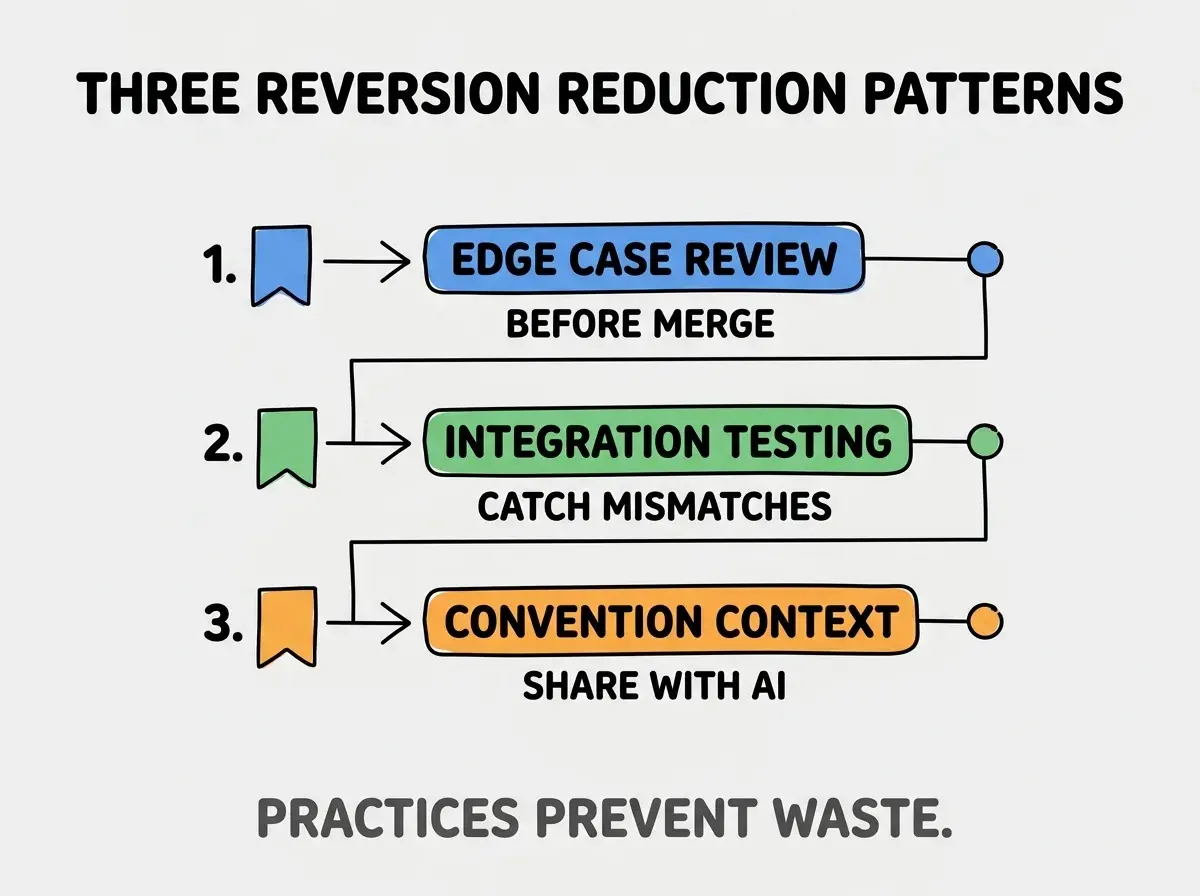
Pattern 1, edge case review before merge. Explicit edge case checklist during review. Without checklist, reviews miss edge cases AI did not handle.
Pattern 2, integration testing catches mismatches. Tests covering integration points catch what unit tests miss. Integration testing matters dramatically.
Pattern 3, convention context provided to AI during generation. Sharing conventions produces compatible code. Without context, AI generates correct but incompatible code.
What Makes Reversion Reduction Sustainable
Three patterns separate sustainable reversion reduction from problematic patterns.
Pattern 1, review practices match AI generation pace. Faster generation requires more efficient review. Without practice evolution, review becomes bottleneck.
Pattern 2, production monitoring catches issues fast. Fast catching enables faster reversion or fix. Without monitoring, issues persist longer than necessary.
Pattern 3, learning from reversions prevents recurrence. Post reversion review identifies pattern. Without learning, same patterns produce repeated reversions.
The combination produces sustainable reversion reduction. Without these patterns, reversion rates persist despite tool improvements.
How To Apply Patterns To Your Team
Three application patterns help teams reduce AI code reversion.
Pattern A, audit recent reversions for pattern identification. What patterns dominate your reversions. Without audit, prevention may target wrong patterns.
Pattern B, develop pattern specific prevention practices. Each pattern needs specific prevention. Without specificity, generic practices miss pattern specific value.
Pattern C, measure reversion rates over time. Measurement reveals practice effectiveness. Without measurement, practice value stays anecdotal.
The combination produces reversion reduction matched to team patterns. Without application, generic practices produce generic results.
The most damaging AI code reversion mistake is treating reversion as inevitable cost of AI productivity. 41 percent reversion is not inevitable; teams with practices achieve 18 percent. The fix is to invest in review and verification practices that catch issues before merge; investment pays back through reduced reversion that exceeds practice cost. Teams that accept reversion as cost waste resources that practices would preserve.
The other mistake is missing reversion pattern analysis. Patterns reveal what needs prevention; without analysis, prevention misses targets.
A third mistake is treating all reversions as failures. Some reversions reflect appropriate response to learning. Distinguishing learning from failure matters.
A fourth mistake is reversion blame culture. Blame discourages honest pattern identification; learning culture surfaces patterns that blame culture hides.
How To Handle Specific Reversion Causes
Three causes deserve specific approaches.
Cause A, edge case reversions through prompt improvement. Prompts requesting edge case handling produce better coverage. Prompt patterns reduce edge case reversions.
Cause B, integration reversions through test infrastructure. Better integration tests catch integration issues earlier. Infrastructure investment reduces integration reversions.
Cause C, convention reversions through documented standards. Documented standards in AI prompts produce compatible code. Standards documentation reduces convention reversions.
The combination produces approaches matched to reversion causes. Without specific approaches, generic practices produce generic results.
How AI Code Reversion Will Likely Evolve
AI code reversion rates will likely continue evolving as AI capabilities mature.
The first likely evolution is reversion rates declining slowly. AI improvements reduce some reversion patterns. Decline expected but slow.
The second likely evolution is reversion patterns shifting. Different patterns become dominant as old patterns get prevented. Shift requires evolved practices.
The third likely evolution is automated reversion prevention emerging. Tools that catch reversion patterns before merge. Automation reduces human review burden.
The combination suggests reversion will remain concern but become more manageable. Engineers learning prevention now build skills that remain valuable.
How Reversion Affects Engineering Trust
Reversion affects engineering trust in AI tools beyond the direct waste cost. The trust effect compounds over time and shapes long term AI tool adoption patterns.
The first compounding effect is engineer skepticism toward AI suggestions. Repeated reversions train engineers to discount AI suggestions, reducing AI value even on suggestions that would have been correct. Skepticism produces conservative AI usage.
The second compounding effect is review burden increase. High reversion rates push teams toward more thorough review which slows everything. Slow review produces slower velocity that should have come from AI productivity.
The third compounding effect is process overhead growth. Teams add process to address reversion patterns; process accumulates beyond what reversion patterns required. Overhead persists after patterns addressed.
The combination produces secondary costs of reversion beyond the direct waste. Teams that prevent reversion preserve engineering trust and process efficiency that high reversion teams lose.
Common Questions About AI Code Reversion
AI code reversion raises questions worth addressing directly.
The first question is whether reversion rates indicate AI tools are bad. No; rates indicate verification deficit not tool quality. Better practices reduce rates with same tools.
The second question is whether to slow AI generation to reduce reversion. No; faster generation with appropriate review produces best outcomes. Speed and review balance matters.
The third question is whether reversion data is comparable across teams. Not directly; team practices vary. Compare your team to your past rather than to other teams.
What This Means For You
AI code reversion rates reveal practice gaps that proper investment prevents. The four patterns, reduction approaches, and team application strategies produce framework for reducing waste.
- If you're a senior dev: Reversion rate is critical AI productivity metric. Track it; invest in practices that reduce it.
- If you're a product manager: Help engineering team prioritize reversion reduction practices. Without prioritization, business pressure favors generation over verification.
- If you're a founder: Reversion represents pure waste in AI productivity. Help team invest in practices that capture AI value rather than wasting it through reversion.
Browse more foundations
Read more foundations