To build white-label templates for agency work in 2026, structure your templates around four high-frequency project categories (landing page, marketing site, e-commerce starter, dashboard app), use a configuration-driven approach so customization is editing a config file rather than rewriting code, build with components flexible enough to handle 80 percent of variations without code changes, and set up a one-command "new client project" workflow that bootstraps a customized version in minutes. The investment is two weekends per template; the savings compound across every client project.
This piece walks through the four template categories, the configuration-driven approach, the customization patterns, and the four mistakes that turn templates into maintenance burdens.
Why Agencies Need White-Label Templates Now
The economics of agency work changed dramatically with AI. A landing page that took 2 weeks to build now takes 2 days. A marketing site that took a month now takes a week. The implication is that the value of templates went up, not down: when each project is faster, the per-project win from a great template compounds across more projects per year.
Agencies that systematize their delivery via white-label templates ship 5 to 10 times more projects per year than agencies that custom-build everything. The gap is not in talent; it is in operational discipline.
A 2025 Agency Operations survey of 800 digital agencies found that agencies using systematic white-label templates had 47 percent higher gross margins and 2.8x more projects per developer per quarter compared to agencies that custom-built each project. The gap was widest in mature templates (year 2+) where the configuration system had been refined through use. White-label templates are one of the highest-leverage agency operations investments available in 2026.
The pattern to copy is the way restaurant chains operate. Each location is a customization of a standard template (menu, decor, operations), not a from-scratch design. The standardization is what enables consistent quality at scale; the customization is what makes each location feel local. Agency white-label templates work the same way.
The Four Template Categories That Scale
Agencies need different templates for different project types. Four categories cover most agency work.
Category 1, landing page template. Single-page marketing site optimized for one CTA. Hero, features, testimonials, CTA, footer. The most-built template; should be the most refined.
Category 2, marketing site template. Multi-page brochure site. Home, about, services, blog, contact. The default for most service business clients.
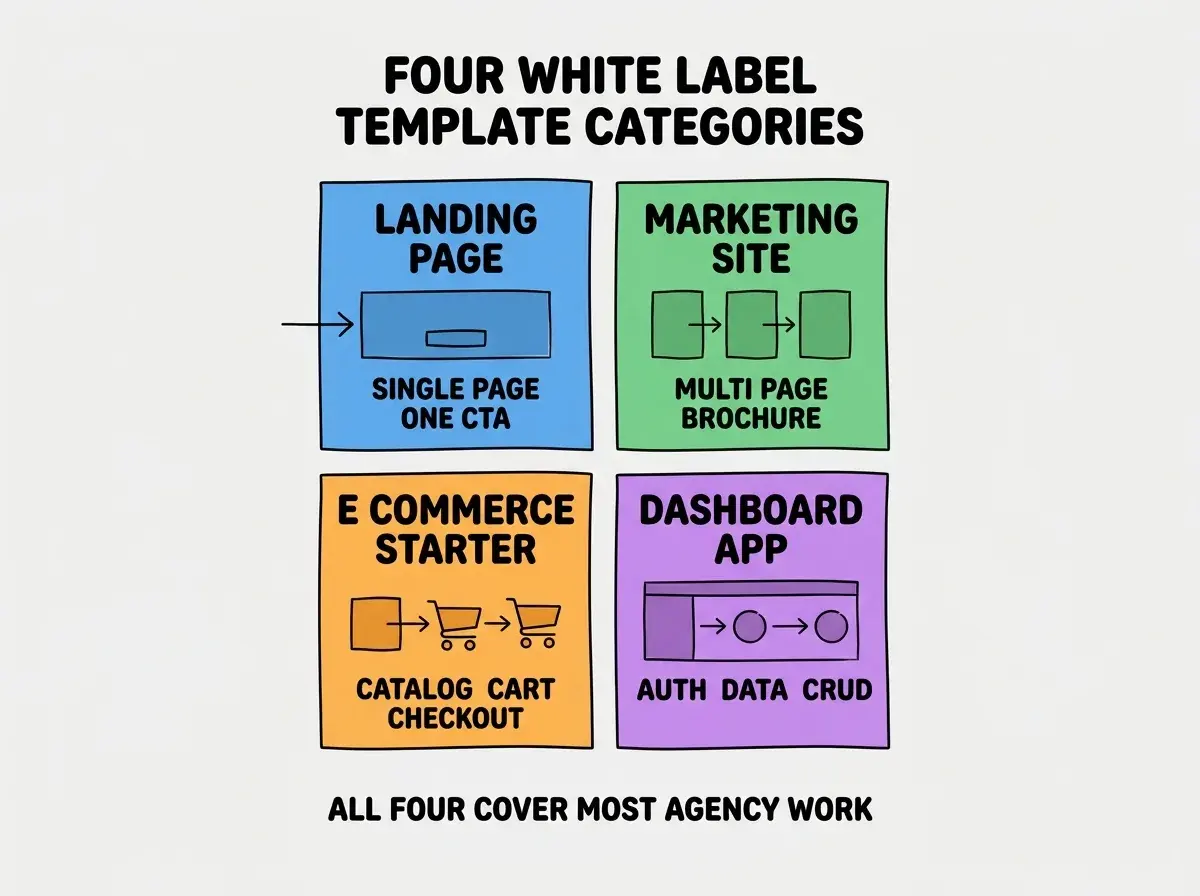
Category 3, e-commerce starter. Catalog, cart, checkout, order management. Right for clients selling products online without enterprise needs.
Category 4, dashboard app. Auth, data table, CRUD, basic charts. Right for internal tools, admin panels, simple SaaS MVPs.
The Configuration-Driven Approach
Templates that require code changes to customize do not scale. Templates that customize via configuration scale dramatically.
Pattern 1, brand config file. Single JSON file with colors, fonts, logo URLs, brand voice settings. One file to update per client.
Browse more agency build guides
Read more build articlesPattern 2, content config file. Separate JSON file with copy, images, links. Lets you swap content without touching design.
Pattern 3, feature flags. Toggle sections on/off via config. Clients who do not need testimonials can disable them without code changes.
The combination means a new client project is mostly editing config files, not writing code. The work that used to take days takes hours.
The Customization Patterns That Work
Beyond configuration, three patterns handle the customization that does require some code work.
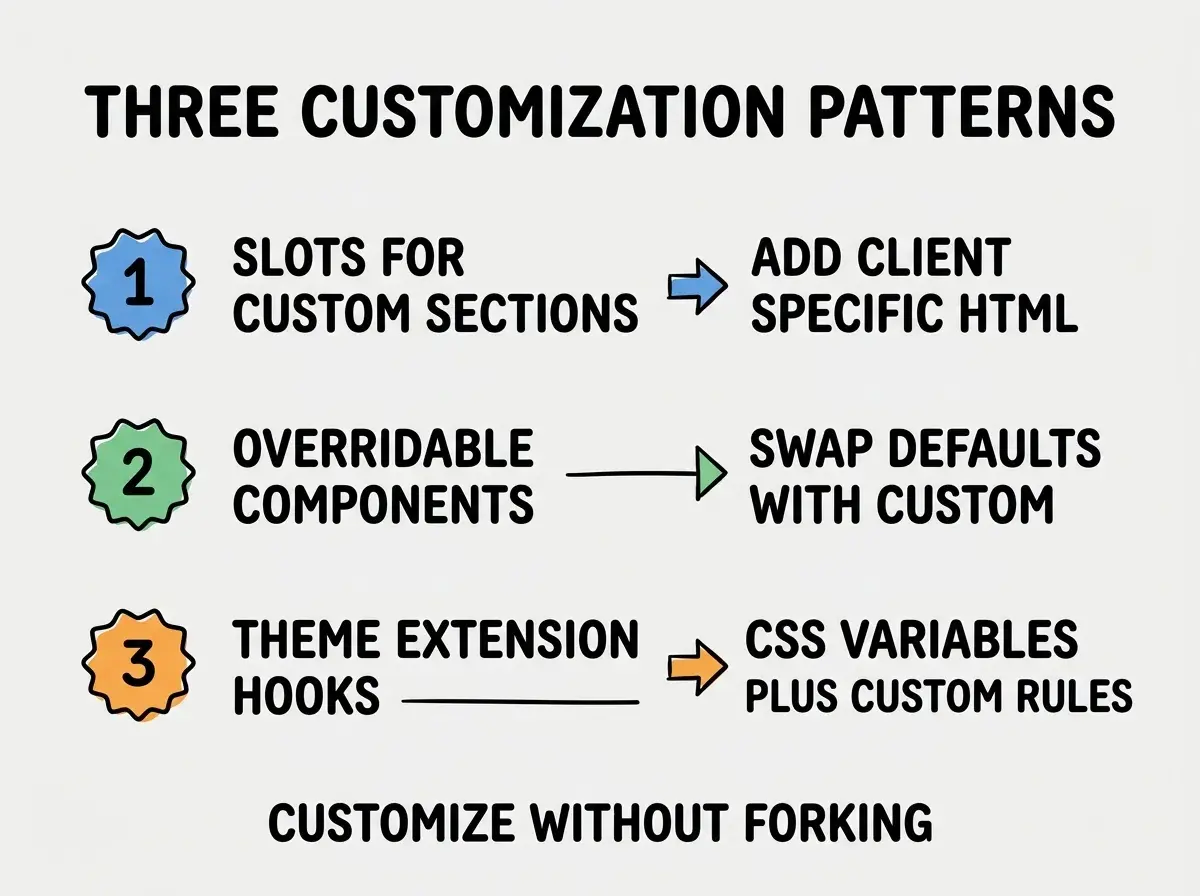
Pattern 1, slots for custom sections. Designate areas in the template where a client can add custom HTML/components. Default content for most; client-specific overrides where needed.
Pattern 2, overridable components. Components that can be swapped via config. Client A uses default Card; Client B specifies their custom Card. No template changes required.
Pattern 3, theme extension hooks. CSS variables for the basics; CSS extension files for client-specific custom styles. Layered theming that does not require template forks.
The One-Command Bootstrap Workflow
The bootstrap workflow is what makes templates fast to use. Three pieces handle most of it.
Piece 1, project initialization script. "create-client-project [client-name] [template-type]" sets up the new project with config files, brand placeholder, deployment hooks. About 30 seconds.
Piece 2, content collection workflow. A standardized intake form that gathers brand assets, copy, content from the client. Feeds directly into the config files. Eliminates "wait for client to send assets" delays.
Piece 3, deployment automation. New project deploys to a staging URL automatically. Client previews; agency iterates; production deploys when approved. The whole cycle in days, not weeks.
The combination produces an agency operating model where the bottleneck is client decisions, not agency code. That is exactly the right place for the bottleneck to be.
The most damaging white-label template mistake is letting individual client customizations leak back into the template. An agency builds a template, customizes it for Client A, fixes a bug for Client B in the customization, then back-ports the fix to the template incorrectly, breaking Client C. The fix is strict separation: templates are read-only from client projects' perspective. Client-specific changes live in the client's project, not in the template. Template improvements happen via deliberate releases that all client projects can opt into. Without this discipline, templates become unmaintainable within a year.
The other mistake is over-templating: trying to template every project type when only some categories have enough volume to justify the investment. Build templates for project types you do 5+ times per year; custom-build the rest. Templates are an investment that pays back through repetition; without enough repetition, the investment never pays.
Maintenance Patterns Across Many Client Projects
Once you have templates running across many client projects, three maintenance patterns keep the system healthy.
Pattern A, version-pinned client projects. Each client project pins a specific template version. Template improvements roll out via deliberate version bumps, not silent updates. Prevents one client's project breaking when the template changes.
Pattern B, regular template release cycle. New template versions ship on a predictable cadence (monthly works for most agencies). Clients can plan around upgrades rather than facing surprise migrations.
Pattern C, deprecation policy. Old template versions get supported for a defined period (6 to 12 months) then deprecated. Clients on deprecated versions are notified and migrated. Prevents the long tail of legacy projects on ancient template versions.
The combination of these patterns produces a template ecosystem that stays healthy across years of agency operation. Without them, templates become legacy code burdens; with them, templates remain the operational advantage they were designed to be.
How Templates Affect Pricing
Templates change what agencies can charge in interesting ways. Three pricing patterns work for template-based agencies.
Pattern 1, fixed price by project type. "Marketing site, $8,000, ships in 1 week" is sellable when the template makes the timeline reliable. Replaces the typical hourly billing model with predictable client commitments.
Pattern 2, premium for customization above template. Base template work at standard pricing; significant deviations from the template at hourly rates. Aligns price with effort while keeping the standard work efficient.
Pattern 3, ongoing maintenance contracts. Templates make ongoing maintenance cheap, which makes monthly maintenance contracts profitable. Recurring revenue from low-effort work compounds across the client base.
The combination of these patterns means templates do not just speed up work; they enable business models that hourly-billing agencies cannot match. The operational advantage becomes a strategic advantage.
Dig deeper
A few hand-picked sources if you want to go further.
What This Means For You
White-label templates are one of the highest-leverage operational investments any agency can make in 2026. The build cost is real but pays back through dramatically faster client delivery.
- If you're a founder running an agency: Invest in one great template per project category you do 5+ times per year. The compound effect on margins is significant.
- If you're changing careers into agency work: Templates are increasingly central to modern agency operations. Building one demonstrates operational maturity.
- If you're a student: Build a template for a common project type (landing page, dashboard) for your portfolio. The reusable artifact demonstrates higher-order thinking than one-off projects.
Browse more agency build guides
Read more build articles