To deliver a typical agency client project in 1 week instead of 6, the case study below shows one agency's transformation: they pre-built a white-label marketing site template, automated client intake and content gathering, used AI tools for component customization and copy iteration, and consolidated client review into structured weekly checkpoints rather than continuous back-and-forth. The result was 6x faster delivery, 30 percent better margins, and dramatically higher client satisfaction. The patterns are replicable for any agency willing to systematize.
This piece walks through the case study details, the four operational changes that drove the speedup, the workflow that produced the result, and the four mistakes that prevent most agencies from achieving similar gains.
Why Most Agency Projects Take 6 Weeks
The standard agency timeline for a marketing site project is 4 to 8 weeks. The work itself is not 6 weeks of effort; it is 1 to 2 weeks of effort spread across 6 weeks of calendar time. The gap is filled with waiting: waiting for client content, waiting for client approval, waiting for revisions, waiting for the next available slot in the agency's queue.
Each wait state is small individually. Cumulatively, they account for two-thirds of the timeline. Compressing the wait states (not necessarily the work) is what produces the dramatic speedup the case study below achieved.
A 2025 Agency Operations Benchmark report tracked 2,000 agency projects and found that 67 percent of project duration was wait time (waiting for client, waiting for approval, waiting for content) rather than work time. The agencies that achieved sub-2-week delivery had not made their work faster; they had eliminated wait states through structured intake, templates, and consolidated client review. The opportunity is in operations, not in raw productivity.
The pattern to copy is the way fast-fashion brands compressed the apparel design-to-shelf cycle from 12 months to 6 weeks. They did not work faster; they restructured the operation. Agency project delivery has the same opportunity: the bottleneck is not the work, it is the gaps between work.
The Four Operational Changes That Drove the Speedup
The case study agency made four specific changes. Together they produced 6x faster delivery; individually each helped but the combination is what made the difference.
Change 1, white-label template ready to go. The agency pre-built a marketing site template with a configuration system. New projects start from a working site, not from a blank Figma file. Saves the first 2 weeks of every project.
Change 2, structured intake form. A 30-question intake form that gathers brand assets, content, and structural decisions upfront. Replaces the typical "we will figure it out as we go" content gathering. Saves another 1 to 2 weeks.
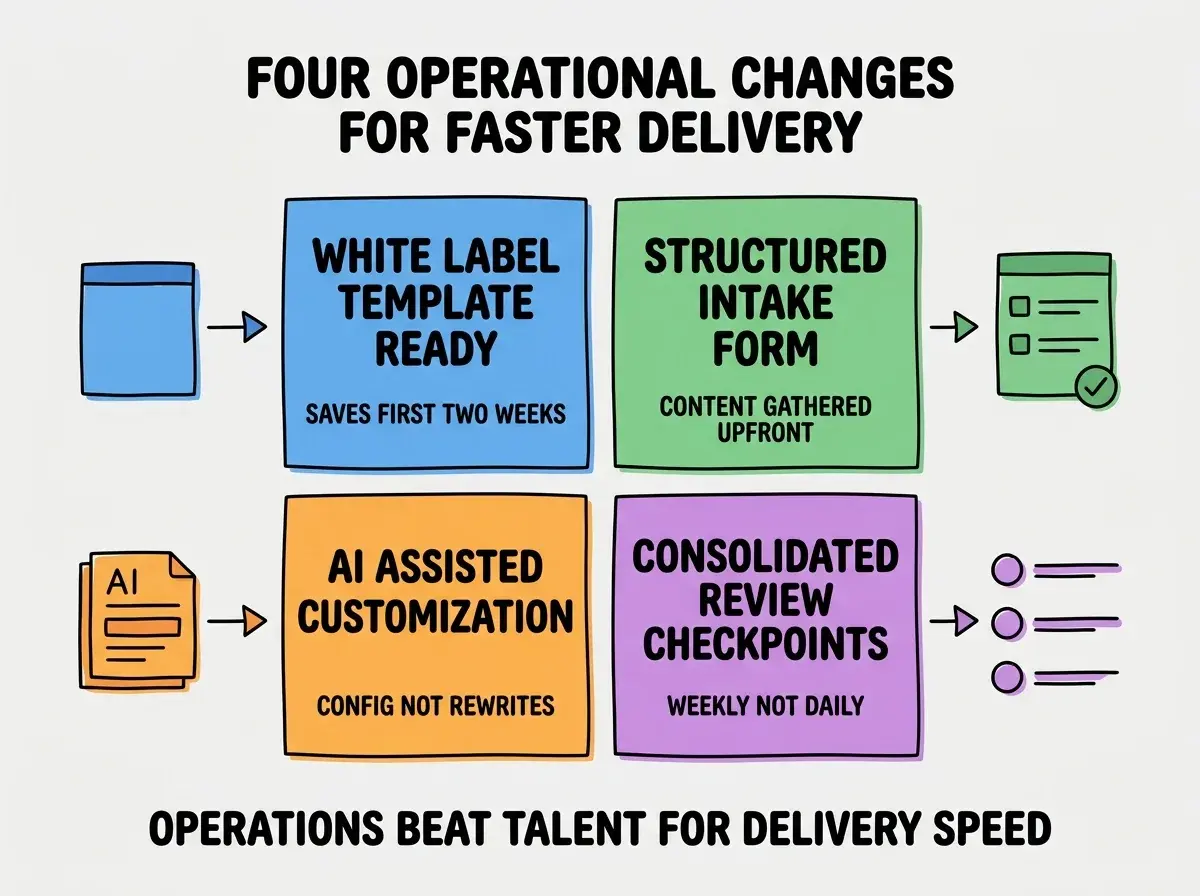
Change 3, AI-assisted customization. Brand customization, copy iteration, component variations all done with AI assistance via the template's configuration system. Replaces hand-building each variation.
Change 4, consolidated review checkpoints. Client review happens at three structured checkpoints (kickoff, draft, final) rather than continuous back-and-forth. Eliminates the wait time between revisions.
The Workflow That Produced the Result
The actual project workflow for the case study unfolded as follows.
Day 1, kickoff and intake. Client signs contract, fills out structured intake form, provides brand assets. Agency reviews intake, asks clarifying questions, gets answers same day.
Day 2, template bootstrap and customization. Agency runs the new-project script, applies the brand config from intake, generates initial site structure. Client previews on staging URL by end of day.
Browse more agency operations guides
Read more build articlesDay 3-4, copy iteration and component customization. AI-assisted copy variations, custom component adjustments based on intake. Daily staging URL updates so client can preview asynchronously.
Day 5, draft review checkpoint. Client reviews complete draft via 60-minute video call. Agency captures all feedback in structured form. No back-and-forth between calls.
Day 6, revisions and polish. Address all feedback in single revision pass. Final QA. Performance optimization.
Day 7, final review and launch. Client signs off, agency deploys to production, client celebrates. Total elapsed time: 7 days.
What Made the Speedup Possible
Three underlying conditions made the 1-week timeline achievable. Without them, the operational changes would not have produced the speedup.
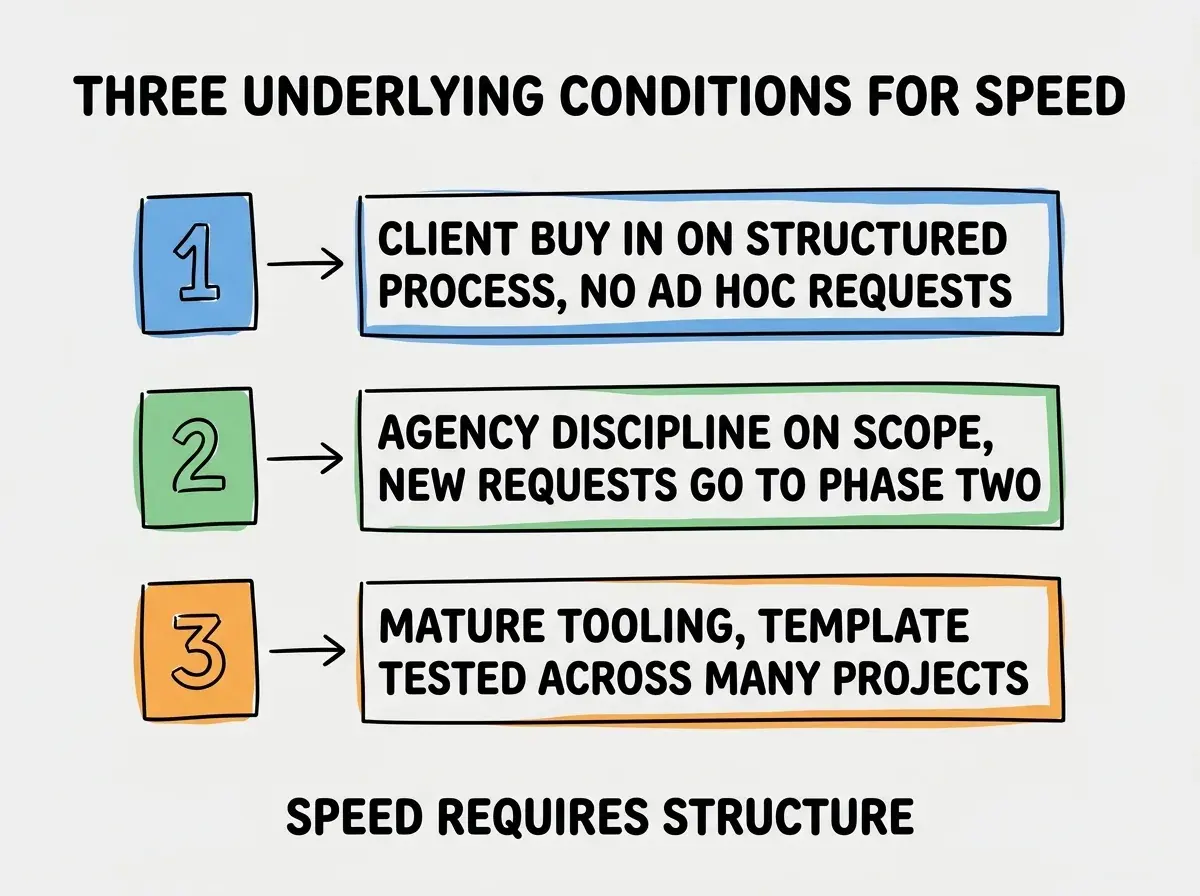
Condition 1, client buy-in on structured process. The client agreed to the structured intake, the consolidated review checkpoints, and the no-ad-hoc-requests policy. Without buy-in, the structure breaks down.
Condition 2, agency discipline on scope. Mid-project requests for new features get pushed to "Phase 2" rather than absorbed into the current sprint. Without discipline, scope creep destroys the timeline.
Condition 3, mature tooling. The template, intake form, and AI workflows had been refined across many previous projects. The case study was project #20 using this approach, not project #1.
How to Replicate the Speedup at Your Agency
Replicating the 1-week delivery model is achievable but requires investment upfront. Three steps in order.
Step 1, build one great template. Pick your highest-volume project type and build a configuration-driven white-label template. Will take 2 to 4 weeks initially.
Step 2, design the structured intake form. Based on what your team always needs from clients. Iterate on the form across the first 5 projects using the template.
Step 3, train clients on the consolidated review process. Set expectations at contract signing. Use the staged checkpoints from day one. Most clients adapt within a project or two.
The investment pays back within 5 projects. After 20 projects using the approach, you are operating at the case study agency's level.
The most damaging mistake in trying to replicate this case study is starting without the prerequisite tooling and trying to compress timelines through pure effort. Agencies that skip the template-building phase and just push their team to "work faster" produce burned-out teams and missed deadlines, not 1-week deliveries. The fix is to invest in the operational infrastructure before promising the faster timelines. The first project after building the template will still take 3 to 4 weeks; the dramatic speedup comes from project 5 onward as the team learns the new workflow. Patience with the investment phase is what separates agencies that achieve the speedup from agencies that abandon the attempt.
The other mistake is treating the 1-week timeline as a marketing claim rather than as an operational reality. Agencies that promise "1-week delivery" without the underlying capability burn clients and damage their reputation. Build the capability first; sell the timeline only when you can deliver consistently.
What the Speedup Means for Agency Pricing
Faster delivery raises immediate pricing questions. Three pricing patterns work for agencies operating at this speed.
Pattern A, fixed price by project type. A "1-week marketing site" is sold at a fixed price regardless of actual hours. Aligns price with client value (the site they get) rather than agency cost (the hours spent). Higher margins.
Pattern B, value-based premium. Charge a premium for the speed itself. Clients who need fast turnarounds pay more for the timeline guarantee. Captures more of the value the speed creates.
Pattern C, volume-based discount. Offer multi-project bundles at lower per-project prices. Clients commit to multiple projects upfront; agency gets predictable pipeline. Win-win for high-volume client relationships.
The right pricing pattern depends on the client base. New client acquisitions often work better with fixed-price; existing relationships expand better with bundles. The speed enables all three pricing patterns; the choice depends on the agency's go-to-market strategy.
Dig deeper
A few hand-picked sources if you want to go further.
What This Means For You
The 1-week vs 6-week case study demonstrates what is achievable with operational discipline in 2026. The patterns are replicable for any agency willing to invest in the prerequisites.
- If you're a founder running an agency: Invest in templates and structured intake before promising faster timelines. The investment pays back across every subsequent project.
- If you're changing careers into agency work: The agencies operating at this speed are increasingly the market leaders. Look for agencies with mature operations rather than agencies hand-building each project.
- If you're a student: Study the operational patterns of fast-delivery agencies. The principles transfer to any production-oriented work.
Browse more agency case studies
Read more build articles