Agency workflow for managing 5 or more client projects with AI tools in 2026 means treating context as a first-class artifact, using per-client repository isolation, building a daily ritual that prevents codebase confusion, and accepting that the AI tools amplify both throughput and the cost of mistakes. Small agencies (3 to 10 people) running this pattern consistently ship work for 8 to 15 concurrent clients with the same headcount that previously handled 4 to 6, and the productivity gain is real. The cost is that the workflow has to be deliberate; the casual "just use Cursor for everything" approach falls apart at the third client.
This piece walks through the per-client setup, the daily and weekly rituals that make multi-client work sustainable, the four failure modes that destroy agencies attempting this, and the tooling decisions that scale.
Why Agencies Are Different From Solo Builders
A solo builder using AI tools can hold the full context of one project in their head and in the AI's memory. An agency engineer working on five projects cannot. Each project has different conventions, different stack choices, different client preferences, and different historical decisions. Switching between projects multiple times per day creates context loss that degrades quality on every project.
The mistake most agencies make when adopting AI tools is to assume the workflow that worked for solo development will scale. It does not. The throughput gain from AI is real, but capturing it requires deliberate workflow design that preserves context per project rather than letting it bleed across projects. The agencies that scale best in 2026 invested in this workflow design early.
A 2025 Digital Agency Network survey of 200 small agencies adopting AI coding tools found that the median agency saw a 2.4x increase in client throughput per engineer. The top quartile saw 3.8x. The bottom quartile saw 1.1x and reported worse client satisfaction. The differentiator was process design: agencies with formal per-client context management captured the full AI gain, while agencies without it captured only a fraction.
The pattern to copy is the way restaurant kitchens handle multiple tables. A line cook can run 2 or 3 tables in their head; running 8 requires a ticket system, a clear hand-off protocol, and a head chef coordinating across stations. Agencies running multiple AI-assisted projects need the same kind of explicit coordination structure, not a hope that the AI will figure it out.
The Per-Client Setup That Works
The foundation is per-client isolation across three dimensions. Each client has its own repository, its own AI context document, and its own session history.
Repository isolation. Each client is a separate repo with no shared code. This prevents conventions from one client leaking into another and makes it easy to give the AI clean context for each session.
AI context document. A markdown file in each repo (CLAUDE.md or similar) that captures the client's conventions, stack choices, brand voice, and any historical decisions. The AI loads this on every session, so context is never lost between switches.
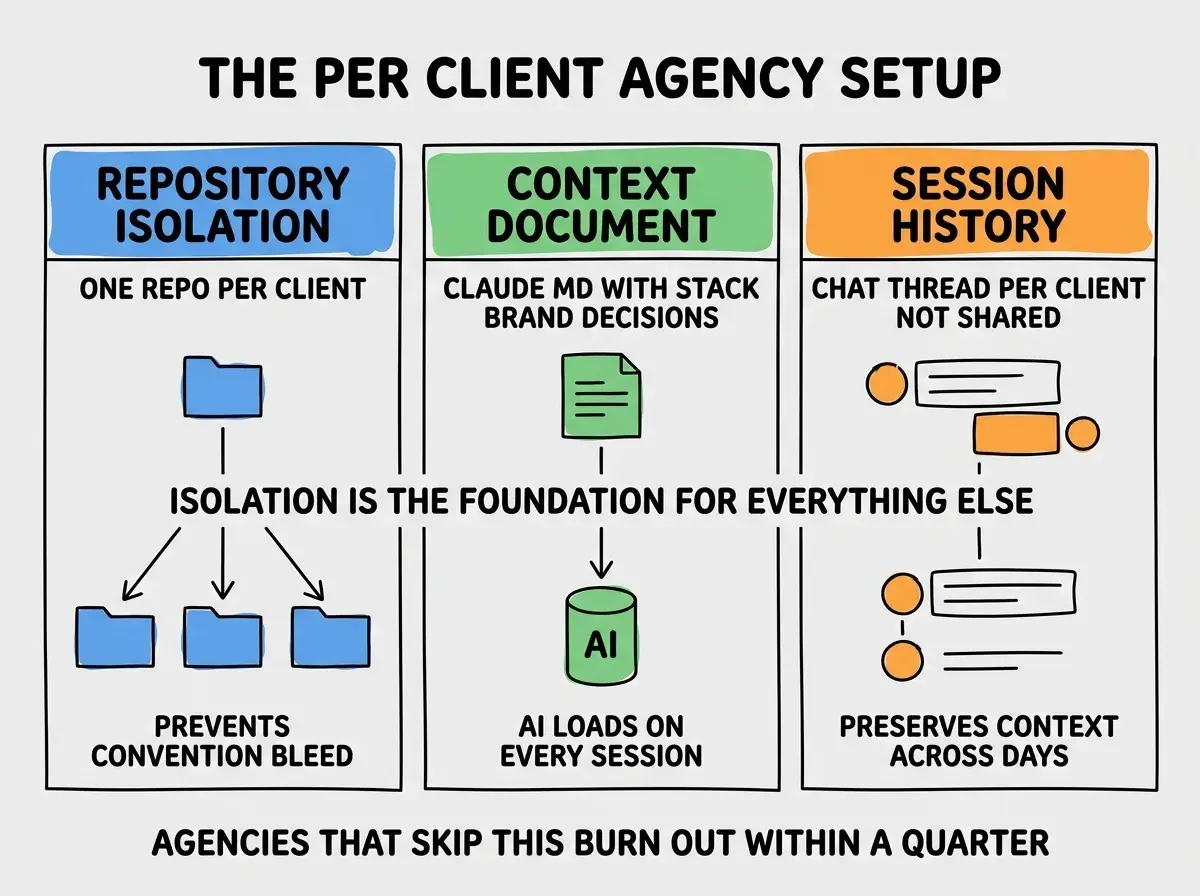
Session history. Each client has its own AI chat thread, kept active across days and weeks. Switching to a client means resuming their thread rather than starting fresh. This preserves context across days and across team members.
Daily and Weekly Rituals
Even with isolation in place, daily rituals prevent context loss and weekly rituals catch drift before it becomes a client-facing problem.
Daily, morning context refresh. Before starting work on any client, the engineer rereads the client's context document and the most recent session history. Five minutes per client per day. This sounds tedious but the cost of skipping it shows up as bugs that match a different client's conventions.
Browse more agency and workflow guides
Read more build articlesDaily, end-of-day journal. At the end of each day on each client, write a 3 to 5 sentence journal of what was decided and what is next. This becomes the morning context refresh for the next session. Cumulative cost: maybe 30 minutes per day across all clients.
Weekly, drift audit. Once a week, review each client's recent commits for code that does not match the client's documented conventions. Catch and fix drift before clients notice. About 30 minutes total.
The Four Failure Modes
Each failure mode is preventable but kills agencies that do not design around it.
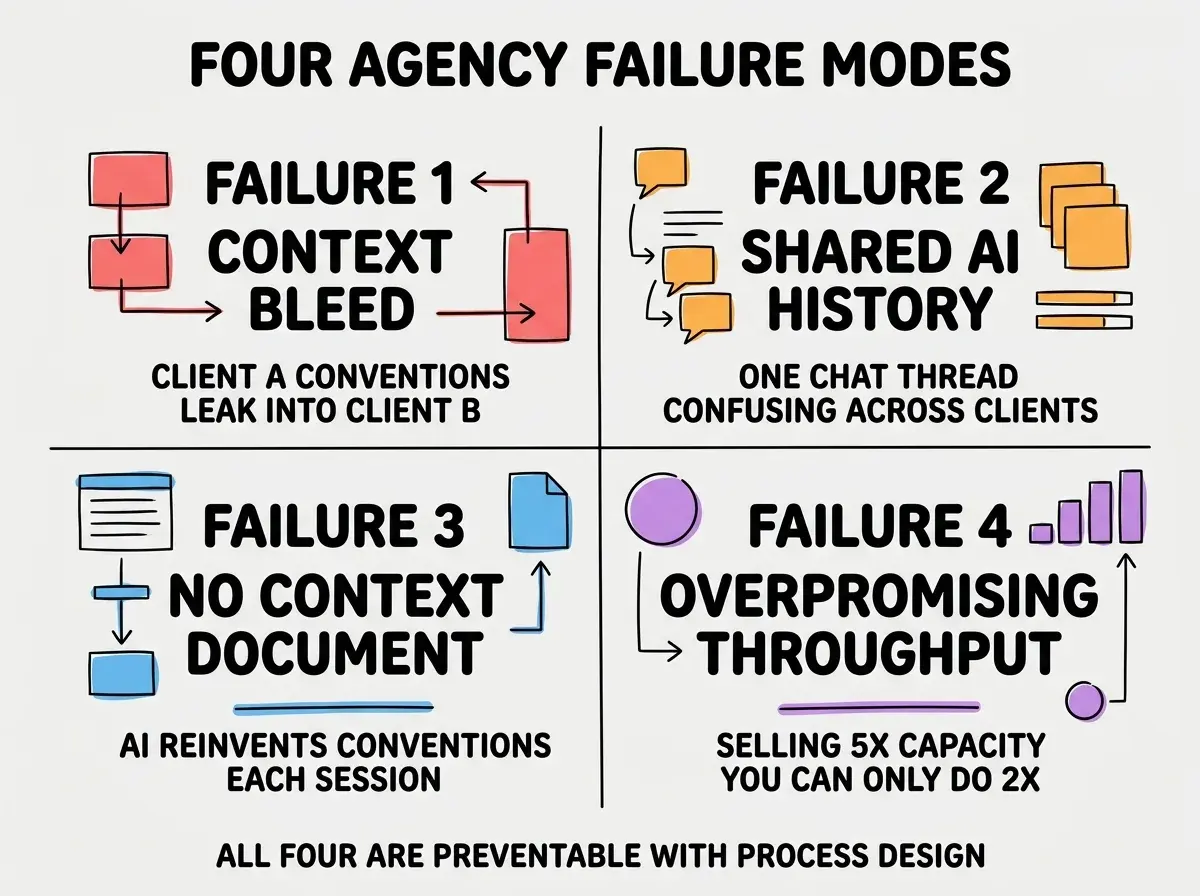
Failure 1, context bleed. Client A's brand colors end up in Client B's project. Or worse, code from one project gets pushed to another's repo. The fix is strict repository isolation and the morning context refresh.
Failure 2, shared AI history. Using one Cursor or Claude Code session for multiple clients confuses the AI and produces output that mixes conventions. The fix is per-client session threads.
Failure 3, no context document. Without a CLAUDE.md per client, the AI reinvents conventions each session and the engineer has to re-explain everything. The fix is to invest in the document upfront and update it on every meaningful decision.
Failure 4, overpromising throughput. Agencies that pitch "we can do 5x more work with AI" usually fail to deliver because the math is wrong. The realistic number is 2 to 3x for most agencies. Pricing and timeline commitments should reflect the realistic gain.
The most damaging agency mistake is treating AI as a magic productivity multiplier without redesigning the workflow. AI tools amplify whatever process you have; if your process was disorganized, AI makes it more disorganized faster. Invest in the per-client isolation, daily rituals, and weekly drift audit before you sell the AI-assisted capacity to clients. The infrastructure pays back many times over the life of the agency, and the absence of it predicts agency failure within 12 to 18 months.
The other mistake is undercommunicating with clients about AI use. Some clients are excited about AI-assisted work; others are wary. Telling them upfront, framing it as a speed and quality advantage, and showing them your process builds trust. Hiding the AI use creates a fragile relationship that breaks when something goes wrong.
A practical way to operationalize all of this is to maintain a single dashboard or document that lists every active client, their current sprint, the engineer assigned, and the next deliverable date. Update it daily. The dashboard prevents the situation where two clients think you are working on their project this week and only one of them is right. The discipline costs maybe 15 minutes a day and produces calmer client relationships across the entire portfolio.
A final small habit that pays off is to schedule explicit context-loading time at the start of each client session. Five minutes to reread the CLAUDE.md, the most recent commits, and the active issues. This sounds like overhead but produces dramatically better output for the rest of the session, because the engineer (and the AI) is not improvising context from memory.
Dig deeper
A few hand-picked sources if you want to go further.
What This Means For You
Multi-client AI workflow is one of the highest-leverage process investments any agency can make in 2026. The discipline pays back faster than the cost, and the gap between agencies that get this right and those that do not is widening.
- If you're a founder: Treat your agency's AI workflow as a competitive advantage worth investing in. The 2x to 3x throughput gain is real for those who build the process.
- If you're changing careers: Working at an AI-native agency is a fast way to develop both technical and process skills. Choose carefully; the wrong agency will burn you out.
- If you're a student: Try freelancing for 2 or 3 small clients simultaneously to feel the context-switching problem firsthand. The process patterns make sense once you have lived the problem.
Browse more agency and workflow guides
Read more build articles