To recognize when to stop vibe coding and hire a developer in 2026, watch for the four signals that indicate vibe coding has reached its limits for your project (you are spending more time debugging than building, the product is doing well enough that downtime hurts revenue, you are turning down feature requests because of complexity, you are exhausted by the operational load), make the hiring transition deliberately rather than as a panic move, and structure the handoff so the new developer can work effectively without rebuilding from scratch. The transition is normal at certain stages; recognizing the timing matters more than fearing the change.
This piece walks through the four signals to hire, the transition patterns that work, the handoff process, and the four mistakes founders make at the hiring decision point.
Why This Decision Is Hard for Founders
Vibe coding founders often have emotional attachment to building their own product. Hiring a developer can feel like admitting defeat or losing control. Both feelings are normal and both are usually wrong. The decision to hire is about scaling the business, not about the founder's worth.
The 2026 reality is that successful vibe-coded MVPs increasingly graduate to production engineering at predictable scale points. Founders who recognize the graduation moment and act on it produce dramatically better outcomes than founders who hold on too long.
A 2025 First Round Capital study of 400 vibe-coded startups that crossed $50K MRR found that 76 percent had hired their first developer by month 6 of meaningful revenue. The 24 percent that did not hire by then had 2.4x higher founder burnout rates and 1.8x higher product incident rates. The hiring transition is not about whether to do it; it is about when. Earlier is usually better than later, and the data is becoming clearer about the right thresholds.
The pattern to copy is the way solo restaurant owners eventually hire kitchen staff. The owner can cook everything alone in the early days; success creates volume that requires help. The hiring decision is about scaling the restaurant, not about the owner's cooking ability. Tech founders face the same trajectory.
The Four Signals to Hire
Four signals consistently indicate it is time to hire a developer. Two strong signals usually justify hiring; three or four make it urgent.
Signal 1, debugging exceeds building time. When you spend more hours fixing problems than shipping features, the codebase has outgrown your maintenance capacity. A developer can stabilize what you built.
Signal 2, downtime hurts revenue. Once the product produces meaningful revenue, every hour of downtime costs real money. Professional engineering reduces downtime in ways vibe coding cannot.
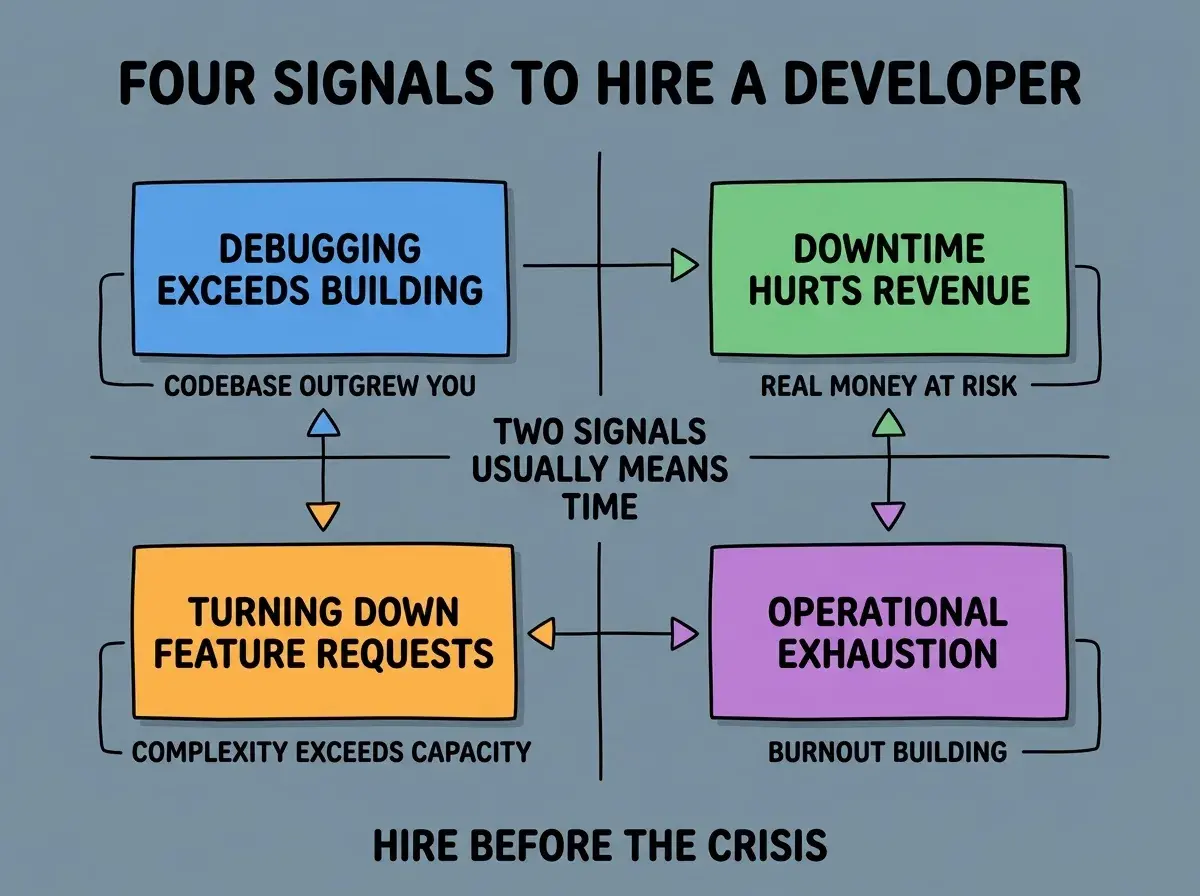
Signal 3, you are turning down feature requests. Customers want things you cannot build because complexity has exceeded your capacity. The opportunity cost of declined features grows quickly.
Signal 4, operational exhaustion. Founders who burn out building their MVP often kill the company at the same time. Hiring offloads operational work and preserves founder capacity for strategy.
The Transition Patterns That Work
Three transition patterns produce smooth founder-to-developer handoffs.
Pattern 1, hire part-time first. Engage a senior developer for 10-15 hours per week initially. Test the working relationship before full-time commitment.
Browse more founder decision guides
Read more foundations articlesPattern 2, focus first hire on stabilization. First developer should focus on stabilizing what you built (tests, monitoring, refactoring critical paths) before adding new features.
Pattern 3, gradual handoff of architecture decisions. As trust builds, hand off more architectural authority. The developer becomes the technical leader; you focus on product and business.
The Handoff Process
Three steps make the codebase handoff productive rather than painful.
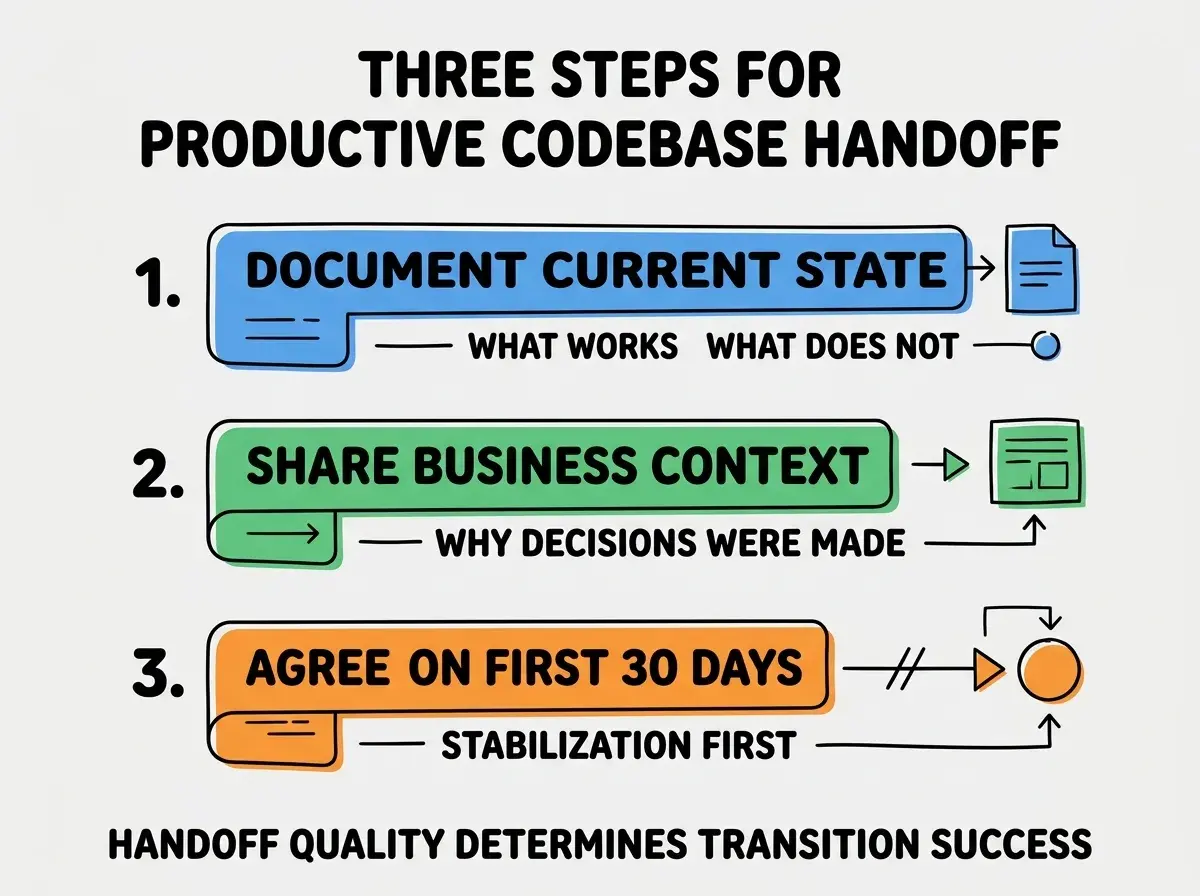
Step 1, document current state. What works, what is fragile, what you wish was different. The documentation does not need to be polished; it needs to be honest.
Step 2, share business context. Why decisions were made the way they were. The developer needs business context to make appropriate technical decisions.
Step 3, agree on first 30 days. Stabilization, learning the codebase, identifying highest-risk areas. New features come after the developer understands what they are building on.
How to Budget for the Hire
Three principles help budget realistically for the first developer hire.
Principle 1, allow for 3-6 months of runway. Senior developers in 2026 typically cost $8K-15K per month for full-time engagements; part-time runs $4K-8K. Budget enough runway to evaluate the relationship and ramp the developer effectively.
Principle 2, hire when revenue covers 60 percent of cost. If the developer costs $10K monthly, hiring is sustainable when MRR is at least $6K. Below that, hiring stresses the business; above $15K MRR, the hire often produces immediate ROI through stabilization and feature velocity.
Principle 3, factor in tooling and infrastructure costs. New developers often want to upgrade tooling (better hosting, observability, CI/CD). Budget an additional $500-1K monthly for infrastructure improvements that enable developer productivity.
The combination produces realistic financial planning that prevents the common pattern of hiring then panicking about cost. Founders who plan financially do better than those who hire reactively without budget clarity.
How to Find the Right First Developer
Three patterns help find a good first developer match. The match matters more than pure technical skill.
Pattern A, hire someone who has worked with vibe-coded codebases. They understand the patterns and quirks. Not everyone has this experience yet, but it is increasingly common.
Pattern B, look for product sense, not just engineering skill. First developer often becomes technical co-founder informally. Product judgment matters as much as code quality.
Pattern C, test with a small project before committing. Pay for a 1-2 week project (specific feature, specific bug fix). The work product reveals fit better than interviews.
The combination produces hires that work out long-term. Without these patterns, founders sometimes hire based on resume credentials and end up with mismatches that hurt the business.
The most damaging hiring-timing mistake is waiting until crisis mode. Founders who hire only after the product is failing produce worse outcomes than founders who hire proactively from a position of stability. The fix is to start the hiring process as soon as 2 of the 4 signals match strongly. Hiring takes 2-3 months from search to onboarded; starting late means the developer arrives mid-crisis when you need stabilization yesterday. Hire before you desperately need to; the calmer transition produces better long-term outcomes.
The other mistake is hiring a junior developer to save money. Junior developers typically need senior guidance to be productive; founders hiring juniors often end up doing more management than they expected. For first hire, senior is usually the right choice even though it costs more. The stability and judgment of seniors is what the transitioning project needs most.
A third mistake is failing to maintain founder technical engagement after hiring. Some founders hand off all technical work and lose the ability to understand technical tradeoffs the developer presents. The fix is to stay technically engaged at the architecture level even after handing off implementation. Read the PRs, attend the technical discussions, ask questions about decisions; you do not need to write code, but you need to understand what is being built and why.
What This Means For You
The decision to stop vibe coding and hire is a normal part of successful founder journeys in 2026. Recognizing the signals and acting on them produces better outcomes than holding on too long.
- If you're a founder: Watch for the signals proactively. Plan to hire when 2-3 match strongly, before you are in crisis.
- If you're changing careers into founder roles: Build the muscle of hiring decisions early. The skill transfers across every business you build.
- If you're a student: Study founder-to-team transitions in your favorite startups. The patterns generalize across companies.
Browse more founder decision guides
Read more foundations articles