To understand intellectual property for AI-generated code in 2026, recognize four ownership scenarios that arise (code you wrote with AI assistance is fully yours, code generated entirely by AI raises copyright questions in some jurisdictions, code generated from copyrighted training data may carry residual rights claims, and code committed to public repositories may grant licenses you did not intend), check your AI tool's terms of service for ownership claims, and consult an IP attorney for high-stakes situations rather than relying on internet advice. The IP landscape for AI code is still evolving; founders who understand the scenarios make better decisions than founders who assume everything is fine.
This piece walks through the four ownership scenarios, what tool terms of service say, the legal precedents shaping the area, and the four mistakes founders make about AI code intellectual property.
Why IP Matters for AI-Built Products
Intellectual property determines whether you can defend your product against competitors, license it commercially, raise venture funding, or sell the company. Unclear IP undermines all of these; clear IP enables them.
The 2026 reality is that IP law for AI-generated code remains unsettled in many jurisdictions. Courts have issued some rulings; legislatures are slowly drafting laws; tool vendors include various contractual claims. Founders who understand the landscape navigate it well; founders who ignore it sometimes face surprises that derail their businesses.
A 2025 Cooley LLP startup survey of 600 AI-built startups found that 31 percent had at least one IP-related issue surface during fundraising due diligence, ranging from minor (license grants in tool ToS that needed cleanup) to severe (ownership disputes that delayed rounds by 6+ months). The pattern was that founders who proactively addressed IP early raised faster and at higher valuations than founders who treated IP as someone-else's problem. IP awareness is part of founder fluency in 2026.
The pattern to copy is the way songwriters think about music rights. Songwriters know early in their careers which rights they hold, which they have licensed, which are co-owned. The rights determine what they can monetize. Software founders should approach IP with similar precision; code rights determine business options.
The Four Ownership Scenarios
Four scenarios arise consistently for AI-generated code. Each has different IP implications.
Scenario 1, code you wrote with AI assistance. You provided the design, architecture, and substantial input; AI helped with implementation. Generally you own the code; AI tools are tools, like compilers or IDEs.
Scenario 2, code generated entirely from a single AI prompt. "Build me an app that does X" with the AI generating everything. Copyright in some jurisdictions requires human authorship; pure AI output may not qualify for copyright protection.
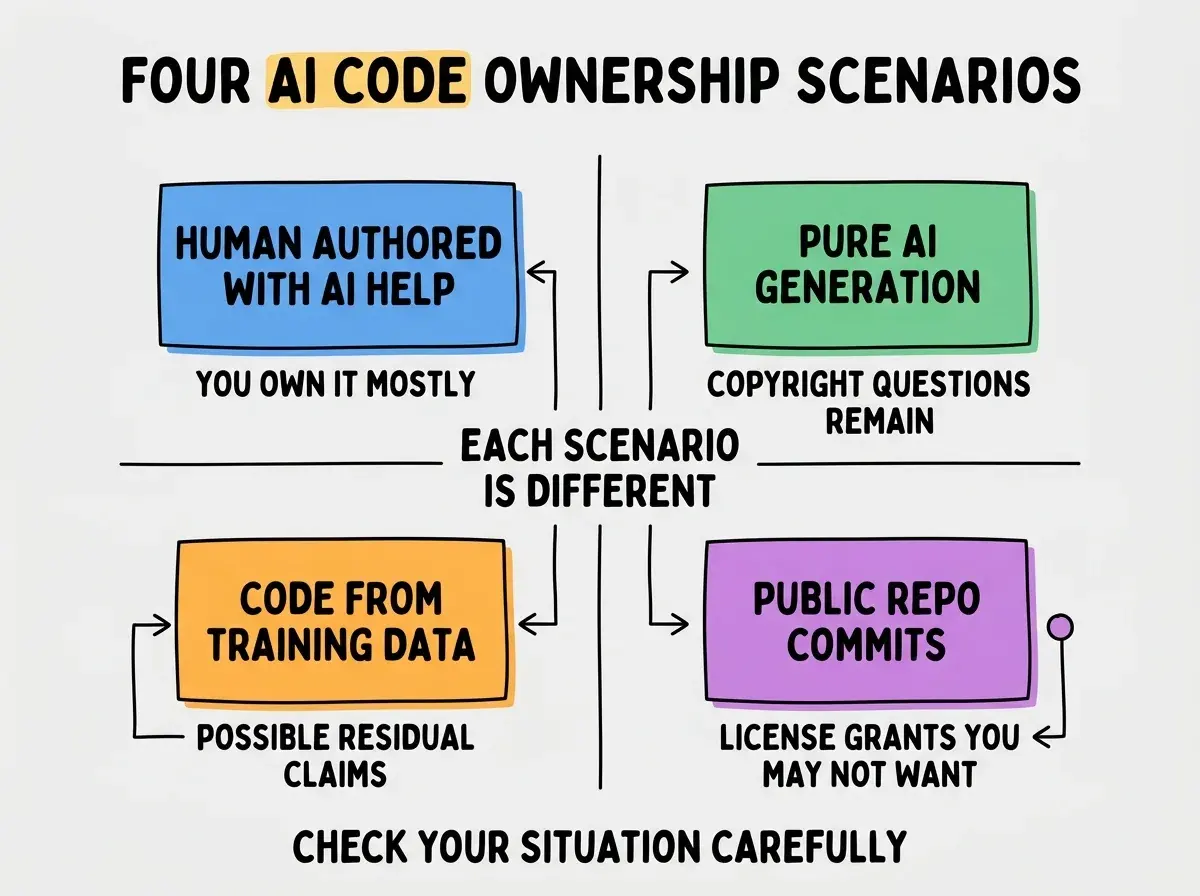
Scenario 3, code generated from copyrighted training data. AI models trained on copyrighted code may produce output that reflects training data. Courts have ruled on some cases; uncertainty remains.
Scenario 4, code committed to public repositories. Public commits may grant licenses (especially under permissive licenses like MIT). What feels like "publishing for portfolio" may grant broader rights than intended.
What Tool Terms of Service Actually Say
Three patterns appear consistently in AI coding tool terms of service. Reading them protects against surprises.
Pattern 1, customer ownership of output. Most major tools (Cursor, Copilot, Claude Code) explicitly state the user owns generated code. This is the favorable case; verify your tools follow this pattern.
Browse more legal and business guides
Read more foundations articlesPattern 2, license grants to vendor. Some tools include clauses granting the vendor a license to use your prompts and output for model improvement. This may be acceptable but you should know about it.
Pattern 3, indemnification limits. Most tools disclaim liability if your generated code infringes on third-party IP. The risk falls to you, not to the tool vendor.
The Legal Precedents Shaping the Area
Three precedents help calibrate expectations even as the area continues to evolve.
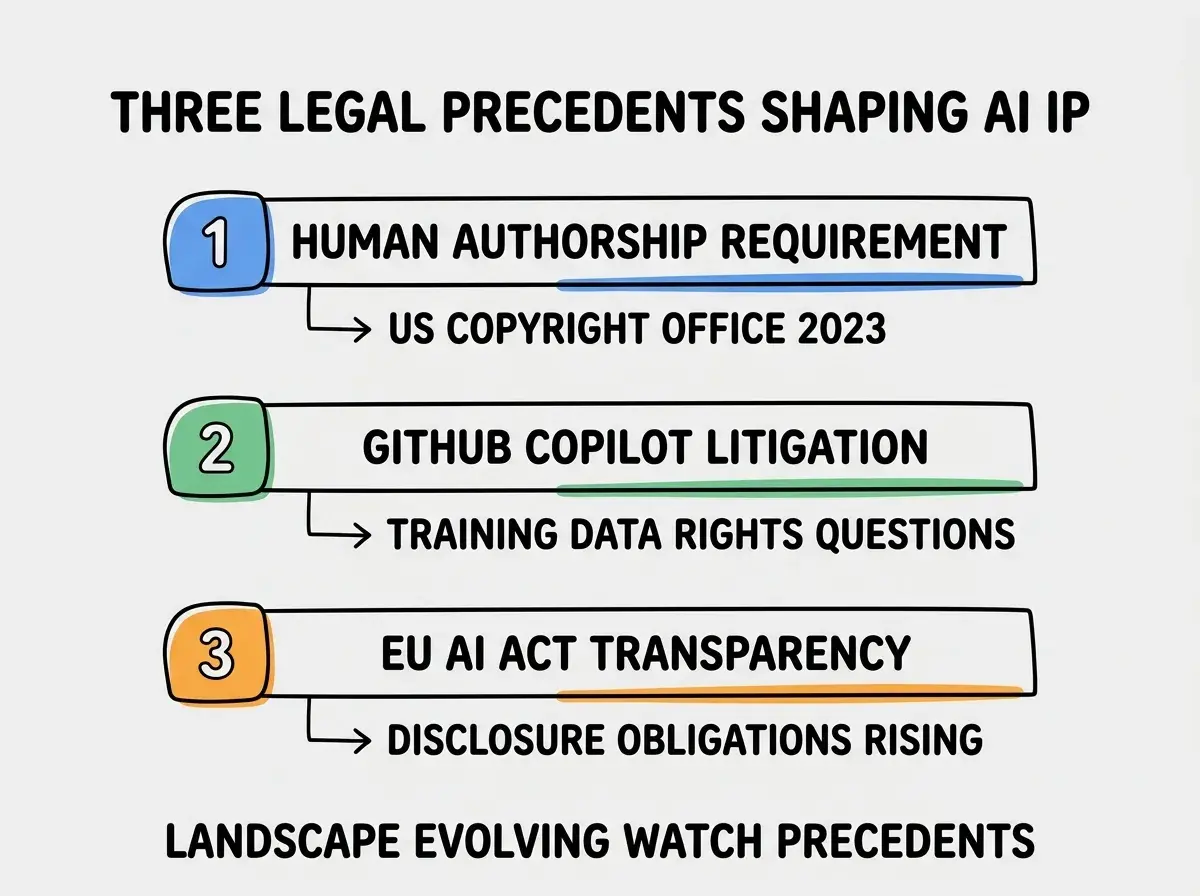
Precedent 1, US Copyright Office human authorship requirement. The US Copyright Office has held that purely AI-generated works are not copyrightable in the US. Substantial human authorship matters.
Precedent 2, GitHub Copilot litigation. Ongoing lawsuits over training data rights. Outcomes will shape model training going forward; current state is uncertain but precedents are accumulating.
Precedent 3, EU AI Act transparency requirements. EU rules increasingly require disclosure of AI usage in software. Compliance may become a B2B sales requirement for European customers.
How Different Jurisdictions Treat AI Code Differently
Three jurisdictional patterns matter for products with international users or operations.
Pattern 1, US treatment. Copyright Office requires human authorship for protection; pure AI output may not be copyrightable. Patent rights depend on inventor identification. The legal landscape is still developing through court cases.
Pattern 2, EU treatment. EU AI Act creates transparency requirements for AI-generated content. Disclosure obligations are increasing; the GDPR also affects what training data can be used.
Pattern 3, China treatment. Chinese courts have been more permissive about AI authorship in some recent rulings; the legal landscape differs from US and EU treatment in ways worth knowing.
The combination matters for products with multi-jurisdictional operations. Without awareness of jurisdictional differences, founders sometimes operate under assumptions that hold in one country but not another.
How to Protect Your AI-Built Product's IP
Three patterns help protect IP for AI-built products without requiring expensive legal work for every decision.
Pattern A, document your human contributions. Keep records showing your design decisions, architectural choices, and substantial human input. The documentation supports human authorship claims if needed.
Pattern B, use AI tools with favorable ToS. Pick tools that explicitly grant ownership to users without retaining broad licenses. Most premium tools do; verify before committing.
Pattern C, consult an IP attorney for high-stakes situations. Fundraising due diligence, large customer contracts, exit conversations all warrant IP attorney review. The cost (typically $300-800 per hour) is small relative to the deal size and the protection produced.
The combination produces sufficient IP protection for most AI-built products. Without these patterns, IP issues surface at inconvenient moments and can derail business outcomes.
The most damaging IP mistake for AI-built products is assuming the legal landscape is settled. Founders read one blog post, conclude AI code IP is fine, and move on. The reality is that the area is evolving rapidly; what was settled in 2024 may be unsettled in 2026 as new cases get decided. The fix is to stay informed about IP developments relevant to your business and revisit your IP position annually. Founders who treat IP as one-time decision miss developments that affect their rights; founders who treat it as ongoing awareness adapt as the landscape evolves.
The other mistake is mixing AI-generated code with proprietary client code without clear documentation. For freelancers and contractors building for clients, the question of who owns what becomes critical when relationships end. The fix is to document explicitly which portions of work used AI assistance, what licensing applies, and what the client owns. Clear documentation prevents disputes; ambiguous arrangements produce expensive disagreements.
What This Means For You
IP for AI-generated code is real consideration in 2026 even though many founders ignore it. The four scenarios, ToS patterns, and protection approaches produce reasonable IP positions for most products.
- If you're a founder: Read the ToS of every AI tool you use. Document your human contributions. Consult an IP attorney before high-stakes events like fundraising or sales.
- If you're changing careers into development: Understand IP basics as part of professional fluency. The knowledge protects your work and your clients' work.
- If you're a student: Study IP law fundamentals (your university likely offers a course). The understanding transfers to every job and every product you ever build.
Browse more business and legal guides
Read more foundations articles