To build an MVP in a weekend realistically in 2026, accept that "MVP" means demo-quality not production-quality, scope to one core workflow rather than a full product, use AI assistance heavily for boilerplate (auth, forms, database setup), and treat the weekend as a validation sprint rather than a launch event. The hype version promises a shipped product; the honest version delivers a credible demo that proves the concept and informs the next 60 days of work.
This piece walks through what is actually achievable in 48 hours, the four scope patterns that work, the time allocation that produces shipping rather than stalling, and the four mistakes that turn weekend MVPs into Sunday-night abandonment.
Why the Weekend MVP Promise Is Both True and Misleading
The weekend MVP narrative is true in that AI tools genuinely accelerate basic web app construction by 5-10x compared to 2022. It is misleading in that "MVP" in this context rarely means what investors and founders historically meant by MVP (a minimum viable product that can serve real customers). The version you can build in 48 hours is closer to a demo or prototype than a market-ready product.
The 2026 reality is that vibe coding produces working software faster than ever, but the gap between "working in localhost" and "ready for users" remains substantial. Weekend MVPs are excellent for validation, prototyping, and concept demos; they are insufficient for paying customers without significant follow-up work.
A 2025 IndieHackers analysis of 800 founders who attempted weekend MVPs found that 71 percent finished a working demo, but only 14 percent had a product that real users were using two weeks later. The finishing rate is high; the conversion-to-real-product rate is much lower. The implication is that weekend MVPs work as the start of a journey, not the journey itself. Plan accordingly.
The pattern to copy is the way film school students think about short films. A short film is not a feature; it demonstrates the filmmaker can tell a story and produce visuals. Weekend MVPs are the same; they demonstrate you can build a working thing without proving the thing is a product. Both have legitimate but limited purposes.
The Four Scope Patterns That Work
Four scope patterns consistently produce shippable weekend MVPs. Picking the right scope is the single most important weekend decision.
Pattern 1, single workflow CRUD. One core thing users can do (create, read, update, delete) plus auth. Examples: a minimal task list, a recipe saver, a personal CRM. Limited but coherent.
Pattern 2, content aggregation. Pull data from APIs and present it. Examples: a niche news aggregator, a personal dashboard, a comparison tool. AI handles the API integration; you handle the curation logic.
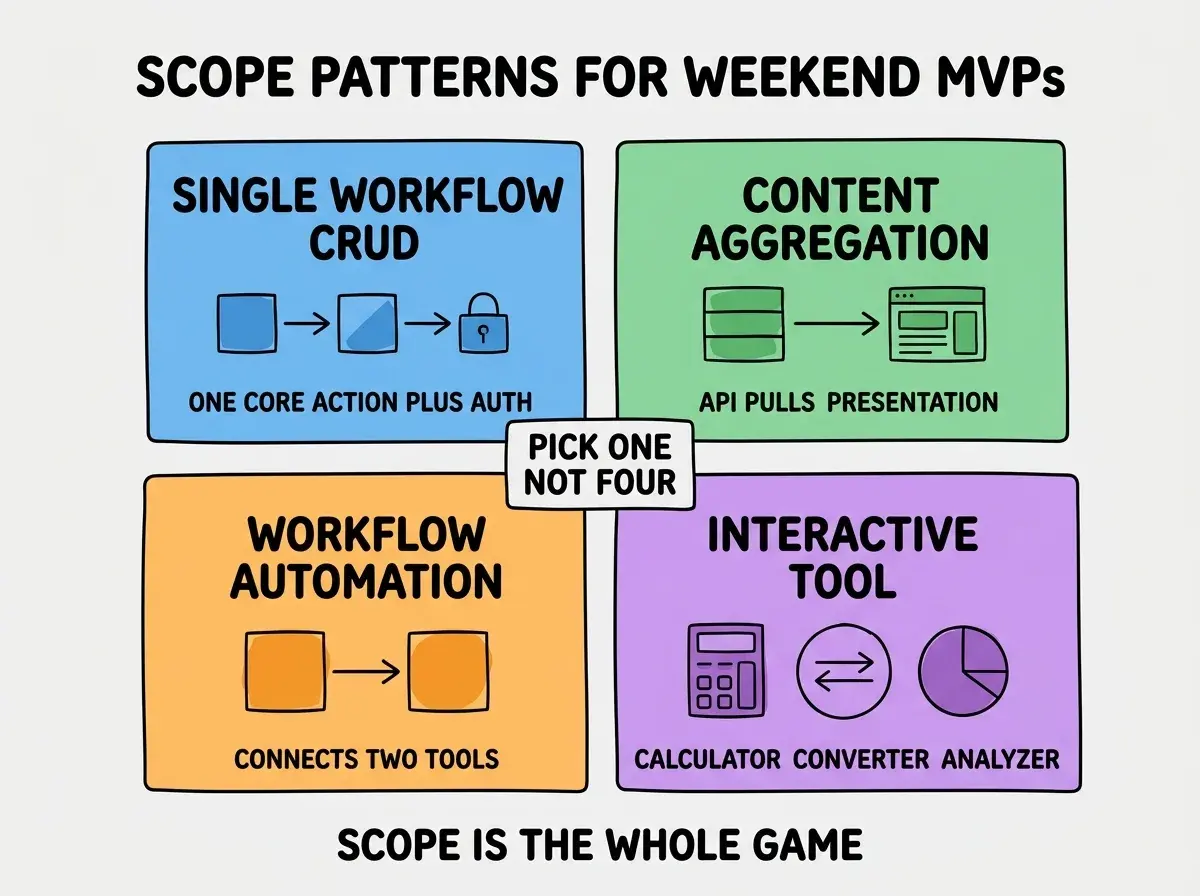
Pattern 3, workflow automation. Connect two tools to do something useful (Slack to Notion, Stripe to email, GitHub to Calendar). AI handles the API plumbing; you handle the workflow logic.
Pattern 4, interactive tool. A calculator, converter, or analyzer that takes input and produces useful output. Examples: tax estimators, date calculators, text analyzers. No backend required for the simplest versions.
The 48-Hour Time Allocation
Three time blocks structure the weekend so it ends in shipping rather than abandonment.
Block 1, hours 0-8, scope and scaffold. Friday night plus Saturday morning. Lock the scope (the single hardest decision), set up the project, get auth and database working. Resist building features.
Browse more MVP and validation guides
Read more foundations articlesBlock 2, hours 8-32, build the core workflow. Saturday afternoon through Sunday afternoon. The actual feature work. Use AI heavily; do not write code from scratch when AI can scaffold it. Stop adding features by hour 28.
Block 3, hours 32-48, polish and ship. Sunday afternoon and evening. Fix the obvious bugs, add basic styling, deploy to production, write a launch post. The polish phase is what separates "demo on localhost" from "live on the internet."
What to Sacrifice for Weekend Speed
Three sacrifices are non-negotiable for weekend timelines. Trying to keep them all turns 48 hours into 480 hours.
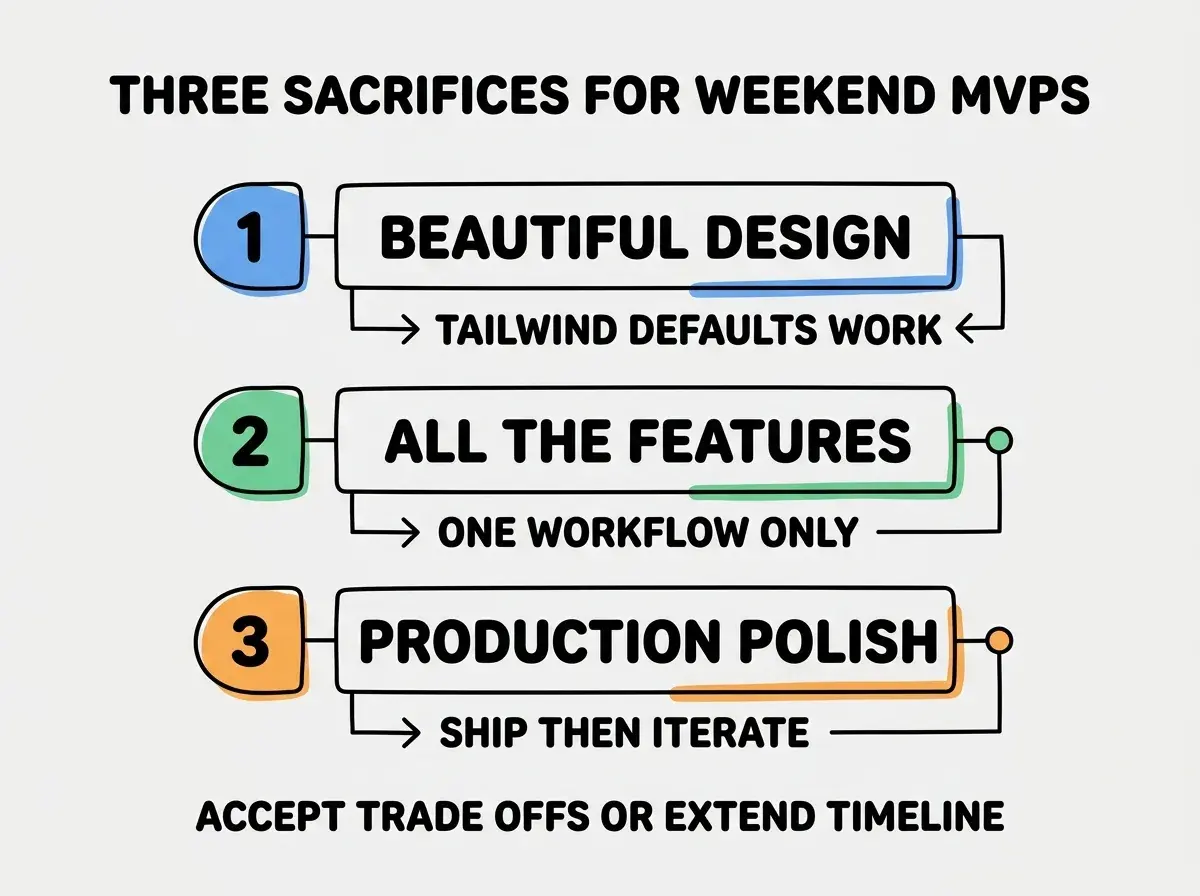
Sacrifice 1, beautiful design. Use Tailwind defaults, shadcn/ui components, sensible color choices. Stop. Custom design takes weeks; weekend MVPs ship with default design and improve it later if the concept validates.
Sacrifice 2, all the features. One workflow only. Every additional feature multiplies the integration testing burden. Five-feature weekend MVPs almost never ship; one-feature weekend MVPs often do.
Sacrifice 3, production polish. Error handling, edge cases, accessibility, performance optimization. These matter for production but kill weekend velocity. Ship the demo; improve the polish in week 2.
How to Prepare Before the Weekend Starts
Three preparation tasks before Friday night dramatically increase weekend shipping rates.
Task 1, lock the scope precisely. Write a one-page document describing exactly what the MVP will do (and explicitly what it will not do). The document is the contract you make with yourself; refer to it Saturday afternoon when scope creep tempts you.
Task 2, set up the development environment in advance. Account creation for hosting, domain registration, API keys for services you will use. The setup is boring but consumes hours during the weekend if not pre-done.
Task 3, identify your AI assistance approach. Cursor, Claude Code, or Copilot configured and ready. The prompting style and tool fit takes hours to learn during a project; learn it before the weekend starts.
The combination removes hours of friction from the weekend itself. Founders who prepare ship dramatically more often than founders who try to do prep work and building simultaneously.
How to Decide if the Weekend MVP Validated
Three signals indicate the weekend MVP succeeded as validation, regardless of whether it became a real product.
Signal 1, you learned something specific about the problem. If 48 hours of building taught you something you could not have learned through research, the weekend was successful. The learning is the deliverable.
Signal 2, you have an honest opinion about the next 30 days. Either "this is worth pursuing" or "this is not worth pursuing." Both are valid outcomes; the weekend MVP gave you the data.
Signal 3, you can show it to potential users. Even a rough demo enables real conversations with real users. If the weekend produced something showable, you can have those conversations.
The combination determines whether the weekend was successful. Without any of these signals, the weekend produced code but not learning, which is the worst outcome.
The most damaging weekend MVP mistake is choosing a scope that requires more than one workflow to demonstrate value. Founders try to build "an Airbnb for X" or "a CRM for Y" in a weekend, then discover by Sunday afternoon that they have neither feature complete. The fix is to scope brutally; if the demo cannot work with one workflow, the weekend MVP scope is wrong. Founders who scope to one workflow ship 4x more often than founders who attempt multi-workflow products in 48 hours. Scope discipline is the highest-leverage weekend decision.
The other mistake is treating the weekend output as ready for paying customers. Real customers expect reliability, security, and polish that weekend MVPs do not have. Use the weekend output for validation conversations and free beta users; charge money only after several more weeks of production work. Charging too early produces refund requests and damaged reputation.
What This Means For You
Weekend MVPs are a real and valuable practice in 2026, but the realistic version differs significantly from the hype version. Calibrating expectations produces dramatically better outcomes than chasing the marketing narrative.
- If you're a founder: Plan weekend MVPs as validation sprints, not launch events. The follow-up matters more than the weekend itself.
- If you're changing careers into founder roles: Practice weekend MVPs to build the shipping muscle. The skill transfers across every product you ever build.
- If you're a student: Use weekend MVPs as portfolio projects. Even rough versions demonstrate the ability to scope, build, and ship within constraints.
Browse more validation guides
Read more foundations articles