To decide whether AI saves money vs hiring a developer in 2026, recognize that AI tools are dramatically cheaper for prototype-stage and validation work but lose their cost advantage when projects need substantial production engineering, evaluate against four scenarios that determine the right choice (validation and prototyping, simple production work, complex production work, ongoing maintenance), and calculate the break-even point honestly using real numbers rather than aspirational comparisons. AI is not universally cheaper; it is cheaper in specific situations and more expensive in others.
This piece walks through the four scenarios, the break-even calculation, the hidden costs both options carry, and the four mistakes founders make when comparing AI to developer hiring.
Why This Comparison Is Often Done Wrong
Most AI vs developer comparisons compare list prices: "$50/month for AI vs $10K/month for a developer." The comparison is misleading because the work outputs differ dramatically. AI excels at scaffolding and exploration; developers excel at architecture and production work. Comparing prices without comparing capabilities produces wrong conclusions.
The 2026 reality is that the right comparison depends on what work you actually need done. Validation work strongly favors AI; mature production engineering favors hired developers. The middle is genuinely contested and depends on specifics.
A 2025 First Round Capital portfolio analysis of 300 startups using both AI tools and human developers found that AI tools produced 8-12x cost advantage for validation and prototype work but only 1.5-2x cost advantage for production engineering. For complex production work (scale infrastructure, complex domains, regulatory environments), human developers were often cheaper than AI when total project costs were calculated honestly. The break-even point depends entirely on work type; one-size-fits-all comparisons mislead.
The pattern to copy is the way construction projects evaluate prefab vs custom-built. Prefab dominates simple structures (sheds, basic homes); custom-built dominates complex projects (custom homes, commercial buildings). Each approach wins in its zone; the choice depends on the project. AI vs developer comparisons follow the same logic; one wins in some zones, the other in others.
The Four Scenarios
Four scenarios cover most situations. Each has different cost economics.
Scenario 1, validation and prototyping. AI dominates dramatically. Speed of iteration matters more than code quality; throwaway nature reduces the cost of imperfect output. AI is 10-20x cheaper for this work.
Scenario 2, simple production work. AI competes well. CRUD apps, basic dashboards, standard integrations. AI handles 80 percent at fraction of cost; the remaining 20 percent (production polish) needs human attention but the total still favors AI.
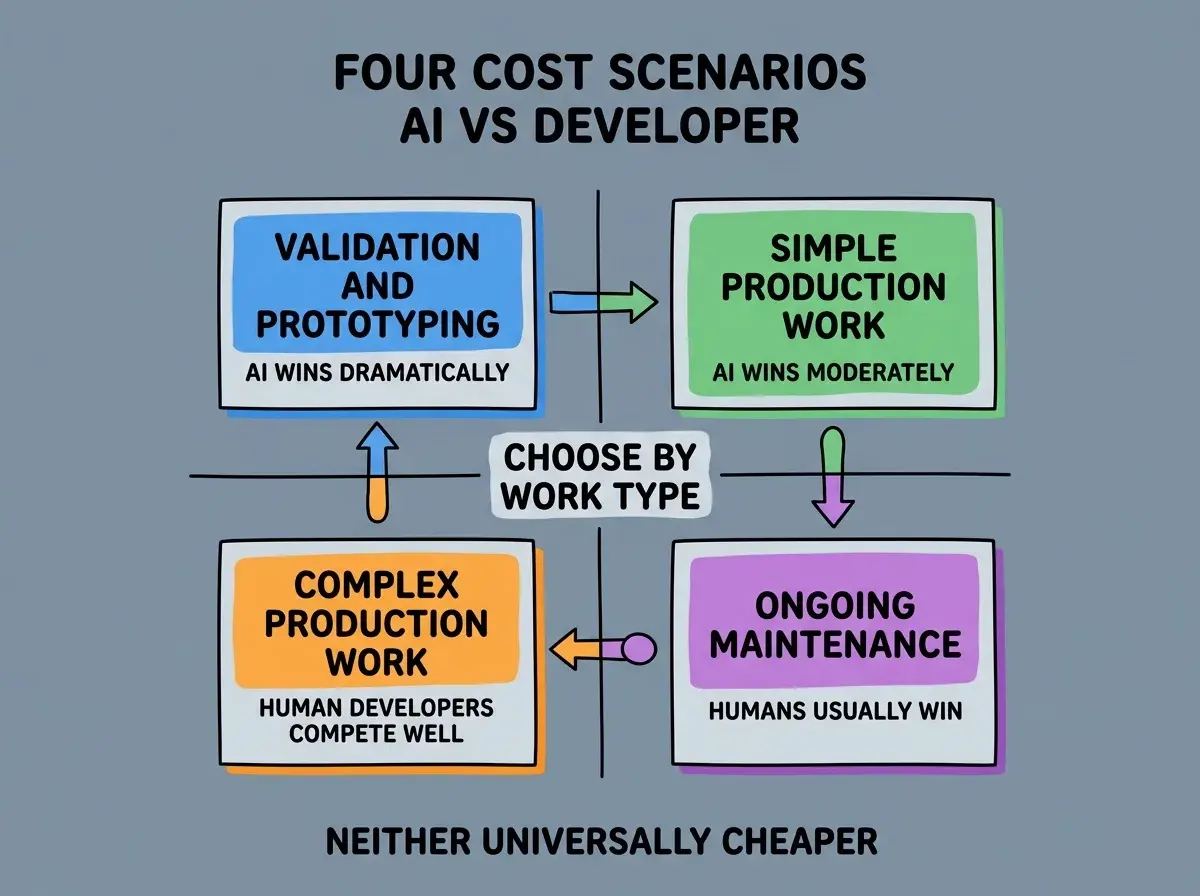
Scenario 3, complex production work. Human developers compete well. Architectural decisions, performance optimization, complex domain logic. AI assists but humans drive; total cost may favor humans for complex projects.
Scenario 4, ongoing maintenance. Humans usually win. Long-term maintenance requires deep system understanding that AI tools struggle to maintain across sessions. Humans amortize learning across years; AI restarts each session.
How to Calculate the Break-Even
Three calculation patterns produce realistic break-even points.
Pattern 1, value the work output, not the hours. AI producing 100 hours of output for $50 vs human producing 40 hours of output for $10K is the comparison that matters. Compare outputs; raw hour counts mislead.
Browse more cost analysis guides
Read more foundations articlesPattern 2, factor your time into AI cost. AI work requires founder oversight; founder time has cost too. AI plus 10 founder hours often costs more than a developer plus 1 founder hour; account for the management overhead.
Pattern 3, factor quality differences into total cost. Lower quality output produces downstream costs (bugs, support tickets, rework). The downstream costs often exceed the upstream savings; account for them honestly.
The Hidden Costs Both Options Carry
Three hidden cost patterns appear consistently. Most comparisons miss them.
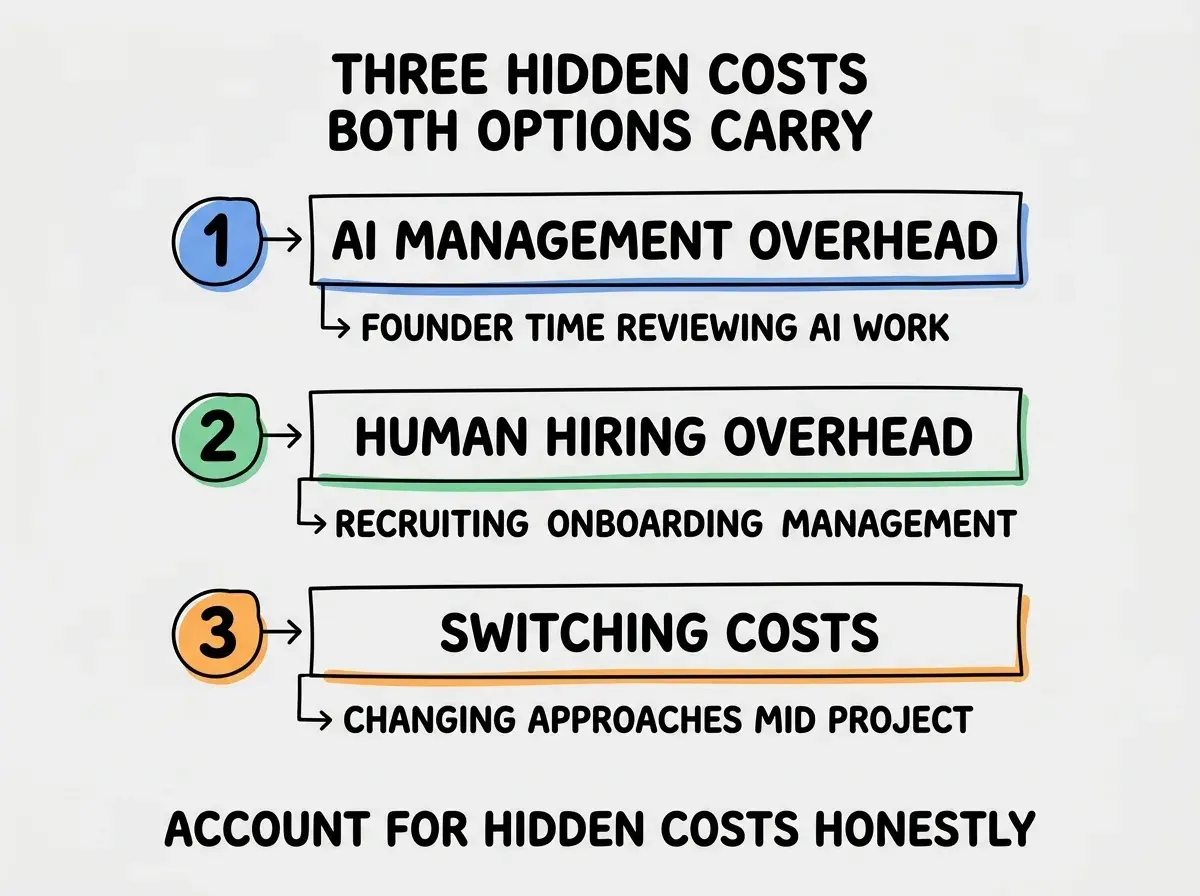
Cost 1, AI management overhead. Reviewing AI work, providing context, handling AI mistakes. Real founder hours that should appear in AI cost calculations but usually do not.
Cost 2, human hiring overhead. Recruiting, interviewing, onboarding, ongoing management. Real founder hours that should appear in developer cost calculations but usually do not.
Cost 3, switching costs. Changing approaches mid-project (firing the developer to use AI, or graduating from AI to hired developer) carries substantial costs. Stay with one approach long enough to amortize the setup.
How the Comparison Changes Over the Project Lifecycle
Three lifecycle phases produce different cost answers even within the same project.
Phase 1, ideation through MVP (months 0-3). AI dominates. Speed and cost matter more than quality; throwaway iterations favor AI economics. Hiring developers at this stage often slows the founder down.
Phase 2, MVP to product-market-fit (months 3-12). Mixed economics. AI handles many things; specific complex pieces benefit from developer attention. Many founders use AI primarily with developer help on hard problems.
Phase 3, scale and maintenance (year 1+). Developers usually win. Sustained system understanding, architectural decisions, complex production work all favor humans. AI assists but does not lead.
The combination explains why AI vs developer is not a one-time decision but an evolving choice. Founders who recognize the phase changes adjust their approach; founders who default to one approach face mismatched economics at later stages.
How to Decide for Your Specific Project
Three decision principles help pick the right approach for your situation.
Principle 1, default to AI for validation and early prototyping. Below substantial product-market-fit, AI almost always wins. The 8-12x cost advantage for early work is overwhelming.
Principle 2, default to humans for complex production at scale. Above significant scale, human judgment for architecture and production becomes the bottleneck. AI assists; humans drive.
Principle 3, evaluate the middle case honestly. Mid-stage work (post-validation, pre-scale) is genuinely contested. Run honest calculations rather than defaulting to whichever feels cheaper.
The combination produces calibrated decisions. Without explicit principles, founders default to whichever option matches their identity (AI fans pick AI; engineering fans pick humans) regardless of project fit.
The most damaging cost-comparison mistake is comparing today's AI tool prices to today's developer prices without accounting for trajectory. AI tools improve and get cheaper monthly; developer rates rise with experience and inflation. Today's break-even point shifts every quarter. The fix is to make decisions based on current data but revisit annually; what was right in early 2025 may be wrong by mid-2026 as both AI capabilities and developer costs evolve. Continuous reassessment beats one-time decisions for tooling choices.
The other mistake is treating the choice as binary when it is really a portfolio. Most successful AI-built companies use AI heavily for some work (prototyping, simple features, exploration) while hiring developers for other work (architecture, complex domains, scale). The fix is to design a portfolio approach: AI for what AI does well, humans for what humans do well, both contributing to the same product. Portfolio thinking produces better outcomes than pure-AI or pure-human approaches.
A third mistake is comparing across different output qualities and treating them as equivalent. AI-generated production code with significant bugs costs more in user-facing problems than developer-written code with fewer bugs. The bug rate is part of the cost; ignoring it understates the AI option's true total cost. Account for quality differences honestly.
What This Means For You
The AI vs developer choice is consequential and benefits from explicit analysis rather than assumption. The four scenarios, break-even calculations, and decision principles produce reasonable outcomes for most situations.
- If you're a founder: Run honest cost calculations for your specific situation. The default answer (AI cheaper for everything) is wrong; the right answer depends on your work mix.
- If you're changing careers into business or operations: Cost analysis fluency is increasingly expected. Practice calculating real costs for hypothetical projects.
- If you're a student: Study how successful AI-built companies use the portfolio approach. The hybrid model is the norm; pure-AI and pure-human are edge cases.
Browse more business strategy guides
Read more foundations articles