Technical debt is the accumulated cost of shortcuts in your codebase that make every future change harder, slower, and more expensive. The term was coined by programmer Ward Cunningham in 1992, and it remains one of the most important concepts in software now that AI tools make it easier than ever to take shortcuts without realizing it.
If you have ever wondered why adding a "simple" feature suddenly takes weeks instead of hours, or why your developer says "we need to refactor before we can build that," you are feeling the effects of technical debt.
Credit Card Debt for Your Codebase
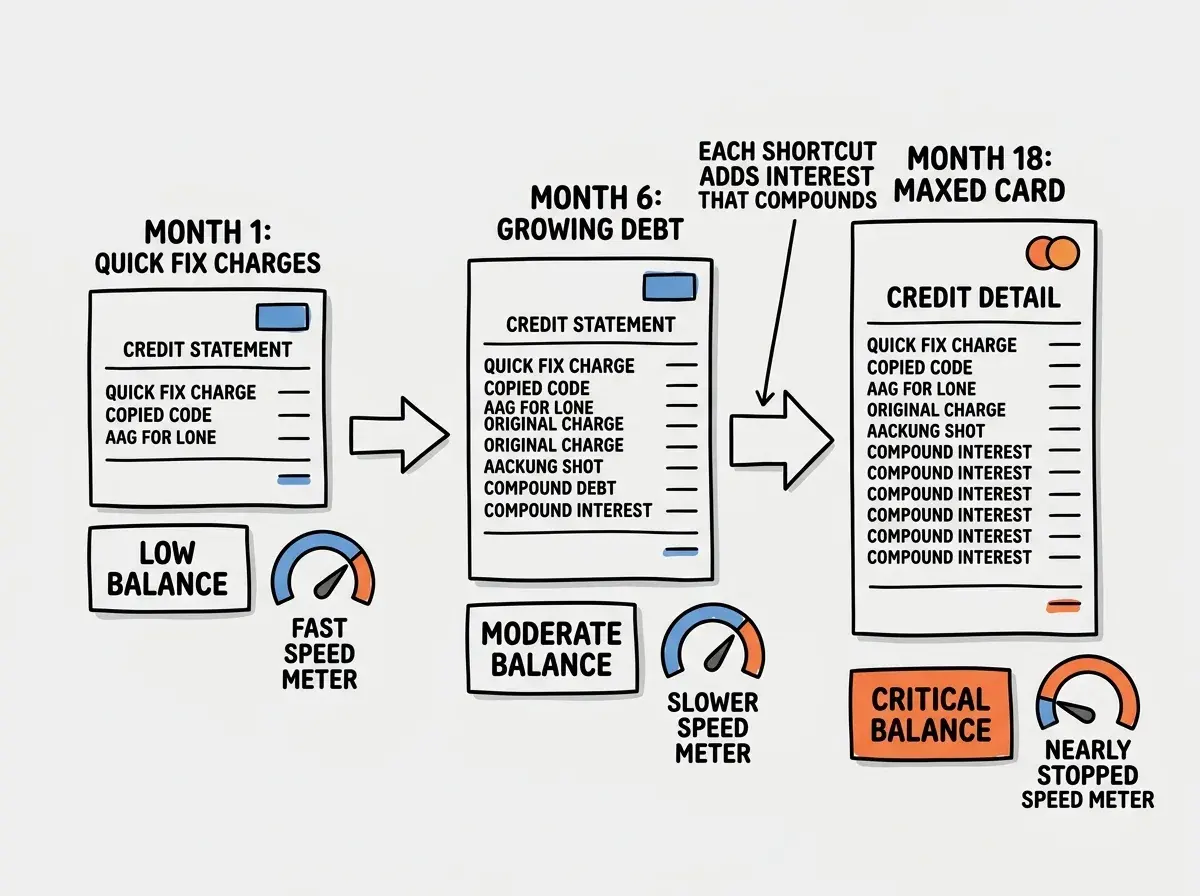
Think of technical debt exactly like credit card debt. Every shortcut you take in your code is like putting a purchase on a credit card. You get the thing now (the feature ships), but you owe interest later (future maintenance, bug fixes, and the growing difficulty of making changes).
A few charges on the credit card are fine. Sometimes you need to ship fast, and a shortcut is the right call. You will pay it off next month.
The problem is when you keep charging without paying down the balance. Interest compounds. Each new charge costs more because you are paying interest on top of interest. Eventually, the minimum payment consumes your entire budget and you cannot afford new purchases at all.
In a codebase, this looks like a project where adding a button takes three days because the code is so tangled that changing one thing breaks five others. The "interest" is the extra time, frustration, and bugs that accumulate with every shortcut you never went back to clean up.
How Shortcuts Become Debt
This confuses everyone at first because individual shortcuts seem harmless. Each one is a small, reasonable decision. The debt accumulates not from any single shortcut but from the pattern of never going back to fix them.
Here are common shortcuts that create technical debt. Copying and pasting code instead of creating a reusable function. Hardcoding values that should be configurable. Skipping error handling because "it works for now." Naming variables temp or data2 because you are moving fast.
None of these are catastrophic on their own. But fifty pieces of copied code scattered across your project means that fixing a bug requires finding and updating all fifty copies. Miss one, and the bug persists in a way that is nearly impossible to track down.
A single $50 charge is trivial. Fifty $50 charges with 24% interest, never paid down, becomes a financial emergency. The individual purchases were not the problem. The pattern was.
Why AI-Built Apps Max Out the Card Faster
Here is where this concept becomes especially relevant for vibe coders. AI coding tools are optimized to make things work right now. They are not optimized to make things maintainable later. Every time you prompt an AI to "just make it work," you are essentially saying "put it on the card."
AI generates what developers call "structurally shallow" code. It solves the immediate problem without asking deeper questions. A human developer might pause and think "will this database schema be painful to migrate when we add teams?" An AI builds the schema that works for the current request and moves on.
The numbers tell the story. A study found that 41% of AI-generated code gets reverted within two weeks. The code shipped, caused problems, and had to be undone. That revert cycle is technical debt in action: the shortcut created interest that had to be paid immediately.
Mo Bitar, a developer who spent two years building with AI tools, described the result with painful honesty: "Despite reviewing individual code changes, the full codebase became pure, unadulterated slop." He reviewed each piece individually, and each piece seemed fine. But the accumulated whole was unmaintainable. That is compound interest at work.
You might think that AI-generated code is either good or bad. But actually, most AI code is individually reasonable and collectively problematic. Each function works. The architecture does not. Each room in the house is fine, but the hallways do not connect and the plumbing runs through the living room.
Technical debt is not about writing bad code. It is about the gap between "it works now" and "it will keep working as the project grows." Every project accumulates some debt. The danger is not having debt; it is not knowing you have it. AI tools accelerate debt accumulation because they optimize for immediate results without considering long-term structure. Awareness is the first step toward managing it.
Recognizing the Warning Signs
How do you know when technical debt is becoming a problem? The symptoms are consistent and recognizable.
Features take longer and longer to build. The first feature took a day. The fifth took a week. The tenth takes a month. If each new feature is harder than the last, debt is accumulating.
Bugs appear in unrelated areas. You change the login page and the checkout breaks. When code is tightly coupled (tangled together instead of cleanly separated), changes ripple unpredictably through the system.
You are afraid to touch certain files. Every codebase eventually develops "haunted" files that nobody wants to modify because they break things in mysterious ways. Those files are concentrated pockets of debt.
Onboarding new people takes forever. When a new developer or AI session needs hours of context before making a simple change, the "interest payments" are dominating the work.
You keep working around problems instead of fixing them. Every workaround is new debt on top of existing debt. When workarounds become the norm, the card is maxed out.
Understanding technical debt helps you work with AI more effectively and avoid the traps that slow projects down.
Learn the basicsPaying Down the Balance (Refactoring)
Refactoring is the process of improving your code's structure without changing what it does. It is paying down your credit card balance. The features stay the same, but the codebase becomes cleaner and easier to change.
Good refactoring targets the highest-interest debt first. That tangled file everyone is afraid to touch? Untangle it. Those fifty copies of the same code? Consolidate them into one reusable function.
The challenge is that refactoring feels unproductive. You spend a day improving code, and from the user's perspective, nothing changed. This is exactly why technical debt accumulates. Paying down debt is invisible work, and invisible work gets deprioritized.
But the investment pays off. After refactoring, the next feature takes hours instead of days. Bug fixes become straightforward instead of archaeological expeditions.
A growing market has emerged around this need. Developers who specialize in cleaning up AI-generated codebases charge $200 to $400 per hour for what the industry calls "the cleanup economy." That price reflects the real cost of accumulated technical debt.
Is Technical Debt Always Bad
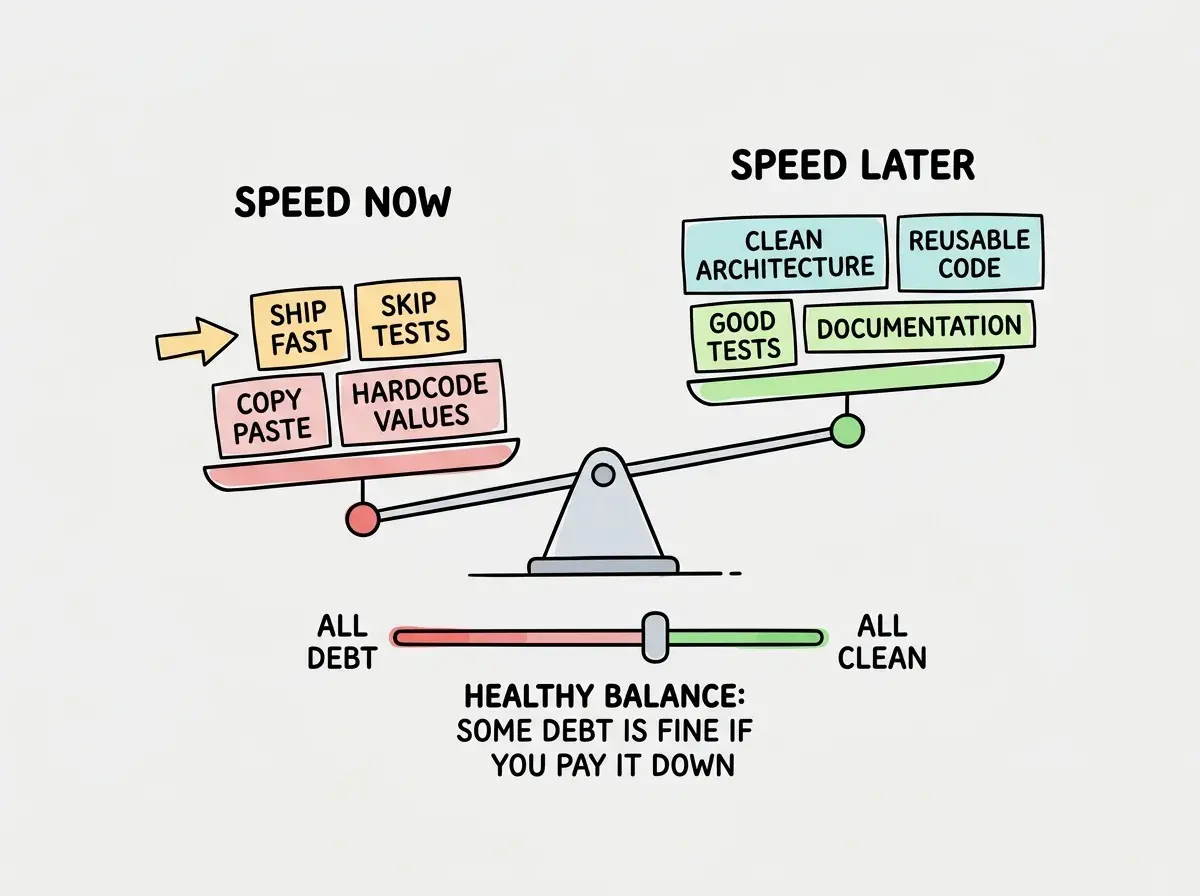
The goal is not zero technical debt. Sometimes debt is the right tool. Shipping an MVP fast to validate an idea is worth the debt because you might learn the idea does not work, and all that "clean" code would have been wasted.
The key is intentional debt versus accidental debt. Intentional debt is saying "I know this is a shortcut, and I will fix it after launch." Accidental debt is not realizing you took a shortcut at all, which is the default mode when AI writes your code.
Here is a practical framework for managing it as a vibe coder.
Review AI code for structure, not just functionality. Does the code create reusable pieces, or does it solve the same problem differently in five places?
Schedule regular refactoring. Dedicate 20% of your building time to cleanup. One day out of five. This prevents debt from compounding to the point where forward progress stops.
Keep a debt log. When you take a conscious shortcut, write it down. "Hardcoded the pricing tiers, needs to be configurable before launch." A known debt is manageable. An unknown debt is dangerous.
Ask AI to review its own code. Prompt your AI tool with "What shortcuts did this code take?" The answers are often revealing.
Thinking that rewriting the entire app from scratch is the solution to technical debt. It almost never is. Rewrites take two to three times longer than estimated, introduce new bugs, and often accumulate new debt of their own. Incremental refactoring, improving the worst parts piece by piece, is almost always more effective than starting over. Pay down the highest-interest debt first and work outward.
What This Means For You
Technical debt is credit card debt for your codebase. Every shortcut charges the card, and every unresolved shortcut accrues interest that makes future work harder and slower. AI tools tend to max out the card quickly because they optimize for "make it work now." The solution is not to avoid debt entirely but to manage it intentionally through regular refactoring and awareness of what you owe.
- If you are a founder or indie hacker building a product: Technical debt is the hidden cost that turns a promising product into an unmaintainable one. Budget time for refactoring the same way you budget for feature development. When your app starts feeling sluggish to build on, that is debt talking. The $200 to $400 per hour cleanup economy exists because founders who ignore debt eventually have no choice but to pay someone to fix it.
- If you are a career changer building with AI tools: Understanding technical debt separates builders who ship once from builders who ship continuously. After every AI-generated feature, ask yourself whether the code is maintainable or just functional. Build the habit of reviewing AI output for structural decisions, not just whether it runs.
- If you are a product manager evaluating development speed: When your team says "we need to slow down and refactor," they are asking to pay down debt before it becomes unmanageable. Denying that request is like making minimum payments on a maxed-out credit card. Advocate for regular refactoring sprints and track velocity over time to see the payoff.
Technical debt is one of many concepts that help you build apps that last. Explore the others.
Explore more