Your app works. Users can sign up, click buttons, and everything does what it is supposed to do. But under the surface, the code is a disaster. Functions are in the wrong files. Variables have names like temp2 and data_final_v3. There are three different ways to format a date, scattered across twelve files. Nothing is broken, but everything is harder than it should be.
Refactoring is the act of cleaning this up without changing what the app does. Not adding features. Not fixing bugs. Just reorganizing so the next time you (or your AI tool) need to make a change, you can actually find things.
The Kitchen That Works But Slows You Down
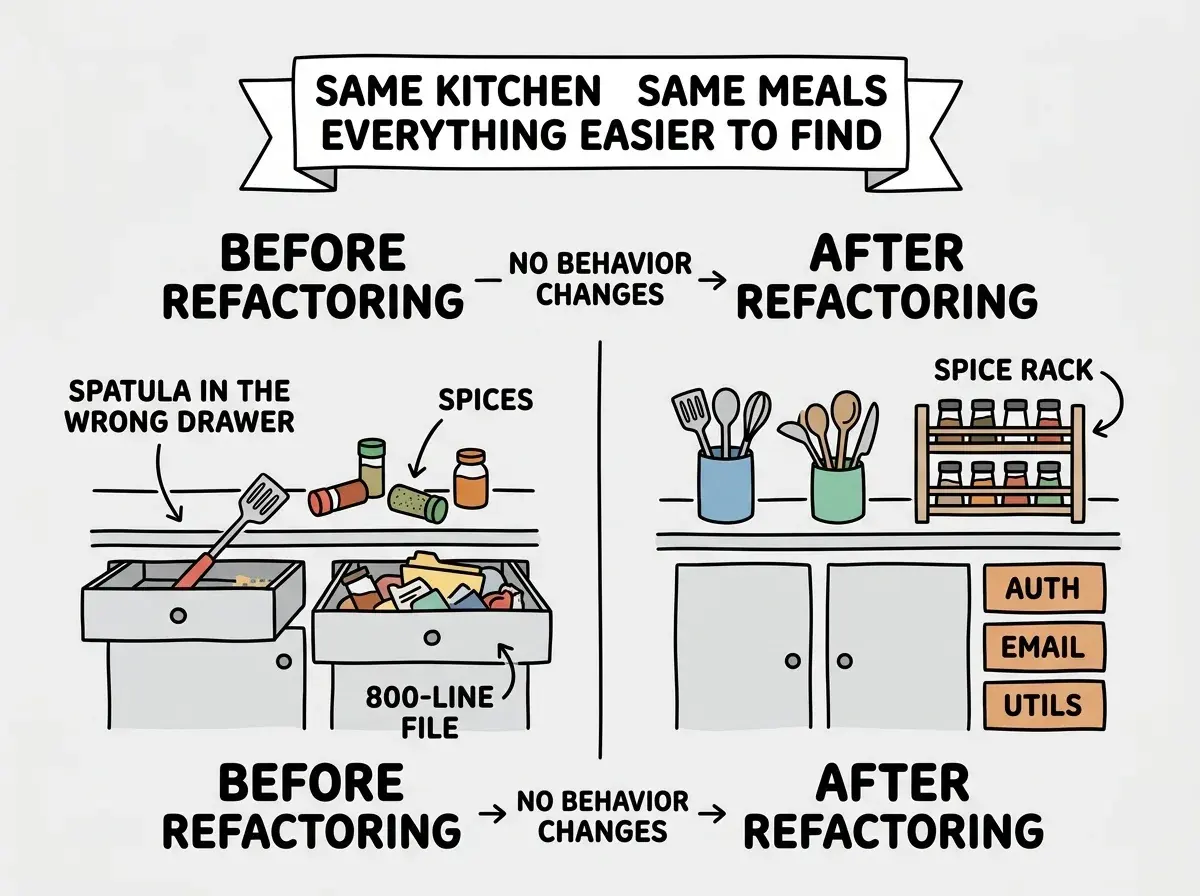
Imagine a kitchen where everything is functional but nothing is organized. The spatula is in the utensil drawer alongside three corkscrews, a roll of tape, and a pair of scissors. The salt is on the counter, the pepper is in the pantry, and the paprika is on top of the fridge. You can still cook. But finding the right thing at the right moment takes twice as long.
Refactoring is reorganizing that kitchen. You are not throwing away any food or changing any recipes. You are putting the spatula with the cooking utensils, grouping the spices together, and labeling containers so you do not have to open four jars to find the cumin.
The meals taste exactly the same after reorganizing. But you cook them faster, with less frustration, and with fewer moments where you accidentally grab cinnamon instead of chili powder. The app behaves identically before and after. The only thing that changes is how easy it is to work with.
Why Code Gets Messy in the First Place
This confuses everyone at first. If you just built the thing, how is it already messy?
Building software is an act of discovery. You do not know the final shape of your app when you start. You try one approach, it does not work, you try another. You add a feature you did not plan for. Each decision makes sense in the moment, but after a few weeks, the kitchen has accumulated clutter.
AI-generated code accelerates this problem dramatically. When you ask an AI to add a feature, it solves the immediate problem without considering how that solution fits into the broader structure. It is like a helpful assistant who puts the groceries away by shoving things wherever they fit. Technically everything is stored, but now the cereal is under the sink.
Mo Bitar, an experienced developer, described this phenomenon after two years of building with AI tools. "Despite reviewing individual code changes," he wrote, "the full codebase became pure, unadulterated slop." Each individual change looked fine. The accumulated effect was chaos.
This is not a theoretical problem. Research shows that 41% of AI-generated code gets reverted within two weeks. Not because the code was wrong, but because it created structural problems that made future changes too difficult. The code worked, but the kitchen was unusable.
Refactoring does not change what your app does. It changes how easy your app is to modify, extend, and debug. A well-refactored codebase lets you (and your AI tools) move faster because every function, file, and variable is where you would expect it to be. Think of it as the difference between cooking in a kitchen where everything has a logical place versus one where you spend half your time just looking for things.
Recognizing When Your Kitchen Needs Reorganizing
Professional developers talk about "code smells," which is a great term. A code smell does not mean something is broken. It means something feels off, like opening the fridge and catching a whiff of something questionable. You should investigate before it becomes a real problem.
Here are the most common code smells, translated to our kitchen analogy.
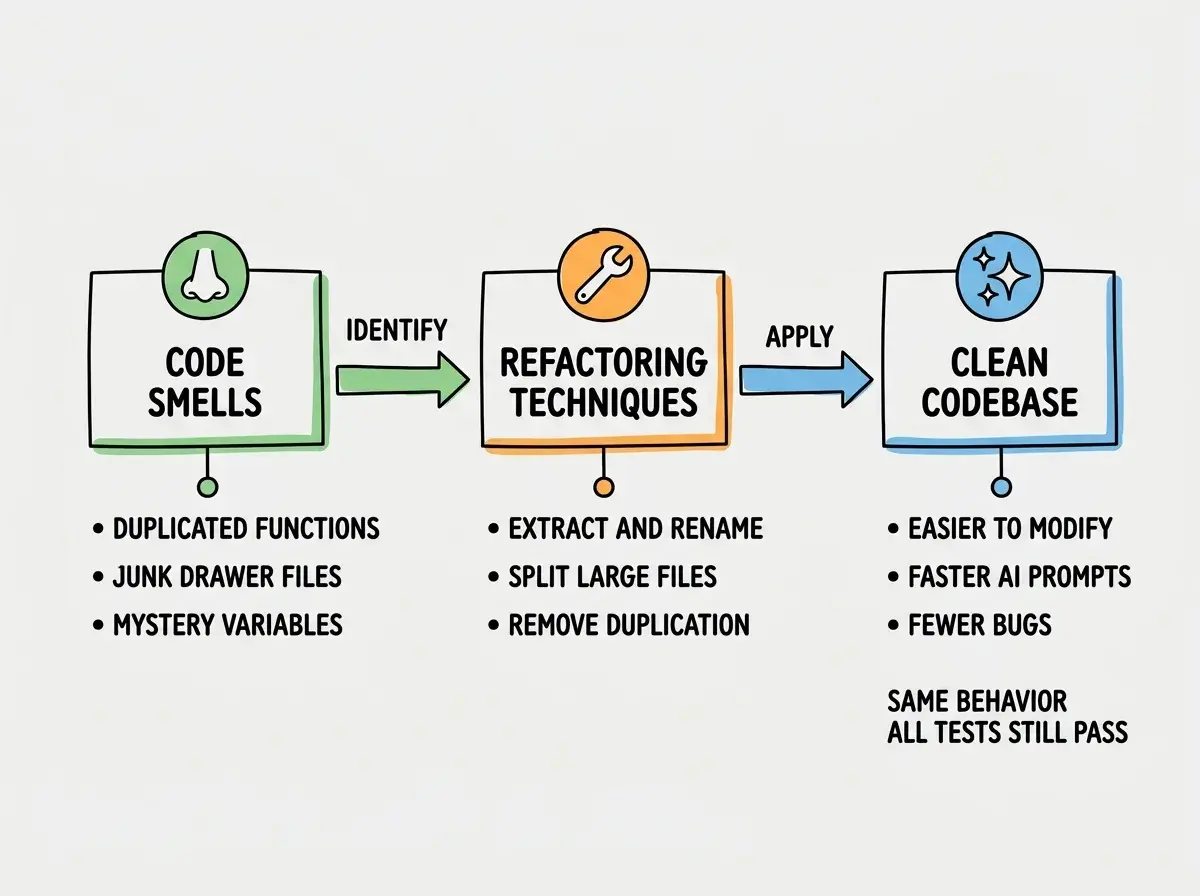
Duplicated recipes. The same function copied in three different files. This is like having three identical recipe cards in three different drawers. When you update the recipe, you have to find and update all three. Eventually you miss one, and now your app has inconsistent behavior.
The junk drawer. One file has grown to 800 lines and handles everything from user authentication to email formatting to date calculations. This is the drawer where everything without an obvious home gets tossed.
Mysterious labels. Variables named d, temp, handleStuff, or processData2. These are spice jars with the labels peeled off. You have to open each one and taste it to figure out what is inside.
Overly complicated recipes. A function that takes twelve parameters with nested if-statements five levels deep. This is a recipe requiring you to simultaneously monitor four burners, two oven racks, and a timer. It works, but nobody else can follow it.
The Boy Scout Rule and When to Actually Do It
There is a principle in software development called the Boy Scout Rule. Leave the code a little better than you found it. Every time you open a file to make a change, clean up one small thing. Rename a confusing variable. Extract a duplicated function. Add a comment that explains a tricky section.
In the kitchen analogy, this is like putting one thing back in its proper place every time you cook. You came in to make dinner, and while the water is boiling, you move the paprika off the fridge and into the spice rack. You do not reorganize the entire kitchen. You just leave it slightly better.
You might think refactoring should be saved for a big dedicated cleanup session. But actually, that approach almost never works. Dedicated "refactoring sprints" get deprioritized in favor of new features, pushed back quarter after quarter. The Boy Scout approach works because it is small enough to do consistently.
The exception is when the mess has gotten so bad that you cannot make progress. When every new feature breaks two existing features because the code is so tangled. That is when you need a focused reorganization effort.
Learn the patterns that help you manage AI-generated code and keep your projects moving forward.
Explore moreCan AI Tools Refactor Code for You
AI-generated code has specific patterns that need specific cleanup. Understanding these patterns helps you know what to look for.
Structural shallowness. AI tends to produce code that solves the immediate problem without building deeper abstractions. It gives you ten similar functions instead of one flexible function that handles all ten cases. In the kitchen, this is like having a separate cutting board for every vegetable. Technically functional, wildly inefficient.
Inconsistent conventions. If you have had multiple conversations with your AI tool, each session may have used different patterns. One used async/await, another used promises, a third used callbacks. This is like three different people organizing the kitchen according to their own systems.
Over-engineering. Sometimes AI adds complexity that is not needed. A full state management system for a page with two buttons. This is buying commercial kitchen equipment for a home kitchen.
The cleanup economy around AI code is real. Specialists now charge $200 to $400 per hour to refactor AI-generated codebases. Not because refactoring is inherently expensive, but because letting the mess accumulate makes it exponentially harder to untangle.
How to Refactor Without Breaking Things
The fear with refactoring is always the same. What if I reorganize the kitchen and accidentally throw away something important? What if moving the flour means the bread recipe stops working?
There are three safeguards that make this fear manageable.
First, have tests. Even basic tests that verify your main features work. Run them before you reorganize, run them after. If they pass, you did not break anything.
Second, make small changes. Do not reorganize the entire kitchen in one afternoon. Move one drawer at a time. Commit each change separately. If something breaks, you know exactly which small change caused it.
Third, use version control. Git is your safety net. If the reorganization goes sideways, you can always go back to the working version. This is like taking a photo of your kitchen before you start moving things.
Refactoring and adding features at the same time. When you reorganize the kitchen while also trying a new recipe, you cannot tell if the dish failed because of the new recipe or because you moved the oven mitts. Keep refactoring and feature work in separate commits. Refactor first, verify nothing broke, then add the new feature. This discipline saves hours of debugging.
What This Means For You
Refactoring is not optional maintenance that you can skip forever. It is the practice that keeps your codebase workable as it grows, and it matters even more when AI is generating chunks of your code.
- If you are a founder building a product: Budget time for code cleanup the same way you budget for feature development. A codebase that never gets refactored will slow your team down and increase your bug rate. When hiring developers, ask how they approach refactoring. The ones who take it seriously will save you from the $200-to-$400-per-hour cleanup specialists later.
- If you are a career changer learning to code: Learn to recognize code smells before you learn fancy design patterns. The ability to look at a file and say "this function is doing too many things" or "these three blocks are basically identical" is one of the most valuable skills in professional development. Practice the Boy Scout Rule from your very first project.
- If you are a student exploring software development: Refactoring is where you develop taste in code. Anyone can get something working. The skill that separates junior developers from senior ones is the ability to make working code clean, readable, and maintainable. Every time you refactor, you are building that judgment.
Learn the skills and patterns that turn AI-generated code into maintainable projects.
Start learning