Context engineering is the discipline of deciding what an AI coding tool sees at every step of a project. It rests on four pillars: persistent project context (CLAUDE.md, AGENTS.md), session-level context (open files, @-mentions, conversation history), retrieval (RAG, MCP servers, search tools), and durable memory (decision logs, summaries, scratchpads). Get those four right and the AI feels almost telepathic. Get them wrong and you spend your day arguing with a confidently wrong intern.
Most people who hit a wall with AI coding think they have a model problem. They do not. They have a context problem. This guide explains what context engineering actually is, why it took over from prompt engineering as the dominant frame in late 2025, and the practical moves you can make this week to feel the difference.
Why Context Engineering Matters Now
Three things shifted in 2025 to put context engineering on every senior developer's radar. First, context windows got long enough that what you put in them became the bigger question than how to fit. Models like Claude Opus 4.7 and Gemini 3 routinely take 200K to 1M tokens of context. The bottleneck is no longer storage. It is curation. Second, agentic loops became normal. A modern AI coder does not answer one prompt and stop. It plans, calls tools, reads files, edits, runs tests, and iterates for minutes or hours. Each step needs the right context fed into it, not a single perfect prompt up front. Third, every major editor (Cursor, Claude Code, Windsurf, Cline) shipped some flavor of project rules file, memory system, or MCP server support. The plumbing for context is now standard. The skill is using it well.
The phrase itself comes from a small group of practitioners (Tobi Lutke at Shopify, Andrej Karpathy, Simon Willison, Andrew Ng) who started using "context engineering" in late 2024 to name what they were already doing. By mid-2025 the term had crossed into mainstream developer vocabulary. Search volume sits at around 5,400 monthly searches as of February 2026, growing steadily. If you are reading this in a year, the number will be larger.
The model you pick matters less than the context you feed it. Practitioners who track this seriously report that switching from a careless context setup to a deliberate one moves output quality more than upgrading from a mid-tier model to a frontier one. Context engineering is the highest-leverage skill in AI-assisted coding right now.
The most useful way to internalise this: imagine you hired a brilliant contractor who shows up every morning with no memory of yesterday. They are smart, they can write any code you ask for, but they have never seen your project. What you hand them at 9am decides whether they ship something useful by 5pm. Context engineering is the practice of preparing that handoff.
The Four Pillars Explained
Each pillar handles a different time horizon, and you need all four working together.
Pillar 1, persistent project context. This is the file the AI reads before every conversation. CLAUDE.md for Claude Code. AGENTS.md as the emerging cross-tool standard. .cursorrules for Cursor. .windsurfrules for Windsurf. .clinerules for Cline. All of them serve the same purpose: tell the AI your stack, your conventions, your "do not" list, and the file structure of your project, once, so you never have to repeat yourself. A good persistent context file is 200 to 500 lines, written in plain language, and updated maybe once a week. It is the cheapest, highest-impact move in this whole list.
Pillar 2, session-level context. This is what changes from one conversation to the next. The files you have open, the ones you @-mention, the conversation history with the AI, the diff of recent changes you paste in. Session context is the noisiest pillar because it accumulates fast. A 90-minute conversation can balloon to 60K tokens of history, most of it irrelevant by the end. Good session context is small, deliberate, and refreshed often. The mantra "one concern per conversation" lives here.
Pillar 3, retrieval. This is how the AI gets information it does not already have. Codebase search, RAG over docs, MCP servers that expose your database or your design system, a Sentry MCP server that pulls error logs at debug time. Retrieval is the pillar that grew most in 2025. MCP went from a Claude-only experiment in November 2024 to an industry-standard interop layer by late 2025. If your AI coder cannot reach for the information it needs mid-task, you are leaving 30 to 50 percent of its capability on the table.
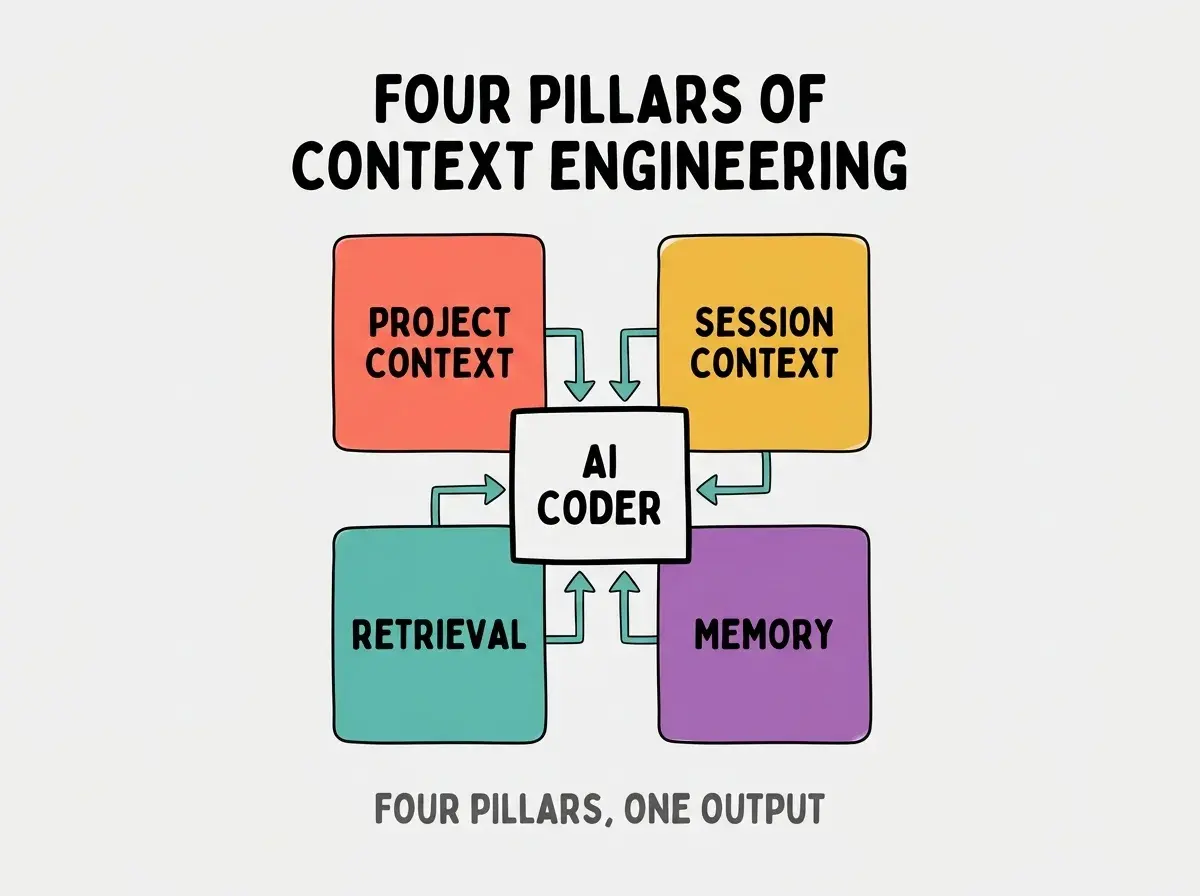
Pillar 4, durable memory. This is what survives between sessions. A DECISIONS.md file at the root of your repo that captures architectural choices ("we picked Supabase over Firebase because of RLS"). A scratchpad that the AI updates as it works through a long task. A vector store of past summaries the AI can search. Memory is the newest and least-standardised pillar. Tools are still figuring out the best UX for it, but every editor has shipped something in this direction (Claude Code's /memory command, Cursor's project rules, Cline's memory bank). Without memory, your AI re-litigates the same settled questions every Monday morning.
Agentic search and prompt caching rule everything around me.
How to Start This Week
You do not need to overhaul your workflow. Pick one move from each pillar and stack them.
For project context, write a CLAUDE.md (or AGENTS.md if you want cross-tool compatibility) for your most active project. Cover your stack with versions, your file structure, your code style preferences, and three to five "do not" rules. Spend 30 minutes on it. Update it whenever you catch the AI making the same mistake twice.
For session context, adopt one rule: when you start a new task, you start a new conversation. Resist the urge to keep an old conversation alive because "the AI already knows the project." It half-knows it, badly. A fresh conversation with the right three to five files in context beats a sprawling thread every time.
Get the four-pillar setup running in your project this week
See the playbookFor retrieval, install one MCP server. The filesystem server if you do not have it already. The GitHub server if you work on a team. The Sentry or Linear server if you debug production issues frequently. One server, configured properly, will save you more keystrokes in a week than you spent setting it up.
For memory, create a DECISIONS.md file in your repo root. Add a one-line entry every time you make an architectural call ("2026-02-12: chose Drizzle over Prisma, ORM was too heavy for our edge runtime"). Reference it in your CLAUDE.md so the AI reads it on every conversation. You will be surprised how quickly the AI starts sounding like a teammate who actually remembers what you decided last week.
How Context Engineering Differs From Prompt Engineering
Prompt engineering is the craft of writing one good message to an AI. Context engineering is the practice of running an entire AI-assisted system over weeks and months. The two are not opposed. Prompt engineering is a subset of context engineering, the way good copy is a subset of good marketing.
The shift in framing matters because the failure modes are different. A bad prompt produces a bad single response. A bad context system produces compound failure: the AI forgets your conventions, contradicts decisions from last week, generates code that calls deprecated functions, and slowly trains you to distrust its output. The fix is not a better prompt. The fix is structural.
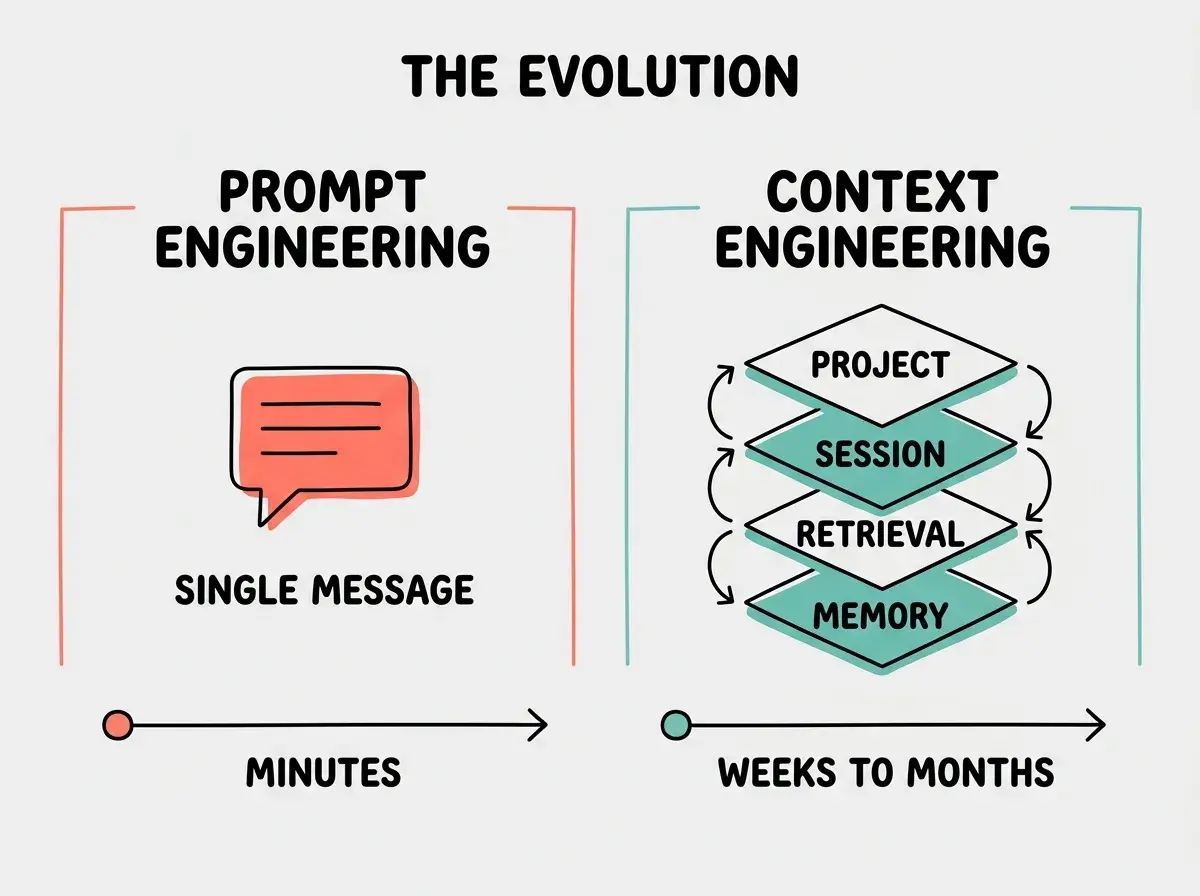
There is also a practical reason the field moved on. Prompt engineering peaked when models were small and brittle and a magic incantation actually changed the outcome. Modern frontier models are more robust to prompt phrasing. The same query with three different polite framings gets you broadly the same answer. What changes the answer is the context the model has access to. That is where the leverage went.
The most damaging context engineering mistake is treating the project context file as a write-once artifact. Teams write a great CLAUDE.md on day one, then never touch it. Six months later it lists React 18 patterns for a project that moved to React 19, points at a folder structure that got refactored, and bans an ESLint rule that got reversed in a PR no one remembers. Stale context is worse than no context, because the AI confidently follows it. Treat your project rules file like any other piece of source code: review it, refactor it, and update it the same week the underlying decision changes.
The other failure mode worth flagging is the opposite extreme: stuffing every possible piece of information into context "just in case." A 4000-line CLAUDE.md does not produce a more careful AI; it produces a distracted one. Models pay more attention to information at the start and end of their context windows. Anything stuck in the middle of a bloated context file gets reliably underweighted. Restraint is part of the discipline.
What This Means For You
Context engineering is the skill that separates people who use AI tools casually from people who ship serious work with them. The good news is that the moves are not difficult, just deliberate. You do not need a PhD in prompt design or a custom-trained model. You need a project rules file, a habit of starting fresh conversations, one MCP server, and a decisions log. Stack those four and the difference is immediate.
- If you are a senior developer, treat your CLAUDE.md or AGENTS.md as part of the codebase. Review it on PRs. Refactor it when it grows past 500 lines. Pair it with a DECISIONS.md and you have an institutional memory layer that survives team turnover.
- If you are an indie hacker, the highest-leverage move is the decisions log. You are the only person on the project, which means context loss between sessions is your single biggest productivity drain. Twenty seconds of writing today saves you ten minutes of re-explaining tomorrow.
- If you are a founder or product manager, you do not need to write code to benefit from this. The same pillars apply to product specs, design briefs, and customer interview notes. A persistent context file plus a fresh-conversation habit improves AI-assisted writing the same way it improves AI-assisted coding.
- If you are a student or career changer, learn the pillars before you learn any specific tool. Tools change every six months. The four pillars have been stable since people started naming them, and they will outlast whatever editor you start with.
The teams shipping the most ambitious AI-assisted projects in 2026 are not the ones with the biggest budgets or the newest models. They are the ones who treat context as the primary surface to engineer, and everything else as variable.
From project rules to memory layers, get the practical guide
Read the next post