Context engineering and prompt engineering work on different time horizons. Prompt engineering is the craft of writing one message that gets one good response. Context engineering is the discipline of building the project rules, retrieval tools, and memory systems that shape every response over weeks and months. They are not competitors. Prompt engineering is a subset of context engineering, the way wording is a subset of writing.
The reason the framing shifted in late 2025 is that the failure modes you actually hit on real projects stopped responding to better prompts and started responding to better systems. This piece explains what changed, what each discipline still owns, and where the leverage genuinely lives now.
Why The Frame Shifted
Three forces collapsed prompt engineering from the dominant skill into a small craft inside a larger one.
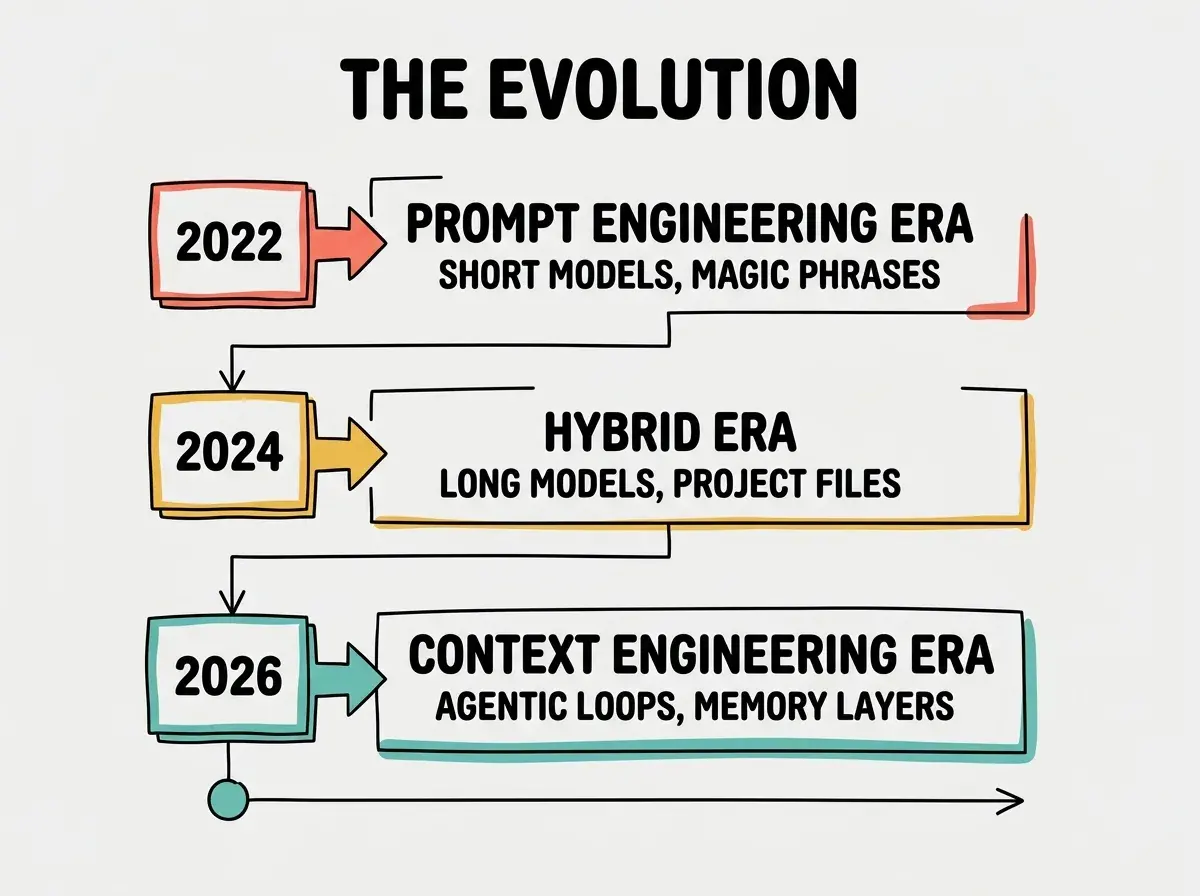
The first is model robustness. Frontier models in 2026 (Claude Opus 4.7, GPT-5, Gemini 3) are dramatically less prompt-sensitive than the GPT-3.5 generation that produced the term "prompt engineering" in 2022. Three differently-phrased polite requests for the same thing will get you broadly the same answer. The magic incantations that mattered in 2022 ("you are an expert", "think step by step") have been baked into post-training. A small prompt edge still exists at the margins, but it is not where the gains live anymore.
The second is the rise of agentic loops. A modern AI coding session is not one prompt and one reply. It is a planning step, twenty tool calls, a few file reads, three file writes, two test runs, and a summary. Even if you write the perfect opening prompt, you control 1 of 50 messages in the session. The other 49 are populated by whatever the system has been engineered to feed the model. That is context engineering, not prompt engineering.
The third is project complexity. The interesting work in AI-assisted coding moved from "write a function" to "ship and maintain a real codebase." A real codebase has decisions, conventions, half-finished refactors, deprecated APIs, and three different state management patterns layered over four years. No single prompt can carry that. The information has to live somewhere durable, get retrieved on demand, and survive between sessions. That is a system design problem, not a prompt design problem.
The same prompt produces dramatically different code depending on what the AI has access to when it answers. Context engineering decides what the AI has access to. That is why a careful project setup with a mid-tier model regularly outperforms a sloppy setup with a frontier model, even though the cost is often lower.
This does not mean prompt engineering is dead. It means it is no longer the highest-leverage skill. A senior practitioner in 2026 spends maybe 10 percent of their AI-related effort on the words of any given prompt and 90 percent on the surrounding system: project rules, file scoping, memory layers, retrieval tools.
What Each Discipline Actually Owns
The cleanest analogy is a kitchen. Prompt engineering is the order ticket: the words on the slip that go to the line. Context engineering is the restaurant: the menu, the ingredient suppliers, the prep, the recipe binder, the standing instructions for how the kitchen handles a sub-in.
Prompt engineering still owns:
- The wording of a one-shot ask ("rewrite this in TypeScript", "explain this regex")
- The structure of a few-shot example block when you want a specific output format
- The role-priming line at the top of a chain-of-thought prompt
- The phrasing of evaluation prompts in eval pipelines
These are still real skills. They still move the needle, especially when you are running a prompt at high volume in production where 5 percent quality matters.
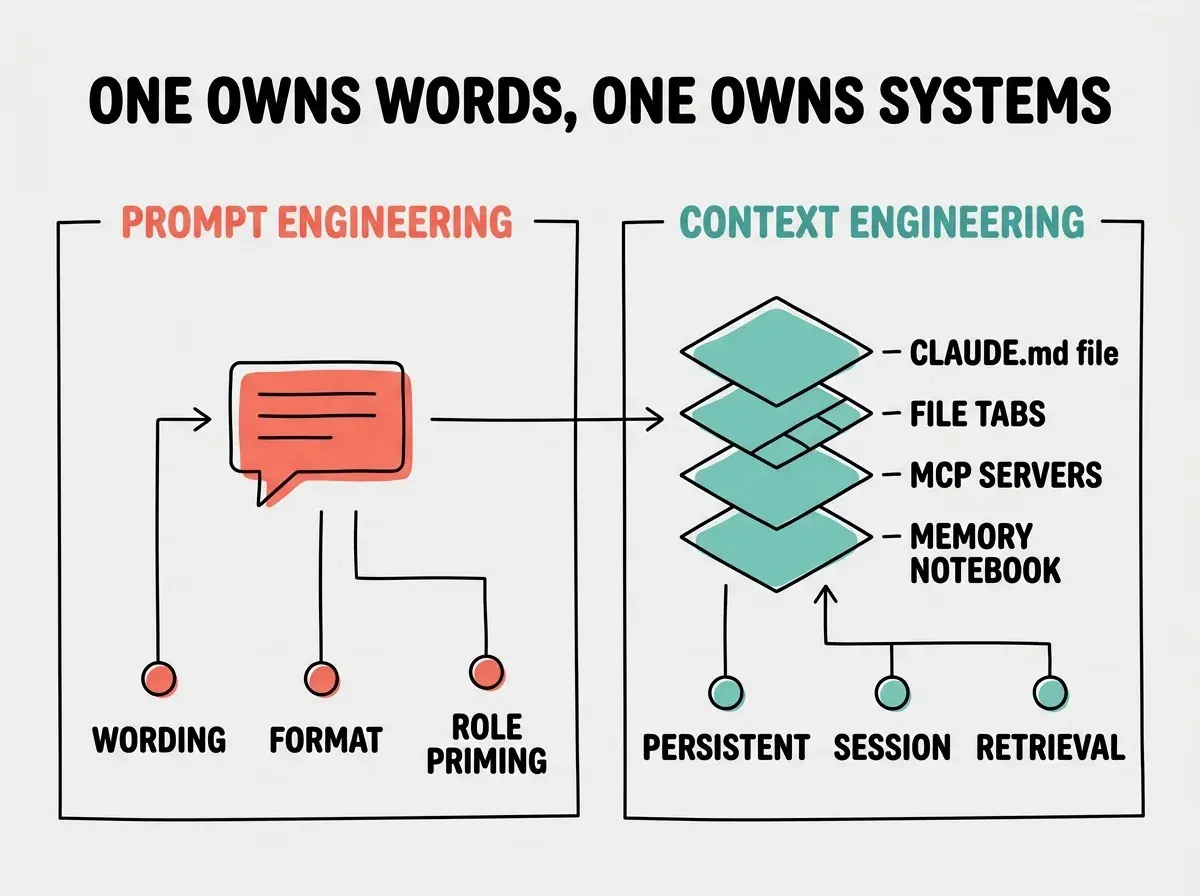
Context engineering owns:
- What CLAUDE.md or AGENTS.md says about your stack and conventions
- Which files are open or @-mentioned in any given session
- Whether the AI can reach out via MCP to your database, error logs, or design system
- What survives between sessions in a decisions log or memory file
- How you scope a multi-step task so each step gets the right slice of the project
Notice the asymmetry. The prompt engineering list is about a single moment. The context engineering list is about a system running for months. That is why one feels like a craft skill and the other feels like an architecture skill. They both matter; they just live at different altitudes.
When Prompt Engineering Still Matters
There are three real situations where the wording of the prompt is genuinely the bottleneck, and squeezing it pays off.
The first is high-volume production prompts. If you have an LLM call running 100,000 times a day in a feature, a 5 percent quality bump from prompt tuning is worth real engineering hours. This is the world of evaluation suites, A/B-tested prompts, and prompt registries. Most readers of this article do not work in that world day-to-day, but it is real and active.
The second is one-shot batch tasks. If you are asking an AI to relabel 5,000 customer support tickets or extract structured data from 2,000 PDFs, you have one prompt running at scale. Tightening the wording, the role priming, and the few-shot examples actually matters because there is no agentic loop forgiving you.
See the practical playbook for getting it running this week
Read the guideThe third is novel domains. If you are pushing a model into territory it was not trained heavily on (specialised legal jargon, niche scientific notation, an internal DSL nobody else uses), you may need to coach phrasing harder than usual. Even here, the bigger wins usually come from retrieval (give the model docs about the domain) than from raw prompt phrasing.
For everyday AI-assisted coding, none of these three situations applies. You are running an interactive multi-turn session in your editor. The prompt is one move in a long conversation. The system around the conversation is what is actually shaping the output.
Where Context Engineering Takes Over
The clearest signal that you have crossed from prompt-land into context-land is when you start hearing yourself say the same thing to the AI repeatedly in different conversations. "Use Tailwind, not styled-components." "We use Zod, not Yup." "Server actions, not API routes." If you are repeating yourself, the AI is not the problem. The persistent context layer is.
Context engineering takes over once your project has more than a single concern. The signals are familiar:
- The AI generates code that contradicts something it wrote yesterday
- It calls a function that does not exist or uses an API you deprecated last month
- It asks for clarification on architectural decisions you already made
- Output quality drops as the conversation gets longer
- Switching to a fresh conversation feels like starting from scratch with a new contractor
Each of those is a context problem, not a prompt problem. Stale persistent context, missing decisions log, no retrieval tooling, conversation thread that should have been retired hours ago. None of those get fixed by editing the wording of your next message. They get fixed by changing what the AI has access to.
The other signal is when you find yourself constantly switching contexts in your own head. You explain to a new conversation what your stack is, what state library you use, what your testing setup is, then the conversation runs out, and you do it again two hours later. Each repeat is a leak. A good persistent context file plugs those leaks. A decisions log plugs them across days. An MCP server plugs them across systems.
Treating context engineering as if it just means "writing a longer prompt with more background information at the top." Pasting your tech stack, your file tree, and your style guide into every message is not context engineering. It is manual prompt stuffing, and it actually performs worse than the equivalent setup as a CLAUDE.md or AGENTS.md file. Models attend more carefully to the start and end of context windows; bulk information dumped into the middle of a regular message gets reliably underweighted. The structural moves (project rules files, retrieval tools, memory layers) are not interchangeable with bigger prompts.
The other related mistake is over-promoting prompt engineering to compensate for missing context infrastructure. Senior developers will sometimes spend an hour wordsmithing a single prompt because they can feel the AI is missing something. The hour would have been better spent writing the project rules file that fills the gap permanently. Prompt-level fixes do not compound; structural fixes do.
One of the biggest realizations I've had working on Claude Code is that you fundamentally have to design agents for prompt caching first, almost every feature touches on it somehow.
What This Means For You
The shift from prompt engineering to context engineering is not a tooling change you can buy your way out of. It is a discipline shift in how you set up AI-assisted work. The good news is that almost every individual move is small. The compounding is what makes it powerful.
- If you are a senior developer, audit how much of your AI time goes into prompt phrasing versus context setup. If the ratio is above 30 percent prompt and below 70 percent context, you are leaving leverage on the table. Move the recurring corrections you keep typing into a CLAUDE.md.
- If you are a product manager, the same principle applies to AI-assisted PRD writing or research synthesis. The persistent context (your team's product principles, the decisions log of past trade-offs) matters more than the wording of any single ChatGPT request.
- If you are an indie hacker, lean hard into the structural moves. You have no team to absorb the cost of context loss between sessions. A 30-line CLAUDE.md and a DECISIONS.md will save you more time than any prompt template library.
- If you are studying or career-changing, learn both, but invest more in context engineering. Prompt engineering is a small craft you can pick up in a weekend. Context engineering is a system design discipline you will keep getting better at for years.
The honest summary is that prompt engineering is still useful in 2026, the same way knowing how to write a clear email is still useful in 2026. It is a basic skill, not a specialty. Context engineering is the new specialty, and the practitioners who move first into it will produce noticeably better work for the next several years until the field finds its next frame.
Get the four-pillar context engineering setup running this week
See the playbook