To understand the environmental cost of AI-assisted development in 2026, recognize four sources of impact (data center energy for AI inference, water usage for cooling, embodied carbon in AI hardware, and induced demand from cheaper software production), see the actual numbers behind common claims, and adopt practical patterns that reduce your specific footprint without abandoning AI tools entirely. The environmental impact is real but smaller per-developer than headlines suggest; the patterns to reduce it are accessible to individual builders.
This piece walks through the four impact sources, the real energy data, the reduction patterns that work for individual builders, and the four mistakes developers make when reasoning about AI environmental impact.
Why Environmental Impact Deserves Honest Analysis
AI environmental impact has become a popular topic, often discussed with strong rhetoric on both sides. The reality is more nuanced than either "AI is destroying the planet" or "AI environmental impact is overblown." Honest analysis requires looking at actual data and considering both direct and indirect effects.
The 2026 reality is that AI energy consumption is real and growing, but per-developer impact varies dramatically based on usage patterns. Heavy users have meaningful impact; light users have minimal impact. The reduction patterns that work depend on usage intensity.
A 2025 Hugging Face energy study of AI coding tool usage found that the average developer using AI heavily consumed approximately 50 kWh annually for AI inference alone (roughly equivalent to running a refrigerator for 1 month). Heavy users consumed up to 300 kWh annually. The numbers are real but not catastrophic; comparable to other professional tool usage. The reduction patterns matter; they can cut individual impact in half without sacrificing productivity.
The pattern to copy is the way the aviation industry approaches environmental impact. Aviation does not pretend it has no impact; it measures the impact, identifies reduction patterns (more efficient aircraft, optimized routes, sustainable fuels), and continuously improves. AI coding tool usage benefits from the same approach; honest measurement plus reduction effort produces real progress.
The Four Sources of Environmental Impact
Four sources cover most environmental impact from AI-assisted development.
Source 1, data center energy for inference. Each AI request runs on GPUs in data centers. The energy varies by model size and request complexity. Most measurable; most direct.
Source 2, water usage for cooling. AI data centers consume substantial water for cooling. The water impact is concentrated in specific regions; some AI providers use water-stressed regions, others do not.
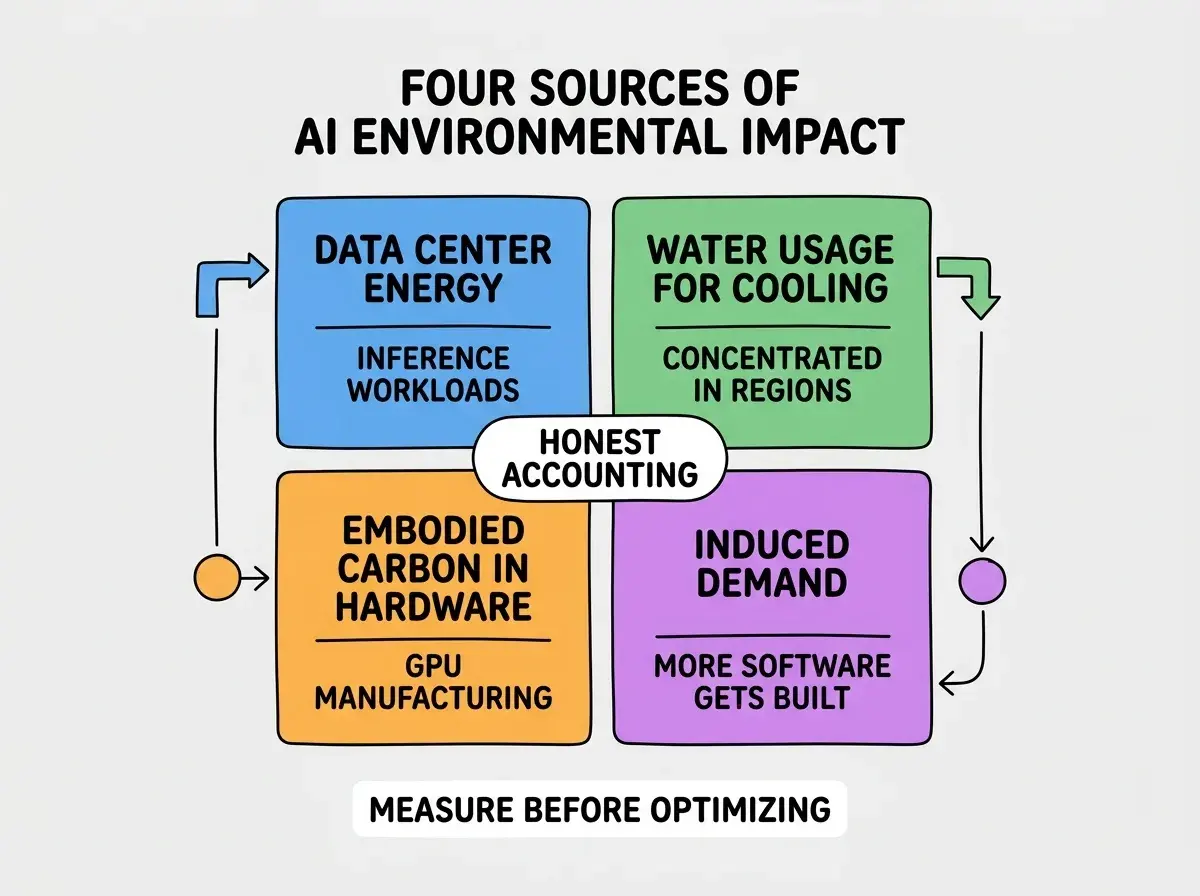
Source 3, embodied carbon in AI hardware. Manufacturing GPUs requires substantial energy and resources. The embodied carbon is amortized across hardware lifetime; high-utilization hardware spreads the cost across more usage.
Source 4, induced demand effects. AI tools make software cheaper to produce, which increases total software produced. The induced demand effect is harder to measure but real; should be included in honest accounting.
The Real Energy Data Behind Claims
Three data points help calibrate expectations against common claims.
Data point 1, per-request energy is small. A single AI coding query consumes roughly 0.001-0.01 kWh (depending on model). Compared to streaming video (0.07 kWh/hour), AI coding is per-request relatively low energy.
Browse more sustainability guides
Read more foundations articlesData point 2, training is the largest energy cost. Training a frontier model consumes on the order of 1-10 GWh. Per user, this amortizes to a few kWh annually. The training cost is real but not the dominant per-user impact.
Data point 3, model efficiency improves over time. Each new model generation typically does the same task with less energy. The efficiency improvements compound; future models will likely have substantially better per-task energy.
Reduction Patterns That Work for Individual Builders
Three reduction patterns produce meaningful impact reduction without sacrificing productivity.
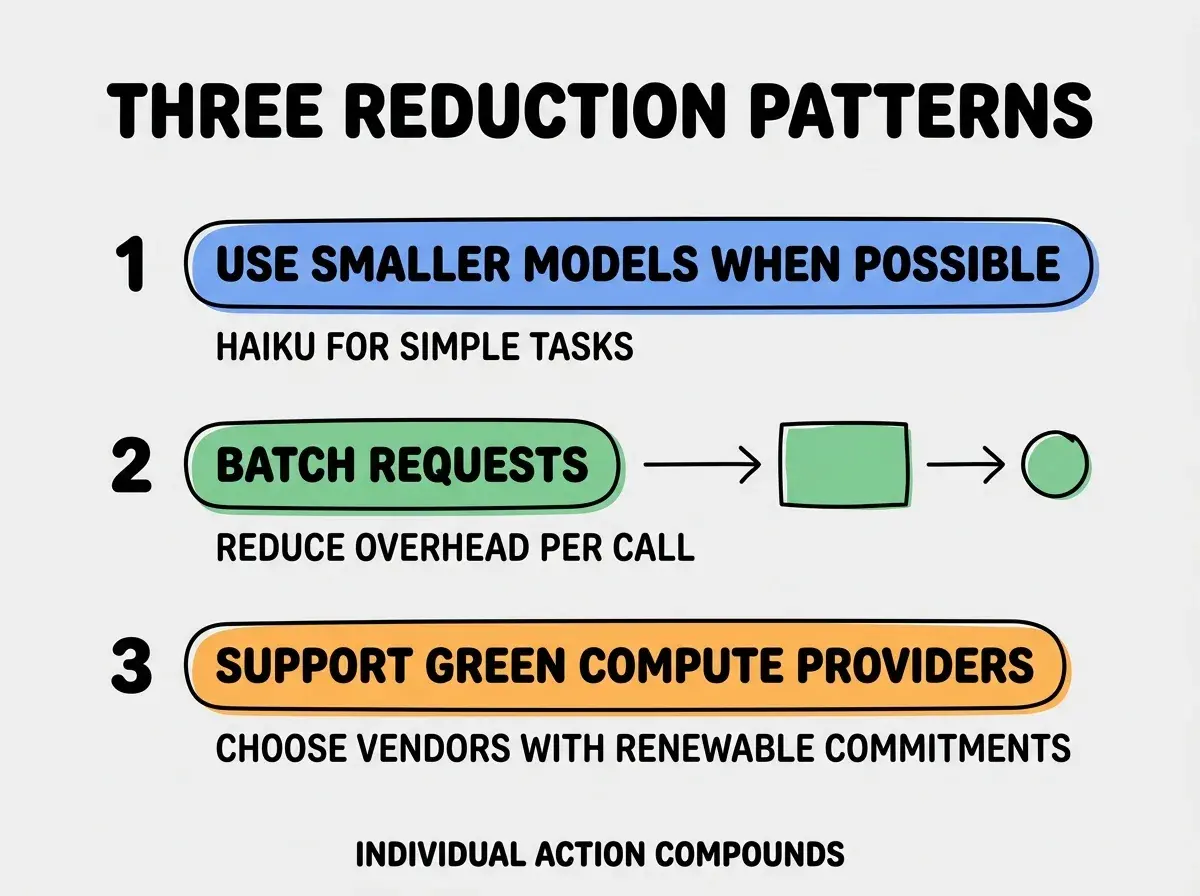
Pattern 1, use smaller models for simple tasks. Claude Haiku for completion suggestions; full Claude for complex reasoning. Right-sizing models to task reduces energy without reducing capability for the specific work being done.
Pattern 2, batch requests when possible. Multiple small queries cost more than one larger query covering the same work. Batching produces real efficiency gains and often produces better outputs too.
Pattern 3, support providers with renewable energy commitments. Some AI providers (Microsoft, Google) have stronger renewable energy commitments than others. Choosing providers based on renewable commitments shifts demand toward cleaner energy.
How AI Compares to Other Developer Activities
Three comparison patterns help calibrate AI energy impact against everyday developer work.
Comparison 1, AI inference vs video calls. A 1-hour Zoom call consumes roughly 0.3 kWh; a typical AI coding session at moderate intensity consumes a similar amount. AI is comparable to other knowledge work tools, not categorically different.
Comparison 2, AI inference vs commute. A 30-minute car commute (5 days/week, 50 weeks) consumes roughly 1500 kWh annually; AI use even for heavy users consumes 50-300 kWh. Transportation dwarfs AI for most workers.
Comparison 3, AI inference vs cloud hosting. A typical SaaS application backend consumes hundreds of kWh annually for compute; AI inference for development is comparable order of magnitude. AI is significant but not uniquely impactful.
The combination shows AI environmental impact in context. Without comparison, AI feels disproportionately impactful; with comparison, it sits within the range of normal professional tool usage.
How to Measure Your Own Impact
Three measurement patterns help understand your specific footprint.
Pattern A, count tokens per session. Most AI tools report token usage; tokens correlate with energy consumed. Track weekly token usage to understand your level and identify patterns.
Pattern B, estimate based on usage hours. Heavy use (4+ hours daily) puts you in the high-impact category; light use (under 1 hour daily) puts you in the low-impact category. Time correlates roughly with energy though not perfectly.
Pattern C, use vendor sustainability reports when available. Some vendors publish per-customer sustainability data. Use it where available; estimate where not. The reports vary in quality and detail across vendors.
The combination produces honest assessment of your specific impact. Without measurement, builders either over-worry (assuming high impact when actual impact is low) or under-worry (assuming low impact when actual is high).
The most damaging environmental impact mistake is treating it as binary (use AI or do not). The choice is rarely useful at individual level; AI tools have benefits that justify their costs in many situations, and complete avoidance produces other problems. The fix is to optimize within AI tool usage rather than abstain entirely; the reduction patterns produce meaningful impact reduction while preserving productivity benefits. Optimization beats abstention for individual environmental decisions.
The other mistake is assuming personal optimization solves systemic problems. Individual reduction matters but is small compared to vendor-level decisions about energy sources, hardware efficiency, and model design. The fix is to combine personal optimization with advocacy for systemic improvements (vendor selection, regulatory engagement, industry standards). Both individual and systemic action are needed.
A third mistake is using AI environmental impact as a reason to dismiss AI tools entirely without comparison to alternatives. The relevant question is not "AI vs nothing" but "AI vs the alternatives." If AI tools enable shipping software that produces value efficiently, the alternative (slower development, more developers, more meetings) may have its own environmental cost.
What This Means For You
Environmental impact of AI-assisted development is real but manageable in 2026. The four sources, real data, and reduction patterns produce informed approach rather than reflexive responses.
- If you're a founder: Measure your team's AI usage; apply reduction patterns where they help; choose providers with strong sustainability commitments.
- If you're changing careers into development: Build sustainability awareness alongside technical skills. The combination is increasingly expected by employers.
- If you're a student: Study the data behind environmental claims (in any direction). Critical thinking about environmental impact is core skill for technologists.
Browse more sustainability and environment guides
Read more foundations articles