A tech stack is the combination of technologies that work together to make your app function. If you have ever wondered what people mean when they say "we are built on React and Node" or "our stack is Next.js with Supabase," this article will make those words click. More importantly, it will help you understand why certain combinations work better with AI coding tools than others.
You do not need to become a developer to understand this. You need the same level of knowledge that a restaurant owner has about their kitchen. Not enough to cook every dish, but enough to know why certain ingredients go together.
The Recipe Analogy That Explains Everything
Think of your app as a dish you are cooking. A tech stack is the recipe: the full list of ingredients, tools, and techniques needed to make that dish.
Every recipe has layers. Base ingredients (flour, eggs, butter), cooking tools (oven, mixer, pans), and serving infrastructure (plates, a table, a kitchen). If any layer is missing, the dish fails. You cannot bake a cake without an oven. You cannot serve a meal without plates.
An app works the same way. When someone says "our tech stack is React, Next.js, Tailwind, and Supabase," they are reading you the recipe. Once you know what each ingredient does, you can evaluate that recipe the same way a chef evaluates a menu.
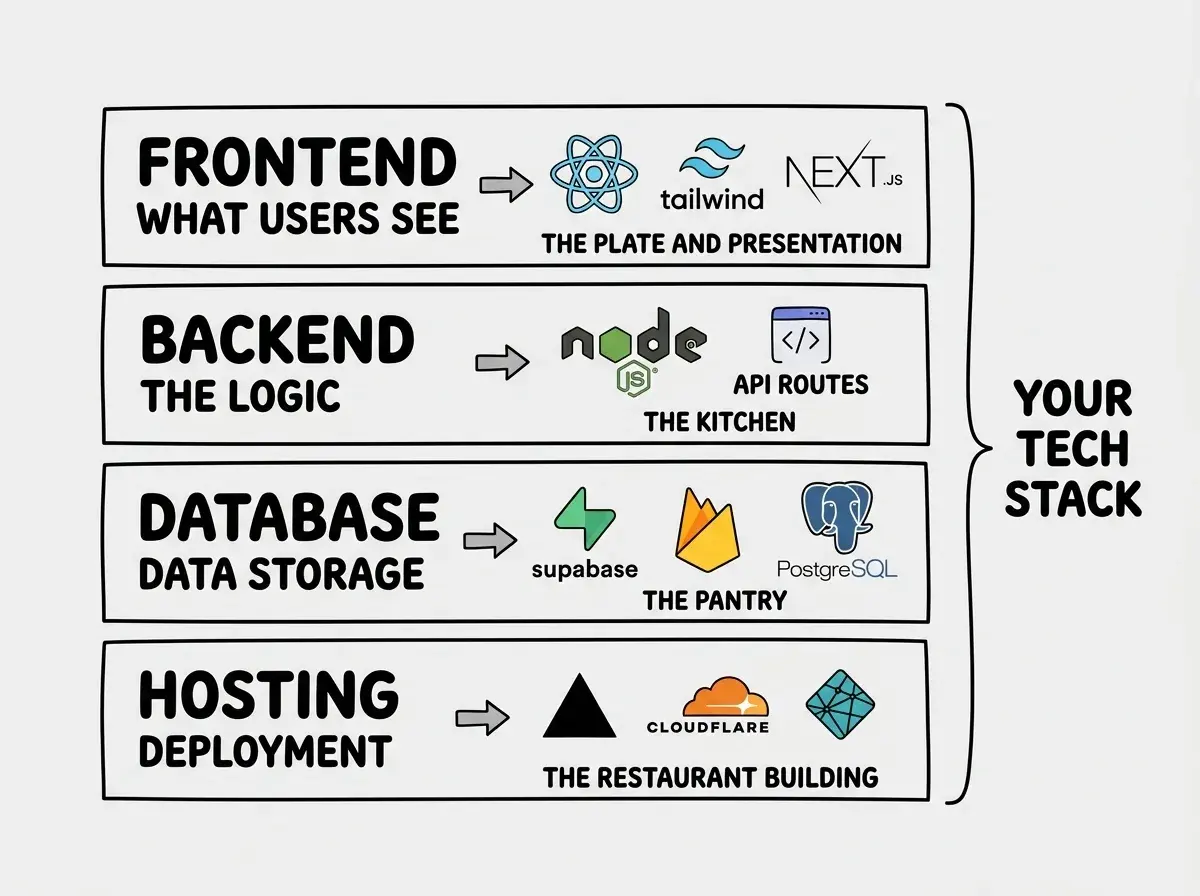
The Four Layers Every App Needs
This confuses everyone at first because people treat "tech stack" as one big blob of technology. It is not. It is four distinct layers, each with a clear job. Once you see the layers, the whole concept clicks.
Layer 1: The Frontend (what people see and touch). This is the plate the food is served on. The buttons, text, colors, animations, everything the user interacts with directly.
The most popular frontend ingredient is React, originally created by Facebook. React lets you build interfaces from reusable pieces called components. Think of components like standardized plate sizes. A dinner plate, a salad plate, a bread plate. Each has a consistent shape, and you combine them to set any table. React components work the same way: a button component, a card component, a navigation component.
Tailwind CSS is the seasoning. It controls how everything looks: colors, spacing, fonts, and layout. Where React builds the structure, Tailwind makes it beautiful.
Layer 2: The Backend (the kitchen where the real work happens). Nobody sees the kitchen. But the kitchen is where the actual cooking happens: processing orders, following recipes, handling special requests.
Your backend handles everything the user does not see. When you log in, the backend checks your credentials. When you place an order, it processes the charge, updates inventory, and sends a confirmation email.
Node.js is the most common backend ingredient. It lets you write server logic using the same language (JavaScript) that your frontend uses. Like having a kitchen that speaks the same language as the front of house.
You do not need to know how to build each layer yourself. You need to know what each layer does so you can make informed decisions about your project and have productive conversations with AI tools, developers, or technical co-founders. Understanding the layers is like knowing the difference between appetizers, entrees, and desserts. You do not need to cook them to order well.
Layer 3: The Database (the pantry and cold storage). Every restaurant needs somewhere to store ingredients. Pantry, fridge, walk-in freezer. Your database serves the same function. It stores user accounts, product listings, order history, preferences, and everything else your app needs to remember.
Supabase is the most popular database ingredient in the vibe coding world because it gives you a database with built-in user authentication and an API, all from one service. It is like getting a pantry that comes pre-organized with a labeling system. Other options include Firebase, PlanetScale, and even Airtable for simpler projects.
Layer 4: Hosting and Deployment (the restaurant building itself). You can have the best chef and the best ingredients, but without a restaurant, nobody eats. Hosting is where your app runs and becomes accessible to users.
Vercel and Cloudflare Pages are the two most popular hosting ingredients. They take your finished app, make it available on the internet, and handle servers, global distribution, and scaling automatically.
What Is the Most Popular Tech Stack for Vibe Coders
Here is where this knowledge becomes practically valuable. AI coding tools are not equally good with every tech stack. They are dramatically better with certain combinations because of how they were trained.
If an AI learned to cook by studying ten million recipes, and eight million used olive oil, garlic, and tomatoes, that AI is going to be incredible at Italian food. Ask it to make a Thai curry and it will manage, but the results will not be as refined.
The same applies to AI coding tools. They learned from millions of open-source projects and code repositories. The most popular, most documented combination in that training data is React, Next.js, and Tailwind CSS. Next.js is a framework built on top of React (like a recipe template built around specific base ingredients), and Tailwind has exploded in adoption because it is fast to write and easy for AI to understand.
You might think the tech stack does not matter much since AI tools can work with anything. But actually, the difference is dramatic. Ask an AI to build a dashboard with React and Tailwind, and you get clean code on the first try. Ask it to build the same dashboard with an obscure framework, and you spend more time correcting mistakes than building.
Understand the fundamentals that help you work with AI tools effectively.
Learn the basicsThe Starter Recipes That Work
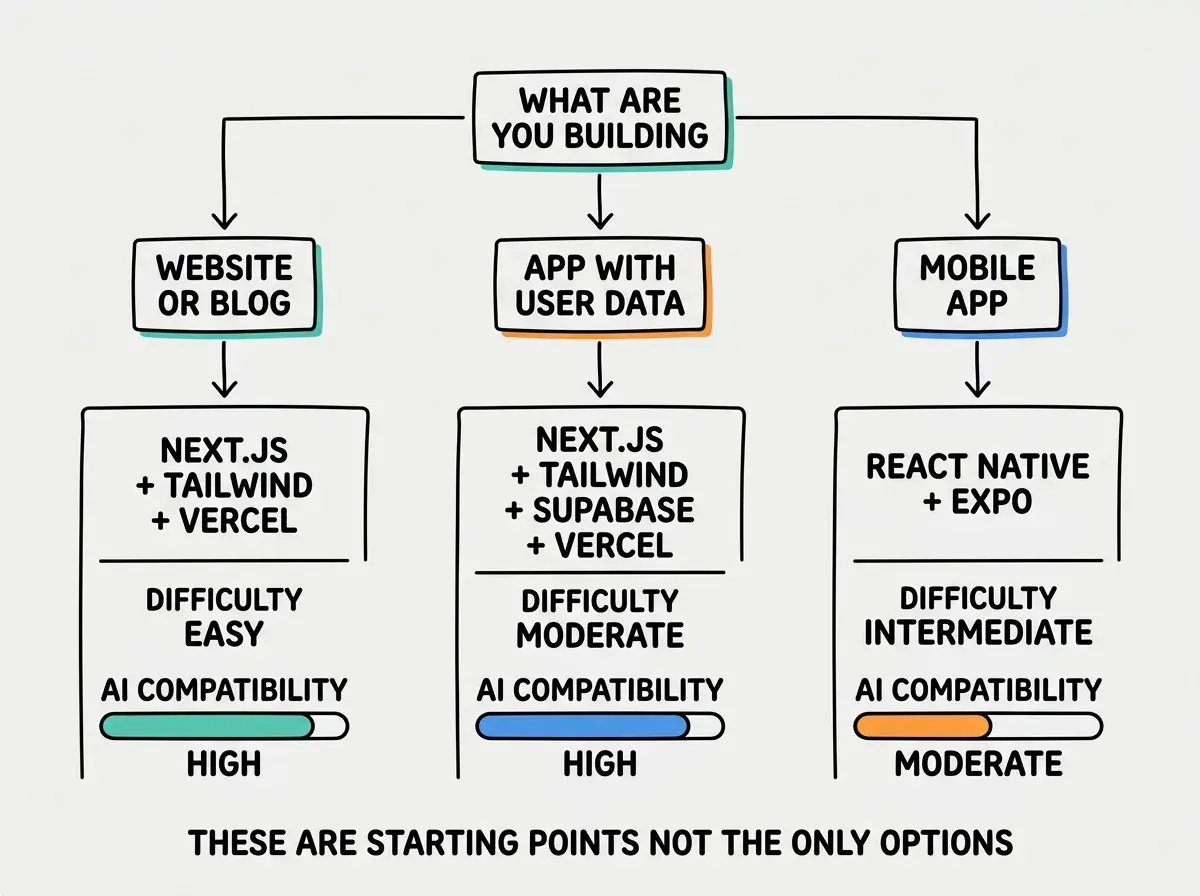
If you are a vibe coder choosing a tech stack for a new project, here are the combinations that give you the best results with current AI tools.
For a website or blog: Next.js plus Tailwind plus Vercel. The simplest complete recipe. Next.js handles frontend and basic backend needs, Tailwind handles styling, and Vercel handles hosting with zero configuration.
For an app with user accounts and data: Next.js plus Tailwind plus Supabase plus Vercel. Adding Supabase gives you a database and user authentication. This is the recipe for SaaS tools, marketplaces, project management apps, or anything where people log in and interact with stored information.
For a mobile app: React Native plus Expo. This extends the React ingredients to mobile devices. It will not be as smooth as web development, but it is the most AI-friendly path to mobile apps.
The common thread is React. It is not about React being the best technology. It is about React being the most AI-compatible technology right now, and that practical advantage matters more than any theoretical comparison.
What You Do Not Need to Know (Yet)
This is permission to not know things. You do not need to understand how React renders components. You do not need to know what a virtual DOM is. You do not need to learn SQL to use Supabase.
What you need is the vocabulary. When an AI tool asks "should I use client-side or server-side rendering?" you need enough context to make a reasonable choice. When a tutorial says "install the Tailwind dependency," you need to know that is the styling layer, not the backend.
Spending weeks researching the "perfect" tech stack before building anything. Non-technical founders (who make up 36.4% of vibe coders) often get stuck comparing React versus Vue versus Svelte, debating Supabase versus Firebase, and reading comparison articles instead of building. For your first project, use Next.js, Tailwind, and Supabase. Not because they are perfect, but because AI tools work best with them and you will make faster progress. You can always switch ingredients later once you understand the recipe.
The depth comes with experience. After three projects, the vocabulary will feel natural. After five, you will have opinions about which ingredients you prefer. That knowledge builds through doing, not through pre-study.
When to Care About Your Stack (and When Not To)
For your first three projects, do not overthink it. Use the AI-friendly defaults (Next.js, Tailwind, Supabase) and focus on building. The stack matters less than finishing something.
Once you have built a few things, the tech stack matters for specific reasons. Performance matters when your app gets real users. Cost matters when your hosting bill climbs. Scalability matters when your database outgrows a hobby project. But these are problems you want to have, because they mean your project is succeeding.
The recipe analogy holds here too. When you are learning to cook, you use whatever pans you own and whatever ingredients the grocery store has. When you become a serious cook, you invest in specific tools because you know exactly why they make a difference. The same progression applies to tech stacks.
What This Means For You
A tech stack is just a recipe. Understanding the four layers (frontend, backend, database, hosting) and knowing which ingredients AI tools work best with gives you enough knowledge to make smart decisions about your projects.
- If you are a founder building a product: Knowing your tech stack lets you evaluate technical recommendations without being a developer. When a CTO candidate says "I want to rebuild everything in Rust," you will know enough to ask why, and whether that serves the business or the engineer's preferences. For vibe-coded MVPs, stick with React and Next.js.
- If you are a career changer learning vibe coding: Start with one recipe and learn it well. Next.js plus Tailwind plus Supabase covers 80% of what you will want to build. Understanding one stack deeply is more valuable than knowing five superficially.
- If you are a student exploring technology: Understanding tech stacks gives you a framework for evaluating every new tool that launches. Instead of being overwhelmed by new frameworks, ask "which layer does this replace?" and "is the AI ecosystem ready for it?" Those two questions cut through most of the noise.
Now that you know the recipe, learn how to work with AI tools to bring your ideas to life.
Explore more