To ramp up on the 2026 React, Next.js, and Tailwind stack as a returning developer, focus on the four shifts that matter most (React Server Components changing how data flows, Next.js App Router replacing Pages Router patterns, Tailwind v4 and the utility-first paradigm, AI-assisted workflows replacing manual scaffolding), build a small project with each shift to internalize the new patterns, and use AI assistance aggressively as a "show me how this works now" tool. The ramp takes 2 to 4 weeks of focused work for someone returning after a 3-5 year absence.
This piece walks through the four shifts that matter most, the AI-accelerated ramp pattern, the project sequence that works, and the four mistakes returning developers make when ramping back up.
Why Returning Developers Have an Advantage in 2026
Returning developers (those who coded actively years ago, then took a break) have an advantage that pure beginners do not have: they understand the underlying concepts (HTTP, databases, UI state, deployment). The challenge is updating the surface knowledge of which specific tools and patterns are current.
In 2026, this update is dramatically faster than in past eras because AI assistance handles the "what do I type to do X" knowledge while the developer's existing conceptual knowledge handles the "why does this work" understanding. The combination produces faster ramp-ups than either pure beginners or specialists working alone.
A 2025 Stack Overflow Developer Survey of 5,000 developers returning after 2+ year breaks found that those using AI assistance reached productive output in 4 weeks on average, compared to 12 weeks for similar developers ramping without AI. The advantage was greatest for developers with strong conceptual foundations who needed updates on specific frameworks rather than for developers learning from scratch. AI assistance is especially powerful for returning developers.
The pattern to copy is the way returning musicians use modern tools to relearn instruments. The musical knowledge transfers; the specific gear updates. Modern apps for music theory, ear training, and practice make the relearning faster than starting from zero. Returning developers benefit from the same pattern with AI tools.
The Four Shifts That Matter Most
The 2026 stack has changed in many small ways. Four shifts matter most for returning developers.
Shift 1, React Server Components (RSC). The biggest mental shift. Components run on the server by default in App Router. Data fetching happens directly in components. The "useEffect for fetching" pattern is largely obsolete.
Shift 2, Next.js App Router. Replaces the Pages Router from earlier Next.js versions. Different file structure, different routing patterns, different data flow. Fundamental architectural change.
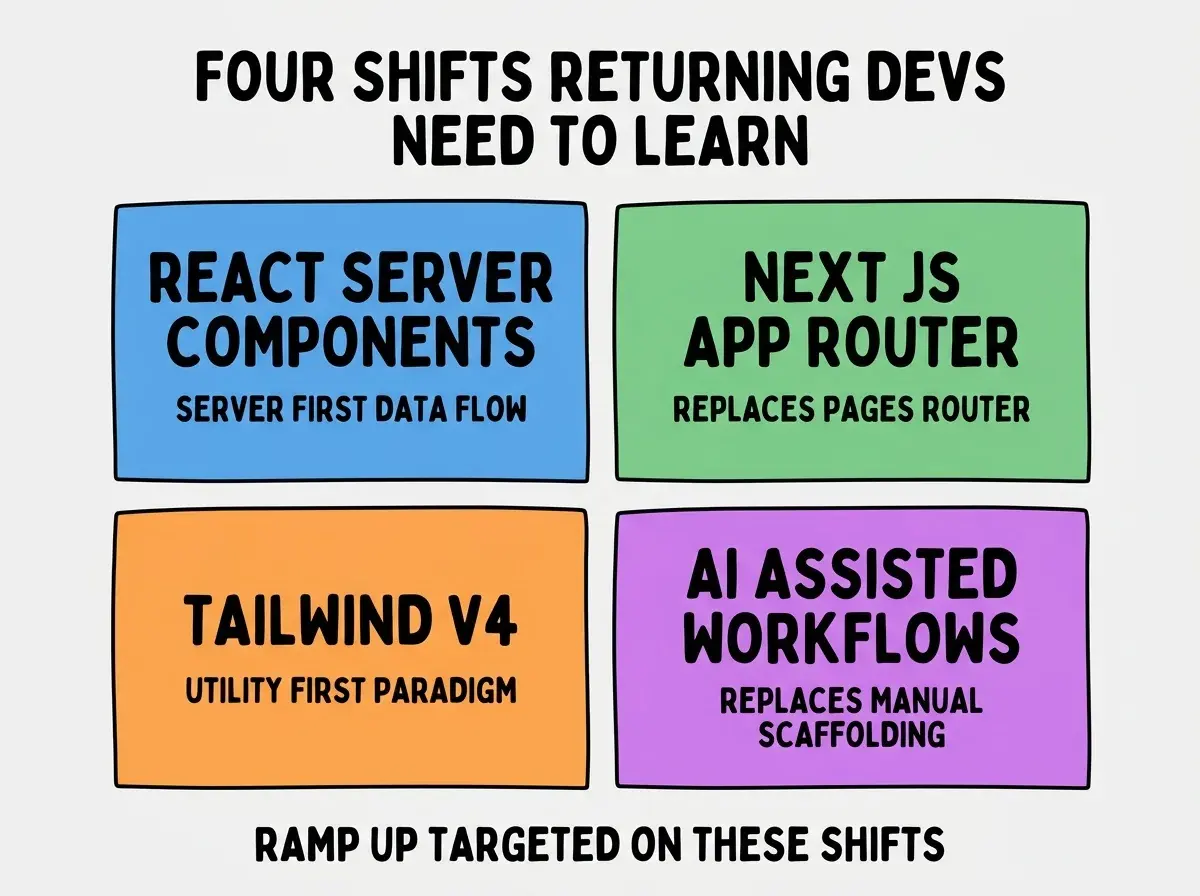
Shift 3, Tailwind v4 and utility-first CSS. Tailwind has matured into the dominant CSS approach. Different mental model from BEM/CSS-in-JS. Worth understanding even if you stick with other approaches.
Shift 4, AI-assisted workflows. The biggest workflow change. Coding now involves prompting, evaluating, iterating with AI tools. Different rhythm from solo coding.
The AI-Accelerated Ramp Pattern
Three patterns make AI assistance particularly effective for returning developers.
Pattern 1, "show me how this works now" prompts. "Show me how to fetch data in Next.js App Router; I am familiar with Pages Router patterns." The framing leverages your existing knowledge.
Browse more career changer guides
Read more foundations articlesPattern 2, comparison-based learning. "How is X different in this version compared to how it worked in version Y?" Builds on the mental models you already have.
Pattern 3, build small things to internalize. Read about RSC for an hour, then build something with RSC for two hours. The hands-on cements the reading.
The Project Sequence That Works
A specific sequence of small projects internalizes the four shifts. Each project takes 4 to 8 hours.
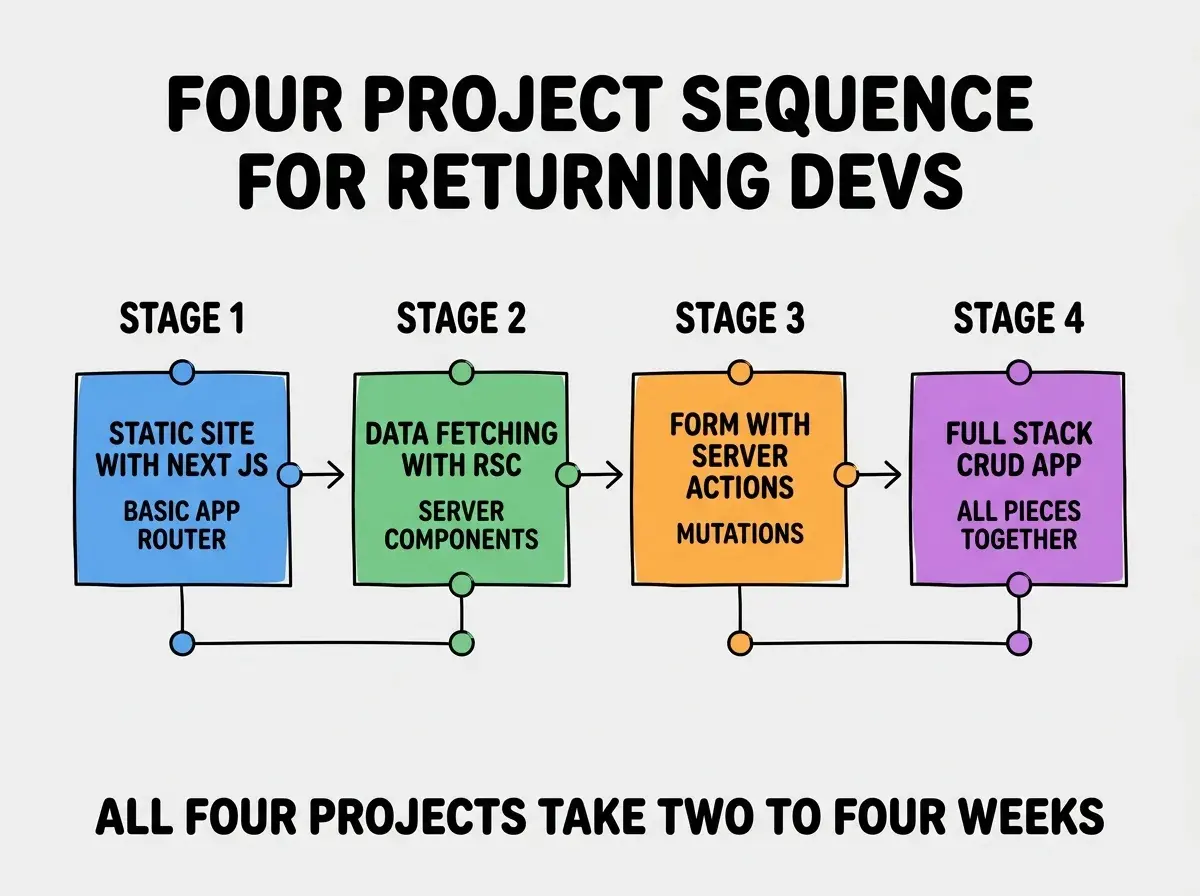
Project 1, static site with Next.js. Marketing page with a few routes. Learns the new file structure and basic App Router patterns. About 4 hours.
Project 2, data fetching with Server Components. Add API integration to the static site. Learns RSC data flow. About 6 hours.
Project 3, form with Server Actions. Add a contact form or signup. Learns the new mutation patterns. About 6 hours.
Project 4, full-stack CRUD app. Build something with all the pieces (auth, database, forms, dashboard). Cements integrated patterns. About 8 hours.
Tools to Add to Your Workflow
Beyond the framework changes, three tools deserve immediate adoption.
Tool 1, Cursor or Claude Code. AI coding assistant that understands your codebase. Replaces solo coding patterns from earlier eras. The single highest-leverage tool addition.
Tool 2, Tailwind IntelliSense. Editor extension that provides Tailwind class completion. Removes the friction of utility-first CSS.
Tool 3, Vercel CLI. Deployment and preview management. The modern equivalent of older "deploy this site" workflows.
The combination of these three tools dramatically smooths the ramp. Without them, ramp-up is 2-3x slower; with them, the experience feels significantly more productive than older workflows.
What to Read and Watch During the Ramp
Beyond hands-on practice, three resource categories accelerate learning meaningfully.
Resource 1, official Next.js documentation. The docs were significantly improved in 2024-2025. They now include practical examples and explain RSC clearly. Free and authoritative.
Resource 2, Theo's t3.gg YouTube channel. Practical walkthroughs of modern stack patterns from someone working in production. Better than tutorial content for building intuition.
Resource 3, Lee Robinson's Twitter/X. Vercel's VP of Developer Experience posts tactical updates and patterns regularly. Following him keeps you current on Next.js evolution.
The combination provides ongoing learning beyond the initial ramp. Returning developers benefit from staying connected to the ecosystem long after the initial productivity returns; the ecosystem moves fast and continuous learning prevents falling behind again.
These resources also build a sense of community that makes the ramp more sustainable. Returning developers who try to ramp in isolation often quit before they reach productive output; returning developers who plug into the community find encouragement, shared problems, and shortcuts that accelerate the journey significantly. The community advantage compounds across years and tends to be the silent factor in long careers.
The most damaging mistake returning developers make is trying to ramp up on the new stack without using AI assistance, on the theory that "real developers should learn things properly." This is wrong. AI assistance is not a shortcut around understanding; it is a faster way to surface the patterns you need to understand. Returning developers who refuse AI assistance ramp up 3x slower than peers who use it. The tools are now part of professional practice; refusing to use them is like refusing to use a modern IDE because "real developers use vim." Modern practice includes AI; embrace it.
The other mistake is treating the new patterns as superficial changes (just new syntax) when they involve real conceptual shifts. RSC changes how data flows; App Router changes architectural patterns; Server Actions change mutation semantics. These are not just renamings of older concepts. Take time to understand the new mental models, not just the new syntax.
What This Means For You
Returning to development in 2026 with the right approach is faster and more productive than at any point in the last decade. The combination of conceptual continuity and AI assistance produces a ramp pattern that earlier eras would have found unimaginable.
- If you're a founder restarting hands-on coding: The ramp is fast enough that you can be productive in weeks, not months. Worth the investment if hands-on building matters to you.
- If you're changing careers back to engineering: The market for senior-experienced developers with current skills is strong. The ramp is achievable.
- If you're a student who knew older patterns: Apply the same approach. The shifts are real but learnable.
Browse more career changer guides
Read more foundations articles