To understand what hiring managers look for in AI-assisted developer experience in 2026, recognize four signals they consistently value (specific outcomes shipped with AI involvement, clear thinking about when AI helps vs hurts, ability to evaluate AI output critically, and team collaboration patterns that work with AI), demonstrate these signals through specific examples in your portfolio and interviews, and avoid the common patterns that signal AI dependency rather than AI mastery. The hiring bar has shifted; demonstrating AI fluency requires more than claiming it.
This piece walks through the four signals hiring managers value, the demonstration patterns that work, the interview questions to expect, and the four mistakes candidates make about AI-assisted experience.
Why Hiring Managers Care About AI Experience Specifically
In 2026, AI tool fluency has become baseline expectation for most engineering roles. Hiring managers no longer ask "do you use AI tools" but "how thoughtfully do you use AI tools." The shift has changed what they evaluate; surface-level claims no longer differentiate candidates.
The 2026 reality is that AI experience is increasingly evaluated on judgment rather than just usage. Candidates who can explain when they reach for AI vs when they reach for documentation, when they trust AI output vs when they verify, when they automate vs when they handle manually demonstrate the judgment that distinguishes seniors from juniors.
A 2025 LinkedIn talent insights report found that hiring managers ranked "demonstrated AI judgment" as the most-important AI-related criterion, ahead of "AI tool fluency" or "AI prompting skill." The judgment criterion separated candidates who could explain their AI decisions from those who could only use AI tools. The shift reflects market maturation; AI fluency is no longer the differentiator, AI judgment is.
The pattern to copy is the way hiring evolved for power tools in trades. Initially, knowing how to use a power drill was differentiator; now, every electrician can use a drill. The differentiator became knowing when to use which drill, when to use it carefully, when to choose hand tools instead. AI fluency follows the same pattern; the differentiator is judgment, not basic usage.
The Four Signals Hiring Managers Value
Four signals consistently appear in successful interviews for AI-assisted roles.
Signal 1, specific outcomes shipped with AI involvement. Concrete projects, measurable outcomes, your role in producing them. Vague claims of AI usage do not differentiate; specific shipped work does.
Signal 2, clear thinking about when AI helps vs hurts. When did you choose to use AI? When did you choose not to? The reasoning reveals judgment.
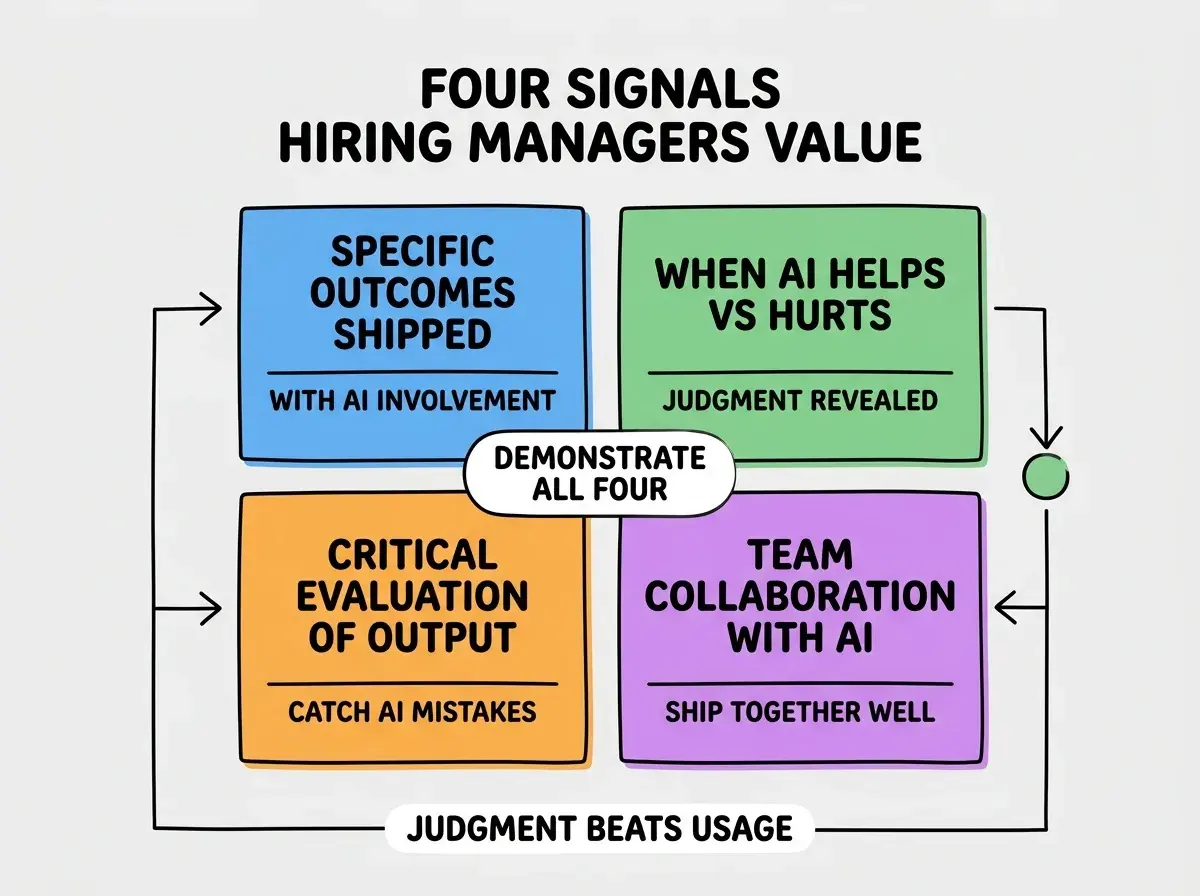
Signal 3, ability to evaluate AI output critically. Examples of catching AI mistakes, debugging AI-generated code, recognizing when AI output is wrong. The skill demonstrates technical depth.
Signal 4, team collaboration patterns that work with AI. Code review of AI-generated work, communication patterns that include AI context, processes that integrate AI without disrupting team workflow.
How to Demonstrate the Signals
Three demonstration patterns help signal the right things in interviews and portfolios.
Pattern 1, prepare 3-5 specific stories. Real projects with AI involvement, your role, what worked, what did not, what you learned. Specific stories beat generic claims dramatically.
Browse more career and interview guides
Read more foundations articlesPattern 2, document your AI decisions in portfolio. Annotations explaining why you used AI for specific things, why you did not for others. The annotations make judgment visible.
Pattern 3, discuss AI failure modes you have encountered. Specific examples of AI getting things wrong, how you noticed, how you handled. The examples demonstrate critical evaluation skill.
The Interview Questions to Expect
Three interview question patterns appear consistently for AI-assisted roles in 2026.
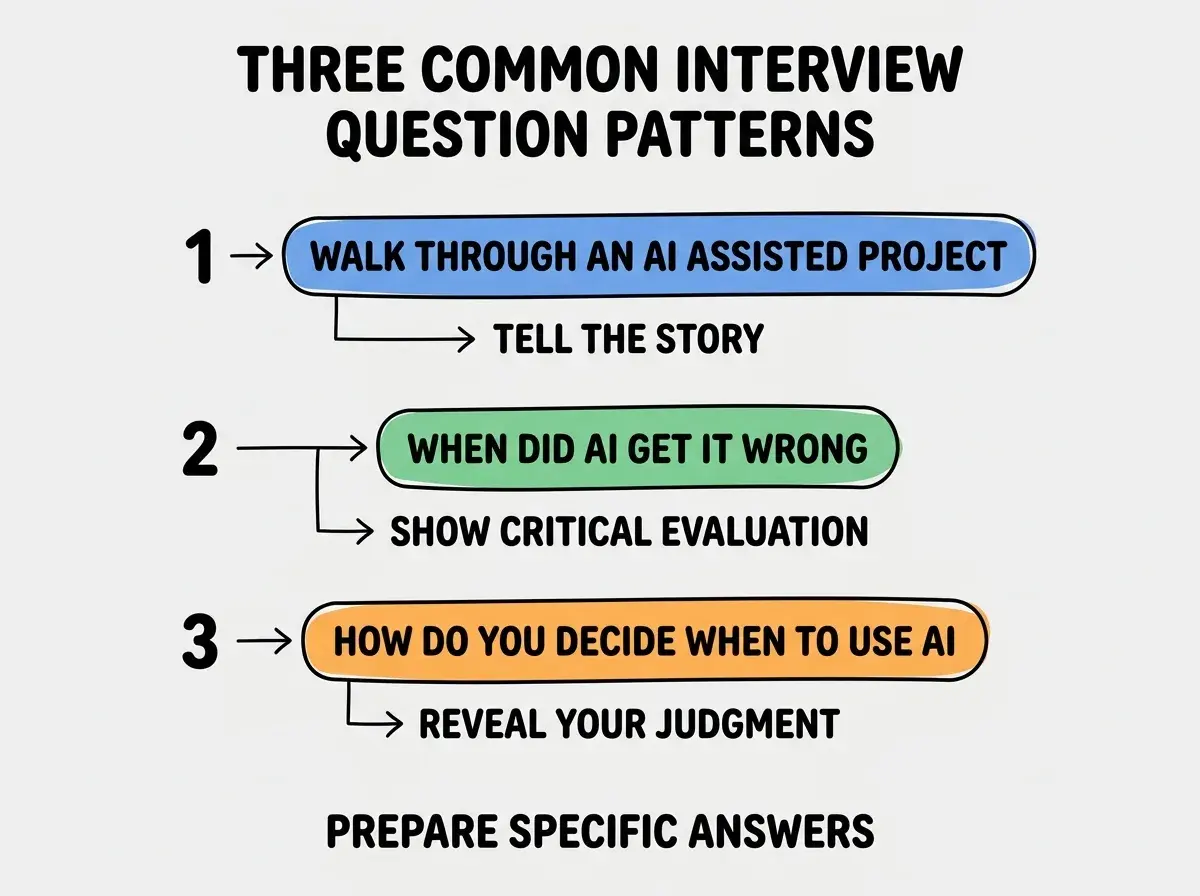
Question 1, walk through an AI-assisted project. Tell the story end to end: what you built, how AI was involved, what you decided, what shipped. Have 1-2 stories ready.
Question 2, when did AI get it wrong? Specific example of AI failure and how you handled it. Demonstrates critical evaluation skill that pure-AI-fans lack.
Question 3, how do you decide when to use AI? The judgment question. Demonstrates the maturity that hiring managers most value in 2026.
How Different Company Types Evaluate Differently
Three company-type patterns help calibrate your interview approach to the role.
Type 1, AI-native startups. Founded after 2023; AI baked into culture and process. Heavy emphasis on AI fluency; less concern about traditional credentials. Match their energy.
Type 2, traditional tech companies adopting AI. Established companies adding AI to existing practice. Want both traditional engineering depth and AI fluency. Demonstrate hybrid profile.
Type 3, large enterprises with AI policies. Big companies with formal AI tool policies. Compliance with policy matters as much as technical fluency. Research their stated AI position before interviewing.
The combination produces calibrated interview approach. Without company-type awareness, candidates use the same approach across all interviews and underperform with companies that need different framing.
How to Avoid Patterns That Signal Dependency
Three patterns to avoid keep you on the right side of the dependency line.
Pattern A, do not credit AI for outcomes. "I shipped X" is correct framing; "AI shipped X" undermines your credit. You used AI as tool; the outcomes are yours.
Pattern B, do not appear unable to work without AI. Discuss AI as multiplier on your skill, not as replacement for your skill. Mention work you did before AI tools; mention manual debugging skills; signal independence alongside fluency.
Pattern C, do not lecture about AI tools. Hiring managers know about AI tools; they want to evaluate your specific experience and judgment. Brief context is fine; lecturing wastes time and signals that you mistake explanation for capability.
The combination produces interviews that signal mastery. Without these patterns, candidates sometimes signal dependency that worries hiring managers, even when actual capability is strong.
The most damaging interview mistake for AI-assisted roles is hiding AI usage to seem like a "real engineer." Some candidates underplay their AI usage; the result is incomplete picture and missed opportunity to demonstrate judgment. The fix is to discuss AI usage openly and thoughtfully; hiring managers in 2026 expect AI usage and want to evaluate how you use it. Concealment signals discomfort with the modern tool stack; openness plus judgment signals professional maturity.
The other mistake is treating AI experience as differentiator independent of underlying capability. AI fluency on weak technical foundation produces weak outcomes; AI fluency on strong technical foundation produces excellent outcomes. The fix is to invest in technical fundamentals continuously, treating AI tools as multiplier on the foundation, not as substitute for it.
A third mistake is failing to research the company's specific AI culture before interviewing. Some companies are AI-enthusiastic; others are AI-cautious; both have legitimate positions. The fix is to research culture through job postings, blog content, and engineer LinkedIn profiles; matching your framing to the culture produces better outcomes than generic AI advocacy.
What This Means For You
Hiring for AI-assisted roles has matured significantly in 2026. The four signals, demonstration patterns, and interview preparation produce successful candidacies for prepared candidates.
- If you're a founder: Apply the same evaluation criteria when hiring; the signals that matter for being hired are signals that matter for being hired well.
- If you're changing careers into development: Build interview portfolio around the four signals from your earliest projects. The framing transfers across role types.
- If you're a student: Practice articulating your AI judgment alongside your technical skills. The combination is what employers most want.
Browse more career and hiring guides
Read more foundations articles