The junior developer dilemma in age of AI is that traditional junior tasks (boilerplate code, documentation, simple bug fixes) increasingly automated by AI, eroding traditional learning paths. Four dimensions matter: tasks AI does vs tasks juniors learn from, mentor availability decreasing as senior time goes to AI orchestration, hiring criteria shifting from coding ability to judgment, and learning paths needing redesign for AI augmented reality. Junior developers face new reality requiring different strategy than 2020 era junior path.
This piece walks through the four dimensions, what makes junior career sustainable, what to learn now, and the four mistakes juniors make adapting to AI age.
Why The Junior Dilemma Matters
The junior dilemma matters because traditional learning path through boilerplate work disappearing. Without learning path, junior development stalls; stalls compound over career.
The 2026 reality is that companies hiring juniors at lower rates as AI handles boilerplate. Junior hiring decline creates real career challenge for entry level developers.
A 2025 developer career survey of 5000 junior developers found that traditional junior bootcamp graduates faced 60 percent harder hiring market in 2025 than 2022, primarily because AI handles tasks juniors traditionally proved themselves on. Junior career strategy must adapt; old playbooks no longer work.
The pattern to copy is the way medical residents adapted when diagnostic AI emerged. Residents shifted from pattern matching tasks to judgment and patient communication; AI handled pattern matching. Junior developers face similar shift.
The Four Dimensions
Four dimensions describe the junior developer dilemma.
Dimension 1, tasks AI does vs tasks juniors learn from. AI handles boilerplate, simple CRUD, basic styling; juniors traditionally learned from these. Learning gap emerges.
Dimension 2, mentor availability decreasing. Senior developer time increasingly goes to AI orchestration; mentorship declines. Less mentorship means slower junior development.

Dimension 3, hiring criteria shifting. Companies want juniors with judgment, not coding speed. AI provides coding; judgment differentiates.
Dimension 4, learning paths needing redesign. Bootcamp curriculum often outdated; new paths emerging slowly.
What Junior Career Sustainable Looks Like
Three patterns separate sustainable junior careers from struggle.
Pattern 1, focus on judgment and review skills. Reading code, evaluating quality, identifying issues; these matter more than writing.
Browse more foundations
Read more foundationsPattern 2, build portfolio of completed projects. Completion proves judgment; coding speed less differentiating.
Pattern 3, develop AI orchestration skills. Prompting, context management, output evaluation; AI orchestration is junior friendly skill that matters.
What To Learn Now
Three learning priorities matter for new juniors.
Priority 1, AI tool fluency. Cursor, Claude Code, Copilot all worth fluency; tools change fast.
Priority 2, code reading skills. Read large codebases, understand patterns; reading underrated.
Priority 3, system design thinking. How systems work matters; AI generates implementation, you provide design.
What Makes Junior Adaptation Sustainable
Three patterns separate sustainable adaptation from one off learning.
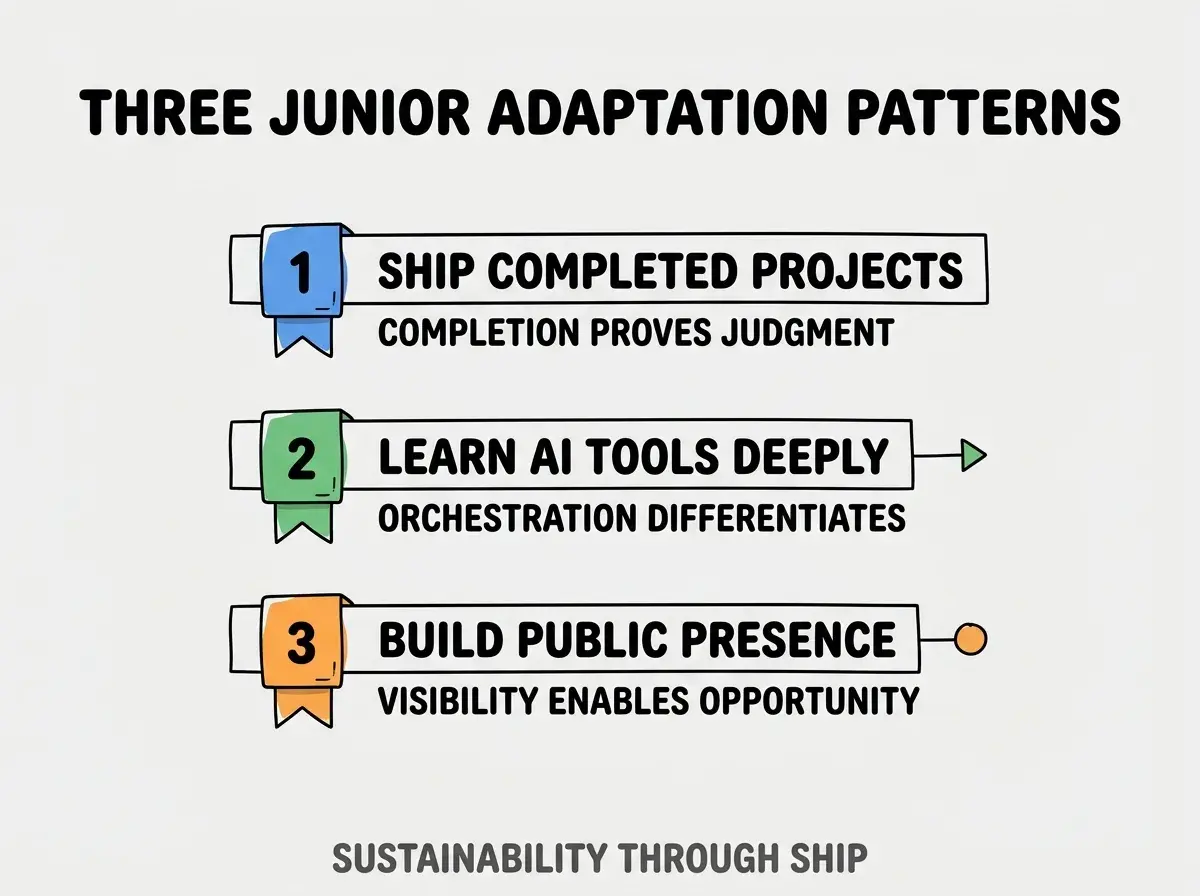
Pattern 1, ship completed projects regularly. Completion proves judgment; pattern compounds reputation.
Pattern 2, learn AI tools deeply. Surface usage common; depth differentiates.
Pattern 3, build public presence. Visibility opens opportunities AI cannot replace.
The combination produces sustainable junior careers. Without these patterns, junior careers struggle in new reality.
How To Get Hired As New Junior
Three patterns help juniors get hired in 2026 market.
Pattern A, portfolio of shipped projects. GitHub with completed apps proves capability beyond bootcamp curriculum.
Pattern B, public learning journey. Twitter/X build in public attracts hiring attention; visibility matters.
Pattern C, network through community engagement. Communities surface opportunities; engagement compounds.
Common Questions About Junior Path
Junior path raises questions worth addressing directly.
The first question is whether to skip bootcamp. Sometimes; depends on alternatives. Bootcamps still useful but not sufficient alone.
The second question is whether to learn coding deeply or learn AI orchestration. Both; depth in one then breadth helps. Coding depth still matters.
The third question is what languages to learn first. JavaScript and Python remain accessible; whatever your community uses works.
The fourth question is whether to do open source for resume. Yes; contributions visible to hiring managers and prove collaboration ability.
How Junior Path Affects Long Term Career
Junior path affects long term career in compounding ways. Career effects compound across decades.
The first compounding effect is skill foundation. Skills built early compound; weak foundations limit ceiling.
The second compounding effect is professional network. Networks built early provide opportunities later.
The third compounding effect is reputation building. Junior work products inform mid level reputation.
The combination produces career trajectories shaped by junior choices. Without thoughtful junior strategy, careers follow chance.
How To Choose Right First Job
Three patterns help junior developers choose right first job.
Pattern A, prioritize learning environment. Companies with good mentorship matter more than salary at junior level.
Pattern B, evaluate technology stack. Modern stack provides better learning than legacy.
Pattern C, assess team culture. Culture affects daily work; daily work affects skill development.
The combination produces junior job choices that compound career. Without evaluation, choices follow chance.
The most damaging junior dilemma mistake is denying the change and following 2020 era playbook. Bootcamp plus LeetCode prep no longer sufficient; companies want judgment and shipped projects. The fix is to acknowledge new reality and adapt; ship projects, learn AI tools deeply, build public presence. Juniors who adapt thrive in new market; juniors who deny struggle for years.
The other mistake is treating AI as competitor. AI is collaborator for juniors who learn to use; competitor only for those who do not adapt.
A third mistake is missing the soft skills emphasis. Communication, judgment, collaboration matter more than ever; technical skills less differentiating.
A fourth mistake is over indexing on FAANG aspiration. Smaller companies offer more growth opportunity for juniors in AI age; FAANG hiring tightened most.
What This Means For You
The junior developer dilemma in age of AI requires new strategy. The four dimensions, sustainability patterns, and adaptation approaches produce junior careers that thrive in new reality.
- If you're a founder: Hire juniors who ship and orchestrate AI; not juniors who memorize syntax.
- If you're changing careers: Junior development still viable; strategy must reflect new reality not 2020 playbook.
- If you're a student: Build portfolio and AI tool fluency; both matter for competitive entry.
Browse more foundations
Read more foundations