To scale WebSockets for thousands of connections, follow the four phase approach (architect for connection limits per server, implement sticky sessions or pub sub for multi server deployment, monitor connection health and resource consumption, and plan capacity based on actual connection patterns), recognize what differs from HTTP scaling, and apply the patterns that produce sustainable WebSocket infrastructure. The WebSocket scaling capability matters because real time features increasingly drive user expectations.
This piece walks through the four scaling phases, what differs from HTTP scaling, the infrastructure patterns, and the four mistakes that produce WebSocket scaling failure.
Why WebSocket Scaling Matters
WebSocket scaling determines real time application capability. The capability matters; applications that handle WebSocket scale enable features that polling architectures cannot match.
The 2026 reality is that real time features have shifted from premium features to baseline expectations. Live updates, collaborative editing, real time notifications all require WebSocket infrastructure that handles connection scale.
A 2025 real time infrastructure study of 200 production deployments found that teams with structured WebSocket scaling practices handled 10x more concurrent connections per server compared to teams without practices. The capability difference reflects whether teams understand WebSocket specifics or apply HTTP patterns inappropriately.
The pattern to copy is the way phone systems scaled to handle millions of concurrent calls. Phone systems handle persistent connections at massive scale through dedicated infrastructure patterns; WebSocket scaling follows similar principles adapted for software infrastructure.
The Four Scaling Phase Approach
Four phases produce WebSocket infrastructure handling thousands of connections.
Phase 1, architect for connection limits per server. Each server has connection limits; architecture determines effective ceiling. Connection limits drive scaling strategy.
Phase 2, implement sticky sessions or pub sub for multi server. Multi server deployment requires either sticky sessions or pub sub between servers. Pattern choice affects scaling characteristics.
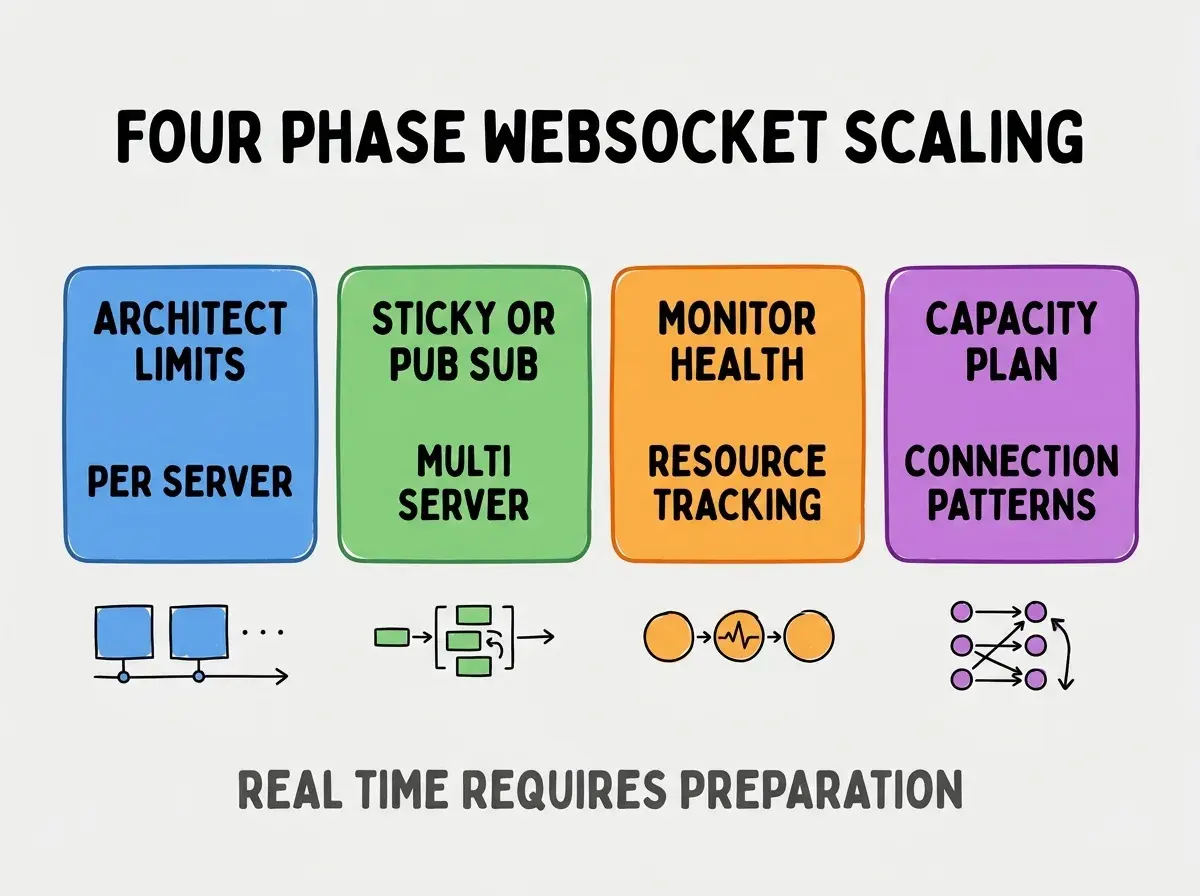
Phase 3, monitor connection health and resource consumption. Memory per connection, CPU usage, message throughput. Without monitoring, capacity ceilings hit without warning.
Phase 4, plan capacity based on actual connection patterns. Connection duration, message frequency, idle versus active. Patterns drive capacity calculations.
What Differs From HTTP Scaling
Three differences distinguish WebSocket scaling from HTTP scaling.
Difference 1, persistent connections consume continuous resources. HTTP requests consume resources briefly; WebSocket connections consume memory continuously. Resource model differs fundamentally.
Browse more grow articles
Read more grow articlesDifference 2, server affinity matters more than HTTP. WebSocket connection establishes affinity to specific server; load balancing differs from HTTP request distribution. Affinity affects routing strategy.
Difference 3, broadcast patterns require cross server coordination. Sending message to all connected clients requires coordination across servers. Coordination matters for collaborative features.
The Infrastructure Patterns That Work
Three infrastructure patterns produce robust WebSocket scaling.
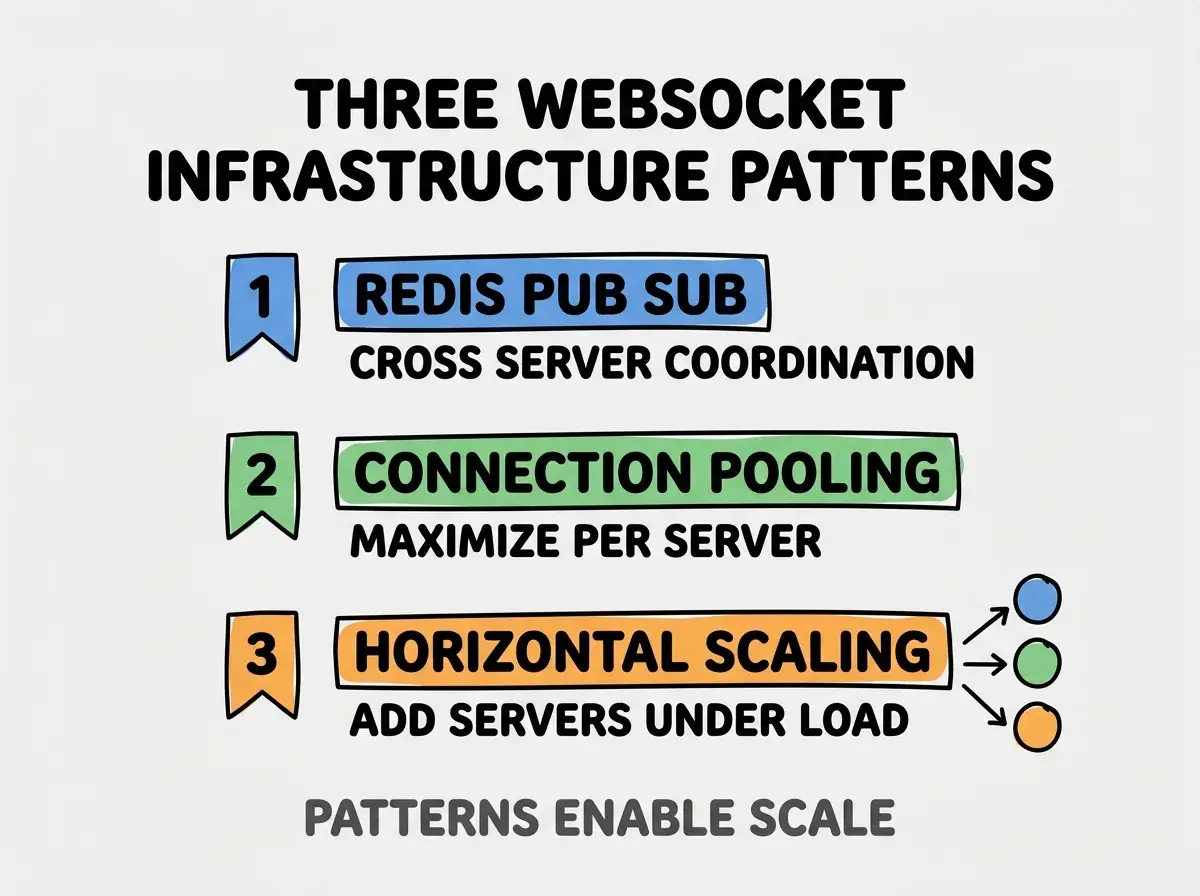
Pattern 1, Redis pub sub for cross server coordination. Servers publish messages to Redis; other servers subscribe. Redis pattern handles broadcast across server farm.
Pattern 2, connection pooling maximizing per server capacity. Connection multiplexing, efficient memory management, optimized event handling. Pooling determines per server ceiling.
Pattern 3, horizontal scaling adding servers under load. Auto scaling based on connection count or resource consumption. Horizontal scaling handles growth beyond single server capacity.
What Makes WebSocket Deployments Sustainable
Three patterns separate sustainable WebSocket deployments from problematic ones.
Pattern 1, graceful disconnection and reconnection handling. Network interruptions are normal; deployments must handle reconnection gracefully. Without graceful handling, transient issues become user visible failures.
Pattern 2, backpressure handling for slow clients. Slow clients can consume server resources; backpressure protects servers from individual slow clients. Without backpressure, single slow client can degrade overall service.
Pattern 3, monitoring of connection lifecycle metrics. Connection establishment time, duration, disconnection reasons. Monitoring reveals patterns that aggregate metrics miss.
The combination produces WebSocket deployments that handle real production conditions. Without these patterns, deployments fail under network conditions that are normal but not handled.
How To Handle Specific Scaling Challenges
Three challenges deserve dedicated attention.
Challenge A, broadcast to large rooms efficiently. Naive broadcast iterates connections; efficient broadcast uses pub sub patterns. Pattern matters for room scale.
Challenge B, presence detection at scale. Tracking who is online requires pattern that scales with connection count. Without pattern, presence detection becomes bottleneck.
Challenge C, message ordering guarantees. Some applications require ordered message delivery; some accept eventual delivery. Choice affects infrastructure complexity.
The combination produces infrastructure handling specific challenges. Without challenge specific approaches, common patterns fail at scale.
The most damaging WebSocket scaling mistake is treating WebSockets as HTTP equivalents that scale similarly. WebSocket connections persist; HTTP requests do not. Infrastructure built for HTTP often fails for WebSockets at modest connection counts. The fix is to design WebSocket infrastructure with persistent connection model from start; treating WebSockets as HTTP equivalents produces architectures that fail at scale that HTTP architectures would handle easily.
The other mistake is testing only with low connection counts. Low count testing misses issues that emerge at scale. The fix is to load test at production scale before production deployment.
A third mistake is not handling network interruptions. Network interruptions are normal; deployments not handling them fail under realistic conditions.
A fourth mistake is treating connection count as primary scaling metric. Message throughput often matters more than raw connection count for resource consumption.
How To Plan Capacity For WebSocket Scale
Three planning patterns help WebSocket capacity planning.
Pattern 1, measure actual per connection resource consumption. Memory, CPU, network. Per connection measurements drive capacity calculations.
Pattern 2, model expected concurrent connection counts. Peak versus average, patterns over time. Modeling drives infrastructure sizing.
Pattern 3, plan headroom for traffic spikes. Spikes happen; planning headroom prevents incidents. Without headroom, spikes become incidents.
The combination produces capacity planning matched to actual usage patterns. Without planning, capacity often hits unexpectedly.
How WebSocket Infrastructure Will Likely Evolve
WebSocket infrastructure will likely continue maturing as real time features become more central.
The first likely evolution is edge WebSocket support expanding. Cloudflare and other edge providers expanding WebSocket capabilities. Edge support reduces latency and infrastructure burden.
The second likely evolution is managed WebSocket services maturing. Pusher, Ably, Liveblocks, others maturing managed offerings. Managed services trade cost for operational simplicity.
The third likely evolution is HTTP/3 enabling new patterns. HTTP/3 connection multiplexing changes some WebSocket use cases. Evolution affects when WebSockets versus alternatives matter.
The combination suggests WebSocket infrastructure will remain critical but become more tooled. Engineers learning patterns now build skills that remain valuable as tooling evolves.
Common Questions About WebSocket Scaling
WebSocket scaling raises questions worth addressing directly.
The first question is when to use WebSockets versus alternatives like Server Sent Events. WebSockets enable bidirectional communication; SSE only enables server to client. Choice depends on bidirectional need; if only server pushes data, SSE often simpler.
The second question is whether managed services like Pusher justify cost. Managed services trade per connection cost for operational simplicity; for teams without operational capacity, managed often cheaper than self hosted. For teams with capacity, self hosted often cheaper at volume.
The third question is how to handle WebSocket connections behind load balancers. Sticky sessions work for some patterns; pub sub patterns work for others. Choice depends on whether broadcast or direct messaging dominates.
What This Means For You
WebSocket scaling determines real time application capability. The four phases, infrastructure patterns, and capacity planning produce framework for thousands of concurrent connections.
- If you're a senior dev: WebSocket scaling differs from HTTP scaling fundamentally. Apply WebSocket specific patterns rather than HTTP patterns.
- If you're an indie hacker: Real time features increasingly matter for product differentiation. WebSocket capability worth investing in even for solo projects.
- If you're a founder: Real time capability affects product positioning. Consider WebSocket scaling capability when planning real time features.
Browse more grow articles
Read more grow articles