Modern software development constantly balances local control with scalable automation. As artificial intelligence becomes deeply integrated into our daily coding routines, the boundary between our local environment and remote execution environments requires careful navigation. This documentation-based review examines the capabilities of the Warp terminal and its newly announced orchestration platform. We will explore how these tools aim to separate interactive local debugging from asynchronous cloud-based agent execution.
Retrospective edition for 2026-02-26. Researched and published September 9, 2026. Product details reflect documentation checked at publication unless explicitly identified as historical.
Evaluating the Warp Terminal Ecosystem and Oz Cloud Platform
The traditional command line interface has long been the primary workspace for software engineers. Warp reimagined this space by introducing native artificial intelligence features directly into the local terminal environment. However, running complex, long-lived autonomous agents on a local machine introduces significant friction. Local execution consumes local compute resources, risks accidental modifications to uncommitted work, and often requires the developer to keep their machine awake and connected to the internet for the duration of the task.
To address these limitations, Warp announced a new orchestration platform named Oz on February 10, 2026. According to the official announcement at Warp's newsroom, Oz is designed as a cloud platform specifically for running and managing coding agents. Instead of tying up your local terminal, Oz shifts the execution burden to managed cloud infrastructure. This allows developers to trigger complex tasks and walk away while the platform handles the underlying compute and orchestration.
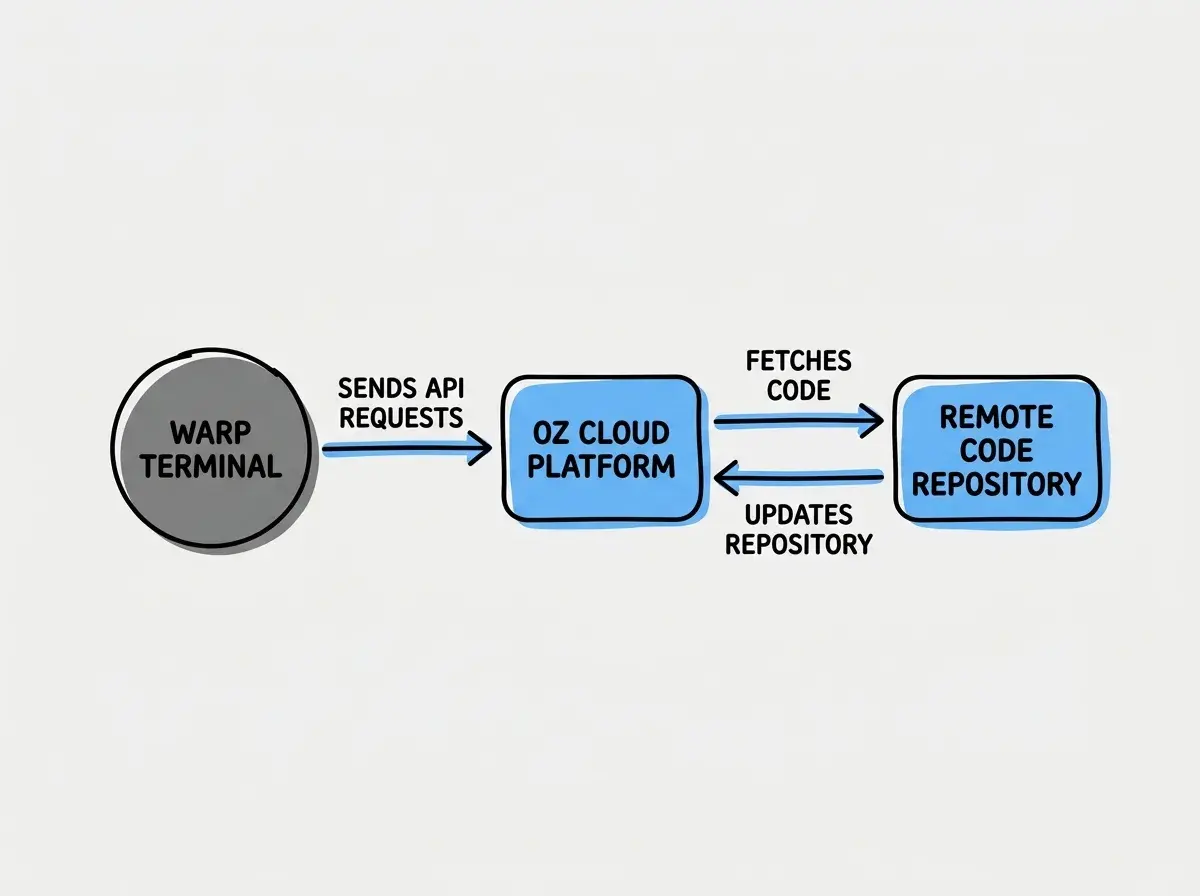
The introduction of Oz creates a distinct bifurcation in how developers should approach artificial intelligence assistance. You now have the interactive, immediate feedback loop of the local terminal and the asynchronous, centrally managed environment of the cloud platform. Understanding when to use each is critical for maintaining an efficient and secure engineering workflow.
Comparing Terminal First Debugging With Cloud Documentation Updates
To understand the practical difference between these two execution models, we must look at specific engineering tasks. Consider a scenario where you are tracking down a memory leak in a local Node application. This task requires immediate, interactive feedback. You need to run the application, monitor process memory, capture heap snapshots, and restart the server repeatedly.
In this situation, a local terminal such as Warp is a practical choice. You can use the terminal's built-in artificial intelligence to help construct complex diagnostic commands or parse cryptic error logs. The running process and its debugging state are local, and the iterative nature of debugging demands the low latency of your own hardware. Sending this task to a cloud agent would be highly inefficient because the agent would lack access to your real-time local state and the specific uncommitted changes you are currently testing.
Do not attempt to use asynchronous cloud agents for tasks that require real-time interaction with local, uncommitted state or live debugging sessions. Cloud agents operate best on pushed code in isolated environments, whereas local terminals provide the immediate feedback loop required for active troubleshooting.
Conversely, consider the task of updating a massive repository's inline documentation to match a newly released internal API standard. This task is tedious, time-consuming, and does not require real-time interactive debugging. It requires reading thousands of lines of code, identifying outdated patterns, and generating standardized comments across multiple files.
This is a useful scenario for evaluating Oz. By offloading this task to a cloud coding agent, you free up your local machine for other work. With the necessary setup and permissions, an agent can work from a repository in a cloud environment, perform the massive refactoring operation, and submit a pull request for human review. You initiate the process via a command line interface or an API call, and the platform handles the heavy lifting asynchronously.
How Oz Manages Cloud Coding Agents and Provides Audit Trails
When shifting execution from a local machine to the cloud, visibility and control become paramount concerns. If an autonomous agent is modifying your codebase, you must have a clear record of its actions. Based on the documentation provided in the Warp blog post, the Oz platform provides mechanisms for both CLI and API control over these agents. This means you can integrate agent execution directly into your existing continuous integration pipelines or trigger them manually from your local terminal.
Crucially, the vendor claims that Oz provides dedicated run links and a comprehensive audit trail for every agent execution. While these are vendor claims and not our own measured results, the documented architecture suggests a strong focus on accountability. Evaluate which commands, file changes, and execution details the run view actually records, and which events require separate monitoring.
Explore clear explanations of AI coding tools, project context, and reliable development workflows.
Explore the blogA shared run link can make review easier than exchanging terminal screenshots. It is not evidence of complete system-call or network auditing. Check log coverage, retention, redaction, and export behavior against your own requirements.
| Feature | Warp Terminal | Oz Platform |
|---|---|---|
| Execution Environment | Local developer machine | Managed cloud infrastructure |
| Primary Use Case | Interactive debugging and local scripting | Asynchronous bulk refactoring and automation |
| State Management | Accesses local uncommitted changes | Operates on remote repository state |
| Audit Capabilities | Local shell history | Centralized run links and execution logs |
Setup Evaluation Checklist for Engineering Teams Adopting Oz
Before integrating any cloud-based agent platform into your engineering workflow, you must conduct a rigorous evaluation. The following checklist provides a framework for assessing whether a platform like Oz meets your team's operational and security requirements. This checklist focuses on verifiable capabilities rather than marketing claims.
First, evaluate the environment reproduction capabilities. A cloud agent is only useful if it can accurately replicate your production or development environment. You must verify how the platform handles system dependencies, custom build toolchains, and specific language versions. If your project requires a highly customized Linux kernel or proprietary binary dependencies, you must determine if the platform allows for custom container images or initialization scripts.
Second, scrutinize the secrets management architecture. Cloud agents often need access to private package registries, cloud provider APIs, or database credentials to perform their tasks. You must evaluate how the platform stores these secrets, how they are injected into the agent's environment, and whether they are masked in the execution logs. Never hardcode credentials into the agent's prompt or configuration files.
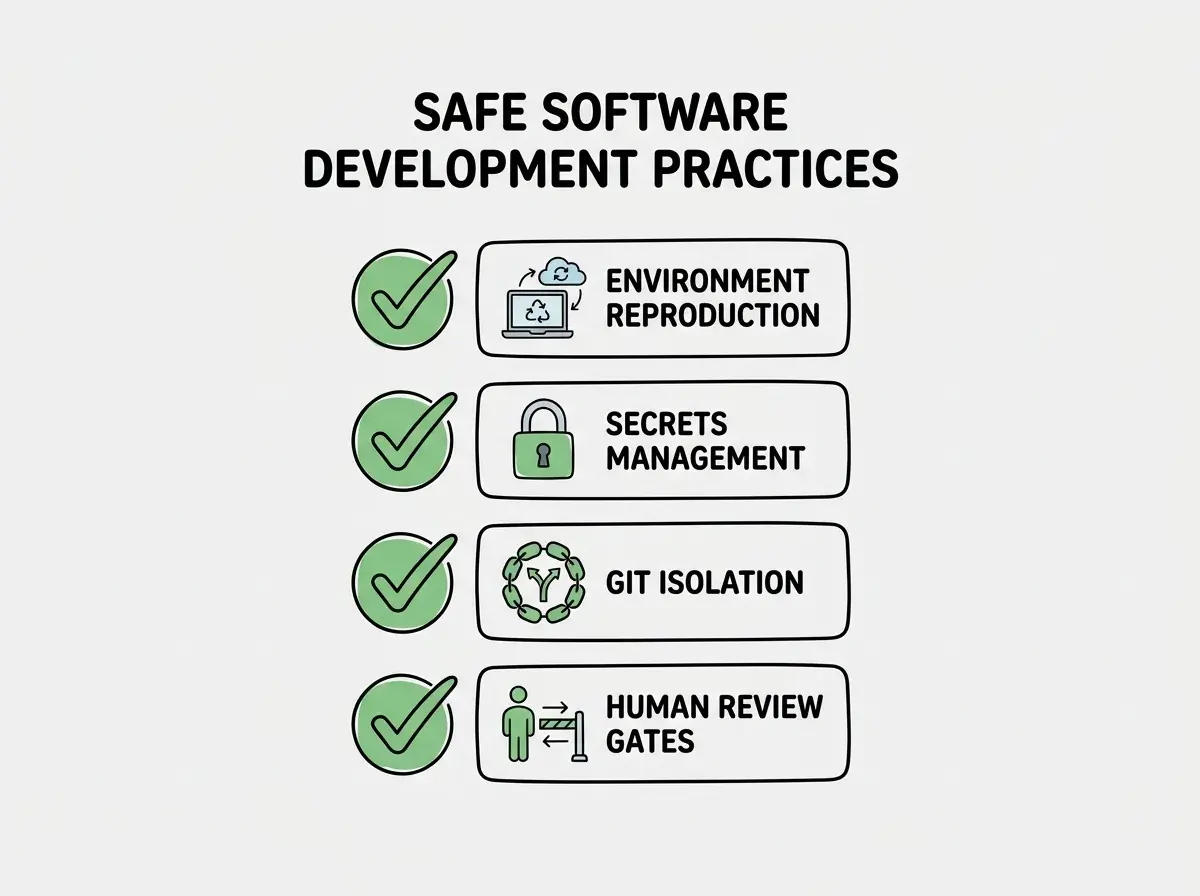
Third, verify the git isolation and branching strategy. The agent should never commit directly to your main production branch. You must ensure the platform can be configured to operate entirely within isolated feature branches. The evaluation should confirm that the agent correctly handles merge conflicts, respects branch protection rules, and accurately attributes commits to the automated system rather than a human developer.
Finally, establish clear human review gates. No automated system should deploy code to production without human oversight. You must evaluate how the platform integrates with your existing pull request workflow. The audit trail and run links provided by the platform should be automatically attached to the pull request, allowing the reviewing engineer to see exactly how the agent arrived at its proposed changes.
Building a Hypothetical Cost Worksheet for Cloud Agent Execution
Transitioning workloads to the cloud always introduces new variable costs. While we cannot provide exact pricing metrics, we can construct a hypothetical cost worksheet to help you model the potential financial impact of adopting a cloud agent platform. This model requires you to estimate several key variables based on your team's historical workload.
Start by estimating the Agent Runtime Minutes. This is the total amount of time the cloud infrastructure spends executing your tasks. You will need to project how many automated tasks your team will run per month and the average duration of each task. Measure runtime for representative tasks; repeated failures can make a seemingly simple task expensive.
Next, factor in the LLM Token Volume. Cloud agents rely heavily on large language models to reason about your code. You must estimate the number of input tokens (the code and context sent to the model) and output tokens (the generated code and explanations). Large repositories may increase retrieval and context costs, but usage depends on what the agent actually reads and how caching works.
When modeling cloud agent costs, always account for the iterative nature of automated tasks. Agents often require multiple attempts and corrections to complete complex refactoring, meaning your estimated token volume and runtime minutes should include a generous buffer for retries and failures.
Finally, consider the Storage and Egress costs. If the agent needs to download large datasets, clone massive repositories, or store significant amounts of generated artifacts, check whether storage and network costs are included, billed separately, or paid through your own connected infrastructure. These worksheet categories are not a claim that Oz invoices each one separately. By combining these hypothetical variables, you can build a baseline model to compare the cost of cloud execution against the cost of your engineers' time.
Frequently Asked Questions About Warp Terminal and Oz Platform
What This Means for Your Daily Software Development Workflow
The introduction of managed orchestration platforms for coding agents represents a maturation of artificial intelligence in software engineering. By clearly separating the fast, interactive local workspace from the heavy, asynchronous cloud execution environment, developers can optimize their time and compute resources.
For working developers, this means learning to delegate effectively. You must develop the intuition to recognize which tasks require your immediate local attention and which tasks can be packaged, configured, and sent to a cloud agent. Embracing this dual workflow allows you to focus on complex architectural decisions and interactive problem solving, while automated systems handle the repetitive, time-consuming maintenance tasks in the background.
Read more practical articles for choosing tools, reviewing changes, and shipping useful software.
Read more guides