Picking a JavaScript framework in 2026 is like choosing a vehicle for a road trip. Vite is a motorcycle. Fast, light, thrilling, and you feel every bump in the road because there is nothing between you and the asphalt. Next.js is a fully loaded SUV. It handles every terrain, carries all your gear, and has backup cameras and lane assist, but it burns more gas and takes longer to park. Remix is a pickup truck. Built to haul heavy loads efficiently, opinionated about how you load the bed, and surprisingly nimble once you learn how it drives.
The vehicle you pick determines how your trip goes. Let me walk through what each one actually feels like when you are building real projects in 2026.
Quick Verdict
Pick Vite when you want speed and simplicity for single-page apps or tools that do not need SEO. Pick Next.js when you need full-stack capabilities, server rendering, and the largest ecosystem. Pick Remix when your app is data-heavy and you want the cleanest loading patterns with the fewest waterfalls.
There is no universally best framework. Vite wins when you need a lean, fast build tool without opinions about routing or rendering. Next.js wins when you need the full kitchen, from server components to image optimization to ISR. Remix wins when your app lives and dies by how cleanly it loads and mutates data. The worst choice is the one you picked because a blog post told you to, without considering what you are actually building.
What Vite Actually Is (And Is Not)
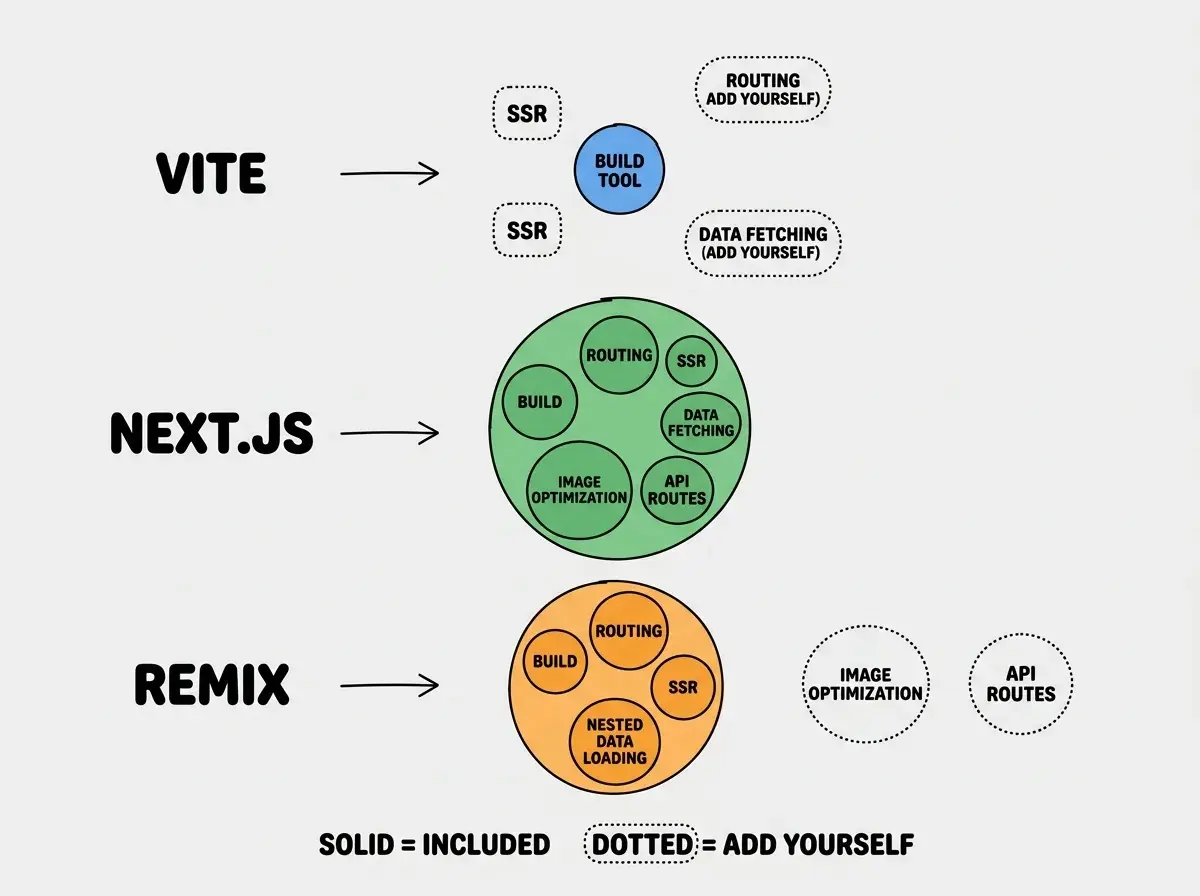
Vite is not a framework in the same way Next.js or Remix are. It is a build tool and dev server that happens to be so fast and pleasant that people build entire apps on top of it. Think of it as the motorcycle engine. You still need to choose your chassis (React, Vue, Svelte, Solid) and bolt on routing, SSR, and data fetching yourself.
The dev server starts in under 200ms. While Next.js developers wait 2-5 seconds for a dev server to spin up and Remix developers wait 1-3 seconds, Vite is ready before your finger leaves the Enter key. Hot module replacement is nearly instantaneous. Change a line of CSS and see it reflected in the browser in under 50ms. This speed compounds over a full day of coding. If you make 500 small changes during a session, Vite saves you real minutes of waiting.
The build output is lean. Vite uses Rollup under the hood, producing highly optimized bundles with aggressive tree-shaking. A typical Vite app ships 30-50% less JavaScript than an equivalent Next.js app because there is no framework runtime overhead. For tools, dashboards, and internal apps where SEO does not matter, that leaner output means faster load times for your users.
But you are on your own for SSR and routing. Vite does not include a router, server-side rendering, or data fetching patterns. You can add React Router, TanStack Router, or build your own. You can add SSR via vite-plugin-ssr (now called Vike). But every addition is a decision you have to make and maintain. On the motorcycle, you feel every bump.
Next.js in 2026
Next.js remains the default choice for most React developers, and for good reason. The SUV does everything. Server components, streaming SSR, incremental static regeneration, API routes, middleware, image optimization, font optimization. If a feature exists in the modern web platform, Next.js probably has an abstraction for it.
Server Components changed the game. In 2026, React Server Components are mature and Next.js is where most developers experience them. Components render on the server by default, sending zero JavaScript to the client unless you explicitly opt in with 'use client'. This means your blog post page ships maybe 5 KB of JavaScript instead of 80 KB. For SEO-heavy sites, content platforms, and marketing pages, this is transformative.
The ecosystem is unmatched. Every component library, every auth provider, every CMS, every database ORM has a Next.js integration guide. When you prompt an AI coding tool to build something, the Next.js version will be the most complete and most correct, because the training data skews heavily toward Next.js examples.
But the complexity is real. The SUV has a lot of buttons. App Router vs Pages Router. Server Components vs Client Components. Server Actions vs API Routes. Static vs Dynamic vs ISR. Edge Runtime vs Node Runtime. Each decision has tradeoffs, and the documentation, while extensive, assumes you understand the mental model. New developers routinely get confused by hydration errors, stale data in server components, and the boundary between server and client.
Deployment costs vary wildly. On Vercel, Next.js deploys in one click. On Cloudflare, you need the OpenNext adapter and careful configuration. On a plain VPS, you need Node.js running with a process manager. The SUV is easiest to drive on the highway it was designed for.
Remix and the Data Loading Philosophy
Remix is the framework that makes you rethink how web apps should load data. The pickup truck analogy holds because Remix is obsessively focused on one thing: getting data to the right place at the right time, without waterfalls.
Nested routing eliminates loading spinners. In Remix, every route segment can define its own loader function that runs on the server. When a user navigates to /dashboard/settings/billing, Remix calls all three loaders (dashboard, settings, billing) in parallel, not sequentially. The page renders with all its data at once instead of showing a cascade of loading skeletons. This pattern eliminates the "spinner inside a spinner inside a spinner" problem that plagues many React apps.
Form mutations feel like the old web, in a good way. Remix uses progressive enhancement for forms. Submit a form and it works without JavaScript. Add JavaScript and it gets smoother with optimistic UI and pending states. This approach is simpler than managing mutation state with React Query or SWR, and it handles edge cases like double-submits and network errors automatically.
The learning curve is different, not steeper. If you have built websites with PHP, Rails, or Django, Remix's mental model will feel familiar. Loaders are like controller actions. Actions handle form submissions. The data flows from server to component in a predictable path. Developers coming from traditional server-rendered frameworks often find Remix more intuitive than Next.js.
| Feature | Vite | Next.js | Remix |
|---|---|---|---|
| Dev server startup | < 200ms | 2-5 seconds | 1-3 seconds |
| SSR built-in | |||
| File-based routing | |||
| Nested data loading | Partial | Best-in-class | |
| Static site generation | Via plugin | ||
| Server Components | Experimental | ||
| Bundle size (typical) | Smallest | Largest | Medium |
| Deploy complexity | Simple static | Platform dependent | Any Node host |
| AI code generation quality | Good (React) | Excellent | Fair |
Real Deployment Costs in 2026
This is where the vehicle analogy gets practical. Gas costs matter.
Vite apps are the cheapest to deploy. A Vite SPA is static files. Host them on Cloudflare Pages, Netlify, or any CDN for free or nearly free. No server compute, no cold starts, no function invocations. If your app does not need SSR, you are looking at $0-5/month for hosting regardless of traffic.
Next.js costs depend entirely on where you deploy. On Vercel, the free tier is generous but the Pro plan at $20/user/month can escalate quickly with bandwidth and function usage. Self-hosting on a $5/month VPS works but you lose edge optimization and preview deployments. On Cloudflare Pages, you get great pricing but rougher DX with the adapter layer.
Remix deploys anywhere Node.js runs. A $5/month VPS on Railway or Fly.io can handle substantial traffic. Remix does not require vendor-specific infrastructure, so your hosting options are wide and your costs are predictable. No edge lock-in, no adapter compatibility worries.
Get the fundamentals of picking the right tools for your project.
Start hereWhen to Pick Each for Vibe Coding Projects
Pick Vite when you are building a tool, dashboard, or internal app that lives behind a login. SEO does not matter. You want the fastest development feedback loop. You are comfortable adding routing and data fetching yourself, or using a meta-framework like Vike on top. The motorcycle is perfect for short, fast trips where you know the road.
Pick Next.js when your project needs SEO, has public-facing pages, or requires a mix of static and dynamic content. You want the largest ecosystem and the best AI code generation support. You are okay trading build complexity for feature completeness. The SUV handles every terrain, and you need that versatility.
Pick Remix when your app is data-intensive with complex forms, nested layouts, and lots of server interactions. You want the cleanest data loading patterns without waterfall requests. You prefer conventions that eliminate entire categories of bugs over flexible-but-manual approaches. The pickup truck hauls heavy loads better than either alternative.
Choosing Next.js for every project because it is the most popular. If you are building a simple internal tool or dashboard with no SEO requirements, Next.js adds complexity you do not need. A Vite + React app with TanStack Router will ship faster, build faster, and deploy for less money. Match the framework to the project, not the other way around.
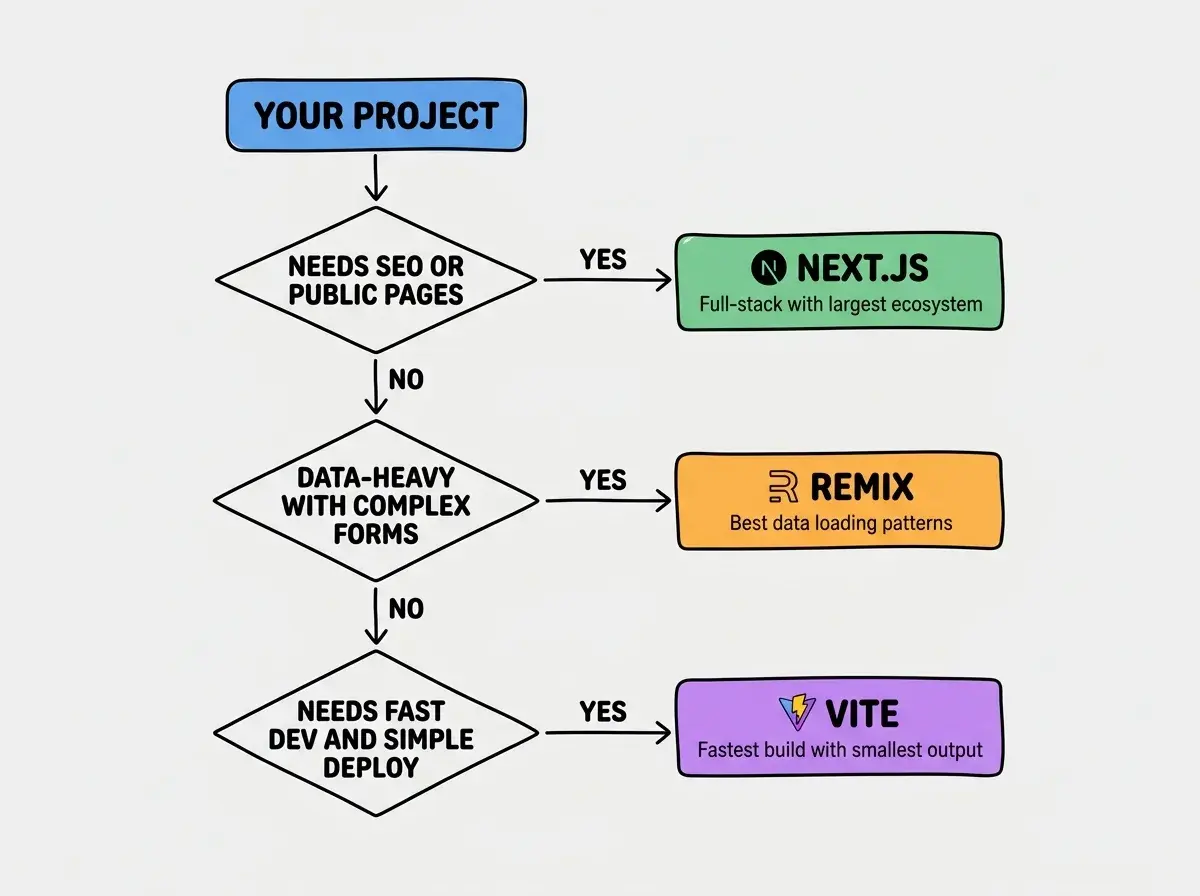
If you are still unsure, this decision flowchart simplifies the choice into three questions.
No matter which framework you choose, the fundamentals of building well remain the same.
Practical guides for shipping real projects with any framework.
Explore guidesFAQ
What This Means For You
The framework wars are less about which tool is objectively best and more about which vehicle matches your trip. A motorcycle rider does not need an SUV. A family hauling camping gear does not need a motorcycle.
If you are starting a new vibe coding project today, ask three questions. Does this need SEO? Is this data-heavy with lots of forms? Do I want the fastest possible dev loop with the smallest possible output? Your answers point directly to Next.js, Remix, or Vite, respectively. And if the answer to all three is "sort of," Next.js is the safe default, because the SUV handles every terrain even if it is not the fastest on any single one.