Next.js vs Remix vs Nuxt is a comparison that matters more than usual in 2026 because AI coding tools have made framework choice a practical constraint, not just a preference. When 92% of developers use AI tools daily and those tools overwhelmingly generate Next.js code by default, your framework decision shapes what your AI assistant can actually help you build.
Quick Verdict
| Next.js | Remix | Nuxt | |
|---|---|---|---|
| Best for | AI-assisted projects, full-stack apps, Vercel ecosystem | Web-standards purists, progressive enhancement, Shopify apps | Vue developers, simpler mental model, content-heavy sites |
| Backed by | Vercel | Shopify | NuxtLabs (Vue ecosystem) |
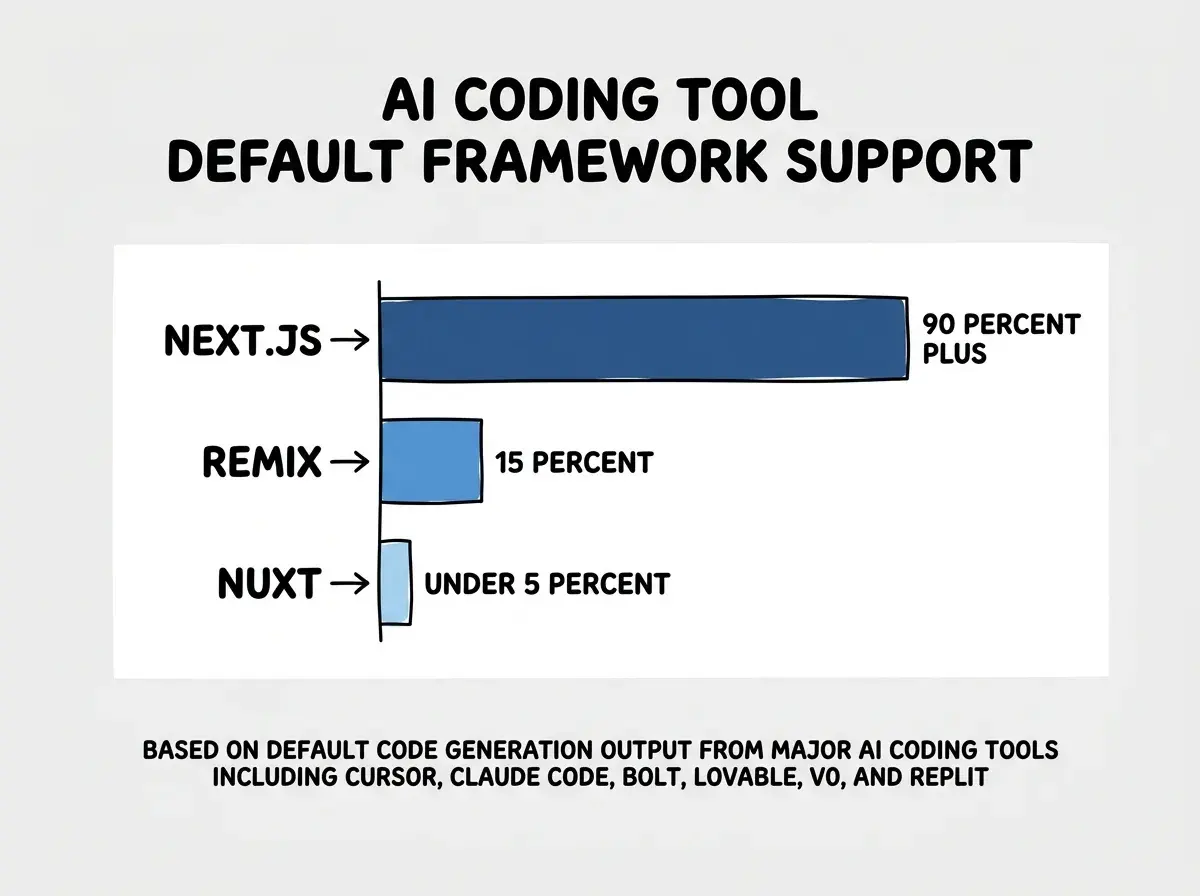
| AI tool support | 90%+ of tools generate Next.js | Limited, growing slowly | Minimal, mostly manual |
| Learning curve | Moderate (App Router complexity) | Lower (web standards) | Lower (Vue simplicity) |
The table tells you the surface-level story. The deeper truth is that each framework optimizes for a fundamentally different philosophy, and the "best" choice depends on your team, your AI workflow, and where you plan to deploy.
AI tool support is now a legitimate framework selection criterion. If you are vibe coding and your AI tool generates Next.js by default, choosing Remix or Nuxt means you will spend significant time correcting, converting, and re-prompting. That overhead is real and it compounds across every feature you build. Factor it into your decision alongside performance, DX, and ecosystem.
What Next.js Gets Right
The dominant framework for AI-assisted development. Cursor, Claude Code, Bolt, Lovable, v0, and Replit all generate Next.js code as their default output. When you prompt "build me a dashboard with authentication and a database," you get a Next.js App Router project with server components, API routes, and a deploy-ready structure. This is not an accident. Vercel has invested heavily in making Next.js the framework that AI tools understand best, and the training data reflects years of Next.js tutorials, documentation, and open-source projects.
The App Router is powerful once you understand it. Server Components, Streaming, Suspense boundaries, parallel routes, intercepting routes, and middleware give you fine-grained control over how your app loads and renders. For complex applications with multiple data sources and varying freshness requirements, the App Router provides tools that neither Remix nor Nuxt can match in flexibility.
The largest ecosystem and community. npm downloads, GitHub stars, Stack Overflow answers, YouTube tutorials, and paid courses all skew heavily toward Next.js. When you hit a problem, someone else has already solved it and written about it. This matters more than framework benchmarks for most teams because developer velocity depends on how fast you can unblock yourself.
Vercel integration is unmatched. Push to GitHub, your Next.js app deploys with ISR, image optimization, edge middleware, and analytics working out of the box. No configuration files, no adapter setup, no compatibility troubleshooting. If you are willing to use Vercel as your hosting platform, the DX is the best in the industry.
The tradeoff is complexity. The App Router introduced a mental model shift that confused even experienced React developers. Server Components versus Client Components, the 'use client' directive, caching behaviors that changed multiple times between versions, and a massive surface area of features that most projects never need. Next.js gives you everything, whether you asked for it or not.
What Remix Gets Right
Web standards as the foundation. Remix builds on top of the Web Fetch API, FormData, Request/Response objects, and progressive enhancement. If you understand how the web works at the protocol level, Remix feels natural. Forms submit without JavaScript. Data loading uses standard HTTP semantics. Error boundaries catch errors at the route level. There is less magic and fewer framework-specific concepts to learn.
Nested routing with parallel data loading. Remix loads data for every route segment in parallel, not in sequence. A page with a layout, sidebar, and main content area loads all three data requirements simultaneously. This architectural decision means Remix apps avoid the waterfall loading patterns that plague poorly structured Next.js apps. Your pages feel fast because the framework prevents you from making them slow.
Shopify backing brings stability and focus. After the Shopify acquisition, Remix merged with React Router (now React Router v7 with framework mode). This means Remix is not a separate framework anymore but rather the full-stack layer on top of the most widely-used React routing library. Shopify uses it in production for their admin interface and storefront themes. The framework will not disappear overnight, and its development is funded by real commerce revenue, not VC money.
Progressive enhancement that actually works. Remix apps function without JavaScript enabled in the browser. Forms submit, pages render, navigation works. JavaScript enhances the experience but does not gate it. For e-commerce, content sites, and anything where accessibility matters, this is a genuine advantage over frameworks that break without client-side JS.
The tradeoff is ecosystem size and AI tool support. Remix has a fraction of Next.js's community, and AI tools rarely generate Remix code by default. You will spend more time writing prompts like "use Remix loader patterns, not Next.js server components" and correcting output that assumes a Next.js project structure.
What Nuxt Gets Right
Vue's simplicity as a superpower. If React's learning curve has ever frustrated you, Vue (and by extension Nuxt) offers a gentler path. Single-file components with template, script, and style blocks in one file. A reactivity system that works without hooks or state management libraries for most cases. Two-way data binding that just works. For solo founders and small teams, Vue's simplicity translates directly into shipping speed.
Auto-imports and convention-over-configuration. Nuxt auto-imports components, composables, and utilities based on directory structure. Drop a component in components/, it is available everywhere. Create a composable in composables/, it is globally accessible. No import statements to manage, no barrel files to maintain. The framework figures out what you are using and imports it for you. This reduces boilerplate significantly compared to Next.js.
Nuxt Content for documentation and blogs. If you are building a content-heavy site, Nuxt Content gives you a file-based CMS with Markdown/MDX support, content querying, and full-text search out of the box. It is more opinionated than Next.js's bring-your-own-CMS approach, and for content sites specifically, that opinionation saves time.
Nitro server engine with universal deployment. Nuxt's server layer (Nitro) deploys to Node.js, Cloudflare Workers, Deno, Bun, Vercel, Netlify, and AWS Lambda with a single configuration change. The deploy target abstraction is cleaner than Next.js's adapter ecosystem, where each hosting platform has its own compatibility quirks.
The tradeoff is the Vue ecosystem itself. The JavaScript world runs on React. Most component libraries, most design systems, most SaaS SDKs ship React components first and Vue components as an afterthought (if at all). AI tools generate React code. Job listings require React experience. Choosing Nuxt means choosing Vue, and choosing Vue means swimming against a very strong current in 2026.
The AI Tool Support Gap
This is the category that did not exist two years ago and now arguably matters more than any other for vibe coders.
Next.js owns AI tool support. Over 90% of AI coding tools generate Next.js projects by default. v0 generates Next.js exclusively. Cursor and Claude Code have extensive training data on Next.js patterns. Bolt and Lovable scaffold Next.js apps. When you ask an AI to "build a SaaS with auth, payments, and a dashboard," you get Next.js. This is self-reinforcing: more Next.js code in training data means better Next.js generation, which means more people use Next.js with AI tools, which means more training data.
Remix gets partial support. Some AI tools can generate Remix code if you explicitly ask. The quality is inconsistent. You will often get code that mixes Next.js patterns with Remix conventions, like using getServerSideProps patterns instead of Remix loaders, or trying to use next/image in a Remix project. Correcting these mistakes eats into the productivity gains that AI tools are supposed to provide.
Nuxt gets almost no support. AI tools trained primarily on React and Next.js struggle with Vue syntax and Nuxt conventions. You will get React components when you ask for Vue components. You will get Next.js API routes when you ask for Nuxt server routes. The gap is wide enough that vibe coding a Nuxt project requires significantly more manual work than vibe coding a Next.js project.
Assuming you can just "tell the AI to use Remix" or "tell the AI to use Nuxt" and get the same quality output as Next.js. The training data imbalance is structural, not a prompting problem. You can improve results with detailed system prompts and framework-specific context files, but you cannot close a 90% versus 5% training data gap with better prompts alone. If AI-assisted development speed is your top priority, this gap is the most important factor in your framework decision.
Deployment Options Compared
Next.js deploys natively on Vercel with zero configuration. It also runs on Netlify, Cloudflare Pages (via @opennextjs/cloudflare), AWS Amplify, and self-hosted Node.js. The Vercel experience is best-in-class, but you are not locked in. The further you move from Vercel, the more configuration you manage yourself.
Remix deploys to any platform that supports Node.js, plus Cloudflare Workers, Deno Deploy, and Fly.io. Because Remix builds on web standards, adapter compatibility is generally smoother than Next.js's adapter story outside Vercel. Shopify's Hydrogen framework uses Remix for Cloudflare Workers deployment at massive scale.
Nuxt deploys via Nitro presets to Vercel, Netlify, Cloudflare, AWS, Azure, and more. The universal deployment story is Nuxt's strongest infrastructure advantage. Changing deploy targets is often a one-line configuration change, which is simpler than either Next.js or Remix when targeting non-default platforms.
Learn how to get the most out of AI coding tools with any framework.
Start herePerformance in Practice
All three frameworks can build fast applications. The performance differences show up in defaults and developer behavior, not in framework ceilings.
Next.js with the App Router and Server Components delivers excellent performance when used correctly. The problem is that "correctly" requires understanding a complex caching and rendering model. Misconfigured caching, unnecessary client components, and waterfall data fetching are common in AI-generated Next.js code.
Remix makes fast apps by default because its architecture prevents common performance mistakes. Parallel data loading, no client-side data fetching waterfalls, and progressive enhancement mean the baseline performance is high without optimization effort.
Nuxt with its auto-import system and built-in optimizations (code splitting, lazy loading, payload extraction) delivers strong performance with minimal configuration. The Vue 3 reactivity system is also lighter than React's reconciliation, resulting in smaller bundle sizes for equivalent functionality.
Who Should Use What
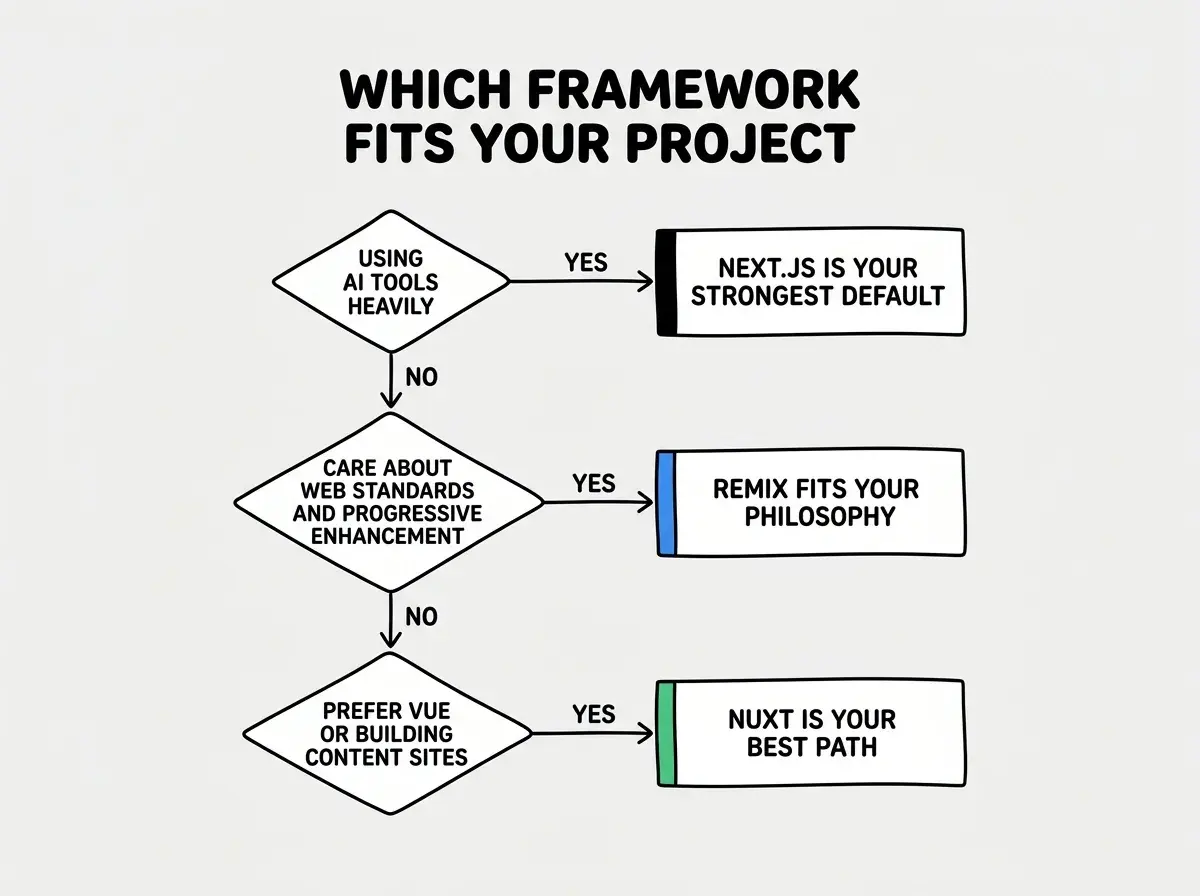
Use Next.js if you:
- Rely heavily on AI coding tools for development speed
- Want the largest ecosystem of components, libraries, and tutorials
- Are deploying to Vercel or need advanced rendering strategies
- Value community size and the ability to hire developers easily
Use Remix if you:
- Care deeply about web standards and progressive enhancement
- Are building for Shopify or e-commerce platforms
- Want a framework that prevents performance mistakes by default
- Have a team comfortable writing more code manually with less AI assistance
Use Nuxt if you:
- Already know and prefer Vue over React
- Are building content-heavy sites or documentation
- Want the simplest mental model with auto-imports and convention-based structure
- Need flexible deployment across multiple platforms
The framework matters, but the tool you build with matters more.
Compare AI coding toolsWhat This Means For You
The framework comparison in 2026 is not purely technical anymore. AI tool support has become a practical multiplier that changes the productivity equation.
If you are a founder building fast with AI tools, Next.js is the pragmatic default. Not because it is the best framework in every dimension, but because every AI coding tool speaks Next.js fluently. The 90%+ support gap is not closing anytime soon, and fighting it costs real development hours.
If you are a senior developer who values clean architecture and web standards, Remix gives you a framework that respects how the web actually works. You will write more code yourself, but the code will be more predictable and more portable.
If you are in the Vue ecosystem and building content sites or internal tools, Nuxt gives you a developer experience that React-based frameworks cannot match for simplicity. The AI tool gap is real, but if your team already thinks in Vue, switching to React for AI support alone is rarely worth the retraining cost.
Pick the framework that matches your strongest constraint. For most vibe coders in 2026, that constraint is AI tool support, and Next.js wins that category by a wide margin. But "most" does not mean "all," and knowing when you are the exception is just as important as knowing the default.