Vibe coding for marketers means building the landing pages, dashboards, and automation tools your campaigns need, without submitting a ticket to engineering and waiting three weeks. Over 1,300 marketers who could not write a line of HTML are now building real, working tools with AI, and the marketing industry is calling it the number one skill for 2026.
This is not about becoming a developer. It is about removing the bottleneck that sits between your marketing ideas and their execution. Every marketer knows the frustration: you need a custom landing page for a campaign launching Friday, but engineering is booked for the next sprint. You need a dashboard to track campaign performance across channels, but the analytics team has a six-week backlog. You need a simple automation to sort incoming leads, but the ops team cannot get to it until next quarter. Vibe coding eliminates the wait.
Why This Is Happening Now
Getting a marketing degree never required you to build a printing press. You learned to create messages, not the machinery that delivers them. But imagine if you could build a printing press in an afternoon, one that prints exactly what your campaign needs, exactly when you need it. That is what vibe coding does for your toolset.
The reason this matters right now is that AI tools have crossed a specific threshold. They are good enough that someone with zero technical knowledge can describe what they want in plain English and get back a working tool. Not a mockup. Not a wireframe. A real, functioning thing that does real work.
vibecodingformarketers.com, a community that has grown rapidly this year, calls vibe coding "the number one skill for marketers in 2026." That is a bold claim, but the reasoning is straightforward: marketers who can build their own tools move faster than marketers who wait for someone else to build them. In a field where speed often determines who wins the campaign, moving faster is a genuine competitive advantage.
63% of vibe coding users are non-developers, and marketers are one of the fastest-growing groups. The ability to build your own tools eliminates the engineering bottleneck that slows most marketing teams down by weeks or months.
The shift is especially significant because marketing tools are, by nature, time-sensitive. The landing page you need for Friday's launch is worthless on Monday. The dashboard you requested last quarter would have been useful last quarter. When the gap between "I need this" and "this exists" shrinks from weeks to hours, the entire pace of marketing operations changes.
The Printing Press in Your Pocket
The printing press analogy goes deeper than you might expect. Before the printing press, if you wanted to distribute a message, you needed a scribe. The scribe was the bottleneck. They were skilled, they were necessary, and they were always busy with someone else's project. The printing press did not eliminate the need for good writing. It eliminated the bottleneck between the writing and the distribution.
Vibe coding does the same thing for marketing tools. Your engineering team is the scribe. They are skilled, necessary, and permanently busy. You are not trying to replace them. You are trying to eliminate the bottleneck between your marketing ideas and the tools that bring those ideas to life.
And just like the printing press did not require you to become a metalworker or an ink chemist, vibe coding does not require you to understand JavaScript, databases, or server architecture. You describe what you need in the same language you would use to brief a designer or explain a campaign to your team. The AI translates that into a working tool.
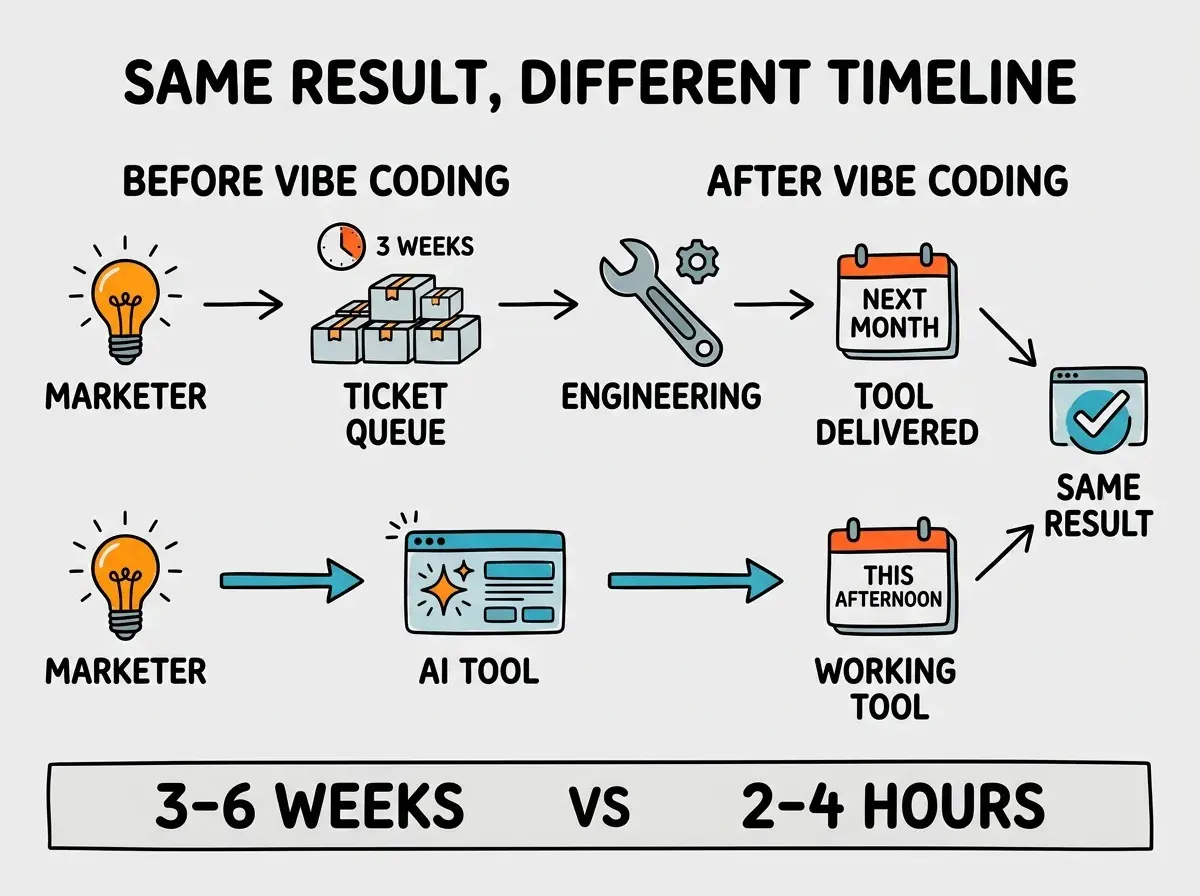
The marketers who are adopting this fastest are the ones who have felt the bottleneck most painfully. They are the ones who have lost campaigns because a landing page was not ready in time, or who have made decisions based on gut feeling because the analytics dashboard they needed was still in the backlog.
What Marketers Are Actually Building
This is where it gets concrete. Forget the abstract potential and look at what 1,300-plus marketers are actually building right now.
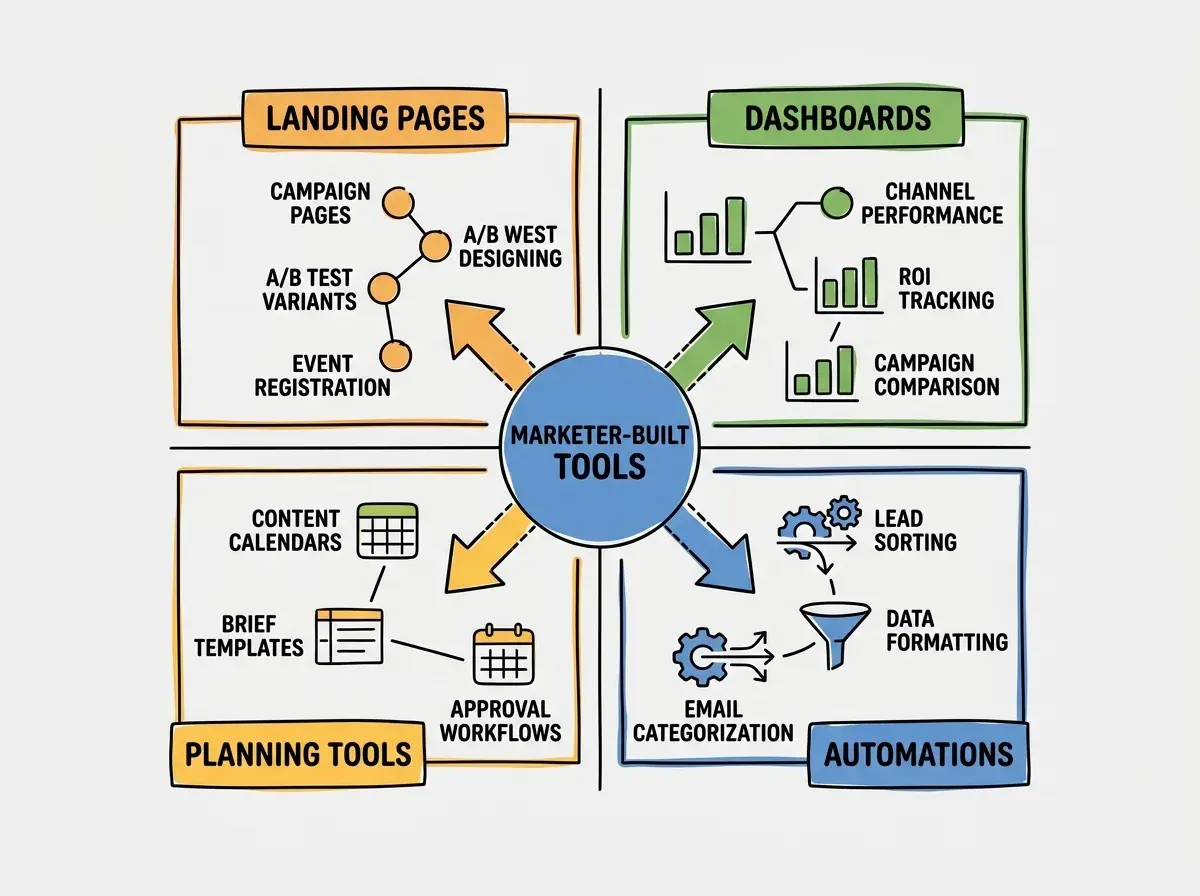
Landing pages that launch when you need them. Not templates you customize in a drag-and-drop builder. Custom pages built from your specific brief, with the exact layout, copy structure, and conversion flow your campaign requires. Describe your audience, your offer, and your goal, and the AI builds a page that matches. This confuses everyone at first because it sounds too easy. It is genuinely that straightforward for simple landing pages.
Campaign performance dashboards. Pull data from your various platforms and display it in one view. The dashboard you have been begging analytics for, the one that shows spend, conversions, and ROI across all channels on a single screen, you can build it yourself in an afternoon. It will not be as polished as a professionally built analytics platform, but it will exist today instead of next quarter.
Content calendars and planning tools. Custom tools that match your specific workflow instead of forcing you into someone else's template. If your team plans content differently than what Asana or Monday assumes, you can build a planning tool that works the way you actually work.
Simple automation tools. Lead sorting, email categorization, content tagging, data reformatting. The small, repetitive tasks that eat hours of your week can often be automated with a vibe-coded tool that takes an afternoon to build.
Learn the fundamental concepts that make vibe coding work.
Start learningNone of these require you to understand programming concepts. You describe what you want in plain language, review what the AI builds, and ask for changes until it matches your needs. The conversation looks less like coding and more like briefing a very fast, very literal freelancer.
Getting Started Without Any Technical Background
You might think you need some technical foundation before you try this. But actually, the marketers who move fastest are the ones who start building immediately and learn by doing. Zero assumed technical knowledge means exactly that.
Here is the practical starting point. Pick the smallest tool that would make your week better. Not the analytics platform that replaces Tableau. Not the marketing automation system that rivals HubSpot. Pick something small: a landing page for next week's campaign, a simple calculator that helps your sales team quote prices, a form that collects and organizes customer feedback.
Open an AI tool (Replit, Lovable, or Cursor are popular choices) and describe what you want in the same language you would use to explain it to a colleague. "I need a page with a headline, three benefit bullets, a testimonial section, and an email signup form. The audience is small business owners who want to save time on invoicing." That is a complete enough brief for the AI to produce a first version.
When the first version appears, you will see things you want to change. Tell the AI directly: "Make the headline bigger," "Change the button color to our brand blue," "Add a second testimonial." Each change takes seconds. Within an hour, you will have something that works. Not perfect, not final, but functional.
The first time you build something that works, the mental shift is dramatic. You go from "I need to ask someone to build this" to "I can build this myself before lunch." That shift does not just change your toolkit. It changes how you think about solving marketing problems, because solutions that used to require a ticket and a three-week wait now require an afternoon and a clear idea.
Trying to build something too complex on your first attempt. Start with a single landing page or a simple dashboard, not a full marketing automation platform. The 70% wall, where AI handles the first 70% well but struggles with complexity, hits harder when you start with an ambitious project. Build small, gain confidence, then gradually increase scope.
The 70% wall applies to marketers too. AI will get your tool 70-80% of the way there quickly, but the final polish can be frustrating. For marketing tools, though, that first 70% is often all you need. A landing page that is 70% polished but launches on time beats a perfect page that launches two weeks late.
Dig deeper
A few hand-picked sources if you want to go further.
What This Means For You
Vibe coding is not replacing marketing skills. It is removing the friction between having a marketing idea and executing it. The marketers who adopt this approach are not becoming developers. They are becoming marketers who do not have to wait.
- If you run campaigns: Start with landing pages. Build the next campaign page yourself instead of submitting a ticket. Even if the page is simpler than what engineering would produce, the speed advantage and the ability to iterate in real time based on early performance data will likely outweigh the polish difference.
- If you manage a team: Vibe coding can eliminate your team's dependency on engineering for routine tool requests. Encourage one team member to try building a simple internal tool, then share what they learn. Teams that adopt this approach report spending significantly less time waiting on other departments and more time on actual marketing work.
- If you freelance: This is a competitive differentiator. Clients who used to need a marketer and a developer for a campaign landing page now need just you. The ability to deliver both the strategy and the execution, without subcontracting the technical work, makes your proposals faster, cheaper, and more compelling than competitors who still need to bring in a developer.
Get the complete beginner guide to vibe coding, no technical background required.
Get started