Vibe coding for founders is the fastest path from business idea to working prototype without writing code or hiring a developer. AI tools now let non-technical founders build real, functional MVPs in days instead of months, turning the traditional startup timeline on its head.
This is not theoretical. Sabrine Matos used vibe coding to build Plinq, a product that grew to 10,000 users and $456,000 in annual recurring revenue. She is one of thousands of founders who skipped the "find a technical co-founder" step entirely. In the latest Y Combinator batch, 25% of startups had codebases that were 95% or more AI-generated. The era of needing a CS degree to build software is over.
Why Founders Are Leading This Shift
The numbers tell a striking story. Founders make up 36.4% of all vibe coding users, the single largest group. That is not a coincidence. Founders have the strongest motivation to build fast and the least patience for anything that slows them down.
The business case is straightforward. A typical MVP built by a freelance developer costs $15,000 to $50,000 and takes two to four months. A vibe-coded MVP costs essentially nothing beyond your time and a monthly AI subscription, and it can be functional within a week. JP Morgan, Salesforce, and Inc Magazine have all published guides helping founders use AI to build their first products. When the financial press starts covering a development approach, you know it has moved past the early-adopter phase.
73% of tech startup founders have already adopted AI coding tools. And the Y Combinator CEO put it bluntly: "Ten engineers using vibe coding deliver what 50 to 100 used to." If that ratio holds for a ten-person engineering team, imagine what it means for a solo founder who previously could not build anything at all.
Founders are the largest group of vibe coders at 36.4%, and 25% of the latest YC batch built 95%+ AI-generated codebases. The cost of building an MVP has dropped from tens of thousands of dollars to nearly zero.
This does not mean every founder should build their own product forever. It means every founder can now build the first version themselves, validate the idea with real users, and then make informed decisions about when and whether to hire engineers.
Learning to Drive, Not to Race
Think of vibe coding like learning to drive. You are not trying to become a Formula 1 driver. You are not trying to understand combustion engines or master heel-toe downshifting. You are learning to drive so you can get to your meetings, pick up supplies, and run your business. You need enough skill to get where you are going, not mastery of the vehicle itself.
This analogy matters because it sets the right expectations. A driving instructor does not start with engine mechanics. They start with "turn the key, check your mirrors, and ease onto the gas." Vibe coding works the same way. You do not need to understand JavaScript frameworks, database schemas, or API architecture. You need to understand how to describe what you want clearly enough for the AI to build it.
The founders who fail at vibe coding almost always fail because they set the wrong goal. They try to become developers instead of trying to build a product. They dive into documentation, watch programming tutorials, and get lost in technical details that do not matter for their first prototype. That is like studying automotive engineering when you just need to pass your driving test.
Your job as a founder is to stay in the driver's seat, not to crawl under the hood. The AI is your engine. You tell it where to go. If it takes a wrong turn, you correct it. If it breaks down, you describe what went wrong and ask it to fix itself. You never need to pop the hood and rewire anything manually.
Your First Week With Vibe Coding
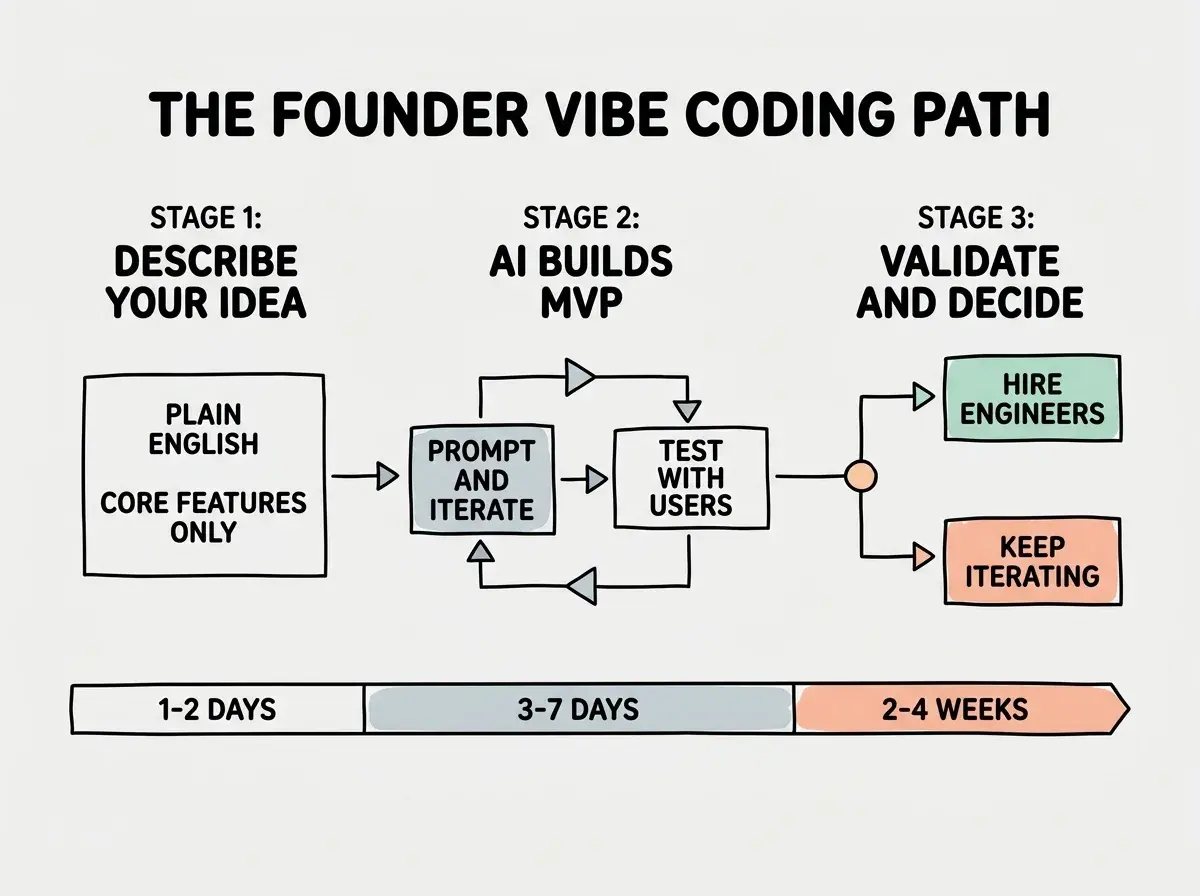
The practical path from zero to working prototype follows a predictable pattern. This confuses everyone at first because it feels too simple, but simplicity is the point.
Day one and two: Write your product brief in plain language. Not a technical spec. Not a feature list. A simple description of who your user is, what problem they have, and what the first version of your product does about it. Keep it to one page. If you cannot describe your MVP in one page of plain language, you are building too much.
Day three through five: Build with an AI coding tool. Start a conversation with an AI tool like Cursor, Replit, or Lovable. Paste your product brief and ask the AI to build it. You will go back and forth, describing what you want changed, what is not working, and what to add next. Lovable reports that 60% of its users are non-developers, which means the tools are explicitly designed for people in your position.
Day six and seven: Get it in front of users. Deploy your prototype and share it with five to ten potential users. Their feedback is worth more than another week of building. This is where most founders discover that the feature they spent the most time on is not the one users care about, which is exactly the insight you need before investing more time or money.
Start with the fundamentals that every vibe coder needs to know.
Learn the basicsThe mistake most founders make is not starting this cycle. They research tools for weeks. They watch tutorial after tutorial. They wait until they feel "ready." You will never feel ready. The learning happens by doing, not by preparing to do. Your first prototype will be rough, and that is exactly what it should be.
The Three Traps That Sink Founder Projects
You might think the hard part of vibe coding is the technical challenge of building something. But actually, the hard part is avoiding three traps that have nothing to do with technology.
Trap one: Building too much before validating. This is the classic founder mistake, amplified by vibe coding. Because building is so fast now, it is tempting to add "just one more feature" before showing it to users. Resist this with everything you have. Every feature you add before validation is a guess. The faster you can build, the faster you should validate. Speed of building should translate to speed of learning, not speed of feature bloat.
Trap two: Skipping security entirely. 45% of AI-generated code introduces security vulnerabilities. When you are building a prototype for five beta users, this is manageable. When you start handling real user data, payments, or personal information, it becomes a serious liability. The driving analogy holds here: you do not need to be a mechanic, but you do need to wear your seatbelt. Basic security hygiene (not storing passwords in plain text, using HTTPS, validating user input) is the seatbelt of vibe coding.
Trap three: No version control. Version control means saving snapshots of your project so you can go back if something breaks. Without it, one bad AI response can destroy hours of work. Every AI coding tool has a way to save versions. Use it before every major change. Think of it as saving your game before a boss fight.
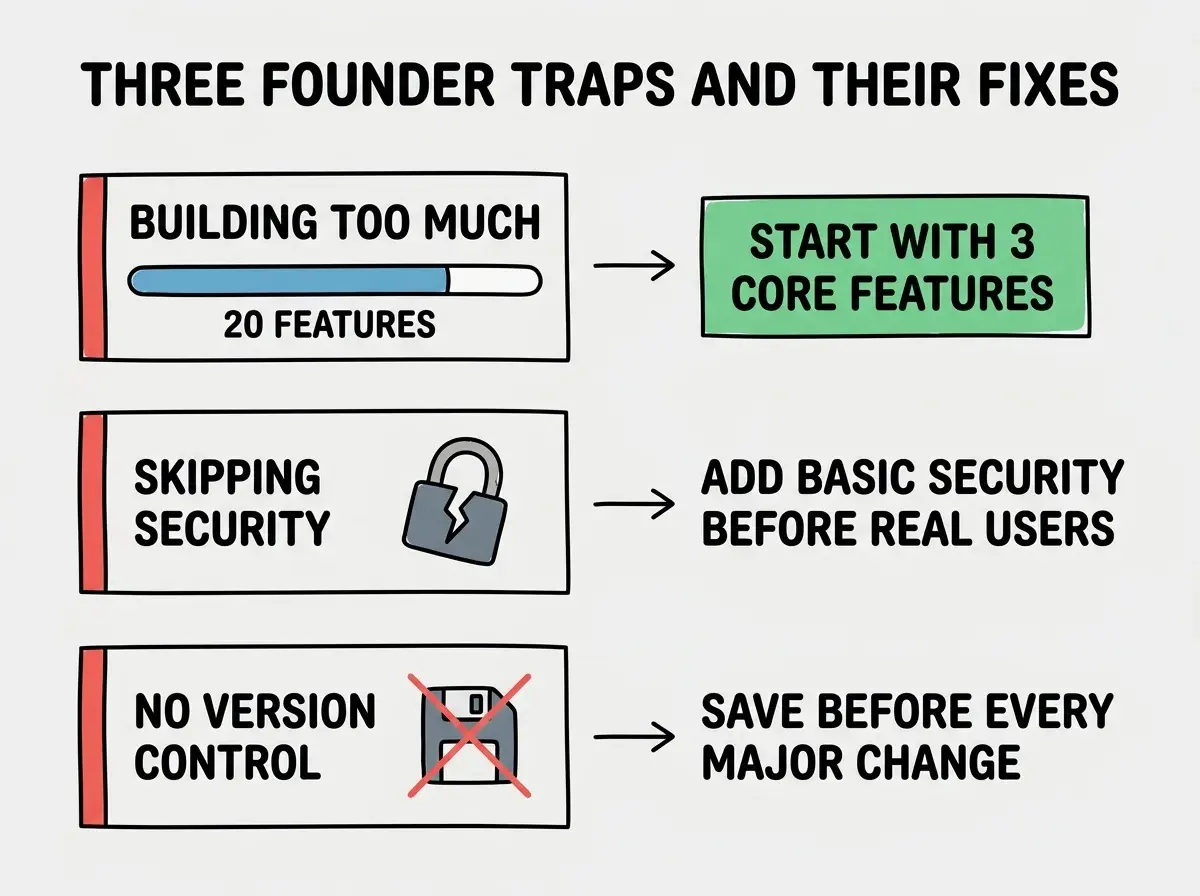
These traps are not unique to vibe coding, but vibe coding makes them easier to fall into because the speed of building removes the natural friction that used to force founders to pause and think. When building took months, you had plenty of time to consider security and scope. When building takes days, you have to be intentional about those pauses.
Building for weeks without showing anything to real users. Vibe coding makes building so fast that founders often skip validation entirely, adding feature after feature instead of testing their core assumption with actual people. Your first prototype should be embarrassingly simple.
The founders who succeed with vibe coding are not the ones who build the most impressive first versions. They are the ones who build the simplest possible version, get it in front of users fastest, and use what they learn to decide what to build next. The $456K ARR success story of Plinq did not start with a polished product. It started with a rough prototype that solved a real problem.
Dig deeper
A few hand-picked sources if you want to go further.
What This Means For You
Vibe coding has fundamentally changed the economics of starting a company. The barrier to entry for building software is lower than it has ever been, which means the competitive advantage shifts from "can you build it" to "do you understand the problem well enough to build the right thing."
- If you are pre-revenue: Start building this week. Do not wait for a technical co-founder, do not save up for a freelancer, and do not spend another month on market research alone. Build the simplest version of your idea in a weekend and get it in front of five real users. The feedback you get will be worth more than any amount of planning.
- If you have raised funding: Use vibe coding to prototype and validate faster, but plan your transition to professional engineering early. Investors expect you to move fast in the early stages, but they also expect the codebase to be maintainable as you scale. Build the first version yourself, then use what you learn to write better specs for the engineering team you hire.
- If you are a solo founder: Vibe coding is your co-founder. It lets you do what previously required a two-person team. But be honest about the 70% wall, the point where AI gets your project most of the way there but struggles with the last stretch. Plan for it. Budget time for it. And when you hit it, use it as the signal that it is time to consider bringing on technical help, not as a sign that you failed.
Get the complete guide to your first vibe coding project.
Start building