To use vibe coding for validation in 2026, build 10 minimal demos in 90 days using a four-stage process (rapid prototyping in 1-2 days each, real-user feedback in 2-3 days each, ship-or-kill decision in 1 day, then graduate the winners to deeper development), set strict scope limits per demo so the throwaway nature is honored, and treat the 10-demo batch as a portfolio rather than 10 separate bets. Vibe coding's superpower is not building one polished product faster; it is testing many small ideas at once and graduating only the ones that show real signal.
This piece walks through the four-stage validation process, the scope discipline that makes 10 demos achievable, the real-user feedback patterns, and the four mistakes that turn idea validation into ten half-built products.
Why Validation Matters More Than Building
Most failed products fail because they solved the wrong problem, not because they were built poorly. Validation reduces this risk by checking whether the problem is real before substantial building begins. Products that validate before building succeed dramatically more often than products that build first and validate after.
The 2026 reality is that vibe coding has changed validation economics. Tools like Cursor and Claude Code make it possible to build a working demo in 1-2 days; the cost of testing an idea has dropped 10x. The leverage is not in building one product faster but in testing many ideas in the time previously needed for one.
A 2025 Y Combinator portfolio analysis of 800 startups found that founders who validated 5+ ideas before committing to one had 2.8x higher product-market-fit rates at month 12 than founders who committed to their first idea. The validation discipline mattered more than the specific idea quality; founders who tested more ideas converged faster on what worked. Vibe coding makes this validation discipline more accessible than ever; founders who use the leverage well outperform those who treat AI as a one-product accelerator.
The pattern to copy is the way pharmaceutical companies test compounds. They do not commit to one drug and force it to work; they screen thousands of candidates, advance the promising ones, kill the failures fast. Vibe coding lets product founders use the same approach with software ideas; the screening produces dramatically better selection than commitment-first approaches.
The Four-Stage Validation Process
Four stages structure the validation work for each idea. The stages must be tight to allow 10 cycles in 90 days.
Stage 1, rapid prototyping (1-2 days). Build the smallest possible demonstration of the core value. Single workflow; no auth if avoidable; no backend if frontend can fake it. The goal is showing the idea, not shipping it.
Stage 2, real-user feedback (2-3 days). Show the demo to 5-10 potential users. Not friends; actual target users. The reactions reveal whether the idea solves a real problem.
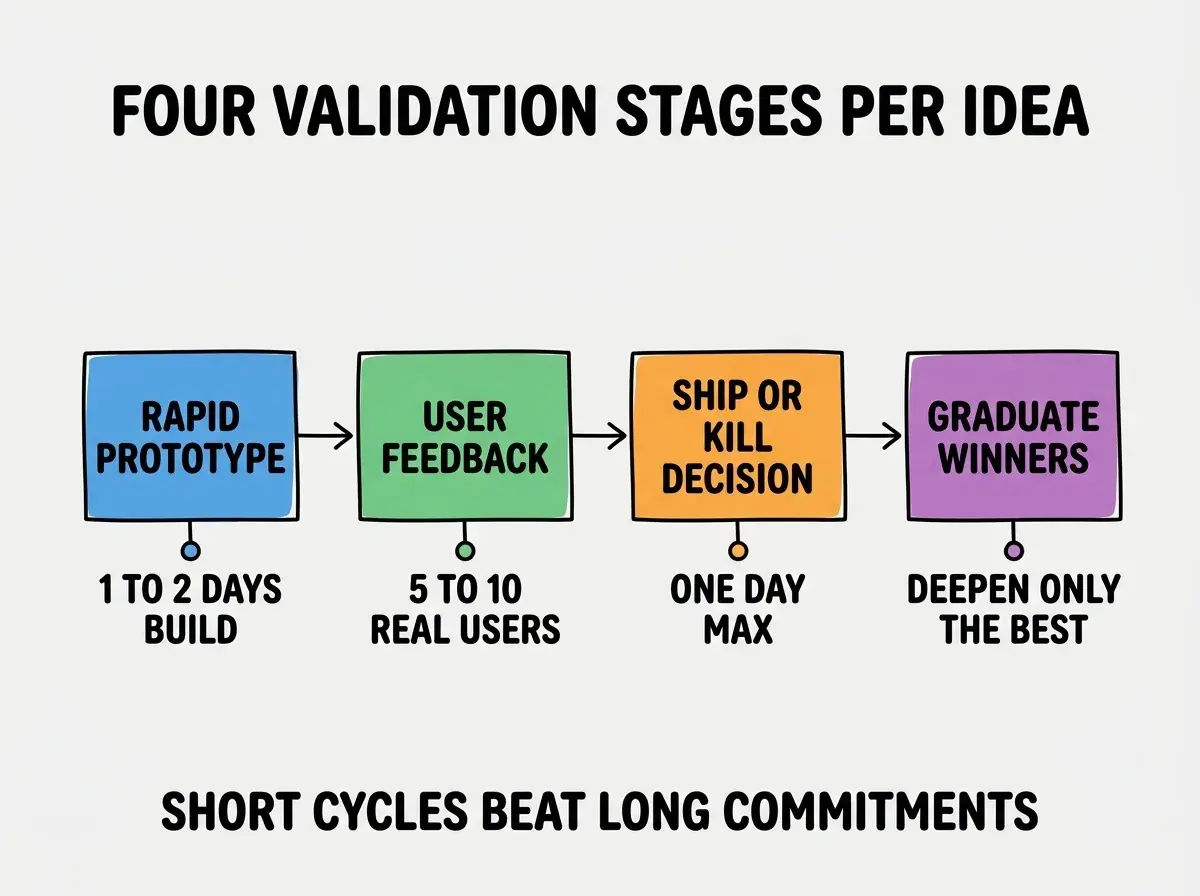
Stage 3, ship-or-kill decision (1 day). Based on user feedback, decide whether the idea graduates to deeper development or gets killed. Ambivalent ideas should usually be killed; only clear winners advance.
Stage 4, graduate winners. Surviving ideas get the deeper development treatment that produces real products. Most ideas die in stage 3; the few that survive justify the time investment.
The Scope Discipline That Makes 10 Demos Possible
Three scope principles enable 10 demos in 90 days rather than 1 polished product.
Principle 1, one workflow per demo. No multi-feature demos; single workflow done well. Multi-feature demos take 5x longer and produce no clearer signal than single-workflow demos.
Browse more validation guides
Read more foundations articlesPrinciple 2, hardcode where possible. Need a list of users? Hardcode 5. Need authentication? Skip it for the demo. Hardcoding is acceptable for validation demos; the goal is testing the idea, not shipping the implementation.
Principle 3, accept ugly. Default styling, no logo, no marketing site. The demo should be functional enough to test the idea; visual polish comes after the idea validates, not before.
The Real-User Feedback Patterns
Three feedback patterns reveal whether ideas have real signal.
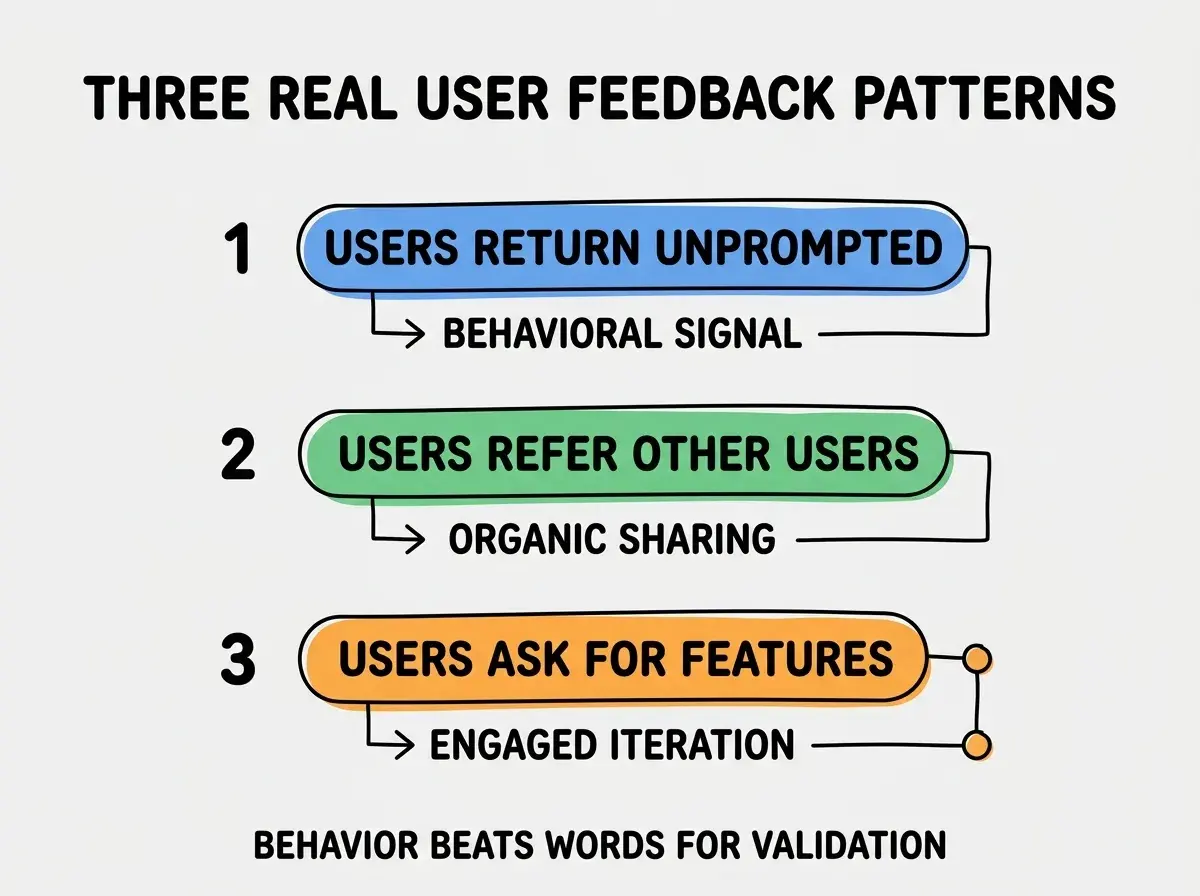
Pattern 1, users return unprompted. Watch what happens after the first session. Users who return without prompting demonstrate real value; users who never return signal the idea did not stick.
Pattern 2, users refer other users. Organic sharing is the strongest validation signal. If your demo users tell friends about your demo, you have signal worth pursuing.
Pattern 3, users ask for features. Engaged users want more; engaged-but-frustrated users have specific suggestions. Both signal real engagement; passive feedback (it's nice, I like it) does not.
How to Recruit Validation Users Quickly
Three patterns help recruit real users for validation demos quickly.
Pattern 1, use Twitter and LinkedIn for cold outreach. Find 50 people in your target audience, send personalized messages explaining you are testing an idea and offering 15-minute interviews. 5-10 percent response rate is normal.
Pattern 2, recruit through founder communities. IndieHackers, specific Discord servers, founder Slack groups have members willing to test other founders' demos. The reciprocity is high.
Pattern 3, offer modest incentives for participation. $25 gift cards or free product credits compensate users for time. Even small incentives substantially increase response rates and quality of feedback.
The combination produces real-user feedback within 1-2 days of demo completion. Without recruitment patterns, founders often delay validation because they have no users; the recruitment is part of the validation skill.
How to Decide Which Ideas Graduate
Three criteria help decide which validation winners deserve deeper development.
Criterion 1, behavioral evidence of value. Users came back, used the product more than once, referred others. Behavioral signals matter more than survey responses.
Criterion 2, market size justifies effort. Even valid ideas in tiny markets may not justify 6+ months of development. Estimate market size before committing; small markets need exceptional unit economics to justify.
Criterion 3, you remain excited after seeing the data. Founder excitement matters; ideas you no longer love after validation usually fail later. Pick winners you will stick with through the production grind.
The combination produces graduation decisions that work. Without explicit criteria, founders default to graduating their favorite ideas regardless of evidence; the criteria force discipline.
The most damaging vibe-coding-for-validation mistake is letting demos drift toward production quality during the validation phase. Founders fall in love with their demos and start adding features before validation completes; the demo becomes a partial product that did not validate properly. The fix is to enforce the throwaway nature of validation demos with hard time limits; if a demo takes more than 3 days, kill scope. Founders who maintain throwaway discipline test 3-4x more ideas than founders who let demos drift toward production. Strict scope is the leverage that makes 10-idea validation possible.
The other mistake is using friends and family as validation users. Friends and family are too polite to give honest feedback; they will tell you the idea is great even when it is not. The fix is to recruit actual target users for validation, even if you have to pay them for their time. Real-user feedback is qualitatively different from friend-and-family feedback; the validation only works with the former.
What This Means For You
Vibe coding for validation is one of the highest-leverage uses of AI coding tools in 2026. The four stages, scope discipline, and graduation criteria produce dramatically better idea selection than commitment-first approaches.
- If you're a founder: Run a 10-idea sprint before your next major commitment. The validation portfolio produces better next-product decisions than picking your favorite idea.
- If you're changing careers into founder roles: Practice validation sprints on small ideas; the muscle transfers to every business you ever start.
- If you're a student: Use validation sprints for portfolio projects. The portfolio of validated demos demonstrates skills that single-product portfolios cannot.
Browse more business strategy guides
Read more foundations articles