To decide whether to vibe code your MVP in 2026, evaluate four signals that point toward yes (you have technical curiosity and willingness to learn, the product is well-suited to web app patterns, you need to validate before raising money, you have 100 to 200 hours available over the next 3 months) versus four signals that point toward no (you need deeply technical infrastructure, your customers will not use AI-built software, you have no patience for the gap from demo to product, you can hire a co-founder or developer immediately). Vibe coding is right for many MVPs but not all; the framework helps you decide.
This piece walks through the four yes signals, the four no signals, the 90-day plan if you go ahead, and the four mistakes founders make at this decision point.
Why This Decision Matters Now
The vibe coding option did not exist in 2022; by 2026 it is a credible path for many founders that previously had no path to building their own MVP. The decision is no longer "vibe code or do nothing"; it is "vibe code or hire a developer or wait for a co-founder or use no-code tools." More options means more important to choose deliberately.
The 2026 reality is that vibe coding works extremely well for some MVPs and poorly for others. The variance is large enough that getting the decision right matters more than executing well on the wrong choice. A bad fit between founder and approach kills more MVPs than execution problems.
A 2025 IndieHackers founder survey of 1,200 founders who chose vibe coding for their MVP found that those who matched the "yes" signals strongly had a 67 percent shipping rate at 90 days. Those who chose vibe coding despite weak signal match had a 23 percent shipping rate. The decision framework matters: founders who pick the wrong path quit at 3x the rate of founders who pick the right one. Spend an hour on the framework before committing 100+ hours to the path.
The pattern to copy is the way prospective home builders evaluate DIY vs hiring a contractor. The decision is not about which option is "better" abstractly; it is about which fits the specific person and project. Vibe coding follows the same logic: best for some founders and projects, wrong for others.
The Four Yes Signals
Four signals consistently indicate vibe coding is the right path for your MVP.
Yes signal 1, technical curiosity and willingness to learn. You enjoy figuring things out, you do not get frustrated by initial confusion, you are willing to spend evenings learning. Vibe coding rewards persistence.
Yes signal 2, web app pattern fits your product. Forms, lists, dashboards, content, payments. Standard web app patterns where AI excels. Less fit for novel UI paradigms or specialized hardware.
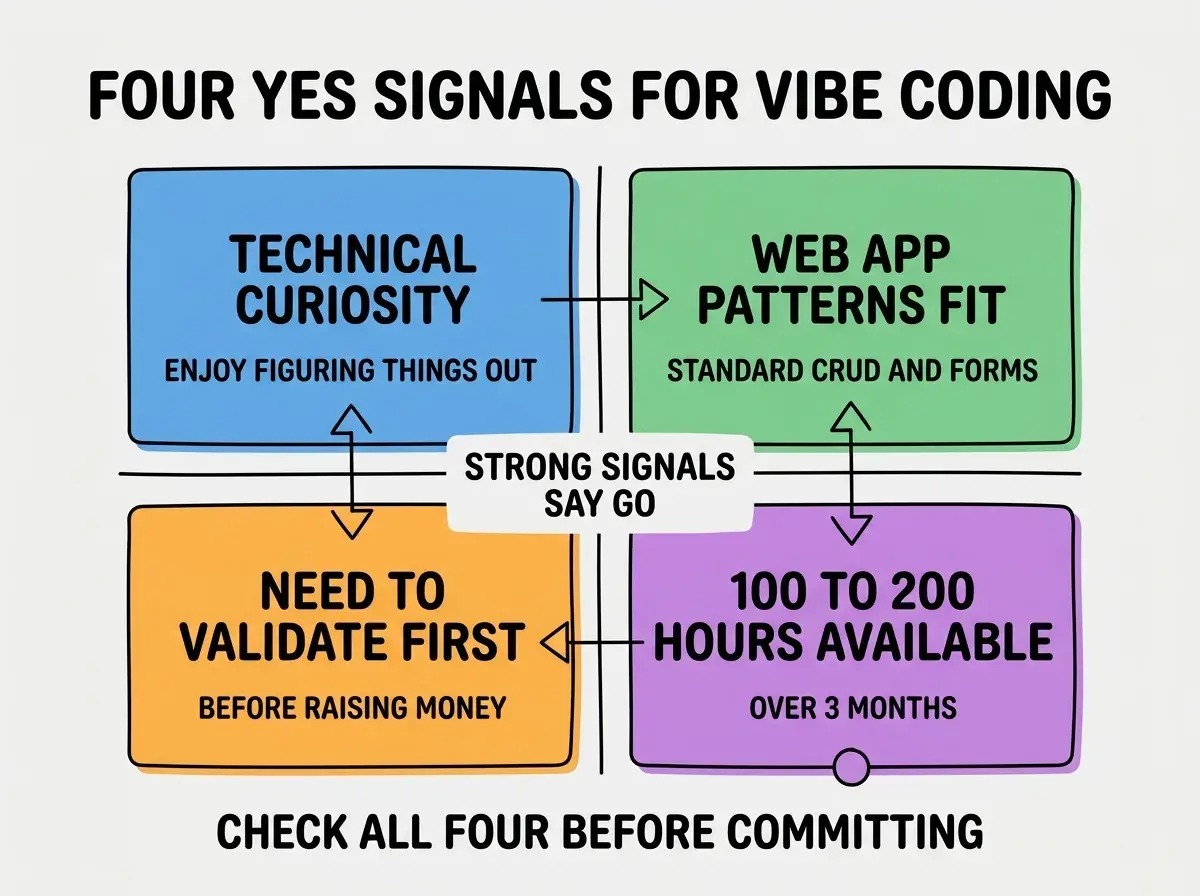
Yes signal 3, you need to validate before raising money. Investors increasingly want to see a working product. Vibe coding produces working demos that show product thinking and execution capability.
Yes signal 4, you have 100 to 200 hours available over the next 3 months. The realistic time investment for a vibe-coded MVP. If you cannot dedicate this time, the project will stall.
The Four No Signals
Four signals consistently indicate vibe coding is the wrong path. Match any of these and reconsider.
No signal 1, you need deeply technical infrastructure. Real-time multiplayer at scale, ML model training, complex distributed systems. Vibe coding can scaffold these but the depth of work exceeds what AI handles well.
No signal 2, your customers will not use AI-built software. Some enterprise customers, regulated industries, legacy buyer audiences have explicit concerns. Validate before building.
Browse more business strategy guides
Read more foundations articlesNo signal 3, you have no patience for the demo-to-product gap. Vibe coding gets you to demo fast; production takes 10x longer. Founders who quit at the gap should not start vibe coding.
No signal 4, you can hire a co-founder or developer immediately. If you have an experienced developer joining the team, their judgment on architecture beats vibe coding's speed advantage. Hire if you can.
The 90-Day Plan If You Go Ahead
If signals point toward yes, three phases structure the next 90 days.
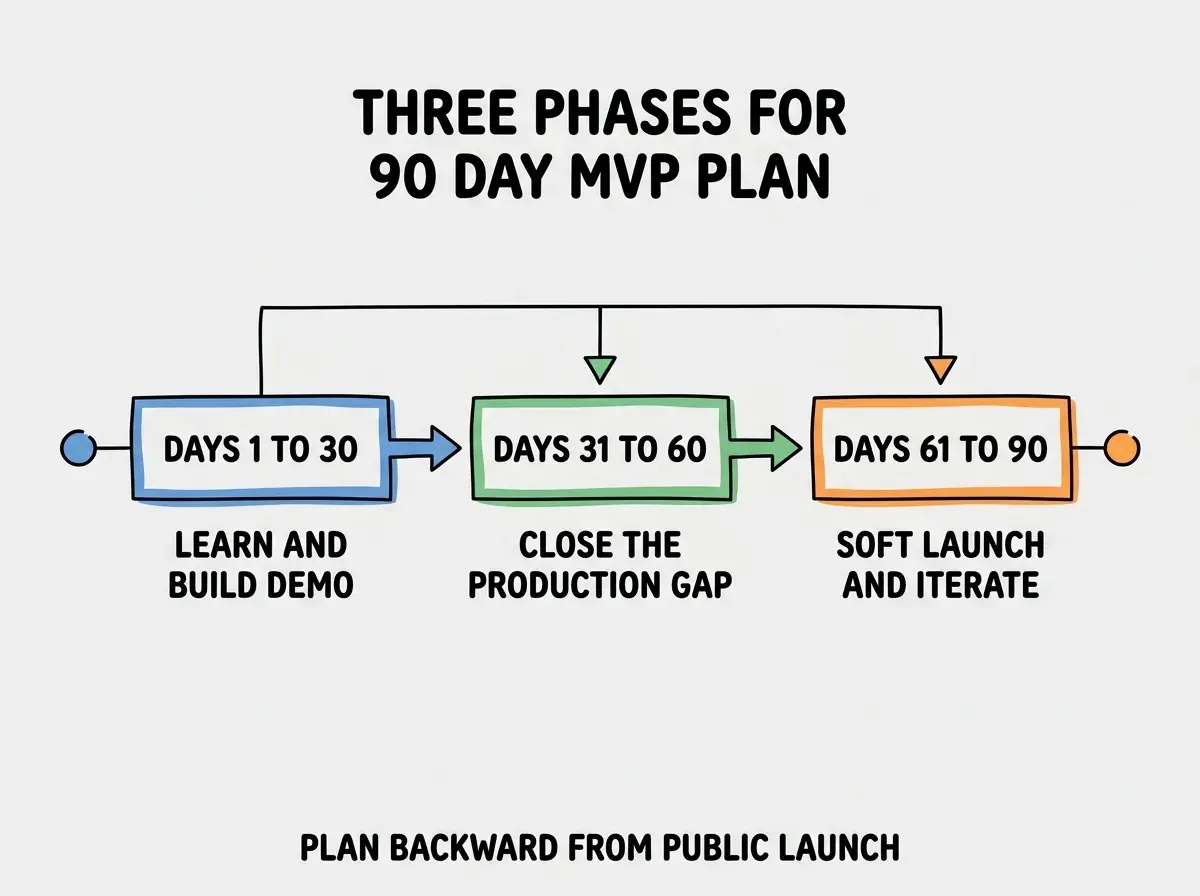
Phase 1, days 1 to 30, learn and build demo. Focus on getting the demo working end-to-end. Use AI assistance heavily. Goal is "demonstrates the core idea" not "production ready."
Phase 2, days 31 to 60, close the production gap. Reliability, security, polish. The unglamorous work that converts demo into product. Most projects die in this phase; commitment is what gets through.
Phase 3, days 61 to 90, soft launch and iterate. Friends and family first, then small public launch, then iterate based on real user feedback. The shipping muscle is what makes the next product easier.
How to Stack the Deck Toward Success
Three additional patterns improve odds of shipping if you choose vibe coding.
Pattern 1, join a vibe coding community. IndieHackers, specific Discord servers, and similar communities accelerate learning dramatically. Other founders solving similar problems share solutions you would otherwise have to discover alone.
Pattern 2, scope smaller than feels comfortable. First-time vibe coders consistently underestimate complexity. A scope you think is "small" is probably the right starting size. The smaller starting scope produces faster shipping and faster learning.
Pattern 3, have a paying customer or commitment before starting. Building toward a known customer dramatically increases shipping rates. Without external commitment, the project competes against everything else in your life and often loses.
The combination shifts shipping probability from coin-flip to favorable. Without these patterns, vibe coding works for some founders but fails for many; with them, the success rate climbs substantially.
When to Pivot Mid-Process
Three signals indicate the project should pivot or pause rather than push through.
Signal 1, you are not learning. If 4 weeks in you do not feel more capable than when you started, the path is not working. Either the AI tools are not fitting your style or the project is too ambitious.
Signal 2, the product is not what you thought. Building reveals what the product actually needs to be. If your MVP no longer matches your vision after 30 days, take a step back to reassess.
Signal 3, your timeline is slipping by 3x. A 3-month plan that becomes 9 months usually becomes never. The slippage signals fundamental misfit; either reduce scope dramatically or change paths.
The combination produces a self-correcting plan that catches problems before they become fatal. Without these signals, founders push through to disappointment; with them, they course-correct early.
The most damaging decision-framework mistake is committing to vibe coding because it sounds appealing rather than because the signals match. Founders see other founders shipping with AI tools and want to do the same, regardless of whether the signals indicate fit. The fix is to honestly evaluate each signal. If only 1-2 yes signals match strongly, vibe coding is probably not the right path. If 3-4 match strongly and no significant no signals appear, it is a good fit. Match-based decisions produce dramatically better outcomes than aspiration-based decisions.
The other mistake is treating the framework as a one-time decision. The signals can change as you learn more about your project. A signal that looked weak initially may strengthen after market research; a strong signal may weaken as you discover product complexity. Re-evaluate at each phase boundary; the framework is meant to be revisited, not applied once and forgotten.
What This Means For You
The decision to vibe code your MVP is one of the most consequential founder decisions in 2026. Getting it right unlocks new building paths; getting it wrong wastes months on the wrong approach.
- If you're a founder: Run the framework honestly before committing. The hour of evaluation prevents months of misfit work.
- If you're changing careers into founder roles: Use the framework on hypothetical projects to develop intuition for which kinds of products fit vibe coding well.
- If you're a student: Apply the framework to portfolio projects. The discipline of matching approach to project transfers to professional contexts.
Browse more business strategy guides
Read more foundations articles