Vibe coding for students is the most natural fit in this entire movement, and it is not even close. You are the first generation to learn programming alongside AI tools from day one. No habits to unlearn, no muscle memory fighting against a new workflow, no existential crisis about whether AI is coming for your career before it even starts. You get to learn the craft and the tools at the same time, the way future developers will learn for the rest of this century.
Here is the number that should make you pay attention: 85% of students already use AI coding assistants, outpacing even professional developers in adoption. Stanford, UC San Diego, and NUS have integrated these tools directly into their computer science curricula. This is not a fringe experiment. It is the new baseline.
But there is a tension here that nobody talks about honestly. If AI can write the code, why learn to code at all? That question deserves a real answer, not a dismissive one.
Why Students Have an Unfair Advantage in Vibe Coding
Think of learning to code with AI like learning to cook with a world-class sous chef standing next to you. The sous chef can prep every ingredient, handle the tedious knife work, and even suggest recipes you have never tried. But the sous chef cannot taste the food for you. They cannot decide whether the dish needs more acid or more salt. They cannot understand why your dinner guest hates cilantro. The creative judgment, the palate, the understanding of who you are cooking for; that stays with you.
This analogy carries further than you might expect. A culinary student who trains alongside a sous chef learns faster, not slower. They attempt more ambitious dishes earlier. They spend less time on repetitive prep work and more time understanding flavor combinations, plating, and the principles that separate a forgettable meal from an unforgettable one. They still learn knife skills, but they learn them in context, while making real food, not in isolation.
You are that culinary student. The AI is the sous chef. And the unfair advantage is this: you get to build real, ambitious projects from your first semester instead of spending months on exercises that never see the light of day.
Students who use AI tools alongside traditional learning build more projects, encounter more real-world problems, and develop judgment faster than students who learn either approach alone. The key word is "alongside," not "instead of."
Previous generations of CS students spent their first year writing sorting algorithms and linked lists in isolation. Those exercises have value. But you can now write a sorting algorithm, ask the AI to explain why your approach is O(n²) while a better one is O(n log n), see both implementations side by side, and then use that understanding to build something real that needs efficient sorting. You compress the learning cycle without skipping it.
How to Learn Real Skills While Using AI
This confuses everyone at first. Students assume that using AI tools means they are not really learning. Professors worry that students are just copying answers. Both concerns are understandable, and both miss what actually happens when you use these tools well.
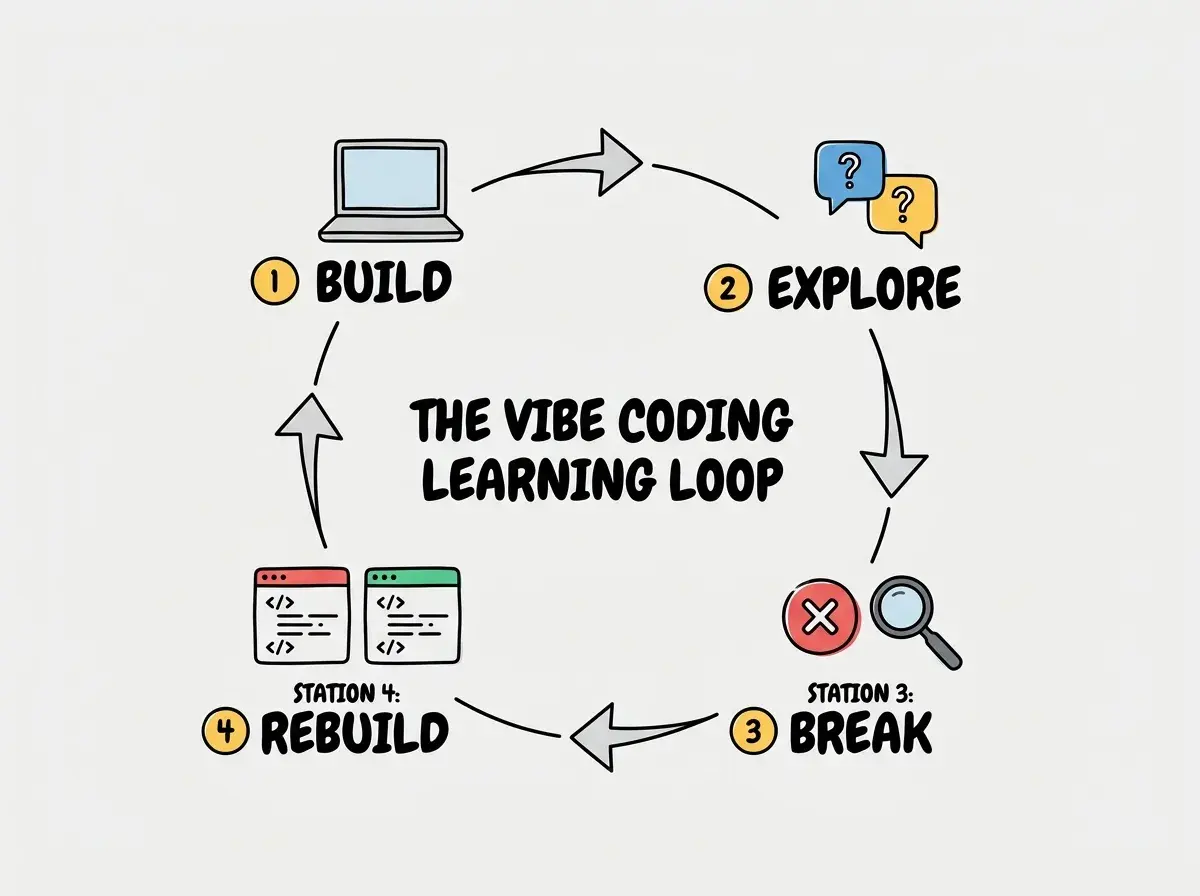
The students who learn the most with AI tools follow a pattern that looks like this:
Build first, understand second. Start a project that excites you. Use the AI to get a working version quickly. Then go back through the code and ask the AI to explain every piece you do not understand. "Why did you use a useEffect here?" "What happens if I remove this async keyword?" "Why is this a POST request instead of a GET?" You are learning through a working example instead of a textbook abstraction, and working examples stick in your memory because they are connected to something you care about.
Break things on purpose. Once you have a working project, start changing things. Remove a line and see what breaks. Swap a component and observe the cascade of errors. Ask the AI to explain each error message. This is how you build mental models of how software actually works. Not by memorizing syntax, but by understanding cause and effect in a living system.
Write it yourself, then compare. For concepts you want to deeply understand, write your own implementation first (even if it is bad), then ask the AI for its version. The gap between your approach and the AI's approach is where real learning lives. You will notice patterns, shortcuts, and best practices that no lecture could teach you, because you discovered them through the contrast with your own thinking.
You might think that using AI tools makes you a weaker developer. But actually, the developers who will thrive in five years are the ones who can direct AI effectively, evaluate its output critically, and know when to trust it and when to override it. Those are skills you can only develop by using these tools, not by avoiding them.
What Employers Actually Look for Now
Here is something your career center might not tell you yet. The job market for developers is shifting in a direction that favors your generation specifically.
Employers are increasingly hiring for judgment over syntax. They want developers who can look at AI-generated code and say "this works, but it will fall apart at scale because of this database query pattern." They want developers who can describe a complex system in plain language so clearly that an AI produces the right architecture on the first try. They want developers who can debug a subtle issue that the AI introduced because the AI optimized for the wrong thing.
None of these skills come from memorizing documentation. They come from building things, breaking things, and understanding why systems behave the way they do. They come from exactly the kind of learning that vibe coding enables.
Students graduating in 2027 and 2028 who can demonstrate a portfolio of real projects, explain the architectural decisions behind them, and show thoughtful AI tool usage will have a significant edge over candidates who either avoided AI entirely or relied on it without understanding what it produced.
Start with the fundamentals that every vibe coder needs to understand.
Learn the basicsThe Mistakes That Will Set You Back
The biggest risk for students is not using AI too much. It is using AI without curiosity.
The failure pattern looks like this: you get an assignment, paste it into an AI tool, submit whatever comes back, move on. You pass the class. You learn nothing. And when you sit down for a technical interview or face a real debugging problem at your first job, you have no foundation to stand on.
The sous chef analogy breaks down if you never taste the food. If you never ask why the AI made a choice, never try your own approach first, never break the code to see what happens, then you are not learning to cook. You are just placing orders.
Submitting AI-generated code without reading it. Every line of code in your project is your responsibility, whether you wrote it or the AI did. If you cannot explain what a piece of code does and why it is there, you do not actually have a working project. You have a black box that happens to pass tests. Employers and professors can tell the difference immediately.
Students who fall into this trap often do not realize it until too late. They have a GitHub profile full of projects but cannot explain how any of them work. The fix is simple: never submit or push code you cannot walk someone through line by line. If you cannot explain it, that is your signal to go back and learn that piece.
Building a Portfolio That Actually Impresses
Your generation has an opportunity that no previous generation of CS students had. You can build genuinely impressive projects during your studies, not toy apps, but functional products that solve real problems. AI tools make this possible because they handle the boilerplate and infrastructure that used to consume all of a student's time.
A sophomore who builds a working SaaS application with authentication, a database, payment processing, and a polished UI is going to stand out. Not because the code is perfect, but because the project demonstrates ambition, follow-through, and the ability to navigate real-world complexity.
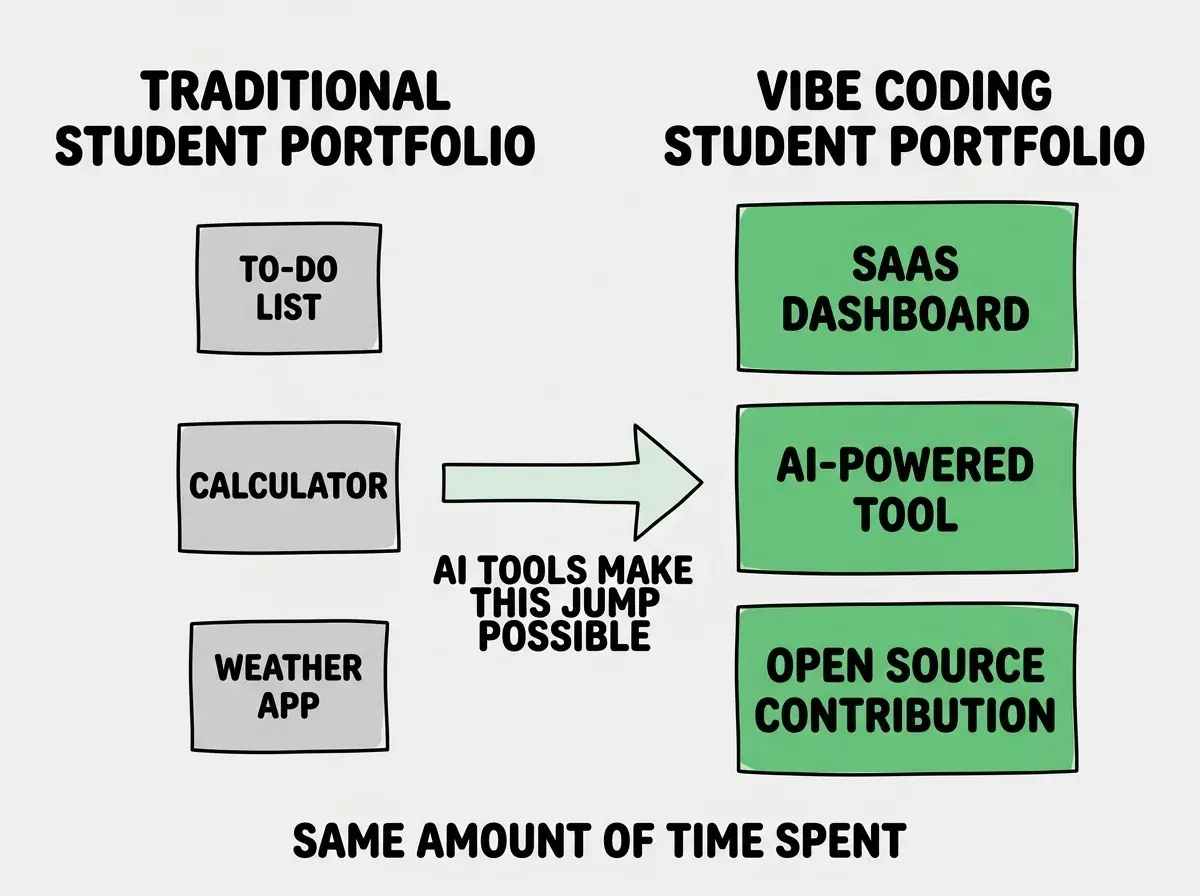
The key is choosing projects that matter to you personally. If you are into music, build a tool that helps musicians collaborate. If you are interested in climate science, build a data visualization dashboard. If you are frustrated by your university's course registration system, build a better one. The domain knowledge you bring to a project is the part AI cannot replicate, and it is the part that makes your portfolio memorable.
Dig deeper
A few hand-picked sources if you want to go further.
What This Means For You
Vibe coding does not replace learning to code. It changes how you learn, shifting the emphasis from memorizing syntax to building judgment. You are entering a field that will look dramatically different in five years, and the skills that matter most (critical thinking, system design, clear communication, domain expertise) are exactly the ones that AI tools help you develop faster.
- If you are a founder: Student vibe coders are your future early hires. They bring native fluency with AI tools and zero resistance to new workflows. Look for students who can explain their projects, not just show them. The ability to articulate technical decisions is the signal that separates students who learned from students who just generated.
- If you are a career changer: Students have the advantage of a clean slate, but you have something they do not: years of domain expertise and professional judgment. Your experience in another field gives your projects purpose and direction that no amount of technical skill can replace.
- If you are a student: Start building now. Do not wait until you feel "ready" or until you have finished your data structures class. Pick a project that excites you, use AI tools to get it working, and then go deep on understanding every piece. Your portfolio of real projects will matter more than your GPA, and the judgment you build by working with AI tools will be the defining skill of your career.
Learn the foundational concepts that make vibe coding click.
Explore more