You can learn traditional coding concepts through vibe coding faster than through a textbook, but only if you change how you use the AI. Treat the AI as a tutor that explains, not a vending machine that produces. Six study patterns turn the same Cursor session that ships a feature into a study session that builds understanding: explain-back, modify-and-predict, restart-from-scratch, intentional-bugs, source-comparison, and concept-laddering. None require giving up the speed of vibe coding. They just route a fraction of that speed into your head.
This piece walks through each pattern, what concept it teaches, and how to fit it around the work you are already doing.
Why Vibe Coding Can Teach as Well as Ship
The default assumption about vibe coding is that it skips learning. You ask the AI for code, the AI produces code, you accept it, you ship. Repeat 200 times and you have a portfolio but no skills. That is one possible outcome, and it is the most common one in 2026, but it is not the only one. The same workflow can become one of the fastest learning paths ever created, if you slow down at the right places.
The reason vibe coding can teach is that the AI is patient, infinitely available, and can explain the same concept in 30 different ways until one sticks. A textbook explains a concept once. A professor explains it twice. Claude or Cursor will explain it as many times as you need, in whatever metaphor works for you. That is a teaching tool that did not exist five years ago.
A 2025 study from Carnegie Mellon found that students who used AI as a tutor (asking "explain why this works" after getting code) scored 27 percent higher on conceptual exams than students who used AI as a code generator (just accepting output). Same tool, different prompt patterns, very different learning outcomes.
The pattern to copy is gym training. A bench press machine builds your chest no matter who pushes the bar, but the difference between someone who lifts mechanically and someone who pays attention to form is enormous over six months. Vibe coding is the same. The work happens either way, but only one mode produces durable strength.
The Six Study Patterns
Each pattern below targets a specific concept type. You do not need to use all six. Pick the two or three that match what you most want to learn, then make them part of your normal workflow.
Pattern 1, explain-back. After the AI generates code, paste it back and ask "explain this line by line, assuming I know nothing." Read the explanation, then ask follow-up questions on anything that confused you. This pattern teaches syntax, library APIs, and idiomatic patterns. It costs about 10 minutes per substantial AI output.
Pattern 2, modify-and-predict. Before running the code, change one line and predict what will happen. Then run it. The gap between your prediction and reality is the learning. This pattern teaches how state, scope, and control flow actually work, which are the concepts that confuse beginners most.
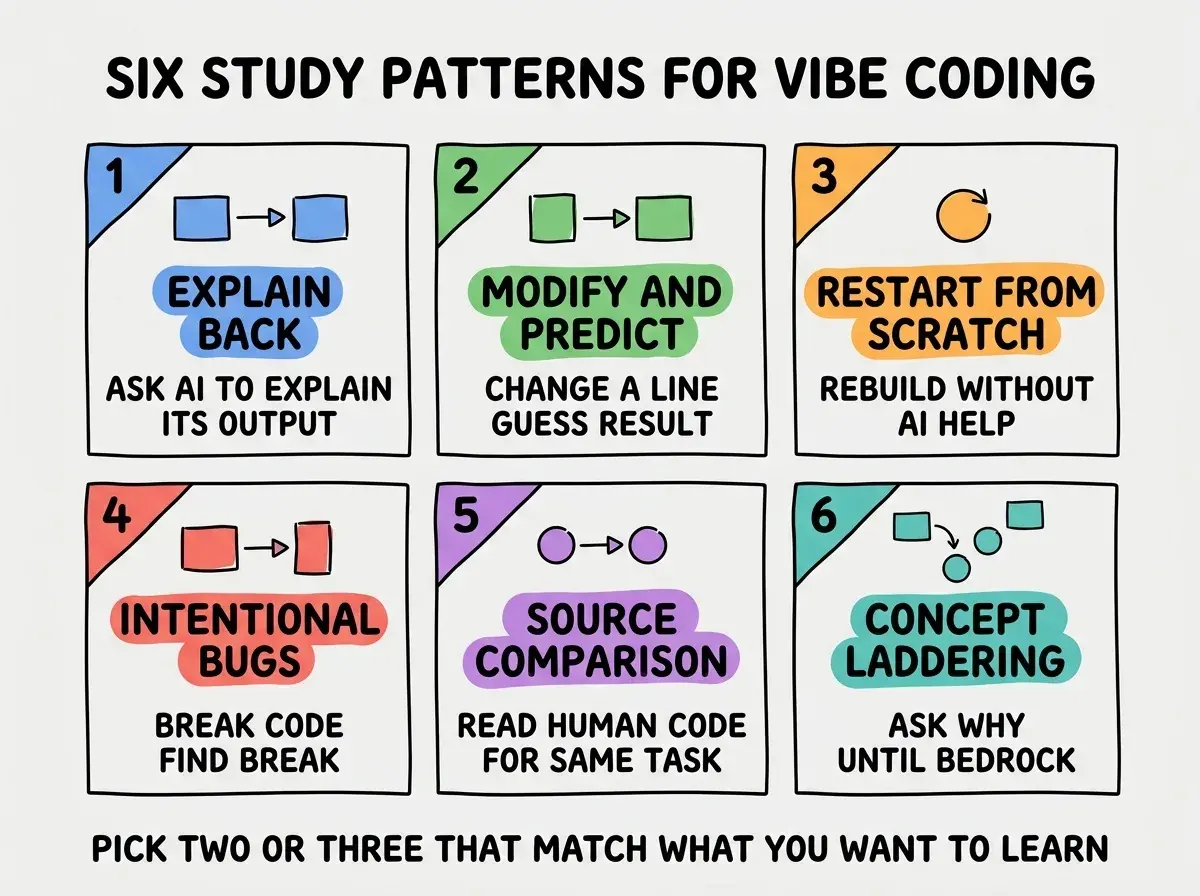
Pattern 3, restart-from-scratch. After the AI builds something, close the file, start a new one, and try to rebuild it without AI help. The gap between what you can recall and what was on screen is your real understanding. This pattern teaches recall and depth, the two things that AI assistance erodes most.
Pattern 4, intentional bugs. Take working AI code and break it on purpose, then watch what error appears. Knowing which break produces which symptom is debugging instinct, and the only way to develop it is by deliberately causing failures.
Patterns 5 and 6, Plus When to Use Each
The last two patterns target deeper conceptual layers. They take more time but pay back the most over the long arc of a career.
Pattern 5, source comparison. After the AI builds a feature, find a human-written open-source implementation of something similar and read it side by side. Note three differences. This pattern builds taste, idiom, and the ability to recognize "good code" from "shipped code." Reading source is one of the most underrated learning activities, and it has not become less valuable.
Browse more learning guides for vibe coders
Read more foundationsPattern 6, concept laddering. When the AI uses a term you do not know, ask "what does that mean," then "why does that matter," then "what would happen without it." Three layers of "why" usually drops you into the actual concept. This pattern builds mental models, the slowest skill to develop and the most lasting.
How to Fit These Into Real Projects
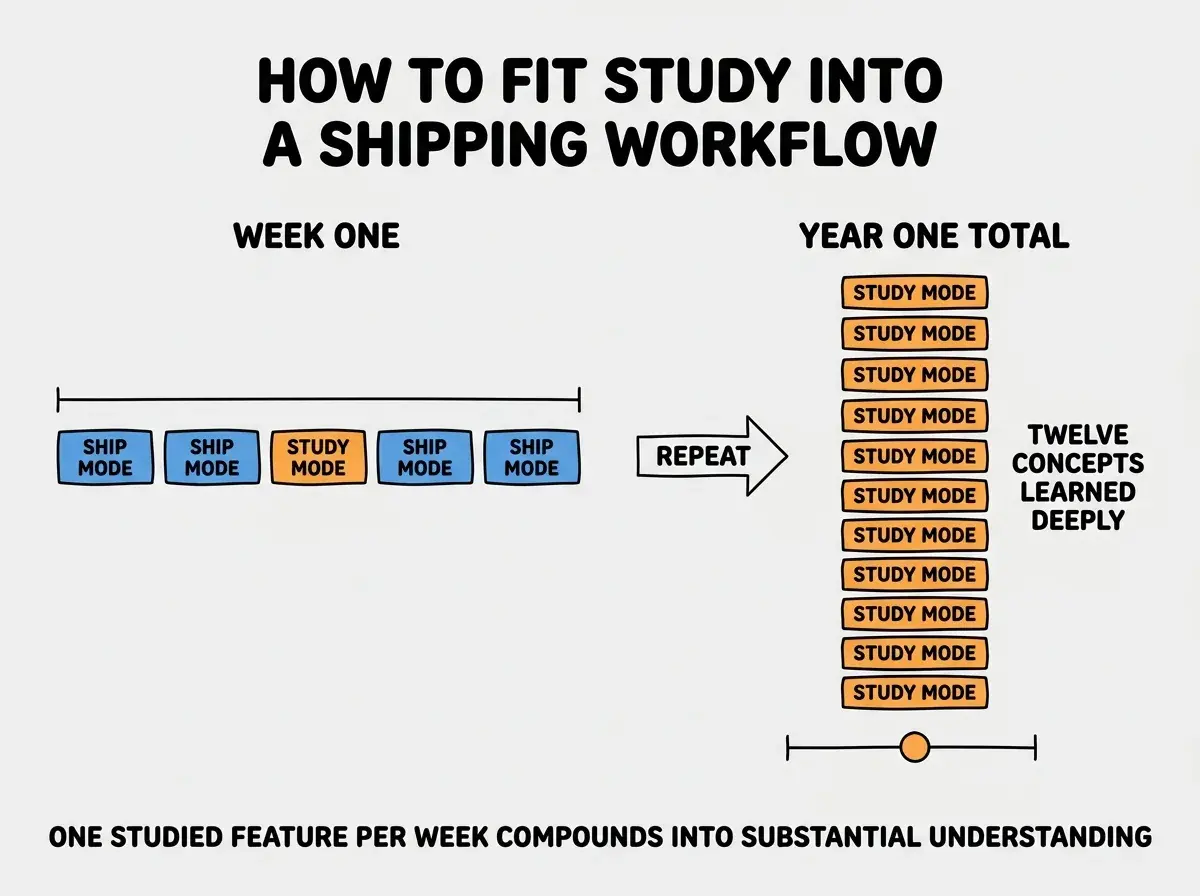
The objection most people raise is that they do not have time for study patterns when they are trying to ship. The honest answer is that you do not need extra time, you need different attention during the time you already spend.
Pick one feature per project to study deeply. The other features can be pure vibe coding. If you ship 20 features in a month, picking one to study using all six patterns adds maybe 4 hours total but produces durable understanding of one substantial concept. Repeat for a year and you have learned 12 substantial concepts deeply, which is more than most CS undergrads cover in a single year of formal coursework.
The other adjustment is to keep a running notes file (a single markdown doc works fine) where you write one sentence about each concept you study. Re-read it weekly. The act of restating the concept in your own words is itself a learning pattern, and the notes become a personal reference that no textbook can match.
The biggest mistake learners make is treating "explain-back" as enough on its own. Reading an explanation and nodding feels like learning, but the retention is poor. Real learning requires active output: writing the code yourself (pattern 3), predicting outcomes (pattern 2), or restating the concept (pattern 6). If you are not producing words or code, you are not learning. You are watching.
The reframe to hold in your head is that vibe coding gives you the world's most patient tutor as a side effect of giving you the world's fastest code generator. Most people use only the second feature. Using both is the cheat code for learning to code in 2026, and the cost is small (a few minutes per session) compared to the long-term return.
What This Means For You
The choice between learning and shipping is a false one. Vibe coding lets you do both, but only if you adopt the patterns above instead of accepting AI output passively.
- If you're a founder: Use pattern 6 (concept laddering) when the AI uses a term you do not know. Founder-level system understanding pays off in better hiring decisions.
- If you're changing careers: Use pattern 3 (restart from scratch) on one project per month. Recall is what interviews test, and AI assistance erodes recall fastest.
- If you're a student: Use all six patterns. You are at the part of your career where building deep understanding pays back the longest.
Browse more career and learning guides for vibe coders
Read more foundations