To use AI coding tools in coursework while maintaining academic integrity in 2026, follow four practice patterns that consistently work across most institutional policies (always disclose AI usage when policy requires, use AI as tutor rather than as solution generator, verify and understand AI output before submitting, and align usage with each course's specific policy), recognize that policies vary by institution and course, and prioritize learning over short-term grade optimization. Academic integrity with AI is achievable; the patterns require deliberate practice rather than reflexive use.
This piece walks through the four practice patterns, the institutional policy variations to navigate, the learning-preserving patterns, and the four mistakes students make about AI in coursework.
Why This Question Has Real Stakes
Academic integrity violations carry real consequences: failed courses, suspension, expulsion, damaged transcripts. The stakes are higher than students sometimes realize, especially for AI usage which leaves traceable patterns that detection tools increasingly catch.
The 2026 reality is that AI tool detection has improved substantially while institutional policies have crystallized. Students who navigate the landscape thoughtfully produce both better learning outcomes and better academic standing than students who use AI reflexively or hide its use.
A 2025 Inside Higher Ed survey of 600 universities found that 78 percent had adopted formal AI usage policies for coursework, up from 23 percent in 2023. Of those policies, 45 percent required disclosure, 30 percent prohibited certain uses, and 25 percent allowed unrestricted use within course-specific limits. The variation is wide; understanding your specific institution and course policies is essential rather than optional.
The pattern to copy is the way students learned to use calculators in math classes. Initial faculty resistance gave way to acceptance with specific guidelines: when calculators are allowed, when they are not, what calculator use must be shown vs hidden. AI tools follow similar patterns; the guidelines exist and need to be followed.
The Four Practice Patterns
Four patterns consistently work for using AI in coursework with academic integrity preserved.
Pattern 1, always disclose AI usage when policy requires. When in doubt, disclose. The cost of disclosure is minimal; the cost of hidden usage discovered later is severe.
Pattern 2, use AI as tutor rather than as solution generator. Ask AI to explain concepts; do not ask AI to solve assignments. The tutoring use builds learning; the generation use replaces learning.
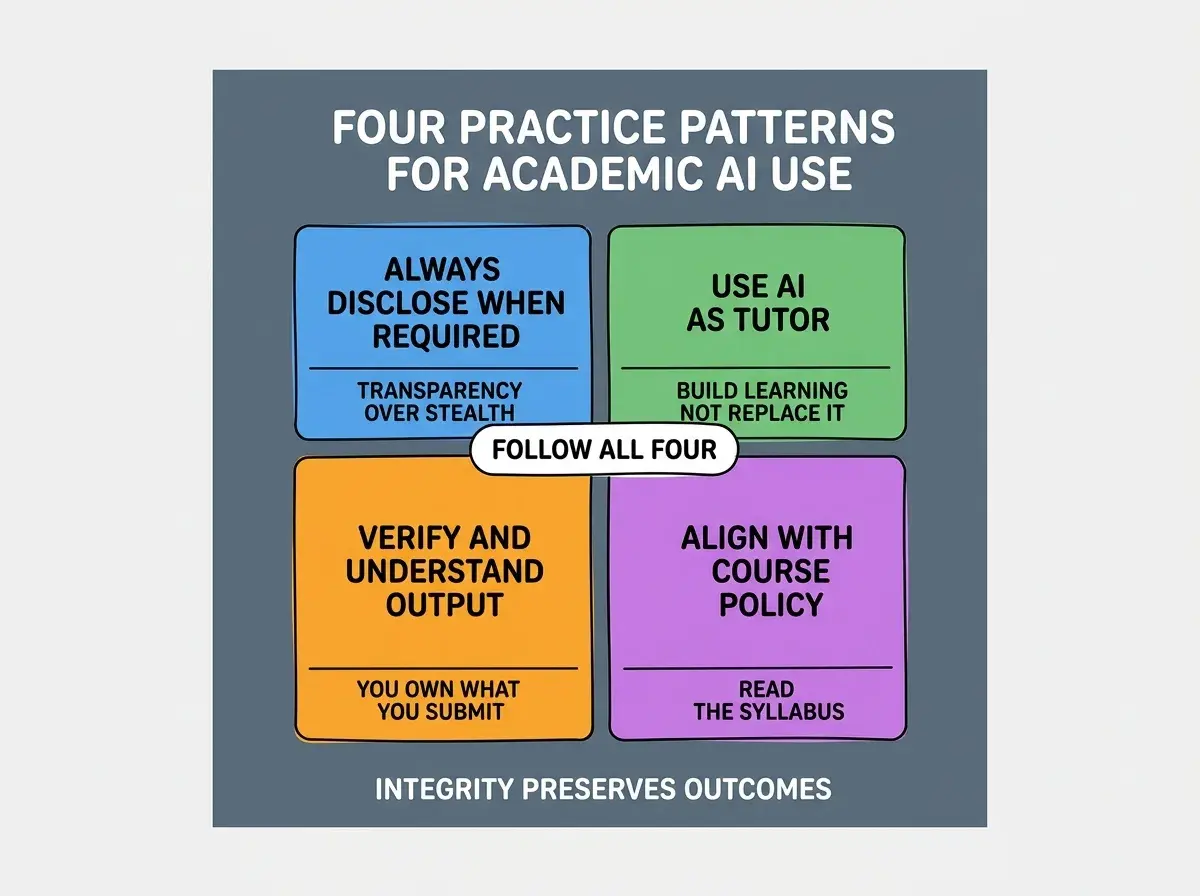
Pattern 3, verify and understand AI output before submitting. If you cannot explain submitted work, you should not submit it. Understanding tests both learning and integrity simultaneously.
Pattern 4, align with each course's specific policy. Different courses have different policies. Read syllabi; ask instructors when policies are unclear; do not assume policies transfer across courses.
How Institutional Policies Vary
Three policy patterns appear across institutions in 2026.
Pattern 1, prohibition with limited exceptions. Some courses prohibit AI use entirely except for specific approved purposes. Most common in foundational courses where learning the fundamental skill matters.
Browse more student learning guides
Read more foundations articlesPattern 2, disclosure-required usage. AI use allowed but must be documented. Submissions include AI usage statements explaining what was used and how. Most common in upper-division courses.
Pattern 3, integrated AI use. AI tools are part of the curriculum; assignments specifically require or assume AI use. Most common in advanced courses focused on AI itself or in professional skills courses.
Learning-Preserving Patterns
Three patterns help maintain learning value while using AI.
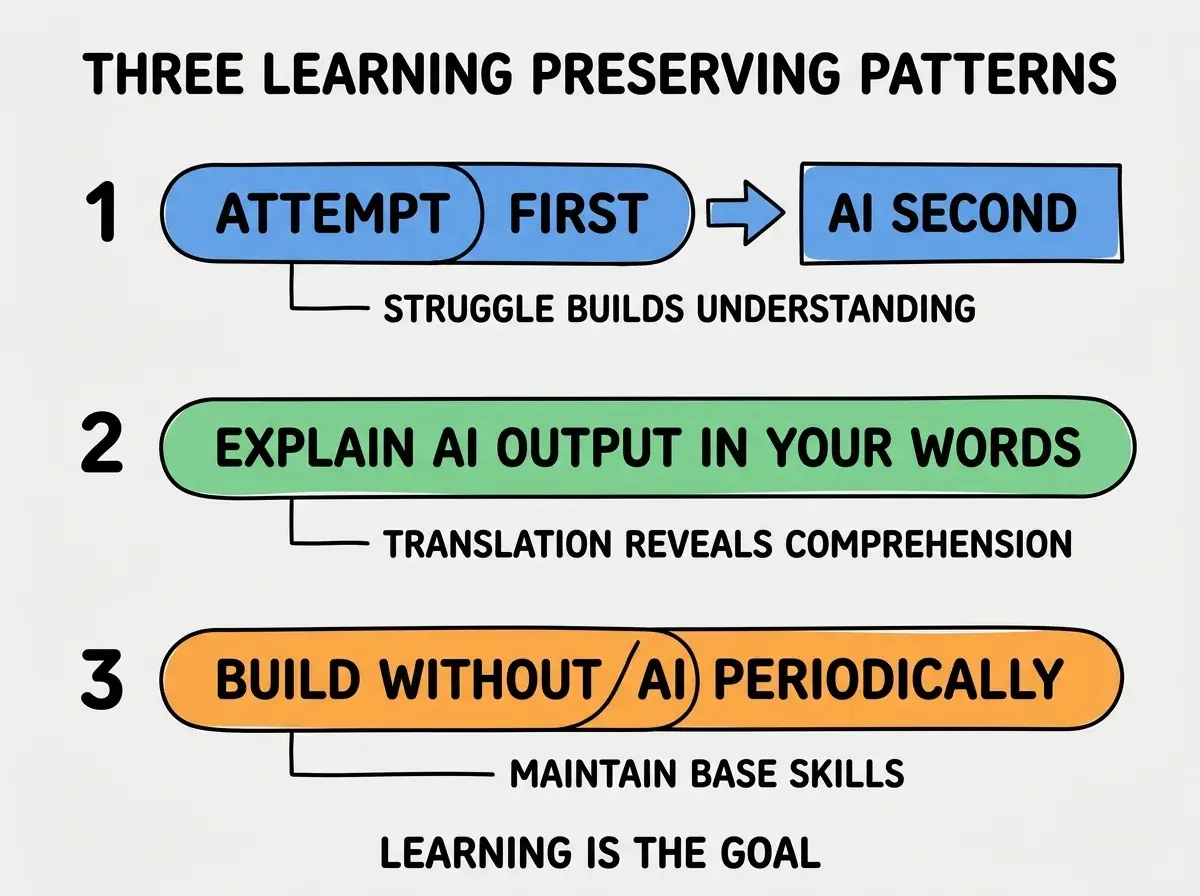
Pattern 1, attempt first, AI second. Try problems on your own before consulting AI. The struggle builds understanding that AI assistance shortcuts; reverse the order and you skip the learning.
Pattern 2, explain AI output in your own words. When AI provides solution, write your own explanation of why it works. Translation tests comprehension; without it, AI usage produces no real understanding.
Pattern 3, build without AI periodically. Some assignments, sometimes, deliberately without AI. The discipline maintains baseline skills that AI can augment but not replace; pure AI dependence produces atrophied fundamentals.
How to Talk With Instructors About AI
Three patterns help productive conversations with instructors about AI tool use.
Pattern 1, ask before you act. Email asking specific questions before submitting work. Most instructors appreciate proactive clarification; they distrust students who only ask after problems.
Pattern 2, share your own thinking about appropriate use. Show that you have considered the integrity question rather than seeking permission to skip it. The thoughtfulness produces better instructor responses.
Pattern 3, propose specific use cases for approval. "I want to use AI to explain this concept; would that be acceptable?" Specific proposals are easier to approve than open requests for AI permission.
The combination produces instructor relationships that support rather than constrain learning. Without these patterns, students often feel adversarial about AI policies; productive conversation reframes the relationship.
How to Handle Unclear Policies
Three patterns help navigate situations where policy is ambiguous.
Pattern A, ask the instructor specifically. Email or office hours; specific question about specific use case. Instructors generally appreciate clarity-seeking and respond helpfully.
Pattern B, default to disclosure when unsure. Even if disclosure is not technically required, voluntary disclosure protects against later interpretation conflicts. The cost is small; the protection is real.
Pattern C, document your usage habits. Keep notes about when and how you used AI in each assignment. The documentation supports later defense if questions arise.
The combination produces safe practice in unclear contexts. Without these patterns, students sometimes get caught in policy interpretation conflicts that go badly for them.
The most damaging academic AI mistake is using AI to circumvent learning entirely. Students who submit AI-generated work without learning the underlying material may pass individual assignments but fail to develop the actual capability the courses are meant to build. The fix is to use AI for learning acceleration, not learning replacement; the value of education is the skill development, not the credentials. Students who optimize for short-term grades through AI shortcuts often graduate without the actual skills employers expect from their credentials.
The other mistake is assuming AI detection will not catch you. AI detection tools have improved substantially through 2025-2026; institutions increasingly use them; the false sense of security from undetected past assignments often catches up later. The fix is to operate as if detection is reliable (because it increasingly is) and prioritize integrity over hidden shortcuts.
A third mistake is using AI dependency in courses to develop fundamental skills. Some courses exist specifically to build skills that are then accelerated by AI; using AI in those courses skips the foundation that makes the AI useful later. The fix is to recognize that some struggle is the point of certain courses; AI shortcut hurts long-term capability even when it helps short-term grades.
What This Means For You
Using AI coding tools in coursework with integrity is achievable in 2026. The four patterns, policy variations, and learning-preserving approaches produce both better academic outcomes and better learning.
- If you're a student: Read your specific course policies. Use AI to accelerate learning rather than replace it. Disclose when required and when in doubt.
- If you're changing careers and taking courses: Same principles apply. The integrity standards exist for good reasons; following them protects your reputation as you build career.
- If you're studying with intent to enter the field: Build genuine skills alongside AI fluency. The combination is what employers want; AI fluency without underlying skills produces hireable resumes but unsuccessful jobs.
Browse more student learning guides
Read more foundations articles